

Flip more often when: the room runs hot (a 45°C summer or a west-facing wall), you are running nine or ten reeds, or the monsoon has the air at 85% humidity.
Flip less often when: the room is cool, sealed and low-traffic, or you are deliberately running four reeds for a gentle, long bottle.
The upper bound: twice a week is a sensible ceiling. Daily flipping buys very little, shortens the bottle and puts oil on your furniture.
2. Every four to five days in real heat. Above roughly 35°C the oil is thinner and the light fraction leaves the exposed surface much faster, so the reed skews base-heavy sooner. A Delhi or Nagpur June, or any room with a west wall that bakes from three o'clock, wants a tighter schedule.
3. Every four to five days at nine or ten reeds. More reeds is more exposed surface accumulating residue simultaneously. A high-count bottle is also finishing faster — four to five weeks on a 50ml rather than six to eight — so a tighter cadence costs you proportionally less than it sounds.
4. Twice a week through a heavy monsoon. At 85% humidity the air is already carrying as much as it wants to carry and the room reads damp and flat. Flipping more often will not beat the weather, but it keeps the reed delivering its brightest material when the air will take it.
5. Every ten to fourteen days in a cool, sealed, quiet room. A north-facing bedroom under AC, four reeds, little traffic — the gradient forms slowly and there is nothing to gain from disturbing it weekly. You will also get comfortably past the stated bottle life.
6. Twice a week is the sensible ceiling. Beyond that the gains are small, the mess is real and the bottle shortens for no benefit you can hear.
7. And flip before guests, not during. A flip takes a few hours to settle into its new rate. Doing it the morning of a dinner is right; doing it as the doorbell goes is theatre.
Composed and handmade in small batches in Pune, and a portion of every order supports girl-child education through Nanhi Kali.
Part one — the three variables that move your schedule
There is no single correct interval because a reed diffuser is not a timer; it is a surface in a room, and the room sets the pace. Three conditions account for nearly all the variation I see in customer correspondence, and helpfully they are all things you already know about your own home without measuring anything.
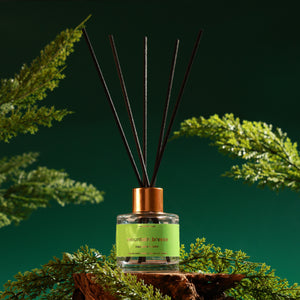
 Mountain Breeze₹849 · 9.4/10At 85% relative humidity — a Kochi August, a Mumbai July, a Kolkata monsoon week — the air is already saturated, evaporation from any surface slows, and rooms read damp and muted regardless of what is standing on the console. Two things follow. The first is that flipping more often is worthwhile, because you want the reed presenting its most volatile material during the hours the air will actually take it. The second is a materials point: rattan reeds swell and clog at this humidity, which is why SOSA supplies fibre reeds instead. A clogged reed cannot be rescued by cadence — you can flip a swollen rattan stick twice a week all monsoon and it will do nothing. Fibre keeps wicking, so the schedule keeps working.
Part two — cadence by condition
Find the line closest to your room and start there for a fortnight. Cadence is easy to test because the feedback arrives within a day: if the room reads noticeably better the evening after a flip and noticeably duller three days before the next one, tighten the interval.
| Condition | What it does to the reed | Suggested interval | What tells you the interval is wrong |
|---|---|---|---|
| Ordinary room, six reeds ★ | Gradient forms at the pace the compositions are dosed for | Once a week, all six | Nothing — this is the calibration |
| Genuine heat: 40–45°C, west-facing wall | Light material leaves fast; tip skews base-heavy in days | Every 4–5 days | Fragrance turns sweet or woody by mid-week |
| Monsoon, 85% humidity | Evaporation slows; damp air masks the whole room | Twice a week | The room reads flat all week rather than only late in it |
| Nine to ten reeds | Half again the exposed surface, all loading at once | Every 4–5 days, without exception | Presence drops off sharply after day three |
| Four reeds, deliberate low setting | Slow gradient, slow throughput, long bottle | Every 10–14 days | Almost nothing — this setting is forgiving |
| Cool, sealed, low-traffic room | Little air exchange; the reed is barely being drawn on | Every 10–14 days | A big surge after every flip means you waited too long |
| Winter, north-facing, under 20°C | Thicker oil climbs slowly; the wet line sits lower | Weekly, but expect less from each flip | Reeds dry above the line — add one or two rather than flipping more |
| The honest caveat: cadence cannot fix a placement problem, and it is often blamed for one. If the bottle sits in an alcove, behind a sofa or inside a cabinet, no schedule will help, because nothing is carrying the fragrance away from the glass; and if it sits in an AC draught or direct sun, a tighter schedule simply empties it faster. Get the position right — near a doorway, waist to chest height, clear space, out of the draught — and then set the interval. | |||
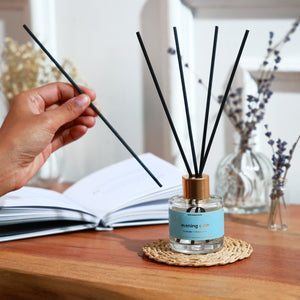
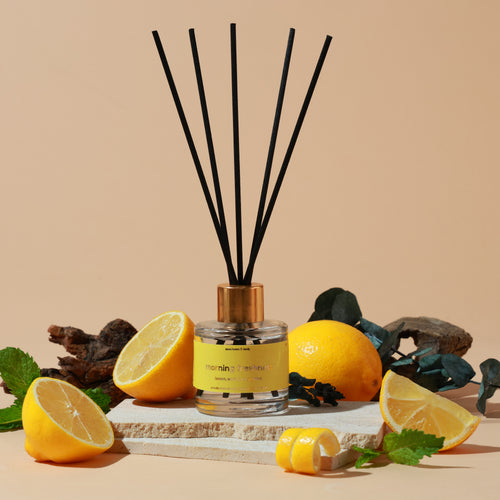
Morning Freshness · 9.0/10from ₹749Shop → 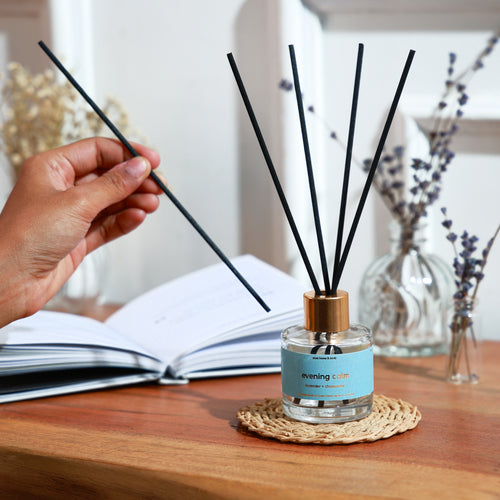 Evening Calm · 8.9/10from ₹799Shop →
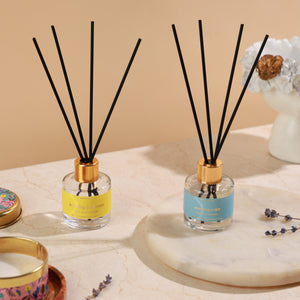
 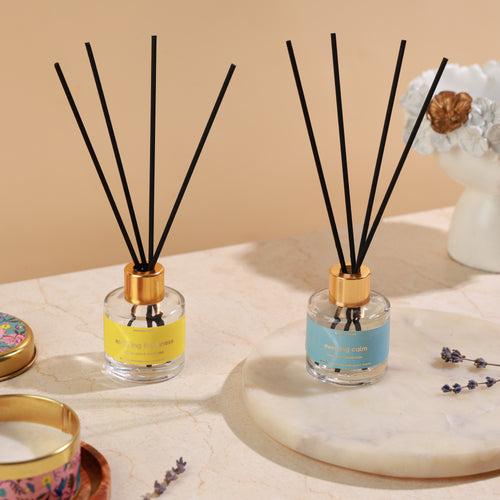 Day & Night duo · 2 × 50ml₹1,498Shop →
Part three — an Indian year, month by month
If you keep a bottle running continuously — and with refills a great many people do — the schedule should move roughly three times a year. From November through February, in most of the country, rooms are cool and often closed; oil is thicker, the wet line sits lower, evaporation is slower and the gradient forms at its most leisurely. This is the season to relax to ten days or a fortnight, and the season in which a 50ml will comfortably reach the far end of its 6–8 week window. The one thing to watch in a genuinely cold north Indian January is a reed that looks dry above a low wet line: that is thickened oil failing to climb, and the fix is an extra reed or two rather than a tighter flipping schedule.
March through June is the opposite case and the season that generates most of my inbox. Rooms above 35°C thin the oil, accelerate the light fraction and steepen the gradient within days rather than weeks. Move to every four or five days, and move the bottle off any surface that catches afternoon sun — direct sunlight will cost you more weeks than every flip you make all summer. Then the monsoon arrives and changes the problem entirely: humidity at 80–85% slows evaporation, the air carries less willingly, and rooms read damp and muted. Twice-weekly flipping is worth doing here, but I would rather be honest that it is a partial answer. A monsoon room simply reads quieter, and the composition that copes best is a cold, sharp one — Morning Freshness at 9.0 reads through damp air better than its number suggests, because sharp material cuts where warm material is absorbed.
Two habits make all of this manageable. The first is attaching the flip to something you already do weekly — the Sunday tidy, the water-plants round, whatever it is — because a schedule you have to remember is a schedule you will not keep. The second is running two bottles rather than one when a home has genuinely different microclimates, which most Indian flats do: a kitchen-facing living room and a sealed north bedroom are not the same environment and should not share a schedule. The Day & Night duo at ₹1,498 for two 50ml exists partly for that reason: Morning Freshness where the traffic and the heat are, on a tight cadence, and Evening Calm in the cool bedroom on a fortnightly one.
Part four — a schedule for every room in the flat
Most homes end up running two or three bottles in rooms with very different conditions. Here is where I would set each of them, assuming six reeds unless stated otherwise, and what to buy if you are still deciding.
| Room | Typical conditions | Reeds | Flip every | Composition I would run |
|---|---|---|---|---|
| Entryway or hall ★ | Constant door traffic, biggest air exchange in the home | 6 | 7 days | Garden Bloom · ₹799 |
| Living room, hosting space | Warm, open, often the largest volume in the flat | 6, or 9 for a weekend | 5–7 days · 4–5 at nine reeds | Fresh Brew · ₹849 |
| Main bedroom, AC, sealed | Cool, still, low traffic, door shut most of the day | 4–6 | 10–14 days | Evening Calm · ₹799 |
| Bathroom | Humid in bursts, small volume, extractor cycling | 6 | 7 days | Morning Freshness · ₹749 |
| Home office or study | Occupied for hours; adaptation is the real enemy here | 6 | 7 days, flipped before you sit down | Mountain Breeze · ₹849 |
| Kitchen-adjacent shelf | Heat, grease-laden air, cooking smells competing | 6 | 5–7 days | Morning Freshness · ₹749 |
| Nursery or a sensitive household | Deliberately gentle; fragrance kept well out of reach | 3–4 | 14 days | Evening Calm · ₹799 |
Versailles
When we were deciding what to print on the card in the box, I argued for a table rather than a number. I lost, and I think correctly — a card that says "it depends" is a card nobody follows. So the card says weekly, because weekly is right for the largest number of rooms in the largest number of months, and everything else belongs in a piece like this one where there is space to explain it.
What I did not expect was how much the honest version would reassure people. A customer in Kochi wrote to say her diffuser "died every July", which she had taken personally for two years. It had not died. Eighty-five per cent humidity was doing exactly what eighty-five per cent humidity does, and the answer was twice-weekly flipping through the monsoon and a colder composition, not a refund.
My own flat runs on two schedules. The hall bottle gets turned every Sunday without fail because the front door opens forty times a day. The bedroom bottle gets turned when I notice, which is roughly every fortnight, and it is the better-behaved of the two. Everything is composed and handmade in Pune, tested through 45°C heat and 85% humidity, and a part of every order funds a girl's classroom through Nanhi Kali.
Frequently asked questions
- Should you flip reed diffuser sticks? — the residue gradient, and why an unflipped reed stalls.
- Is once a week enough? and can you flip every day? — the two ends of the schedule.
- Fibre versus rattan cadence — why SOSA's schedule is more relaxed than most.
- The complete reed-flipping guide, and the complete strength guide.
- Brand: the SOSA founder story.
SOSA reed diffuser range & prices (verified August 2026): alcohol-free, phthalate-free, paraben-free and IFRA-compliant compositions on a heat-stable coconut-derived (CCT) carrier, low-VOC, supplied in a refillable glass bottle with six fibre reeds; 50ml lasts 6–8 weeks and 130ml lasts 14–18 weeks. Morning Freshness (Malabar lemon · peppermint · Nilgiri eucalyptus) 50ml ₹749 · 130ml ₹1,249 · 9.0/10; Garden Bloom (British rose · night-blooming jasmine) 50ml ₹799 · 130ml ₹1,299 · 8.9/10; Evening Calm (Kashmir lavender · chamomile) 50ml ₹799 · 130ml ₹1,299 · 8.9/10; Fresh Brew (Coorg coffee · Kerala vanilla) 50ml ₹849 · 130ml ₹1,349 · 9.5/10; Mountain Breeze (Himalayan pine · sage · Indian cedar) 50ml ₹849 · 130ml ₹1,349 · 9.4/10. Reed diffuser refills are oil only — you reuse your own vessel and reeds: 300ml ₹2,399 (roughly 8–11 months) · 500ml ₹3,499 (roughly 14–18 months), about ₹7–8 per ml against ₹15–17 per ml for a 50ml bottle. Duo sets ₹1,498–₹1,598 for 2 × 50ml and ₹2,498–₹2,598 for 2 × 130ml. Strength figures are positions on SOSA’s own internal strength scale, not an industry standard. Replacement reeds are not sold as a separate SKU; SOSA guidance is to refresh reeds every few months. The reed line is separate from the water-based Hotel Collection for ultrasonic machines (15ml ₹299 · 100ml ₹999 · 300ml ₹1,799) and the two are not interchangeable. Diffusers: Boond 300ml ₹899 · Sukoon 500ml ₹1,899 · Megh 6L ₹3,499 · waterless Vaayu ₹11,999. Composed and handmade in small batches in Pune, India; tested through 45°C summer heat and 85% monsoon humidity. Free shipping above ₹499. A portion of every order supports girl-child education through Nanhi Kali. Prices subject to change — see the live product pages.