


Most Indian flats saturate at two or three. One in the entry-and-living volume, one in the main bedroom, sometimes one in a study or a second bedroom in use. The fourth bottle in a 2BHK is buying overlap, not coverage.
Two bottles beat one big one. Output per bottle is fixed at six reeds, so the only way to raise a home's total is another source. Two 50ml at ₹749–₹849 at opposite ends of a flat do more than one 130ml in the middle — and 130ml at ₹1,249–₹1,349 buys 14–18 weeks rather than 6–8, never more reach.
Past roughly 250–300 sq ft of connected open space, stop buying bottles. A Sukoon at ₹1,899 covers 270–320 sq ft and is a different product line. The Megh at ₹3,499 is a runtime machine at about 215 sq ft and is never a coverage upgrade.
2. Count doors that are habitually shut, not rooms on the plan. If two spaces share open air all day, they are one volume and one bottle. If a door is closed most of the time, what is on the other side of it gets nothing from your bottle and needs its own.
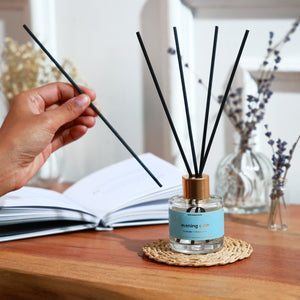
3. The bathroom is the one exception worth making. It is small, enclosed, and the place where a low constant source is most noticeable — which is why Morning Freshness at ₹749 earns its place there even in a home that already has two bottles elsewhere.
4. A bigger bottle is not another bottle. A 130ml at ₹1,249–₹1,349 runs 14–18 weeks against 6–8 and at six reeds fills exactly the same room. Size buys duration. If a second space is unscented, no amount of upgrading the first bottle reaches it.
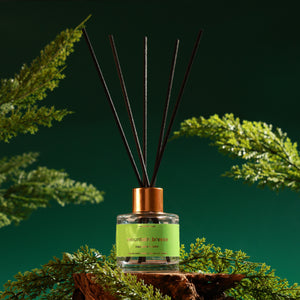
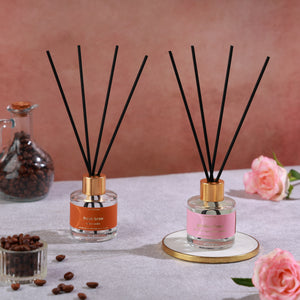
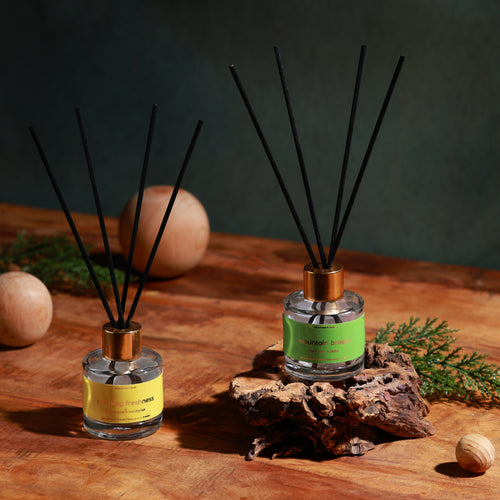
5. Two scents in one home must share a note or you get a seam. Mountain Breeze and Morning Freshness meet on green eucalyptus. Fresh Brew and Garden Bloom meet on warmth and a soft musk underneath. Two unrelated compositions in connected volumes produce a boundary where they argue, and somebody will move one of them into a cupboard.
6. Past roughly 250–300 sq ft of connected open volume, a third bottle is the wrong purchase. A Sukoon at ₹1,899 covers 270–320 sq ft, runs 16–18 hours on low and comes with three 15ml Hotel Collection scents in the box. It is a different product line and the two fragrance types never mix — reed oil never goes in a machine, Hotel Collection never goes in a reed bottle.
7. The Megh at ₹3,499 is not the answer to a coverage problem. Six litres and roughly 100 hours of runtime, but only about 215 sq ft — less than the Sukoon. It is a runtime and humidity machine. I say this on every page it appears on because the price implies otherwise.
8. If you were gifted a bottle you have no volume for, keep it sealed. Unopened, it waits. It is the one gift on an Indian Diwali table that stores indefinitely without spoiling, and starting it when the current one finishes is a better use of it than running two sources in one room.
Everything is composed and handmade in small batches in Pune, and a portion of every order supports girl-child education through Nanhi Kali.
Part one — how to count your own ceiling
This takes about ten minutes and you do it with the doors, not with a tape measure. The unit that matters is a body of air that stays together. Fragrance from a reed diffuser moves by evaporation and by whatever gentle traffic the room has; it does not push round corners, it does not climb stairs in any useful quantity, and it does not go through a shut door at all. Three rules give you the number.
 Sukoon₹1,899 · 500mlA reed diffuser is deliberately low and constant, and there is a volume past which constant-and-low simply disperses to nothing. In my experience that point sits around 250–300 sq ft of connected open space — a long living-dining, or a flat where the entrance, passage and living area all run together with high ceilings. The instinct at that point is to buy a second bottle for the same volume. It works less well than it should, because two low sources in one large space raise intensity near each bottle without ever filling the middle. The honest answer is a different instrument: the Sukoon at ₹1,899 covers 270–320 sq ft, runs 16–18 hours on low with steady, 2H and 4H timers, and comes with three 15ml Hotel Collection fragrances. Most homes I know end up running both formats — bottles behind the doors, a machine in the big room.
Part two — the ceiling by home type
Six household shapes, with the volume count, the bottle count and what the next bottle after that would actually buy you. The last column is the important one, because "one more" is almost always available and almost never useful. Coverage figures for the machines are manufacturer specifications and vary with ceiling height and ventilation.
| The home | Separate air volumes | Bottles it can use | Where they go | What one more would actually buy |
|---|---|---|---|---|
| 2BHK flat ★ | Three | Two, or three with a bathroom | Living-and-entry · main bedroom · bathroom | Nothing — the fourth doubles up on an existing volume |
| One-room flat or studio | One | One, at most | Away from the bed and away from the stove | A second source two metres from the first |
| 1BHK | Two | Two | Living-and-entry · bedroom behind its door | Intensity in one room, not reach into another |
| 3BHK with a study | Four | Three, plus a bathroom bottle | Living · main bedroom · study · guest bath | Only useful if the second bedroom is in daily use |
| Open-plan living-dining over 300 sq ft | One large, plus bedrooms | Bottles for bedrooms only | Bedrooms behind doors; the big room needs a machine | A second bottle in the big room adds two local pockets |
| Duplex or independent house | Four or more, split by floor | Three or four | One per floor's main volume, one per bedroom in use | Genuinely useful here — this is the one home where four works |
| The honest caveat: these counts assume every bottle is actually running. A household that owns four and has three sitting in a cupboard has one bottle, not four, and that is the commonest state I encounter after a couple of Diwalis of being gifted fragrance. If bottles are accumulating faster than they are being used, the fix is not a smaller purchase — it is keeping the surplus sealed and starting the next one only when the current one finishes. Unopened, a bottle waits indefinitely, which is one of the few genuine advantages fragrance has over almost everything else that arrives during the festival. | ||||
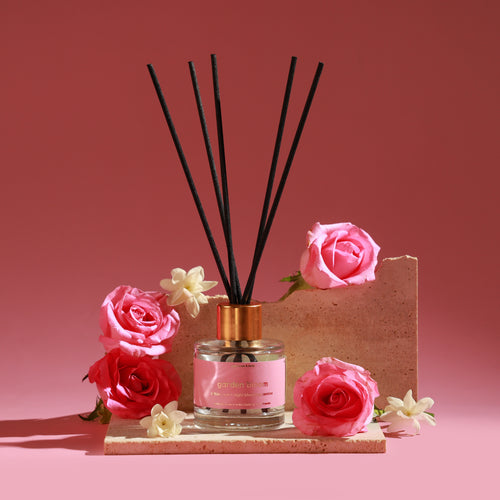 Garden Bloom · the living volume₹799Shop →
 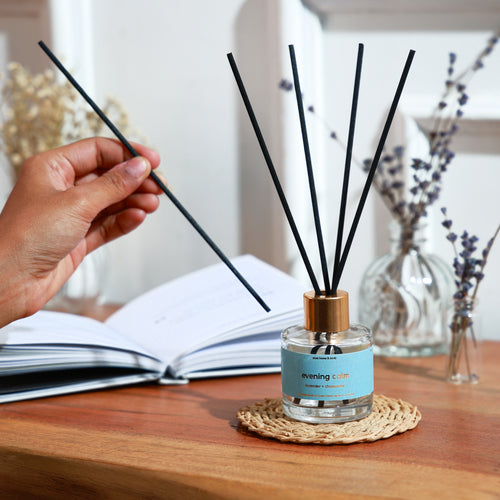 Evening Calm · behind the door₹799Shop →
  Sukoon · past the reed ceiling₹1,899Shop →
Part three — what actually happens past the ceiling
Nothing dramatic, which is exactly why the over-buying is so easy to keep doing. The first thing that happens is a seam. Two compositions running in air that mixes produce a boundary — usually a passage or a doorway — where you get neither one nor the other but a third thing, and it is almost always worse than either. Nobody articulates this; they simply start finding a room slightly unpleasant and move a bottle. The second thing is that the intensity in one volume climbs while the flat's overall reach does not, so the home ends up with one room that visitors comment on and three that are unchanged.
The third is quieter and it costs money. Your nose stops reporting a constant within minutes, and it adapts hardest at home, where you spend the most hours in the same air. So the household running four bottles is, by the fourth week, smelling almost exactly what a household running two would smell — which is to say very little of either. The natural response is to buy a fifth, or to add reeds, and that is the point at which a habit becomes an expense. Guests are the honest witnesses here. If people who do not live in the flat notice the fragrance and you do not, nothing is wrong with the bottles and nothing needs adding.
The fourth is the Diwali-specific one, and it is why this page sits in a gifting cluster at all. A household that is gifted fragrance every year accumulates bottles faster than it consumes them, because a 50ml runs 6–8 weeks and the gifts arrive annually in a batch. Three bottles received in one fortnight is roughly nine months of use handed over at once. The right thing to do with the surplus is nothing: leave it sealed and start it when the current one finishes. Opened bottles all at once is the only way to turn a good gift into a cupboard problem. And if you are the person doing the gifting rather than the receiving, the useful move after the first bottle is not a second scent but a 300ml oil refill at ₹2,399 — they already have the vessel and the reeds, and refilling costs roughly ₹7–8 per ml against ₹15–17 per ml for a fresh 50ml.
Part four — the cost of keeping them running
Owning is one decision; running is another and it is the one nobody costs out. A 50ml lasts 6–8 weeks, so a bottle kept continuously alive is roughly seven to eight refills a year. Here is what each ownership level actually costs across twelve months, with the arithmetic shown. These are listed prices multiplied out — no discount, slab or subscription exists behind any of them.
| How many you run | Bought as fresh 50ml bottles | Bought as oil refills | The sensible pattern |
|---|---|---|---|
| Two, continuously ★ | 2 × 7 × ₹799 = ₹11,186 a year | Two 300ml refills: 2 × ₹2,399 = ₹4,798 | Buy the vessels once, then refill |
| One, continuously | 7 × ₹799 = ₹5,593 a year | One 300ml at ₹2,399 ≈ 8–11 months | One refill covers most of a year |
| Three, continuously | 3 × 7 × ₹799 = ₹16,779 a year | One 500ml at ₹3,499 plus a 300ml = ₹5,898 | Refills, and accept that three is the ceiling |
| Two, run seasonally not always | 4 × ₹799 = ₹3,196 a year | One 300ml at ₹2,399, opened when needed | Honest for most households, and cheapest |
| Two bottles plus a Sukoon | ₹1,899 once, plus the bottles above | Hotel Collection 100ml ₹999 for the machine | The commonest mature setup in a larger flat |
| Four or more bottles | The arithmetic keeps working; the flat does not | Same | Keep the surplus sealed until one finishes |
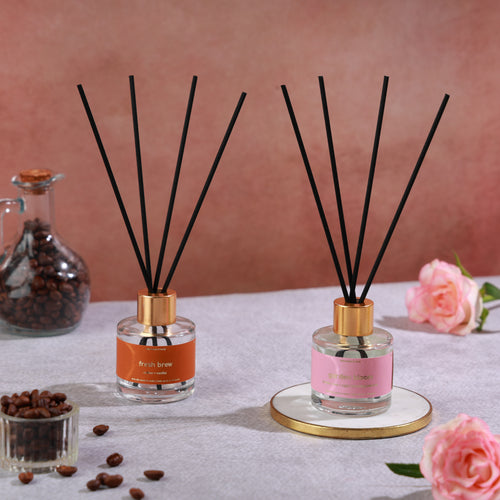
Versailles
I run three bottles at home and I have tried four twice, both times because I had something new I wanted to live with. Both times one of them came out within a month. The flat has three volumes and the fourth bottle had nowhere of its own to be, so it simply sat inside somebody else's air and made a boundary I kept walking through.
The thing I did not expect when we started selling refills is how much resistance the idea meets. People will replace a whole bottle seven times a year and never think about the vessel they are throwing away, and then hesitate over ₹2,399 for eight to eleven months of oil because it does not look like a product. It is the least glamorous thing we sell and the best value in the range, and I would rather say that than sell somebody their fifth bottle.
What I will not tell you is that any particular number of bottles will make a home feel better. I have no way of knowing that and I am wary of anyone who claims it. What I can tell you is how far a low constant source reaches, what happens where two of them meet, and what each arrangement costs over a year. Everything is blended in small batches in Pune and tested through 45°C heat and 85% monsoon humidity. A portion of every order funds a girl's classroom through Nanhi Kali.
Frequently asked questions
- Should you gift a refill instead — excellent value, poor unwrapping.
- I gave them a diffuser last Diwali — the second-year decision.
- Gifting into a one-room flat — where the ceiling is one bottle.
- The full Diwali buying guide — budget, quantity and fragrance in one page.
- Brand: the SOSA founder story.
SOSA range & prices used in this guide (verified from the live store, 27 August 2026): Reed diffusers — alcohol-free, phthalate-free, paraben-free, IFRA-compliant compositions on a heat-stable coconut-derived (CCT) carrier, in a refillable glass bottle with six fibre reeds; 50ml lasts 6–8 weeks, 130ml lasts 14–18 weeks. Morning Freshness 50ml ₹749 · 130ml ₹1,249; Garden Bloom ₹799 · ₹1,299; Evening Calm ₹799 · ₹1,299; Fresh Brew ₹849 · ₹1,349; Mountain Breeze ₹849 · ₹1,349. Duo sets: Day & Night ₹1,498, Fresh & Grounded ₹1,548, Warmth & Bloom ₹1,598 (2 × 50ml); ₹2,498–₹2,598 (2 × 130ml). Oil-only refills 300ml ₹2,399 · 500ml ₹3,499 (vessel and reeds not included). The least expensive SOSA reed diffuser is ₹749 — no reed diffuser exists below that price in any size. Below it: scented jar candles from ₹379 (roughly 15–18 hours), Sandalwood or Smoked Oudh jar candle ₹449, wax melts ₹474 (a burner is needed and is not included), ceramic mugs ₹474, ribbed and face mugs and taper candles ₹569, Amber Rose candle ₹599, ceramic trinket dish ₹664, candle two-pack ₹664 (roughly 30–36 hours). Machines: Boond 300ml ₹899 · Sukoon 500ml ₹1,899 · Megh 6L ₹3,499 (~215 sq ft, a runtime and humidity machine rather than a coverage upgrade) · waterless Vaayu ₹11,999 · Safar car and travel diffuser ₹3,999. The water-based Hotel Collection (15ml ₹299 · 100ml ₹999 · 300ml ₹1,799) is a fragrance for an ultrasonic machine, not a standalone gift. SOSA publishes no bulk or corporate gifting terms — there is no discount slab, no minimum order quantity, no stated GST-invoicing arrangement, no custom branding service and no published lead time — and SOSA sells no gift card, gift hamper, gift box or curated gift set. Larger orders should be discussed with SOSA directly through the contact page before committing. Gift wrapping, gift notes, direct-to-recipient shipping and delivery timing are unconfirmed — check at checkout rather than assuming them; no delivery date is promised anywhere in this guide. Per-head and total costs shown are arithmetic on the listed prices, not quotations. Fragrance adds scent to a room; it does not clean air, remove cooking or smoke smells, or change how anyone feels. Fragrance oil is flammable — keep any diffuser away from diyas, candles and open flame. Composed and handmade in small batches in Pune, India; tested through 45°C summer heat and 85% monsoon humidity. Free shipping above ₹499. A portion of every order supports girl-child education through Nanhi Kali. Prices subject to change — see the live product pages.