


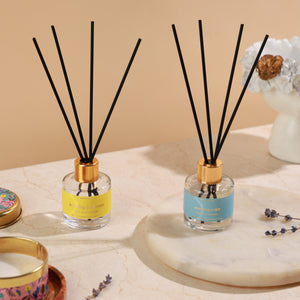
Count doors before floors. A closed bedroom door blocks fragrance more completely than forty feet of open floor does.
Measure volume, not area. Floor area times ceiling height. A 400 sq ft room at 18 ft holds 7,200 cubic feet against 4,000 at 10 ft — nearly twice the air for the same plan.
The bands: under ~300 sq ft connected, one Sukoon or two reed diffusers. 300–800, a Sukoon plus reeds. 800–2,000, the crossover. Above 2,000 sq ft and up to 1000m³, one Vaayu.
2. Count the floors second. Each floor is its own body of air, connected to the others only by a stairwell that moves air vertically on its own terms. One common-space source per floor that has a common space.
3. Measure the connected common volume, in cubic feet. Length times width times ceiling height, added across the rooms that open into one another with no door between them. Divide by 35.3 for cubic metres. This is the only number that decides whether you need a machine at all.
4. Subtract the unscentable. Terraces, balconies, verandahs, open decks and any room whose window stays open. Air exchange there is total and continuous; no format survives it, and money spent is money gone.
5. Now match to bands. Under about 300 sq ft of connected common space, one Sukoon at ₹1,899 or two reed diffusers. Between 300 and 800, a Sukoon plus reeds at the far end. Between 800 and 2,000 you are at the crossover and it becomes a judgement about turnover labour as much as coverage. Above roughly 2,000 sq ft, or up to 1000m³ of connected volume, one Vaayu at ₹11,999.
6. One caution about the big machine. The Vaayu ships with 400ml of cold-air fragrance rated at 90+ days a fill, and SOSA does not currently sell a separate Vaayu refill oil. Ask about availability before you buy if you need continuity.
7. And one honesty note. This page is about the guest's experience of a property, not about performance. No one can promise scenting changes a rating, a review, a booking or occupancy, and nothing here claims it does.
The Vaayu is made in India; our reed diffuser fragrances are composed and handmade in small batches in Pune, and a portion of every order supports girl-child education through Nanhi Kali.
Part one — the counting method, in three passes
Do this once, properly, and you will not have to think about it again for years. It takes about twenty minutes in a four-bedroom property and it replaces the guesswork that leads hosts to own six diffusers and a still-unscented first floor. The principle is that you are counting bodies of air, not rooms, and the thing that separates one body of air from another is not distance but an obstruction — a shut door, a floor slab, an extractor running.
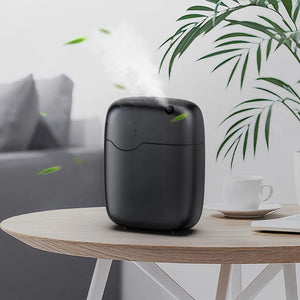
 Sukoon₹1,899 · 270–320 sq ftNow take the spaces that are connected — entrance, living, dining, an open kitchen — and measure them as a single volume. Multiply the combined floor area by the ceiling height, and if part of it is double-height, measure that part separately and add it. A 1,200 sq ft common floor at 10 ft is 12,000 cubic feet, about 340m³; add a 300 sq ft double-height section at 18 ft and you have added another 2,400 cubic feet on top of what you already counted. Divide cubic feet by 35.3 to get cubic metres, which is the unit the Vaayu's 1000m³ figure is quoted in. Then repeat per floor. Each floor with a common space gets one common-space source; the coverage numbers — around 150 sq ft for a Boond, 270–320 for a Sukoon, up to 1000m³ for a Vaayu — describe connected air only.
Part two — typical properties, counted end to end
Six real shapes of Indian listing, run through the method. Treat the totals as a starting point rather than a prescription — your ceiling heights, your door discipline and your ventilation will shift them. Indicative spend uses 50ml reed diffusers at ₹749–₹849 unless stated.
| Property | Doors closed on turnover | Floors | Connected common space | Sources it needs | Indicative spend |
|---|---|---|---|---|---|
| Four-bedroom villa, two floors ★ | 9–10 | 2 | ~1,600 sq ft at 11 ft ≈ 500m³ | 1 Vaayu + 9 reed diffusers | ₹11,999 + ~₹7,200 |
| Studio, one floor | 1 (bathroom) | 1 | ~350 sq ft at 10 ft ≈ 99m³ | 1 reed diffuser + 1 bathroom reed diffuser | From ₹1,498 as a duo |
| 2BHK flat | 4 | 1 | ~450 sq ft at 10 ft ≈ 127m³ | 1 Sukoon + 4 reed diffusers | ₹1,899 + ~₹3,200 |
| 3BHK flat, open living-dining | 6 | 1 | ~700 sq ft at 10 ft ≈ 198m³ | 1 Sukoon (or 2 for a long plan) + 6 reed diffusers | ₹1,899–₹3,798 + ~₹4,800 |
| 4BHK duplex | 8 | 2 | ~1,100 sq ft at 11 ft ≈ 343m³ | 1 Vaayu on the lower floor + 8 reed diffusers | ₹11,999 + ~₹6,400 |
| Six-bedroom villa, three floors | 13–14 | 3 | ~2,400 sq ft at 12 ft ≈ 815m³ | 1 Vaayu on the common floor, 1 Sukoon for the upper lounge, 13 reed diffusers | ₹11,999 + ₹1,899 + ~₹10,400 |
| The honest caveat: the reed diffuser column is a repeating cost — a 50ml lasts six to eight weeks, a 130ml at ₹1,249–₹1,349 lasts 14 to 18, and oil-only refills at ₹2,399 for 300ml or ₹3,499 for 500ml bring the per-millilitre cost down to roughly ₹7–8 against ₹15–17 for a fresh bottle. The Vaayu is a one-off ₹11,999 and ships with 400ml of cold-air fragrance at 90+ days a fill — but SOSA does not currently sell a separate Vaayu refill oil, so a host planning a full season of continuous running must check current availability with SOSA before ordering. The water-based Hotel Collection is for ultrasonic machines and is never a Vaayu refill. | |||||
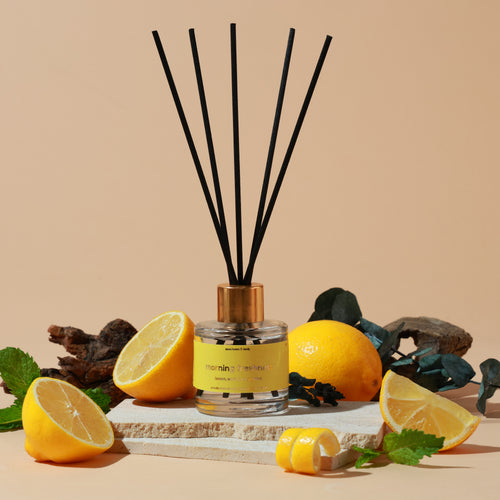 Reeds · one per closed doorfrom ₹749Shop →
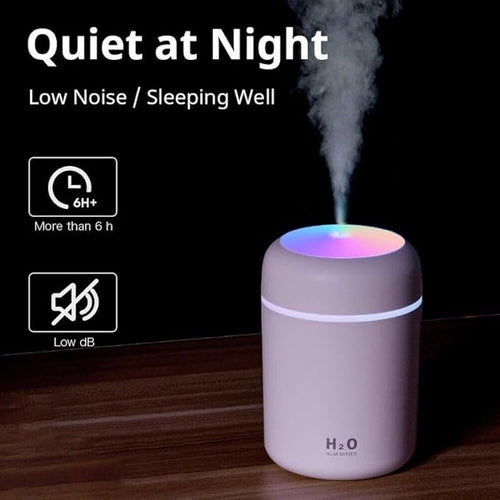
  Sukoon · 270–320 sq ft₹1,899Shop →
 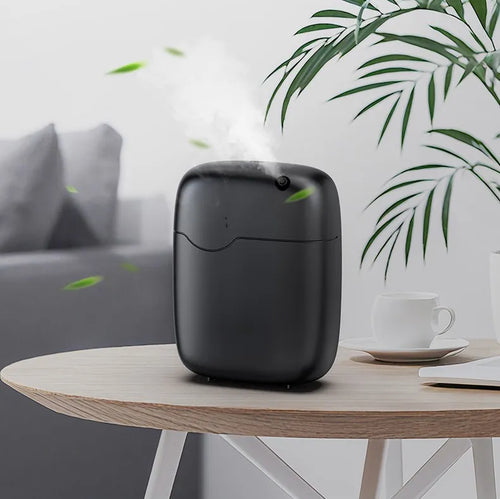 Vaayu · up to 1000m³₹11,999Shop →
Part three — where hosts over-buy, and the count that says stop
The commonest over-purchase in this category is the second machine. A host buys a Sukoon for the living room, finds the dining end still quiet, and buys another. Usually the count says the problem was not output but placement — the first unit was in dead air, low down and behind furniture, in a corner nobody walks past. Before the second machine, move the first: waist to chest height, near a doorway or the route people actually take, several feet clear of an air-conditioning vent or a fan, out of direct sun. A directed draught across any source does the opposite of what you hope, stripping it and emptying it early while the room reads as empty. That correction is free and it resolves a surprising share of the cases that arrive in my inbox as a coverage complaint.
The second over-purchase is the Megh, bought as a step up because it costs ₹3,499 and holds six litres. It is a fine machine and it is not a coverage upgrade: it covers around 215 sq ft, which is less than the ₹1,899 Sukoon's 270–320 sq ft. What the six litres buys is roughly a hundred hours of runtime between refills, and what the volume of mist does is add noticeable humidity — genuinely useful in a dry Delhi winter, actively unhelpful in a coastal villa in August. Buy it for runtime or for humidity. Never buy it to reach further, and be careful of both in a monsoon.
The third is spending on the terrace, the balcony and the porch, which between them can account for a third of a villa's photographed area and none of its scentable volume. And the fourth, which is less a purchase than a habit, is buying more sources to fix a smell that ventilation would have removed. A property that has been shut for nine days does not need more fragrance on arrival day; it needs windows open for twenty minutes and then fragrance. That order — air first, scent second — is the single cheapest improvement available to any host, and it costs the cleaner ten minutes.
Part four — the walk-through worksheet
Six things to write down, in the order you should write them. Take the tape measure; the ceiling height is the number hosts most often guess and most often get wrong.
| Count this | How to count it | What it decides | Typical answer |
|---|---|---|---|
| 1. Doors closed on turnover ★ | Follow the cleaner's route, not the owner's tour | The number of small unpowered sources you need | 6–14 in a large listing |
| 2. Floors with a common space | Ground, first, upper lounge — not the stairwell itself | How many powered sources, at most | 1–2 |
| 3. Connected common area | Add only the rooms that open into each other with no door | Which coverage band you are in | 450–2,400 sq ft |
| 4. Ceiling height, per zone | Tape measure, and measure double-height sections separately | Converts area into the volume that actually matters | 10–18 ft |
| 5. Openings that stay open | Balcony doors, courtyard, windows housekeeping leaves ajar | What to subtract entirely from the plan | Cross them off |
| 6. Who touches it between guests | Whether anyone is on site weekly to flip reeds and check levels | Whether passive sources are practical at all for you | Decides reeds vs machine |
Versailles
When a host writes to ask how many diffusers they need, I ask for two numbers back: how many doors get closed at the end of a clean, and how high the living room ceiling is. Nine times out of ten neither has been counted, and the answer arrives with an apology. It is not a failing — nobody thinks about their house in cubic metres. But those two numbers do more work than any product page can.
What I like about counting is that it usually reduces the bill rather than raising it. The property that arrives believing it needs three machines nearly always needs one machine and eight small bottles, and the small bottles are the part that fixes the complaint the guest would actually have noticed — the bedroom door opening onto nine days of shut air.
I would also gently ask hosts to hold their expectations at the right size. A scented arrival is a nice thing and a real thing. It is not a performance lever, and I will not pretend it is one. Buy it because you would like the house to feel looked after. Everything we make is composed and handmade in small batches in Pune, and a portion of every order funds a girl's classroom through Nanhi Kali.
Frequently asked questions
- Best scent machine for a large Airbnb — sizing to connected volume rather than bedroom count.
- How to fragrance a multi-floor villa — why the stairwell is a chimney and not a duct.
- One machine or many reed diffusers? — the turnover-labour arithmetic behind the count.
- The large Airbnb and villa scenting guide — the whole cluster in one place.
- Brand: the SOSA founder story.
SOSA Vaayu specifications (verified from the live product page, August 2026): ₹11,999 (the product page displays a rounded ₹12,000). Waterless cold-air nebulisation — pressurised air atomises undiluted fragrance oil into a dry nano-mist; no water, no heat, residue-free. Coverage up to 1000m³, about 2,000–3,000 sq ft. 400ml refillable tank, 90+ days per fill at a mid intensity setting. Bluetooth app plus onboard buttons, 1h / 4h / 8h / 24h timers, adjustable mist intensity, auto-stop and key-lock. Under 38 dB. DC 12V / 1A, 5W. 165 × 80.5 × 215 mm, 0.9 kg, black or white. Freestanding or wall / HVAC mount. CE, RoHS and SGS certified. Ships with four SOSA Hotel Collection fragrances at 100ml each (400ml in total) in one of three combos chosen at checkout. SOSA does not currently sell a separate Vaayu refill oil; the 400ml supplied in the box is the fragrance available at the time of writing, and buyers who need long-term supply should confirm current refill availability with SOSA before purchasing. The cold-air oil supplied with the Vaayu is a different product from the water-based Hotel Collection sold for ultrasonic machines (15ml ₹299 · 100ml ₹999 · 300ml ₹1,799), which must not be used in a Vaayu despite sharing scent names. Other SOSA machines: Boond 300ml ₹899 (~150 sq ft) · Sukoon 500ml ₹1,899 (270–320 sq ft) · Megh 6L ₹3,499 (~215 sq ft — a runtime and humidity machine, not a coverage upgrade) · Aangan ₹25,999 (~8,000–10,000 sq ft) · Meenar ₹38,500 (12,000–18,000 sq ft) · Safar car diffuser ₹3,999. Reed diffusers 50ml ₹749–₹849 (6–8 weeks) · 130ml ₹1,249–₹1,349 (14–18 weeks) · duo sets ₹1,498–₹1,598 · oil-only refills 300ml ₹2,399 / 500ml ₹3,499. Runtime, consumption and coverage figures are manufacturer specifications and vary with intensity setting, run hours, ceiling height, ventilation and season; any per-month or per-day figure in this guide is arithmetic on those specifications, not a measurement. Electricity costs vary by state tariff. No claim is made that scenting affects ratings, reviews, bookings, occupancy, revenue, health, mood or air quality. Free shipping above ₹499. A portion of every order supports girl-child education through Nanhi Kali. Prices subject to change — see the live product pages.