



2. Survey each location individually against the three-zone rule. Entrance, washroom and retail areas qualify only where they're genuinely separated from dining — that has to be checked at each of the ten sites, not assumed because it was true at the flagship.
3. Calibrate intensity per site, then lock it. A washroom with an extract fan and a washroom without one need different settings to reach the same result; calibrate against the room actually in front of you, then lock the setting so staff can't drift it.
4. Build a refill cadence around the tank life, not around memory. Vaayu's 400ml tank runs roughly 90-plus days; ten sites running on ten separate clocks needs a schedule, not a hope that someone notices when a unit runs dry.
5. Name one accountable owner for the whole rollout. Standardisation fails less often on the fragrance and more often on nobody being responsible for checking that ten sites are still doing what the spec says.
Ten locations standardised well don't smell identical because they're running the same number — they smell considered because they're all following the same documented decision, tested against each site's own room.

Why one setting can't cover ten different rooms
The instinct behind most failed rollouts is a reasonable one: pick the best machine, pick a good fragrance, run it the same way everywhere, and call it a brand standard. It fails because a brand standard and a machine setting are not the same thing. Ten café locations, even under one fit-out brief, rarely share identical envelopes — different landlords, different retrofit histories, different AC contractors mean a washroom that holds a level cleanly at one site loses it in twenty minutes at another. Standardising the number, rather than the process that produces the number, standardises the wrong thing.
What should be identical across ten sites is the document, not the dial. A spec that says which zones ever qualify, what product goes into each zone type and what intensity band is acceptable gives every site the same starting instructions. What each site then does with those instructions — whether the washroom actually has a real air boundary, what intensity holds without drifting into the corridor — has to be tested at that site, because no head-office assumption substitutes for standing in the room.
This is also where most rollouts either save or waste money. A chain that orders ten identical machines before surveying a single site risks discovering, after the fact, that three locations don't have a washroom or entrance that qualifies at all under the three-zone rule. A chain that surveys first, writes the spec, then calibrates and locks settings site by site spends the same money more precisely — some locations get two zones, some get one, and a few, honestly, get none.
The three decisions a rollout actually needs
 Vaayu₹11,999A spec is a page, not a machine — it should survive being read by someone who has never visited any of the ten sites and still tell them exactly what to check for.
Ten sites, one spec, ten separate surveys
The spec stays fixed. What changes, site to site, is which rows of it actually apply.
| Element | What the spec requires | Applies to | Confirmed how |
| Zone qualification | Each entrance, washroom and retail area tested against the three-zone rule | All 10 sites, individually | A per-site survey before any hardware is ordered |
| Product per zone type | Washrooms and entrances follow the spec's approved register; dining is never scented | All 10 sites, without exception | Written into the spec document, not left to site manager discretion |
| Intensity | Calibrated to what the specific room holds, then locked with the key-lock | Per site, per zone | On-site testing, not copied from another location's number |
| Refill cadence | Tracked against the ~90+ day tank life, confirmed with SOSA | All sites running Vaayu | One accountable owner's schedule, not staff memory |
| A site with no qualifying zone at all follows the spec exactly by installing nothing — that outcome is the spec working correctly, not a gap in the rollout. | |||
Morning Freshness · confirmed small washrooms₹749Shop →  Sukoon · larger washroom suites₹1,899Shop →
  Vaayu · entrances and retail, calibrated per site₹11,999Shop →
How intensity gets calibrated per site
Never copy an intensity setting from one site to another just because both are washrooms of a similar size — the actual variable is airflow, not floor area, and two rooms the same size can behave completely differently depending on whether either has independent extraction.
Sometimes two sites in the same city, even in the same mall, will need noticeably different settings once tested, because one shares a return grille with an AC loop the other doesn't — this is normal, not a sign the spec is failing.
Usually, once a site's setting is found and locked, it holds for months without adjustment — the calibration work is front-loaded into the survey and the first fortnight of running, not an ongoing task for site staff.
The rollout, costed
What a ten-location rollout actually spends money on, in the order it should be spent.
| Route | Premises | Why | What it costs |
| Write the spec | Head office, before any site visit | Defines zones, products and intensity bands every site is tested against | No hardware cost — a documentation exercise |
| Survey all 10 sites | Every location, entrance to washroom to retail | Confirms which zones genuinely qualify under the three-zone rule at each site | A site-visit cost, not a product cost |
| Vaayu, per qualifying entrance or retail zone | Sites with a genuinely separated non-dining area | Calibrated and locked per site, scheduled to that site's own traffic | ₹11,999 per unit |
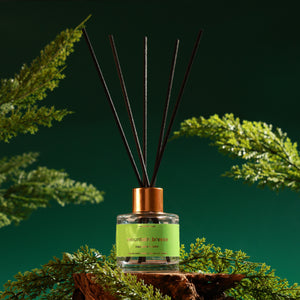
| Reed diffuser or Sukoon, per qualifying washroom | Sites with a confirmed small or mid-sized washroom | Sized to the room, not copied from another location | ₹749–₹1,899 per site |
| Refill cadence, tracked centrally | All sites running Vaayu | One schedule against the ~90+ day tank life, refill supply confirmed with SOSA | No separate line item — a process cost |
Chains come to me two ways. Either they've already bought ten machines and are asking why three sites smell wrong, or they haven't bought anything yet and want to do this properly the first time. I always prefer the second conversation, because by the time the first one happens, money has usually already been spent on machines sitting in zones that never should have qualified.
What I ask for, before recommending a single unit, is the spec. Not a mood board, not a fragrance brief — a plain document naming which zones at which sites are allowed to be scented at all, and what happens when a site fails that test. Chains that can produce this document in a week tend to run a calm rollout. Chains that can't usually discover, expensively, that the document was needed all along.
The chains I'm proudest of having advised are the ones where the tenth site looks nothing like the first on a floor plan, and yet both feel like they belong to the same brand — because what's standardised is the decision, tested honestly against each room, not a number copied from a spreadsheet.
Questions about standardising a café chain's scenting
- Should Every Branch of a Premium Café Chain Smell the Same? — the brand question this rollout answers.
- Should Café Chains Standardise Entrance and Washroom Fragrances? — the two zones this spec actually standardises.
- How Do I Create a Scent SOP for a Premium Café Chain? — the spec turned into a usable document.
- What Should a Café Chain Ask a Commercial Scenting Company Before Installing Machines? — the questions worth asking before this rollout begins.
- Brand: the SOSA founder story.
SOSA products & prices (verified September 2026): Reed diffusers 50ml ₹749–₹849 (to 150 sq ft, 6–8 weeks at six reeds) · 130ml ₹1,249–₹1,349 (above 150 sq ft, 14–18 weeks) · reed refill 300ml ₹2,399. Ultrasonic: Boond ₹899 (~150 sq ft) · Sukoon ₹1,899 (270–320 sq ft, ships with three 15ml Hotel Collection fragrances) · Megh ₹3,499 (6L tank, ~100 hrs runtime, ~215 sq ft — a runtime machine, not a coverage upgrade). Waterless cold-air: Safar ₹3,999 (no published coverage figure) · Vaayu ₹11,999 (up to 1000 m³, roughly 2,000–3,000 sq ft; 400ml tank lasting about 90+ days; app and onboard control, 1h/4h/8h/24h run windows, adjustable intensity, key-lock, under 38 dB, freestanding or wall/HVAC mount, 5W, CE/RoHS/SGS) · Aangan ₹25,999 (8,000–10,000 sq ft). Hotel Collection water-based fragrance 15ml ₹299 · 100ml ₹999 · 300ml ₹1,799 is for ultrasonic machines; reed oil and Hotel Collection are not interchangeable. Reed diffusers are alcohol-free, phthalate-free, paraben-free, IFRA-compliant and low VOC, handmade in small batches in Pune. Every purchase funds a girl's education through Nanhi Kali. Prices and availability subject to change — see the live product pages.