
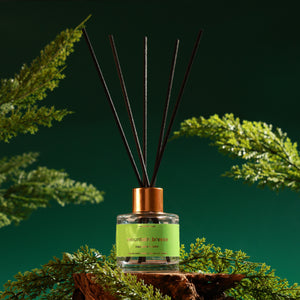
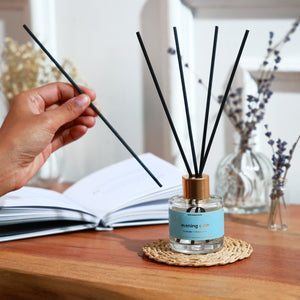


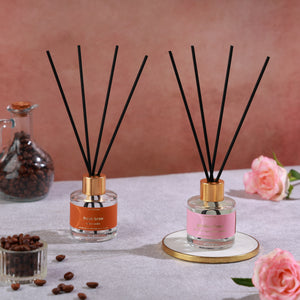
What remains, in three mechanisms: passive capillary (a reed diffuser — oil climbs six fibre reeds and evaporates, silent, unpowered), ultrasonic water mist (Sukoon ₹1,899 — a piezo plate turning oil-in-water into a wet mist), and waterless cold-air nebulising (Safar ₹3,999 — pressurised air shattering undiluted oil into a dry mist, the mechanism hotels actually use).
The straight swap for a candle is a reed diffuser at ₹749–₹849. It is the same idea — an object on a table producing a fragrant zone around itself — minus the flame, the attendance and the fact that it only works while you are watching it. It is also silent, needs no power and costs about ₹13–₹15 a day.
The honest warning: if what you actually miss is incense’s intensity, nothing on this page reaches it. Diffusion is a quieter category by design, and choosing it is choosing a different volume as well as a different format.
The gap in our own range: between Safar — which is named and sold as a car and travel diffuser and has no published room-coverage figure — and the ₹11,999 Vaayu at 2,000–3,000 sq ft, SOSA has no mid-sized waterless bedroom nebuliser.
2. If you want the whole room rather than a zone, you have to add air movement, and that means a machine. This is the honest dividing line in the category. A reed emits but does not transport; an ultrasonic or cold-air machine does both. Sukoon at ₹1,899 covers 270–320 sq ft, holds 500ml, runs 16–18 hours on low and includes three 15ml Hotel Collection scents. The oil is diluted in water, the output adds humidity, and in hard-water areas it can leave a fine white mineral dust.
3. If you want undiluted oil and no water anywhere in the system, that is cold-air nebulising. Pressurised air shatters neat fragrance oil into a dry micro-mist — no heat, no dilution, no added humidity, no white dust. It is the technology luxury hotels genuinely use, and it is the honest answer to why a hotel corridor smells the way it does. Safar at ₹3,999 is that mechanism at personal scale, and you should know before buying that it is named and sold as a car perfume diffuser, with car, handbag, desk, bedside and hotel room among its stated uses. SOSA publishes no room-coverage figure for it, so treat it as personal and small-space scenting.
4. Do the free things before the paid ones, because in a closed-up flat they matter more than the hardware. Ventilate before you fragrance rather than fragrancing over. Close the door of the room you want to scent for the hours you are in it — cutting air exchange raises concentration far more reliably than adding oil. Put the bottle slightly inside the room rather than at the entrance, which is the most turbulent point in a home. And use the reeds as a volume dial: six for full projection, three for a soft bedside level and roughly double the life.
5. Accept that you are choosing a quieter category, and choose it deliberately. Incense is loud because it is combustion. Diffusion is subtle because it is evaporation or atomisation. A hotel does not smell strong so much as it smells even and consistent — the same scent, at the same level, everywhere, for years. Evenness and consistency are what you can actually buy here, and they are most of what you are remembering.
Alcohol-free, phthalate-free, paraben-free, IFRA-compliant, 0 ppm formaldehyde. Free shipping above ₹499, and a portion of every order supports girl-child education through Nanhi Kali.
Taking your two exclusions seriously, one at a time
Most articles that begin “without candles or incense” treat the exclusions as a formality and get to the product in two sentences. I would rather do the opposite, because the reasons you ruled each one out tell you which of the remaining mechanisms you will actually be happy with, and because one of these exclusions costs you something real that you should know about before you spend. Three cards: the candle, the incense, and the thing both of them share that a diffuser does not.
 Evening Calm₹799A scented candle works by melting a shallow pool of wax and letting the fragrance evaporate from its warm surface. That is a perfectly good mechanism and it produces a lovely result — but it comes with three structural conditions. It needs an open flame, which is a decision every household with children, elderly members or simply a habit of leaving rooms makes for itself. It needs attendance: a lit candle is not something you leave running while you go out or fall asleep. And it is an event rather than an ambience — the room is scented from the moment you light it until the moment you put it out, and not one minute either side. If your objection was any of those three, a reed diffuser removes all three at once, because it has no flame, requires no supervision and does not have an on state to forget.
 Hotel Collection₹999Agarbatti and bakhoor are not diffusers with a different smell; they are a different physical process. They work by combustion — burning resin, wood and binder — which puts smoke particulates into the air alongside the aromatic materials, and produces a concentration a passive evaporating source cannot approach. That is why incense fills a flat in minutes, why it reaches rooms nothing else reaches, and why it stays in curtains and upholstery for hours after the stick has gone out. I say this with respect for the practice, which is older and better established than anything in my industry. But it means that if what you are missing is the sheer volume of incense, no diffuser is going to give it to you, and I would rather tell you that now than sell you a machine and have you discover it.
 Sukoon₹1,899Here is the thing worth noticing, and it reframes the whole question. A candle and an incense stick are both point sources with no delivery system. Both rely on the room’s own air to distribute what they release, which is exactly the limitation a reed diffuser has. Incense gets away with it because its output is so high that even poor transport reaches everywhere; a candle does not get away with it at all, which is why a candle scents the table it stands on. So if your real complaint was never about flame or smoke, but about a room that never smelled evenly scented, the format was not your problem. The missing ingredient is transport — moved air — and only an ultrasonic or cold-air machine supplies it. That is also, precisely, what a hotel is doing that your flat is not.
What is left once you burn nothing, and what each option honestly gives you
Three mechanisms remain, and they are genuinely different physics rather than three price points of the same idea. Passive capillary diffusion is the reed: oil climbs six porous fibre reeds and evaporates from their wetted surface, at whatever rate the room’s temperature, humidity and airflow allow. There is no energy input at all, which is simultaneously its great virtue and its hard ceiling. Concentration is highest at the bottle and falls away with distance, so what you get is a fragrant zone rather than a fragranced room. That is the design rather than a defect, and it buys you silence, no power, no filling, no charging, no schedule and an object that looks like an object rather than an appliance.
Ultrasonic water mist is the middle rung. A piezo plate vibrates a water-and-oil mixture into a visible wet mist, and because the mist plume moves air, the machine does both jobs — it emits and it delivers. Boond at ₹899 holds 300ml, covers up to about 150 sq ft and runs about six hours on USB. Sukoon at ₹1,899 holds 500ml, covers 270–320 sq ft, runs 16–18 hours on low and includes three 15ml Hotel Collection scents — it is the value answer for a real bedroom and often simply the right one. The honest costs are that the oil is diluted in water, the output adds humidity, it has to be filled, and hard water can leave white mineral dust nearby. And a note on our own range that I would rather say than have you work out: Megh at ₹3,499 has a six-litre tank and around a hundred hours of runtime, but it covers only about 215 sq ft — less than the ₹1,899 Sukoon. It is a runtime and humidity machine and never a coverage upgrade.
Waterless cold-air nebulising is the top rung and the one that answers the hotel question properly. Pressurised air shatters undiluted oil into a dry micro-mist that travels with the room’s airflow: no water, no dilution, no heat, no added humidity, no white dust. Because the payload per droplet is neat oil rather than oil suspended in water, the same composition reads as considerably more present than it does from an ultrasonic machine — that difference is most of what people are hearing when they say a hotel’s fragrance is “stronger”. Safar at ₹3,999 is this mechanism at personal scale: 20ml of oil, a 2000 mAh Type-C battery good for up to 10 hours continuous or around 30 intermittent, three speeds, a 1, 2 or 3-hour auto-off timer and a 6.9 cm body. Say the awkward part plainly: it is named and sold as a car perfume diffuser, SOSA’s own page also names bedside and hotel room among its uses, and there is no published room-coverage figure, so nobody should expect it to fill a living room.
| Format | How it puts scent in the air | What it produces in a room | Why it is in or out for you | Price |
|---|---|---|---|---|
| Scented candle | Combustion at a wick, evaporation from a warm wax pool | A fragrant zone around the candle, only while lit | Out: open flame, needs attendance, cannot run unattended or overnight | — |
| Incense or bakhoor | Combustion of resin, wood and binder — smoke plus aromatics | Very high concentration reaching the whole flat, lingering in fabric | Out: smoke and combustion. Note honestly that nothing below matches its volume | — |
| Passive capillary — reed diffuser ★ | Oil climbs six fibre reeds and evaporates. No flame, no power, no air moved | A fragrant zone around the bottle, continuously, for 6–8 weeks on a 50ml | In, and the closest like-for-like swap for a candle. Silent, unattended, about ₹13–₹15 a day | ₹749–₹849 |
| Ultrasonic water mist — Boond, Sukoon, Megh | A piezo plate shatters oil diluted in water into a visible wet mist | Genuine room coverage — Sukoon 270–320 sq ft, Boond up to ~150, Megh only ~215 | In. Nothing burns. Costs: dilution, added humidity, refilling, possible white mineral dust | ₹899 / ₹1,899 / ₹3,499 |
| Waterless cold-air nebulising — Safar, Vaayu | Pressurised air shatters undiluted oil into a dry micro-mist. No water, no heat | The mechanism hotels use. Vaayu is rated to 1000 m³, roughly 2,000–3,000 sq ft | In, and the most hotel-like. Safar is a car and travel diffuser with no published room coverage; Vaayu is far too much for one room | ₹3,999 / ₹11,999 |
| The honest gap: between Safar at personal scale and Vaayu at 2,000–3,000 sq ft, SOSA has no mid-sized waterless bedroom nebuliser. If you want the hotel mechanism sized for one Delhi bedroom and nothing else, there is no product that is exactly that — which is why the answer here is a choice between accepting water with Sukoon and accepting personal scale with Safar. | ||||
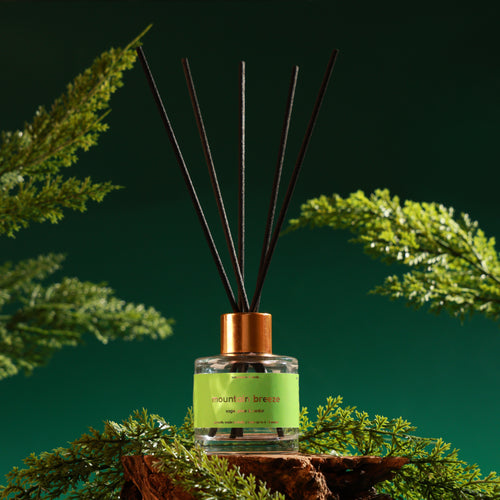
Instead of a candle · Mountain Breeze₹849Shop →  For the room · Sukoon₹1,899Shop →
 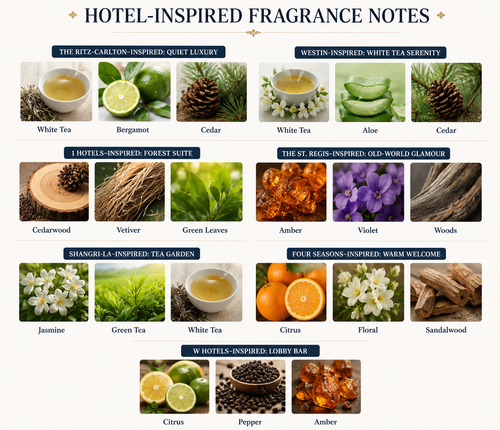 The oils · Hotel Collection₹999Shop →
The Delhi part of the question, which is about a closed flat rather than about weather
Two things about a Delhi apartment change what you should do, and neither of them is a number I am willing to invent. The first is that flats here spend long stretches shut — windows closed against the outside for much of the year, air conditioning or heating running, doors kept shut to keep conditioned air in. That is genuinely good news for home fragrance, because concentration in a room is emission minus removal, and a closed flat removes very little. It also means that whatever else is in the air stays in the air, which is why the sequence matters so much: air the room first, then fragrance it. Fragrance does not remove a smell. Adding a pleasant odour to an unpleasant one gives you a mixture rather than a cancellation, and the mixture is frequently worse because the brain now tracks two things instead of one.
The second is a cooking question, and it is the most common thing people are actually trying to solve when they write to me from a north Indian flat. Cooking aerosols condense onto curtains, upholstery and walls and then re-release slowly for hours. Ventilation clears the airborne fraction in minutes; the deposited fraction comes back. That is why a flat can smell of last night’s tadka at eleven in the morning after being aired at eight. No diffuser of any mechanism addresses that, and buying a bigger one is money spent on the wrong problem. Extraction while cooking, soft furnishings washed on their own schedule, and then fragrance for a room that is already clean and aired — in that order, and the order is not negotiable.
The third thing, which is not specific to Delhi but bites hardest in a flat that stays shut, is adaptation. Olfactory receptors stop reporting a constant, unchanging stimulus within minutes: the molecules still arrive, the brain stops mentioning them because nothing has changed. You cannot smell your own home and you can smell everybody else’s, and the reason a hotel is so noticeable is partly that you arrive at it un-adapted. So before you conclude that a diffuser is too quiet, leave the room for a quarter of an hour and walk back in, or ask somebody who has just come in from outside. If a guest says the flat smells lovely and you cannot detect anything, the diffuser is working for everyone but you — and buying something stronger makes it too much for them while changing nothing for you.
What to buy, in order — and the rung that does not exist
In cost order, because the first row is free and resolves more of this than people expect. The last row is the gap in our own range, stated plainly, because knowing where the ladder stops is more useful than being sold the top of it.
| Do this | What it is | When it is the right answer | Price |
|---|---|---|---|
| 1. Air the room, then close it ★ | Ventilate before you fragrance; extract while cooking; then shut the door of the room you want scented for the occupied hours | First, always. Fragrance does not remove a smell, and a closed room reaches a noticeable concentration far faster than an open one | ₹0 |
| 2. Swap the candle for a reed | A 50ml reed diffuser — six fibre reeds, refillable glass, 6–8 weeks, suits rooms up to about 150 sq ft. Evening Calm 8.9 is the softest, Mountain Breeze 9.4 the deepest woody | When the objection was flame, attendance or a format that only works while lit. Silent, unpowered, about ₹13–₹15 a day | ₹749–₹849 |
| 3. Add transport for the whole room | Sukoon — ultrasonic water mist, 500ml, 270–320 sq ft, 16–18 hours on low, three 15ml Hotel Collection scents included | When a zone is not enough and you want even coverage. You accept dilution in water, added humidity and refilling | ₹1,899 |
| 4. The hotel mechanism, no water | Safar — waterless cold-air nebulising of undiluted oil, 20ml, 2000 mAh Type-C, up to 10 hours continuous or ~30 intermittent, 3 speeds, 1/2/3-hour auto-off, 6.9 cm. Named and sold as a car and travel diffuser, with bedside and hotel room among its stated uses | When water is unacceptable and you want undiluted oil. No published room-coverage figure — personal scenting, not a room machine, and it needs recharging | ₹3,999 |
| Not a coverage upgrade: Megh | 6L tank, around 100 hours of runtime, about 215 sq ft of coverage | Less coverage than the ₹1,899 Sukoon. Buy it for runtime and humidity, never for reach | ₹3,499 |
| The honest gap, twice over | Nothing here matches incense for sheer intensity, and no mid-sized waterless bedroom nebuliser exists at SOSA — nothing between Safar and Vaayu ₹11,999, which is rated to 1000 m³ and is the wrong purchase for one bedroom | Both said plainly, because both change what you should expect after you have bought | — |
Versailles
I get a version of this letter most weeks, and the exclusions are almost always well-considered rather than squeamish. Somebody has a small child, or a household where a lit candle is one thing too many to keep track of, or simply does not want smoke in a flat that stays shut. Those are good reasons and I am not going to spend a paragraph trying to talk anybody back into a flame.
What I do want to be straight about is the second exclusion, because it is the one with a hidden cost. Incense is not a stronger version of what I sell — it is a different process, and combustion produces concentrations that evaporation simply cannot. If somebody grew up with agarbatti in the house and is now looking for the diffuser that does what agarbatti did, they will be disappointed by every product in my range and by every product in everybody else’s. The useful reframe is that a hotel does not smell strong either. It smells the same in the lobby, the lift and the corridor, at the same level, for years at a time. That is a completely different quality from intensity, and it is one you can genuinely buy.
So the honest order is: air the room, then choose the mechanism by how much of the room you want. If you want an object on a table that never has to be switched on or put out, that is a reed diffuser and I would start at ₹749 rather than anywhere higher. If you want the whole room evenly, you need moved air and you should expect to spend ₹1,899. And if water in the system is a problem for you, then you are in cold-air nebulising, where I will tell you plainly that our small device is sold as a car diffuser and our big one is built for a floor rather than a bedroom. Everything is composed in Pune, and part of every order funds a girl’s classroom through Nanhi Kali.
Frequently asked questions
- Mumbai, without a humidifier — another exclusion, and a harder one.
- A small Mumbai apartment — small volume as an advantage.
- Pune with the windows open all day — when air exchange is the constraint.
- A Pune 2BHK on the way home — scheduling rather than strength.
- A Bengaluru work-from-home bedroom — ten occupied hours change everything.
- A closed AC bedroom in Gurgaon — the easy case, where the answer is to use less.
- Humid Chennai, passive or active — why saturated coastal air changes the answer.
- A Hyderabad open-plan flat — the one city page where the large machine is right.
- A humid Kolkata flat where the reed feels weak — airflow and drying before mechanism.
- Brand: the SOSA founder story.
Facts verified August 2026: Three diffusion mechanisms are described — passive capillary (reed diffusers), ultrasonic water mist (Boond ₹899, 300ml, up to ~150 sq ft, ~6 hours, USB, night light; Sukoon ₹1,899, 500ml, 270–320 sq ft, 16–18 hours on low, three 15ml Hotel Collection scents included; Megh ₹3,499, 6L tank, ~100 hours runtime, ~215 sq ft, which is less coverage than Sukoon and never a coverage upgrade) and waterless cold-air nebulising (Safar ₹3,999, 20ml bottle, 2000 mAh Type-C battery, up to 10 hours continuous or around 30 hours intermittent, 3 speeds, 1/2/3-hour auto-off timer, 6.9 cm, named and sold as a car and travel diffuser with car, handbag, desk, bedside and hotel room among its stated uses, no published room-coverage figure; Vaayu ₹11,999, coverage up to 1000 m³ or roughly 2,000–3,000 sq ft, 400ml refillable tank lasting up to about 90+ days, Bluetooth app and onboard buttons, 1h/4h/8h/24h run windows, adjustable intensity, key-lock, under 38 dB, freestanding or wall/HVAC mount, 5W, CE, RoHS, SGS). SOSA reed diffusers: five scents, 50ml ₹749–₹849 lasting 6–8 weeks and suiting rooms up to ~150 sq ft, 130ml ₹1,249–₹1,349 lasting 14–18 weeks and suiting above 150 sq ft, six fibre reeds included and flipped every 3–5 days, six reeds for full projection and three for a soft bedside level, about ₹13–₹15 a day, heat-stable CCT carrier rather than DPG, alcohol-free, phthalate-free, paraben-free, IFRA-compliant, 0 ppm formaldehyde, refillable glass bottle, climate-tested at 45°C and 85% RH, composed in Pune. Duos are two 50ml bottles at ₹1,498–₹1,598; 130ml duos ₹2,498–₹2,598; refills 300ml ₹2,399 and 500ml ₹3,499, oil only and never a first purchase. SOSA strength scale: Evening Calm 8.9, Garden Bloom 8.9, Morning Freshness 9.0, Mountain Breeze 9.4, Fresh Brew 9.5. Hotel Collection fragrance oils are water-based and ultrasonic-only at 15ml ₹299 (a refill), 100ml ₹999, 300ml ₹1,799 and a pack of seven at ₹1,799; they cannot be used in reed diffusers and reed oil cannot be used in ultrasonic machines, so no hotel-inspired reed diffuser exists. Fragrance does not remove a smell — source, then ventilation, then fragrance. Free shipping above ₹499. A portion of every order supports girl-child education through Nanhi Kali. SOSA is an independent Indian fragrance house; the Hotel Collection scents referenced here are SOSA’s own interpretations inspired by the world’s finest hotels, and SOSA is not affiliated with, endorsed by or a supplier to any hotel brand. Prices subject to change — see the live product pages.