



The honest limitation, said once and early: no diffuser of any mechanism reaches incense’s intensity. Burning resin, wood and binder produces concentrations that evaporating a liquid cannot approach, which is why incense fills a flat in minutes and why it stays in curtains for hours after the stick is out. If it is the loudness you miss, nothing on this page — or in anybody else’s range — replaces it.
What you can have instead, and it is what a hotel is really doing: evenness and consistency. A lobby does not smell strong; it smells the same everywhere, at the same level, for years. Sukoon ₹1,899 covers 270–320 sq ft on 16–18 hours of low. Safar ₹3,999 nebulises undiluted oil with no water and no heat — the mechanism hotels genuinely use, at personal scale.
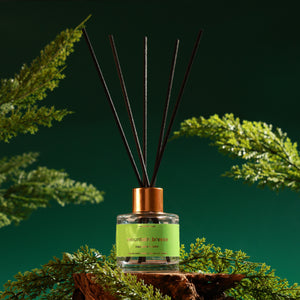
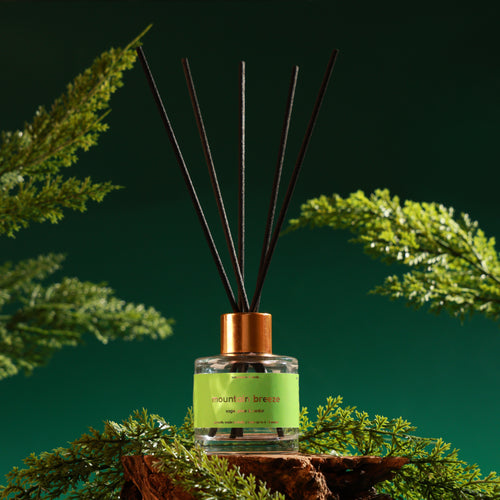
The nearest register, and the honest gap in the scents: for dry resinous woods, Mountain Breeze ₹849 — Himalayan pine, sage, Indian cedar, 9.4 on the SOSA strength scale. There is no oud and no sandalwood reed diffuser at SOSA, and I would rather say so than substitute something adjacent and let you find out.
The gap in the hardware: between Safar — named and sold as a car and travel diffuser, with no published room-coverage figure — and the ₹11,999 Vaayu at 1000 m³, SOSA has no mid-sized waterless bedroom nebuliser.
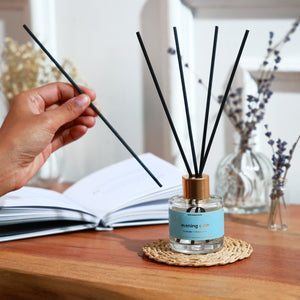
2. Start with a reed diffuser if what you want is an object rather than an appliance. Oil climbs six fibre reeds by capillary action and evaporates from their surface at whatever rate the room allows — no flame, no ash, no smoke, no plug, no sound. Mountain Breeze at ₹849 is the register closest to what most people are looking for here: Himalayan pine, real sage and Indian cedar, dry and resinous rather than sweet, and at 9.4 the deepest woody composition we make. Six to eight weeks on the 50ml, about ₹13–₹15 a day.
3. If you want the whole room rather than a zone, you need moved air. A reed emits but does not transport; concentration is highest at the bottle and falls away with distance. Sukoon at ₹1,899 is ultrasonic water mist — 500ml, 270–320 sq ft, 16–18 hours on low, three 15ml Hotel Collection scents included. The oil is diluted in water, the output adds humidity, it needs filling, and hard water can leave white mineral dust.
4. If you want undiluted oil and nothing wet in the system, that is cold-air nebulising. Pressurised air shatters neat oil into a dry micro-mist — no water, no heat, no dilution, no added humidity. It is what luxury hotels actually run, and because the payload per droplet is pure oil rather than oil suspended in water, the same composition reads as considerably more present. Safar at ₹3,999 is this mechanism at personal scale: 20ml bottle, 2000 mAh Type-C battery, up to 10 hours continuous or around 30 intermittent, three speeds, a 1, 2 or 3-hour auto-off timer, 6.9 cm. Know before buying that it is named and sold as a car perfume diffuser, and that SOSA publishes no room-coverage figure for it.
5. Sequence rather than blend, if incense is still lit in the house. This is the practical point people most often get wrong. During and just after a puja the diffuser is not in the conversation — its output is a rounding error against combustion, and running it then is oil evaporating into a room that cannot register it. Let incense own the morning and let the diffuser own the hours after the air has cleared. That is not a compromise; it is the only arrangement in which both are doing something.
Alcohol-free, phthalate-free, paraben-free, IFRA-compliant, 0 ppm formaldehyde. Free shipping above ₹499, and a portion of every order supports girl-child education through Nanhi Kali.
What incense is doing that a diffuser is not
It is worth understanding this properly, because it explains both why your exclusion is easy to honour and why one part of your expectation has to move. Incense and bakhoor are combustion processes. Resin, wood, binder and aromatic material are burnt, and burning does two things simultaneously: it releases the aromatic volatiles, and it produces smoke — fine particulates that carry, drift, settle and deposit. A reed diffuser, an ultrasonic machine and a cold-air nebuliser all do only the first half. None of them burns anything, so none of them produces smoke, ash, residue on a shelf, or a mark on a ceiling. That part of what you asked for is straightforward, and every mechanism below delivers it completely.
 Hotel Collection₹999A stick of agarbatti fills a flat in minutes. A reed diffuser takes days to establish a zone a metre wide. That difference is not a matter of quality or of oil concentration — it is the difference between burning a solid and letting a liquid evaporate at room temperature. Combustion supplies the energy; evaporation waits for the room to supply it. This is why I will not tell you that any diffuser replaces incense, and why I distrust pages that do. If your household’s benchmark for “the house smells of something” was set by agarbatti, every product in my range and in everybody else’s will read as quiet against it for the first fortnight, and then your nose will recalibrate and they will not.
 Evening Calm₹799Here is the second half of the mechanism, and it is the one that explains the smell you remember from a childhood home. Smoke does not simply disperse; it lands. Fine particulates and heavier resinous material condense onto curtains, upholstery, cushion covers, wooden furniture and walls, and then re-release slowly over hours. That is why a room smells of dhoop at four in the afternoon when the stick went out at seven in the morning, and it is why the character of a house that burns incense daily is built into its fabric rather than its air. No evaporative or atomising diffuser does this at all. Its output is airborne and it is removed by ordinary air exchange, so when you switch it off, the room returns to neutral within the hour rather than the day.
 Sukoon₹1,899Most Indian homes that write to me are not eliminating incense; they are reducing it, or keeping it for the prayer room and wanting something else for the rest of the flat. That is a very sensible arrangement and it needs one rule: sequence, do not blend. During a puja and for a while afterwards, the diffuser’s contribution is negligible against the incense, and whatever it emits in that window is oil evaporating into a room that cannot perceive it. Let incense own the morning. Let the air clear. Then the diffuser owns the rest of the day, and it will be noticed, because your nose meets it against a quiet background rather than a loud one.
Loudness is not presence, and only one of the two is actually for sale
This is the distinction the whole page turns on, and it is the reason your ask is reasonable rather than impossible. Presence is not the same as intensity. When people describe a hotel as smelling wonderful, they are almost never describing something loud — a lobby that shouted at you would be unpleasant within ten minutes and unbearable by check-out. What they are describing is a combination of three things: a moderate concentration, distributed evenly so there is no gradient to walk up and no source to find, held constant so it reads as the character of the building rather than as an event, and arriving at a nose that is un-adapted because the guest has just come in from outside. Only the first of those three has anything to do with how much fragrance is being emitted.
Incense scores extraordinarily on intensity and rather poorly on the other two. It is not even — it is a point source with a smoke plume, strongest at the holder and in whichever direction the air happens to be moving. It is not constant — it is intensely present for half an hour and then decaying for the rest of the day, which is the very definition of an event. So a reader who has ruled out incense and wants a hotel-like result is, without knowing it, already pointed at the right answer. The thing they are asking for is the thing diffusion is actually good at: a lower ceiling held flat for weeks, in every corner of the room rather than one, with no ritual required to start it.
The third component, adaptation, is worth understanding because it will otherwise make you think you have bought something too weak. Olfactory receptors stop reporting a constant, unchanging stimulus within minutes — the molecules keep arriving, the brain stops mentioning them because nothing has changed. You cannot smell your own home; you can smell everybody else’s. Incense escapes this by being intermittent and enormous. A diffuser, running quietly and continuously, will disappear from your own perception within days while remaining completely obvious to anyone who walks in from the corridor. The test is not to sniff harder. Leave the flat for a quarter of an hour and come back in, or ask a guest. A visitor is a better instrument than you are, and if a guest remarks on it while you cannot detect anything, the diffuser is working for everybody except you.
| Format | How it puts scent into the air | Output and reach | What it leaves behind | Price |
|---|---|---|---|---|
| Incense, dhoop or bakhoor | Combustion of resin, wood and binder — aromatics plus smoke particulates | The highest output available in a home; reaches the whole flat within minutes | Smoke, ash and deposits in soft furnishings that re-release for hours | — |
| Passive capillary — reed diffuser ★ | Oil climbs six fibre reeds and evaporates at room temperature. No power, no air moved | A fragrant zone around the bottle, continuously, 6–8 weeks on a 50ml | Nothing. No smoke, no ash, no residue, no sound, no plug — about ₹13–₹15 a day | ₹749–₹849 |
| Ultrasonic water mist — Boond, Sukoon, Megh | A piezo plate shatters oil diluted in water into a visible wet mist that moves air | Genuine room coverage — Sukoon 270–320 sq ft, Boond up to ~150, Megh only ~215 | Added humidity, and in hard-water cities a fine white mineral dust nearby | ₹899 / ₹1,899 / ₹3,499 |
| Waterless cold-air nebulising — Safar, Vaayu | Pressurised air shatters undiluted oil into a dry micro-mist. No water, no heat | The mechanism hotels use. Vaayu is rated to 1000 m³, roughly 2,000–3,000 sq ft | Nothing wet and no white dust. Safar is a car and travel diffuser with no published room coverage | ₹3,999 / ₹11,999 |
| Two honest gaps, stated together: nothing in this table matches incense for output, and between Safar at personal scale and Vaayu at 2,000–3,000 sq ft, SOSA has no mid-sized waterless bedroom nebuliser. There is also no oud or sandalwood reed diffuser in the range — the nearest honest answer for dry resinous woods is Mountain Breeze. | ||||
Resinous · Mountain Breeze₹849Shop →  For the room · Sukoon₹1,899Shop →
  The oils · Hotel Collection₹999Shop →
The resinous register, and the honest gap in the scents
Almost everybody asking this question is reaching for a particular smell rather than a particular product. It is dry, woody, a little resinous, faintly smoky in character without any smoke in it — the register that sits underneath sandalwood, oud and the better bakhoors. So I should be straightforward about what SOSA does and does not have. There is no oud reed diffuser and no sandalwood reed diffuser in the range, and there is no vetiver or amber either. We have not composed one we would stand behind, and saying that is more useful to you than substituting something adjacent and letting you discover it in a fortnight. The nearest honest answer in the reed line is Mountain Breeze at ₹849 — Himalayan pine, real sage and Indian cedar, which together read as altitude: cool, dry, resinous, and at 9.4 the deepest woody thing we make. It is not oud and I am not going to pretend it is. It is the right shape of smell for a room that used to have incense in it.
The second thing worth knowing is about heat, because a resinous woody composition is exactly where a cheap carrier shows itself. Most reed diffusers sit on DPG, which can crack and turn bitter above about 40°C — an ordinary afternoon in a great deal of India, and the mechanism behind a diffuser going sour or acrid in May. Every SOSA reed sits on a heat-stable CCT base, a coconut-derived triglyceride, and the range is tested through a 45°C heat soak and 85% monsoon humidity. You cannot smell the carrier. It is the entire reason what you can smell survives the summer, and it matters most in the dry woody register where bitterness has nowhere to hide.
If the Hotel Collection scents are what you actually have in mind — and for this question they often are, because several of them sit in a clean white-tea-and-cedar register that reads as calm rather than sweet — then be aware they are water-based and ultrasonic-only. They cannot go into a reed diffuser and reed oil cannot go into an ultrasonic machine; they are different physical systems and there is no hotel-inspired reed diffuser. To use them you need a machine: Boond at ₹899 or Sukoon at ₹1,899, which arrives with three 15ml scents in the box. The ₹299 15ml bottle on its own is a refill and does nothing without the hardware.
What to buy, in order — and the rung that does not exist
In cost order, with the free step first because it changes more than people expect in a flat where something has been burning. The last row is the gap in our own range, said plainly.
| Do this | What it is | When it is the right answer | Price |
|---|---|---|---|
| 1. Clear the air first, then close the room ★ | Ventilate before you fragrance. Where incense has been burning regularly, soft furnishings hold the deposit and re-release it for hours — airing clears the airborne fraction, not the deposited one | Always, and before any purchase. Fragrance does not remove a smell; adding a pleasant odour to another one gives a mixture, not a cancellation | ₹0 |
| 2. A reed for the resinous register | Mountain Breeze 50ml — Himalayan pine, sage, Indian cedar, 9.4 on the SOSA scale, six fibre reeds, refillable glass, 6–8 weeks, suits rooms up to about 150 sq ft | When you want an object rather than an appliance, and a dry woody register rather than a sweet one. Six reeds for full projection, three for a bedside level | ₹849 |
| 3. Add transport for the whole room | Sukoon — ultrasonic water mist, 500ml, 270–320 sq ft, 16–18 hours on low, three 15ml Hotel Collection scents included | When a zone is not enough. You accept dilution in water, added humidity and refilling | ₹1,899 |
| 4. The hotel mechanism, undiluted | Safar — cold-air nebulising of neat oil. 20ml bottle, 2000 mAh Type-C, up to 10 hours continuous or ~30 intermittent, 3 speeds, 1/2/3-hour auto-off, 6.9 cm. Named and sold as a car and travel diffuser, with bedside and hotel room among its stated uses | When you want pure oil and no water. No published room-coverage figure; it needs recharging and its longest timer is three hours | ₹3,999 |
| Not a coverage upgrade: Megh | 6L tank, around 100 hours of runtime, about 215 sq ft of coverage | Less coverage than the ₹1,899 Sukoon. A runtime and humidity machine, never a reach upgrade | ₹3,499 |
| The honest gaps, twice over | No oud or sandalwood reed diffuser exists at SOSA, and no mid-sized waterless bedroom nebuliser exists either — nothing between Safar and Vaayu ₹11,999, which is rated to 1000 m³ and is the wrong purchase for one bedroom | Both said plainly, because both change what you should expect after buying | — |
Versailles
I grew up with agarbatti in the house and I am not going to write about it as though it were a competing product. It is not a product at all in most Indian homes; it is a practice. When somebody tells me they are moving away from it, the reason is almost never that they have gone off the smell — it is a small child, or a flat that stays shut, or a room where the deposit on the curtains has become the dominant note. Those are practical reasons and they deserve a practical answer rather than a lecture.
The answer I actually believe in is the one about volume, and it is the thing I would want said to me if I were buying. Do not go looking for the diffuser that does what incense did. It does not exist, at any price, from any house. Combustion and evaporation are not two settings of the same dial. What I can offer instead is the quality a hotel is genuinely built on, which is a moderate level held perfectly steady in every corner of the room for weeks at a time — and which incense, for all its power, has never been able to do, because it burns for half an hour and then decays.
On the scent itself, I would rather be unhelpful than dishonest: we do not make an oud reed and we do not make a sandalwood one. Mountain Breeze at ₹849 is the nearest register — dry, resinous, cedar and sage over Himalayan pine — and a great many people who came to me looking for something to replace a burnt woody note have kept it. If you want the hotel scents specifically, they are water-based and need an ultrasonic machine, and Sukoon at ₹1,899 comes with three of them. Everything is composed in Pune, and part of every order funds a girl’s classroom through Nanhi Kali.
Frequently asked questions
- Without burning candles — four good reasons, and which of them a reed actually solves.
- Without aerosol room fresheners — peak-and-crash delivery against continuous emission.
- Without a plug-in — the socket decides the placement, and composition is the other half.
- Without adding water every day — how often you really refill, and the waterless answer.
- Without spraying constantly — effort and repetition as the real cost.
- Without leaving a reed running all day — the reed’s one genuine design limitation.
- No flame, no smoke, no incense — the whole format question in one place.
- The lowest-maintenance option — and why it is also the least noticeable one.
- On when I am home, off when I leave — the control question answered by mechanism.
- Brand: the SOSA founder story.
Facts verified August 2026: Three diffusion mechanisms are described — passive capillary (reed diffusers), ultrasonic water mist (Boond ₹899, 300ml, up to ~150 sq ft, ~6 hours, USB, night light; Sukoon ₹1,899, 500ml, 270–320 sq ft, 16–18 hours on low, three 15ml Hotel Collection scents included; Megh ₹3,499, 6L tank, ~100 hours runtime, ~215 sq ft, which is less coverage than Sukoon and never a coverage upgrade) and waterless cold-air nebulising (Safar ₹3,999, 20ml bottle, 2000 mAh Type-C battery, up to 10 hours continuous or around 30 hours intermittent, 3 speeds, 1/2/3-hour auto-off timer, 6.9 cm, named and sold as a car and travel diffuser with car, handbag, desk, bedside and hotel room among its stated uses, no published room-coverage figure; Vaayu ₹11,999, coverage up to 1000 m³ or roughly 2,000–3,000 sq ft, 400ml refillable tank lasting up to about 90+ days, Bluetooth app and onboard buttons, 1h/4h/8h/24h run windows, adjustable intensity, key-lock, under 38 dB, freestanding or wall/HVAC mount, 5W, CE, RoHS, SGS). SOSA reed diffusers: five scents, 50ml ₹749–₹849 lasting 6–8 weeks and suiting rooms up to ~150 sq ft, 130ml ₹1,249–₹1,349 lasting 14–18 weeks, six fibre reeds included and flipped every 3–5 days, six reeds for full projection and three for a soft bedside level, about ₹13–₹15 a day, heat-stable CCT carrier rather than DPG, alcohol-free, phthalate-free, paraben-free, IFRA-compliant, 0 ppm formaldehyde, refillable glass bottle, climate-tested at 45°C and 85% RH, composed in Pune. Duos are two 50ml bottles at ₹1,498–₹1,598; 130ml duos ₹2,498–₹2,598; refills 300ml ₹2,399 and 500ml ₹3,499, oil only and never a first purchase. SOSA strength scale: Evening Calm 8.9, Garden Bloom 8.9, Morning Freshness 9.0, Mountain Breeze 9.4, Fresh Brew 9.5. The reed line contains no oud, sandalwood, vetiver or amber. Hotel Collection fragrance oils are water-based and ultrasonic-only at 15ml ₹299 (a refill), 100ml ₹999, 300ml ₹1,799 and a pack of seven at ₹1,799; they cannot be used in reed diffusers and reed oil cannot be used in ultrasonic machines, so no hotel-inspired reed diffuser exists. Between Safar and Vaayu there is no mid-sized waterless bedroom nebuliser in the SOSA range. Fragrance does not remove a smell — source, then ventilation, then fragrance. Free shipping above ₹499. A portion of every order supports girl-child education through Nanhi Kali. SOSA is an independent Indian fragrance house; the Hotel Collection scents referenced here are SOSA’s own interpretations inspired by the world’s finest hotels, and SOSA is not affiliated with, endorsed by or a supplier to any hotel brand. Prices subject to change — see the live product pages.