

How much? Our working guidance is that a genuinely hot position — an unshaded west-facing shelf through an Indian May — can take a 50ml from six to eight weeks down to around four, and in the worst spots closer to half its rated life. Treat that as a range, not a measurement.
The free fix: move the bottle out of direct sun and off any surface that stores heat — marble, granite, the top of a fridge, a set-top box, a shelf on an unshaded west wall.
What heat does not do to a SOSA bottle: turn the composition sour. The reed range sits on a heat-stable coconut-derived CCT base, tested through 45°C.
2. Direct sunlight is the worst form of it. Glass in an afternoon sunbeam runs far hotter than the air in the room, and the oil inside runs hotter still. Our working guidance is that an unshaded position in May can cost a 50ml something like a third to a half of its rated life — a range rather than a figure, because ceiling height, aspect and glazing all move it.
3. Stored heat is the form nobody notices. Marble and granite consoles absorb sun through the middle of the day and radiate it into the evening. So does the top of a fridge, the case of a set-top box or router, and a shelf against an unshaded west wall.
4. Fix it with distance, not with a purchase. Eighteen inches of shade, or the same room's inner wall, usually recovers most of what heat was taking. This costs nothing and — unlike reducing reed count — does not make the room any quieter.
5. Then buy duration, if your climate needs it. A 130ml at ₹1,299–₹1,349 lasts 14–18 weeks against 6–8, which is duration rather than strength; at six reeds it projects about the same. The 300ml refill at ₹2,399 works out around ₹7–8 per millilitre against ₹15–17 for a fresh 50ml.
6. What heat should not do is change the smell. Composed and handmade in small batches in Pune on a heat-stable CCT base, and a portion of every order supports girl-child education through Nanhi Kali.
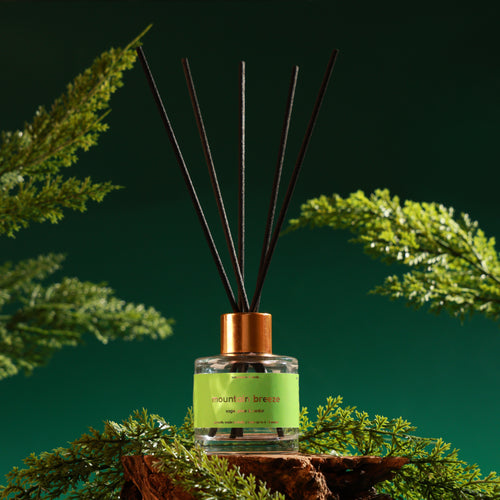
Part one — what heat actually does to a bottle of reed oil
It helps to separate the three things happening at once, because people usually imagine only the last of them. Heat lowers the viscosity of the oil, so it moves through the fibre more freely. Heat raises the vapour pressure of the aromatic materials dissolved in it, so more of them leave the exposed surface every hour. And heat warms the air immediately around the bottle, which rises and is replaced, so the fragrance-saturated layer that would otherwise sit over the reeds is carried away and the surface keeps meeting fresh, unsaturated air. Three separate accelerations stacked on top of each other, all from one variable. That is why heat outranks reed count, flip cadence and bottle geometry on any honest list of accelerants — and why the fix is worth doing before you touch anything else.
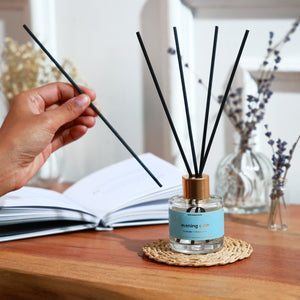
 Evening Calm₹799 · 8.9/10People check the room temperature and conclude heat is not their problem. The room temperature is nearly irrelevant; what matters is the temperature of the glass. A bottle standing in an afternoon sunbeam is being heated directly, and dark oil in clear glass absorbs that energy efficiently. So does the surface underneath it. Marble, granite and stone consoles are heat batteries — they take in sun through the middle of the day and give it back for hours after the beam has moved on, which is why a bottle can be in shade at eight in the evening and still standing on something warm. The same is true of the top of a refrigerator, the casing of a set-top box or router, a shelf directly above a lamp, and any surface on an unshaded west-facing wall in May.
Part two — where the heat actually is, in an ordinary Indian flat
This is the part I would print and stick inside a cupboard door. The positions below are ordered from most expensive to least, and the cost figures are SOSA's own working guidance drawn from in-house testing and years of customer correspondence rather than laboratory measurement — real numbers move with ceiling height, glazing, aspect and how long the room is shut up during the day.
| Where the bottle stands | How warm it gets | What happens to the oil | Rough effect on 6–8 weeks | The free fix |
|---|---|---|---|---|
| Unshaded west-facing sill or shelf, May ★ | Far above room temperature for hours | Thin, fast-climbing, lightest notes driven off first | Can cost a third to a half | Move two feet inward, out of the beam |
| Marble or granite console in a sunlit hall | Stores midday sun, radiates into the evening | Warm long after the sun has gone | Commonly a week or two | Same room, wooden surface, inner wall |
| Top of the fridge | Warm most of the day from the condenser | Steady low-grade acceleration, all year | Roughly a week, every bottle | Any shelf away from the appliance |
| Kitchen counter within reach of the hob | Hot in bursts, plus cooking vapour | Accelerated, and the room smells confused | A week or more, and a muddled scent | Move it out of the cooking zone entirely |
| On or beside a TV unit, router or set-top box | Mildly warm continuously | Small but permanent acceleration | Days rather than weeks | Six inches of clear air is enough |
| Shut-up room with west sun, all day, no AC | The whole room becomes the hot spot | Everything speeds up at once | Several weeks in peak summer | Cross-ventilate morning and evening |
| Inner-wall shelf or sideboard, out of the sun | Room temperature and nothing more | Behaves as rated | None — this is the reference position | Nothing to fix |
| Cool northern room in winter | Below the rating's assumptions | Thick oil, slow climb, quiet room | Lasts beyond the window, reads faint | Flip weekly and be patient |
| The honest caveat: every figure in the fourth column is SOSA working guidance rather than a laboratory measurement, and the ranges are wide on purpose. Two flats on the same floor of the same building can differ by a week because one has a balcony shading the window and the other does not. Use the column to rank the positions, not to predict your own bottle to the day. | ||||
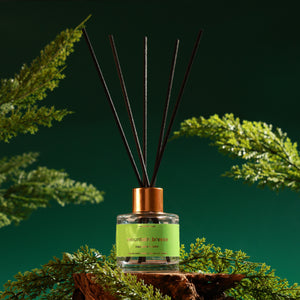
Mountain Breeze · heat-stable basefrom ₹849Shop → 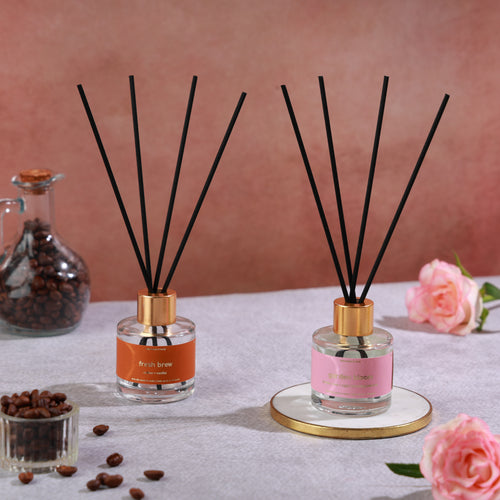 300ml refill · 8–11 months₹2,399Shop →
 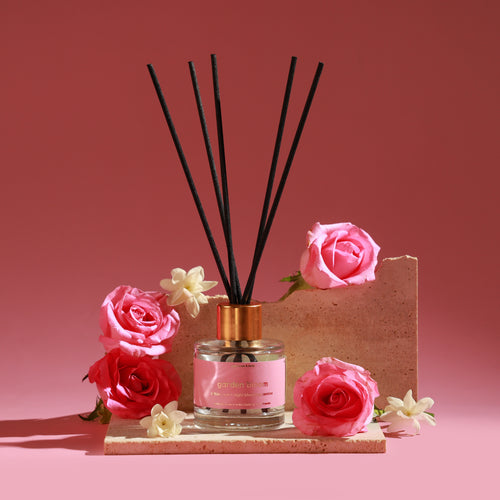 Garden Bloom · 130ml for summerfrom ₹799Shop →
Part three — why the carrier matters more in an Indian summer than anywhere else
There is a version of this article written by a brand that does not have to think about 45°C, and it stops at "keep it out of the sun". Ours cannot stop there, because the second thing heat does to a diffuser is not about speed at all — it is about whether the fragrance survives the journey. Most inexpensive reed oils are carried in a phthalate solvent, and phthalates are genuinely good at one thing: pushing fragrance hard off a reed in the first fortnight. The trade is that they degrade in heat. By week six in a Nagpur or Ahmedabad summer, a bottle that opened brilliantly reads thin, then slightly sour, then faintly chemical, and the owner concludes the fragrance has "gone off". It has, in a sense — the carrier took it there.
SOSA reed compositions sit on a coconut-derived CCT carrier, which is alcohol-free, phthalate-free, paraben-free, low-VOC and IFRA-compliant, and which was chosen for exactly this reason. It is heat-stable through the 45°C summers and 85% monsoon humidity we test against, and the cost of choosing it is stated plainly elsewhere on this blog: a smaller opening. A phthalate diffuser will beat ours in week one. What we get back is a flatter, longer plateau that still smells like the fragrance you bought in week seven, in a country where week seven can be in June. A stable carrier does not stop heat emptying a bottle early — nothing does but shade — but it does mean the weeks you get are the weeks you paid for, rather than a spike followed by a slow apology.
One more thing worth saying, because it comes up every summer in my inbox. If your bottle is finishing early and the room genuinely smells strong, nothing is wrong with the product and there is nothing to claim. You are receiving the fragrance at a faster rate; the total is unchanged. If your bottle is finishing early and the room smells of very little, that is a different story, and it is almost always a draught rather than pure heat — an AC vent, a ceiling fan on high or an open window pulling across the reeds, stripping them and sending the fragrance somewhere you are not. Heat and draught frequently travel together, which is why the window sill is the worst position in most homes. The distinction matters because the first case wants a bigger bottle and the second wants a different shelf.
Part four — the heat audit, and what to buy after you have done it
Ten minutes with the back of your hand, then a purchase only if your climate genuinely demands one. The first five rows below cost nothing; most people never need the last three.
| Heat source | How to tell it is yours | The fix | What it costs |
|---|---|---|---|
| Direct afternoon sun ★ | Stand in the room at 4pm and look for the beam | Move the bottle two feet inward, or draw a sheer curtain | Free — and no loss of presence |
| Heat-storing stone | Marble or granite that reads warm to the back of your hand at dusk | Same room, a wooden or ceramic surface, inner wall | Free — a tray under it protects the wood |
| Appliance warmth | Fridge top, TV unit, router, lamp directly below the shelf | Six inches of clear air, or a different shelf entirely | Free |
| A room shut up all day | The whole flat is warm at 6pm before the AC goes on | Cross-ventilate morning and evening; keep the bottle off outer walls | Free |
| Cooking heat | Bottle within arm's reach of the hob | Relocate; never diffuse over live cooking — extractor on, window ten minutes, then close up and wait half an hour | Free |
| Your actual climate | Everything above is already right and summer still eats bottles | 130ml for the hot months — 14–18 weeks instead of 6–8 | From ₹1,249 · duration, not strength |
| Running cost, if you run several | You are replacing bottles rather than fragrances | 300ml oil refill into your own vessel — 8–11 months | ₹2,399 · about ₹7–8 per ml against ₹15–17 |
| Not a heat fix: more reeds | You added reeds because the summer room felt thin | Reed count raises throughput too — in a hot position the two accelerants compound | Nine reeds ≈ five weeks instead of eight on a 50ml |
Versailles
The first summer I sold reed diffusers, I had a run of messages from Rajasthan and Gujarat that all said roughly the same thing in different words: lovely, but it did not last. I asked every single person where the bottle stood. Nearly all of them described a windowsill or a sunlit console, because those are the places a beautiful glass bottle looks best, and because putting fragrance near a window feels intuitively right in the way that opening a window feels right.
It is the single most expensive instinct in this category. A reed diffuser wants gentle incidental air and ordinary indoor temperatures. What a sunlit sill gives it is direct radiant heat on the glass, a hot surface underneath and moving outdoor air across the reeds — all three accelerants in one location that photographs beautifully. Two feet inward, on a wooden surface, out of the beam, and the same bottle behaves like the bottle we rated.
What I will not do is pretend our oil is immune. It is not; nothing is. What we did was choose a carrier that survives the heat with its composition intact, so that a bottle which has spent its life in a Nagpur June still smells like the fragrance in week seven rather than turning sharp and apologetic. Everything is composed and handmade in small batches in Pune, tested through 45°C, and a part of every order funds a girl's classroom through Nanhi Kali.
Frequently asked questions
- Why is my reed diffuser finishing so quickly? — all six accelerants, ranked.
- Does air conditioning shorten it? and is a window the worst spot? — the two accelerants that travel with heat.
- How to make it last longer — the conservation list, with what each item costs you.
- The complete longevity troubleshooting guide — this page and the eight around it, in one place.
- Brand: the SOSA founder story.
SOSA reed diffuser range & prices (verified August 2026): alcohol-free, phthalate-free, paraben-free and IFRA-compliant compositions on a heat-stable coconut-derived (CCT) carrier, low-VOC, supplied in a refillable glass bottle with six fibre reeds; 50ml lasts 6–8 weeks and 130ml lasts 14–18 weeks. Morning Freshness (Malabar lemon · peppermint · Nilgiri eucalyptus) 50ml ₹749 · 130ml ₹1,249 · 9.0/10; Garden Bloom (British rose · night-blooming jasmine) 50ml ₹799 · 130ml ₹1,299 · 8.9/10; Evening Calm (Kashmir lavender · chamomile) 50ml ₹799 · 130ml ₹1,299 · 8.9/10; Fresh Brew (Coorg coffee · Kerala vanilla) 50ml ₹849 · 130ml ₹1,349 · 9.5/10; Mountain Breeze (Himalayan pine · sage · Indian cedar) 50ml ₹849 · 130ml ₹1,349 · 9.4/10. Reed diffuser refills are oil only — you reuse your own vessel and reeds: 300ml ₹2,399 (roughly 8–11 months) · 500ml ₹3,499 (roughly 14–18 months), about ₹7–8 per ml against ₹15–17 per ml for a 50ml bottle. Duo sets ₹1,498–₹1,598 for 2 × 50ml and ₹2,498–₹2,598 for 2 × 130ml. Strength figures are positions on SOSA’s own internal strength scale, not an industry standard. Replacement reeds are not sold as a separate SKU; SOSA guidance is to refresh reeds every few months. The reed line is separate from the water-based Hotel Collection for ultrasonic machines (15ml ₹299 · 100ml ₹999 · 300ml ₹1,799) and the two are not interchangeable. Diffusers: Boond 300ml ₹899 · Sukoon 500ml ₹1,899 · Megh 6L ₹3,499 · waterless Vaayu ₹11,999. Composed and handmade in small batches in Pune, India; tested through 45°C summer heat and 85% monsoon humidity. Free shipping above ₹499. A portion of every order supports girl-child education through Nanhi Kali. Prices subject to change — see the live product pages.