


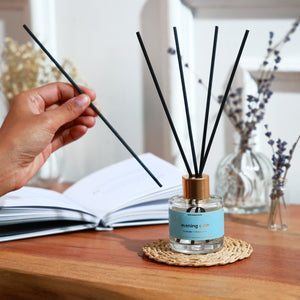
Stay low in value. A jar candle at ₹379 or an Everyday Beautiful Mug at ₹474 is the right register for a subject teacher. A 50ml reed diffuser at ₹749 sits at the top of what I would give a school teacher and is better suited to a private tuition teacher you pay directly.
Give the same thing to every teacher. Uniformity is the mechanism that removes the implication. Six subject teachers at ₹379 each is 6 × ₹379 = ₹2,274, and none of them has to wonder why the class teacher got something different.
Do not personalise it. No engraving, no name of the subject, no note mentioning your child's marks or the class they are in. The gift should be identifiable as coming from a parent, not from which parent.
2. Keep the value low on purpose. The ceiling on this gift is not about what you can afford. It is about what the object says when it is opened in a staff room next to eleven others. Around ₹379 to ₹474 is a register nobody has to think about. From SOSA that is a jar candle at ₹379, the Sandalwood jar at ₹449 or an Everyday Beautiful Mug at ₹474.
3. Buy one thing and buy it as many times as you have teachers. 6 × ₹379 = ₹2,274 for six subject teachers. 9 × ₹379 = ₹3,411 for a full secondary timetable. Identical gifts are the mechanism that keeps this clean: nobody is singled out, nobody is compared, and you spend no time ranking the people who teach your child.
4. Do not personalise it. No engraved name, no printed message, no card that mentions your child's performance, position in class or the marks they were given. Personalisation is what converts a thank-you into a reminder of who sent it, and that is precisely the reading you want to avoid.
5. Hand it over in the open, and let the child give it. A gift passed to a teacher in a corridor, privately, by a parent, has a different character from one handed over by a child in a classroom in front of everyone. The second is a thank-you. The first can look like something else even when it is not.
6. Treat a private tuition teacher as a different question. Someone you pay directly, who comes to your home three evenings a week, is not in the same position as a school teacher with a school policy behind them. There the ceiling is higher and a 50ml reed diffuser at ₹799 is a reasonable thing to give.
7. Timing matters more than you think. If your child is inside an assessment cycle, anything that arrives from a parent is read against that background. This is one of the few gifts where waiting is genuinely better than giving.
Everything is composed and handmade in small batches in Pune, and a portion of every order supports girl-child education through Nanhi Kali.

Part one — the three constraints on a teacher gift
Most Diwali gifting decisions are made against a budget. This one is made against a ceiling, which is a different kind of number: a budget is what you are willing to spend, a ceiling is what the relationship will carry without changing shape. A teacher holds a position of assessment over your child, and that fact does not switch off in the gifting weeks. Three constraints follow from it, and if you satisfy all three the rest of the decision is trivial. If you break any one of them, no amount of taste in the object will repair it.
 Misty Mornings₹379 · jar candleThere is no legal figure here and I am not inventing one. What there is, is a practical band that everybody in a staff room recognises. At ₹379 to ₹474 an object is a courtesy: it is opened, it is thanked for, it is taken home, and nobody thinks about it again. As the number climbs, the object starts to carry a question with it — why this much, and what is expected — and the teacher has to hold that question whether or not you meant to ask it. The unfairness is that the burden falls on the recipient, not on the giver. That is the whole reason to stay low. A ₹379 jar candle, a ₹449 Sandalwood jar or a ₹474 mug all sit comfortably inside it. Our reed diffusers begin at ₹749 and I would put that at the very top of the range for a school teacher, not in the middle of it.
Part two — the school list, role by role
A child in primary school has one or two adults you would think of. A child in secondary school has eight or nine, plus the people whose names nobody learns. The list below is how I would treat each role, and the column that matters most is not what to give but what it gets read as — because that is the variable this whole page turns on. No price appears here for anything outside our own range; the argument is not about what other categories cost.
| Role | What a gift from a parent gets read as | Where the ceiling sits | What I would actually give |
|---|---|---|---|
| Subject teachers, all of them ★ | A courtesy, if identical. A comparison, if not | Low, and the same for every one | One ₹379 jar candle each — 6 × ₹379 = ₹2,274 |
| The class teacher | Warmer, and the most likely to be over-given to | The same as the others, deliberately | The identical candle. Put the extra into the card, not the object |
| Pre-primary teacher and the class helper | Thanks for daily physical care, which is real work | Low, and the helper should not be skipped | An Everyday Beautiful Mug ₹474 for both, the same one |
| Sports, music, art — the teachers nobody remembers | Notice, mostly. They are used to being left off | Identical to the subject teachers | The same candle. Being on the list is the point |
| The head or principal | The role where influence is read fastest | Lowest of all, or nothing | Nothing individual. A note through the office if you want to say something |
| A private tuition teacher you pay directly | An ordinary thank-you between two adults | Higher — no school policy sits behind it | Evening Calm 50ml ₹799 or Morning Freshness ₹749 |
| The school van driver and the attendant | Thanks for something you rely on every single morning | Cash is the convention and it is the right one | Cash. An object only afterwards, and only if you want to |
| The honest caveat: every row above is void if your school has asked parents not to give gifts, and a good number have. That instruction is not a formality to be worked around with something small enough to slip through. It usually exists because teachers were being placed in an impossible position by parents who meant no harm at all. Where it applies, the entire correct answer is a card your child writes, and I would rather lose the sale than tell you otherwise. | |||
 Misty Mornings · buy one per teacher₹379Shop →
  Everyday Mug · assumes nothing₹474Shop →
  Sandalwood jar · the top of the band₹449Shop →
Part three — when the answer is to give nothing
I want to spend a section arguing against the purchase, because on this page the no-gift outcome is common and it is not a failure. The first case is a school that has asked parents not to give. Where that instruction exists, the object is not the problem — the position it puts the teacher in is. She has to either accept something the school has told her not to, or decline a parent to their face at a doorway with other parents behind them. Neither is a small thing to ask of someone. A card in your child's handwriting carries the entire message with none of the cost, and if you want the school to know that a particular teacher has been good to your child, say it in writing to the office where it does the teacher some actual good.
The second case is timing. If your child is inside an assessment window — practicals, projects being marked, anything where a judgement about them is being formed right now — a gift arriving from a parent is read against that background whether or not either of you wants it to be. This is not a suggestion that any teacher would be influenced. It is a point about what the teacher has to spend energy demonstrating they were not. The gift that creates work for the person receiving it has failed, however nice the object is. Waiting until the term settles costs you nothing at all, and Diwali gifting has enough elasticity in it that nobody counts the days.
The third case is the one nobody says out loud: you are the only parent giving, and you know it. In a small class, in a school where this is not the convention, a single gift arriving from a single family is conspicuous in exactly the way you were trying to avoid. Ask another parent what is usual before you commit. If the answer is that most people do something small, do the same small thing and buy nine of them — 9 × ₹379 = ₹3,411 and you never think about it again. If the answer is that nobody does anything, believe them. The convention exists for a reason and being the exception to it is not a kindness to the teacher, who now has one gift on her desk and a staff room that noticed.
Part four — what I would send, by situation
Six situations that all start with the same search. The prices are ours and the arithmetic is shown; the reasoning is about position, not about product.
| Your situation | What I would do | The arithmetic | Why it stays under the ceiling |
|---|---|---|---|
| Six to nine subject teachers, no school rule against it ★ | One Bookshop jar candle each, identical | 6 × ₹379 = ₹2,274 · 9 × ₹379 = ₹3,411 | Low value, no personalisation, nobody compared to anybody |
| Pre-primary, one teacher and one helper | Two Everyday Beautiful Mugs, the same one | 2 × ₹474 = ₹948 | A mug assumes nothing about the home it goes to |
| You want to mark the class teacher specifically | Same object as everyone else. Put the difference in the card | No extra spend at all | The card is invisible to the staff room; the object is not |
| A tuition teacher you pay yourself, three evenings a week | Evening Calm 50ml — softest in the range, hardest to object to | ₹799, and it clears the ₹499 free-shipping line | No school policy behind it, so the ordinary adult ceiling applies |
| The school has asked parents not to give gifts | A card written by your child. Nothing else | Nothing at all | The only answer that does not cost the teacher something |
| You are also giving the van driver and the attendant | Cash first, separately. A ₹379 candle afterwards if you want an object too | ₹379 each, on top of the cash | Cash is the convention here and the object never substitutes for it |
Versailles
I have been on both sides of this. My own school years produced a staff room where the Diwali table was a small archaeology of what different families could afford, and I remember quite clearly that the teachers found it awkward rather than pleasant. Not because anyone was ungrateful. Because a pile of unequal objects, each with a child's name attached, is a difficult thing to sit next to for a week.
That is why every recommendation on this page pushes towards the same object, at a low price, with nothing written on it. It is the arrangement that produces the least discomfort at the receiving end, and the receiving end is the only end that matters here. It also happens to be the cheapest and the fastest way to do it, which I mention because it is true and not because I am pleased about it — a page that tells you to buy nine ₹379 candles is not a page that sells much.
What I will not tell you is that any gift will make a teacher think better of your child, or that it should. I have no way of knowing how a gift is received and neither does anyone writing this kind of page. I can tell you what a candle is, how long it burns, what a diffuser needs from a home, and where our prices sit. Everything is made in Pune in small batches, and a part of every order funds a girl's classroom through Nanhi Kali.
Frequently asked questions
- Cash or a gift? — the honest answer for anyone who works for you, and why the order matters.
- The people who deliver to your home all year — small, immediate, and no obligation created.
- Gifts that aren't sweets nobody eats and whether a reed diffuser suits household staff.
- The guide to the people you owe a gift — the whole obligation list, tier by tier.
- Brand: the SOSA founder story.
SOSA range & prices used in this guide (verified from the live store, 27 August 2026): Reed diffusers — alcohol-free, phthalate-free, paraben-free, IFRA-compliant compositions on a heat-stable coconut-derived (CCT) carrier, in a refillable glass bottle with six fibre reeds; 50ml lasts 6–8 weeks, 130ml lasts 14–18 weeks. Morning Freshness 50ml ₹749 · 130ml ₹1,249; Garden Bloom ₹799 · ₹1,299; Evening Calm ₹799 · ₹1,299; Fresh Brew ₹849 · ₹1,349; Mountain Breeze ₹849 · ₹1,349. Duo sets: Day & Night ₹1,498, Fresh & Grounded ₹1,548, Warmth & Bloom ₹1,598 (2 × 50ml); ₹2,498–₹2,598 (2 × 130ml). Oil-only refills 300ml ₹2,399 · 500ml ₹3,499 (vessel and reeds not included). The least expensive SOSA reed diffuser is ₹749 — no reed diffuser exists below that price in any size. Below it: scented jar candles from ₹379 (roughly 15–18 hours), Sandalwood or Smoked Oudh jar candle ₹449, wax melts ₹474 (a burner is needed and is not included), ceramic mugs ₹474, ribbed and face mugs and taper candles ₹569, Amber Rose candle ₹599, ceramic trinket dish ₹664, candle two-pack ₹664 (roughly 30–36 hours). Machines: Boond 300ml ₹899 · Sukoon 500ml ₹1,899 · Megh 6L ₹3,499 (~215 sq ft, a runtime and humidity machine rather than a coverage upgrade) · waterless Vaayu ₹11,999 · Safar car and travel diffuser ₹3,999. The water-based Hotel Collection (15ml ₹299 · 100ml ₹999 · 300ml ₹1,799) is a fragrance for an ultrasonic machine, not a standalone gift. SOSA publishes no bulk or corporate gifting terms — there is no discount slab, no minimum order quantity, no stated GST-invoicing arrangement, no custom branding service and no published lead time — and SOSA sells no gift card, gift hamper, gift box or curated gift set. Larger orders should be discussed with SOSA directly through the contact page before committing. Gift wrapping, gift notes, direct-to-recipient shipping and delivery timing are unconfirmed — check at checkout rather than assuming them; no delivery date is promised anywhere in this guide. Per-head and total costs shown are arithmetic on the listed prices, not quotations. Fragrance adds scent to a room; it does not clean air, remove cooking or smoke smells, or change how anyone feels. Fragrance oil is flammable — keep any diffuser away from diyas, candles and open flame. Composed and handmade in small batches in Pune, India; tested through 45°C summer heat and 85% monsoon humidity. Free shipping above ₹499. A portion of every order supports girl-child education through Nanhi Kali. Prices subject to change — see the live product pages.