




Why it holds so long: upholstery is three-dimensional. The fabric is the entry; the foam is the store, and foam has enormous internal surface area.
Why it announces itself: sitting down compresses the foam and pushes stored air out. Your guest gets the concentrated version at the exact moment they sit.
2. Because a sofa is deep, not flat. Curtains and cushion covers are two-dimensional; you can wash them and the problem leaves with the water. Upholstery is a three-dimensional open-cell structure — the visible fabric is only the doorway, and the foam behind it has an enormous internal surface area with air moving freely through it. That gives odour molecules somewhere to go that a cloth cannot reach and a washing machine cannot take.
3. Because sitting on it pumps that store back out. Compressing a foam cushion forces the air inside it out through the fabric, carrying whatever that air holds. This is why the smell of a sofa is not constant: it is mild while nobody is on it and noticeably stronger the moment someone sits down. It is also why guests notice it and you do not — they get the concentrated pulse, and you have already adapted to the room.
4. Because it is the one textile nobody ever cleans. Bedding is washed weekly. Cushion covers go in the machine. Curtains come down seasonally. A sofa gets a wipe of a stain and nothing else, often for years. In an open-plan flat where two meals a day are cooked in oil a few metres away, that is a very long accumulation with no reset point at all.
5. And fragrance is the last step, not the fix. A scent laid over a loaded sofa does not neutralise anything; the sofa still pulses its own smell whenever anyone sits. Vacuum it, wash what comes off, dry it completely, then let a reed diffuser or a Sukoon set what the room smells of.
Made in India, composed by an ISIPCA Versailles-trained perfumer — and a portion of every order supports girl-child education through Nanhi Kali.
Why upholstery beats every other fabric in the room
Sorption is the process here: odour molecules adhering to and diffusing into a porous material, then leaving it slowly over days. Every textile in a home does this. What makes a sofa the dominant one is a combination of three things at once — orientation, depth and neglect. Orientation, because settling droplets land on horizontal surfaces and a sofa offers the largest horizontal fabric area in the room. Depth, because behind the fabric sits open-cell foam with a colossal internal surface area, so what lands does not stay at the surface where it might evaporate away, it migrates inward. Neglect, because it is the one large textile in an Indian home that has no cleaning schedule at all.
The release side is worth understanding too, because it explains a peculiar symptom. Re-release from fabric is normally slow and steady, which is why a room smells vaguely of old cooking rather than of anything specific. But a sofa also has a mechanical release: compress the cushion and you push the air out of the foam in one go. Everything stored in that air comes with it. So the sofa is not a steady emitter, it is a bellows. People do not notice their sofa; they notice the moment they sit down on it. That is also the reason humidity makes it so much worse — damp foam holds moisture, moisture raises perceived odour, and a monsoon living room amplifies everything the sofa has been collecting since the last dry spell.
The three parts of a sofa that hold your dinner
 Step fourFrom ₹749These collect the settling fraction — the droplets that rode the ceiling plume, cooled and fell. They also collect skin oils, hair and dust, which mix with the cooking film and oxidise together into the general "lived-in sofa" note. Vacuum with the upholstery brush attachment weekly, not with the bare hose; the brush agitates the pile and lifts settled deposit that suction alone leaves behind. Do the crevices and under the cushions while you are there — that is where crumbs, which have their own smell, actually live.
Symptom to cause: is it really the sofa?
Confirm before you clean. Upholstery cleaning is time-consuming and occasionally expensive, and in perhaps a third of cases the smell people attribute to the sofa is coming from something behind it.
| What you notice | Most likely cause | How to confirm it | What actually fixes it |
|---|---|---|---|
| Smell is strongest at the moment someone sits down ★ | Stored odour in the foam being pumped out by compression | Press a seat cushion hard with both hands and smell the air just above it | Brush-head vacuum weekly; wash removable covers; sun the cushions on a dry day |
| Room smells of old cooking generally, nothing specific | Accumulated oil film across all the soft furnishings, sofa first | Smell the sofa back, a cupboard-fresh cushion cover and the curtain hem in turn | Vacuum upholstery, wash covers and curtains, air everything in sunlight |
| Sofa smells worse in humid or rainy weather | Moisture raising perceived odour and slowing release from damp foam | Compare the same sofa on a dry day and a wet one | Ventilate during dry spells; never wet-clean upholstery mid-monsoon |
| Leather or rexine sofa, smell still present | Deposit on the surface film and in the seams and stitching, not in foam | Wipe one arm with a barely damp cloth and compare it with the other | Wipe down regularly with a well-wrung cloth; clean the seams; dry immediately |
| Smell returns within days of cleaning the sofa | The source is still running — cooking capture and ventilation have not changed | Track whether it returns after a heavy cooking day specifically | Fix chimney timing and cross-ventilation first, or you will clean the sofa forever |
| Earthy or musty smell, dark patching on the wall behind | Damp or mould — a health issue, not an odour problem | Pull the sofa out and inspect the wall and skirting with a torch | Find the moisture source and remove the growth. Do not fragrance this. |
| If none of these fit: lift the sofa and look underneath. Crumbs, a forgotten cloth, a pet's spot, or in ground-floor flats a damp patch of floor are all common and none of them are the upholstery itself. | |||
Reeds · always-on roomsFrom ₹749Shop →  Sukoon · when you want a switch₹1,899Shop →
  Hotel Collection · the scentFrom ₹299Shop →
Getting it out of upholstery
Start with the free version, because it does most of the work. Take the cushions off, vacuum the whole frame including the crevices, and then vacuum every cushion face with the upholstery brush attachment rather than the bare hose — the brush agitates the pile and releases settled deposit that plain suction leaves. Do this weekly if you cook Indian food daily. Then wash whatever comes off: seat covers, back covers, cushion covers, throws. If your sofa has no removable covers, a well-wrung damp cloth over the arms and headrest areas lifts the greasiest part, which is where hands and heads touch.
Then use sunlight and air, which are the only tools that reach foam. On a dry, bright day, stand the cushions on edge outside or on a balcony for a few hours and turn them once. UV and heat drive absorbed volatiles out far faster than airing in shade. Dry bicarbonate of soda sprinkled on, left for an hour and thoroughly vacuumed off is a reasonable extra step for the surface layer. If you go as far as a wet or steam clean, do it at the start of a dry spell and give the sofa a full day with a fan on it afterwards. Foam that is left damp will smell musty within days, and musty is harder to remove than cooking.
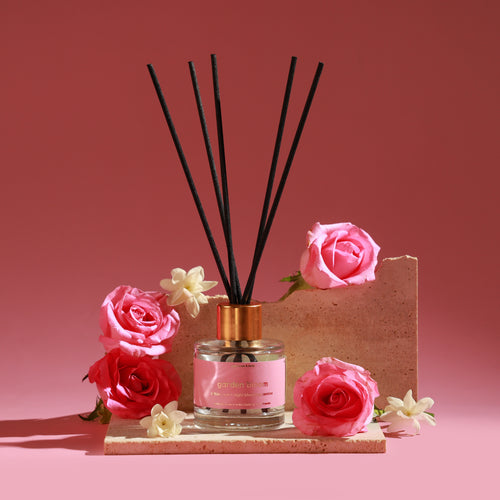
Then stop reloading it, and only then add fragrance. Nothing above lasts if the source keeps running: chimney on before the pan heats and off ten minutes after, lids on, high-odour dishes on a back burner, and cross-ventilation during and immediately after cooking while the odour is still airborne rather than settled. Once the sofa is clean, dry and no longer being topped up daily, fragrance has a job worth doing — giving the living room a consistent character between meals. A reed diffuser from ₹749 does that permanently with no electricity; Mountain Breeze in Himalayan pine, sage and cedar reads dry and clean in a room that has been fighting a cooking smell. If you prefer control, the Sukoon at ₹1,899 with a Hotel Collection scent from ₹299 covers roughly 270–320 sq ft and runs only when you switch it on.
The order that works
The vacuum and the sunlight are free and do most of it. The purchase comes last and its job is to define the room, not to clean it.
| Step | What to do | When | Cost |
|---|---|---|---|
| 1. Remove the source | Chimney on early and off late, lids on, back burner — stop reloading the sofa every evening | Before anything else | ₹0 |
| 2. Move the air | Cross-ventilate during and right after cooking so droplets leave before they settle on upholstery | Daily, five to ten minutes | ₹0 |
| 3. Deal with what holds it | Brush-head vacuum weekly, wash all removable covers, sun the cushions on a dry day, dry completely | Weekly to monthly | ₹0 |
| 4. Then the always-on layer ★ | A SOSA reed diffuser — a permanent, low background for a living room that resets slowly | 50ml 6-8 weeks · 130ml 14-18 | from ₹749 |
| 5. Or the on-demand layer | Sukoon with a Hotel Collection scent — scent for an hour before people arrive, then silence; covers roughly 270–320 sq ft | Run it when you want it | ₹1,899 |
Versailles
If someone tells me their living room smells of cooking and they have already cleaned everything, my first question is when they last vacuumed the sofa properly — not the floor around it, the sofa itself, with the brush attachment, cushions off. The answer is very often "never". It is the largest fabric object in the room and the only one with no cleaning schedule, and it is sitting exactly where the falling droplets land.
The bellows point is the one I would most like people to take away, because it explains the social version of this problem. You do not smell your own sofa — you have adapted to the room and you are not compressing it suddenly. Your guest arrives with a fresh nose and sits down, which pushes a concentrated pulse of stored air out through the fabric at exactly the wrong moment. That is the smell they remember.
I would rather sell someone a reed diffuser for a clean living room than for a loaded one. On a loaded sofa the fragrance does not win; you simply get both smells, and the sofa keeps announcing itself every time somebody sits down. Vacuum, wash, dry, and then let the room have a character of its own. A portion of every order funds a girl's classroom through Nanhi Kali.
Frequently asked questions
- Why an open-kitchen 2BHK holds it for hours — where the plume travels and why.
- Can cushions and rugs hold cooking smell? — sorption across small textiles.
- Living room smells closed after mopping? — the sofa as prime suspect.
- Resetting the living room after a big cook — the timed recovery routine.
- Brand: the SOSA founder story.
SOSA products & prices (verified August 2026): Hotel Collection water-based ultrasonic diffuser fragrance 15ml ₹299 · 100ml ₹999 · 300ml ₹1,799 · Pack of 7 (15ml, all fragrances) ₹1,799; refills 100ml from ₹999. Seven scents: The Ritz-Carlton-inspired (white tea · bergamot · cedar), Westin-inspired (white tea · aloe · cedar), 1 Hotels-inspired (cedarwood · vetiver · green leaves), The St. Regis-inspired (amber · violet · woods), Shangri-La-inspired (jasmine · green tea · white tea), Four Seasons-inspired (citrus · floral · sandalwood), W Hotels-inspired (citrus · pepper · amber). Diffusers: Boond 300ml ₹899 · Sukoon 500ml ₹1,899 · Megh 6L ₹3,499. Water-based, phthalate-free, composed to IFRA standards for home diffusion; 3–6 drops per tank. Made in India, Pune. The Hotel Collection scents are SOSA's own interpretations inspired by the world's finest hotels; all hotel names are trademarks of their respective owners and are used only to describe the scent style — SOSA is an independent Indian fragrance house, not affiliated with or endorsed by any hotel brand. Prices and availability subject to change — see the live product pages.