Founder Diaries · Clinic Air Quality · Recirculated Air
By Sonal Sahani · ISIPCA Versailles 9 min read Updated August 2026
The sentence that answers this question is short and slightly uncomfortable. Your air conditioning cools the air, it usually filters particles out of it, and in a great many Indian clinic installations it brings in no outside air at all — so the same air is going round and round while the building keeps adding to it, and by mid-afternoon the room reads as closed because it genuinely is. That is not a fragrance deficit. It is an air-exchange question, and it is the one situation in this whole cluster where adding a scent most reliably makes things worse: in a volume that is stirred rather than replaced, fragrance does not disperse in the way people imagine — it distributes, thins a little, and then holds, on top of everything else that is already holding. So this page argues for spending nothing until you know one fact about your own building, and the fact is free to obtain. A diffuser adds a scent alongside what is already in the air. It removes nothing, cleans nothing and freshens nothing. In an under-ventilated clinic that is not a limitation to work around; it is a reason to stop.
Quick answers — read this first
Recirculated air is not fresh air. A split or ducted system in cooling mode is a heat exchanger with a particle filter, not a ventilator. Unless there is a deliberate fresh-air path, nothing new enters the building all day.
The one question to ask first, before spending anything: does our air handling bring in any outside air, and if so how much and when. Put it to whoever maintains the system. Very often the answer is none, and that answer explains everything.
More fragrance in an under-ventilated room makes it heavier, not fresher. This is the mechanism practices most often get backwards — the room feels closed, the dose goes up, and four weeks later it is worse.
The free fix is a scheduled purge. Fifteen minutes of open doors at mid-morning and mid-afternoon, or the system on fan with the fresh-air path open if you have one, changes an afternoon more than any product will.
The short answer
Short answer: it smells closed because the air is being recirculated rather than renewed, and everything the building and its occupants release accumulates through the day in a fixed volume. Establish whether you have a fresh-air path, get the filters and condensate drain looked at, and put two fifteen-minute purges into the working day. All of that comes before any fragrance decision, and for many practices it removes the need for one.
Why fragrance is the wrong lever here: in a sealed recirculating building a continuous emitter behaves like every other source — its output accumulates rather than clearing between hours. That is why the room gets heavier through the afternoon and why turning it up compounds the problem instead of correcting it.
Where to shop, if anywhere: nowhere until the ventilation question is answered. If it is answered well and you still want the arrival zone to have a character, a
Sukoon at ₹1,899 on a short timed window is the format that suits a sealed building, because it can be told to stop. Free shipping above ₹499.
Why does my fully air-conditioned eye clinic sometimes smell closed?
Straight answer
1. Because cooling and ventilating are different jobs, and most installations do only the first. A split or ducted system draws room air over a cold coil, drops its temperature, filters some particles out of it and blows it back. Unless somebody specified a fresh-air path, no outside air enters at any point in that loop. The room is cold, clean-ish and entirely recycled.
2. "Sometimes" is the clue, and it almost always means afternoons. Accumulation is cumulative, so the closed quality builds through the day and peaks late. If your complaint is mornings instead, the cause is overnight sealing and there is a separate page for that.
3. It is worse when the building is busy, which is the opposite of intuitive. More people means more sources and more warmth in the same unchanged volume. A clinic that smells fine at eleven with six patients and closed at four with twenty is behaving exactly as an under-ventilated building should.
4. Ask one question before doing anything else: does our system bring in outside air, and how much. Whoever maintains the units can answer it, usually in a phone call. I cannot answer it, I cannot advise on air-handling design or ventilation standards, and I would not want a fragrance supplier's opinion to carry weight in that conversation.
5. Have the filters and the condensate drain checked while you are asking. A loaded filter and a standing condensate tray both contribute their own note, and both usually announce themselves at start-up rather than on entry.
6. Put two purges into the day. Fifteen minutes with the front and rear doors open at mid-morning and mid-afternoon, or the system on fan with a fresh-air path open if one exists. This is free, it is reversible, and it is the only step on this page that removes anything.
7. Do not raise a fragrance setting to fix a closed room — this is the central warning of the page. In a volume that is recirculated rather than replaced, a continuous emitter accumulates like everything else. Raising the dose makes the air heavier and moves it further from the "clean and unremarkable" target that suits a clinic.
8. If you do eventually scent, use a format that can be told to stop, and only in the arrival zone. A reed diffuser has no off switch by design, which makes it the least suitable format for a sealed building. Nothing goes past the consultation door in any format at any level — examination rooms, diagnostics, consultation cabins, the procedure suite and any post-operative area stay fragrance-free, and that boundary belongs to the practice's clinical judgement. Nothing here is medical, clinical, ventilation, air-handling or regulatory advice. Composed and made in small batches in Pune, and a portion of every order supports girl-child education through Nanhi Kali.
TL;DR: a sealed clinic smells closed because the air is recirculated rather than renewed, so everything released through the day accumulates in a fixed volume. Find out whether you have a fresh-air path, get the filters and condensate drain seen to, and add two fifteen-minute purges to the day. All free. Adding fragrance to an under-ventilated room makes it heavier rather than fresher, so do not raise a setting to fix this. If you scent at all afterwards, choose a format with a schedule — a
Sukoon ₹1,899 on a short window — in the arrival zone only.

If a sealed building is ever scented, it is scented in windows
SOSA Sukoon · 500ml ultrasonic, remote and timers ₹1,899
Rated 270–320 sq ft, 16–18 hours on low, with a remote and steady/2H/4H timer modes, and three 15ml Hotel Collection scents in the box.
In a recirculating building the specification that matters is not coverage but the ability to stop, because a continuous source in a volume that never clears accumulates rather than holding steady. A 2H window in the morning and nothing after lunch is a defensible pattern; steady mode for nine hours in a sealed clinic is the pattern that produces the letters I get about rooms becoming heavier over a month. Dose it light — fewer drops in the same water is the cheapest step down an ultrasonic has, and in a clinic I would start at half of whatever seems reasonable. Two honest limits, and the first matters more here than anywhere:
an ultrasonic adds humidity, and a sealed under-ventilated building in monsoon is precisely where you do not want more moisture in the air. If your complaint has any damp or musty character to it, do not buy this. Water-based Hotel Collection only —
reed oil cannot go in it, and nothing water-based goes in a Vaayu. Stand it away from the counter, out of the supply-air stream, and well back from the corridor to consultation.
Part one — what your air conditioning is actually doing
Almost every enquiry on this subject contains the same phrase — but the AC runs all day — offered as evidence that ventilation cannot be the problem. It is the opposite: in most installations the fact that the AC runs all day is precisely why the air has not been changed since you unlocked the door. Three points, and the second is the one that changes what people buy.
1
THE MACHINE · A COOLER, NOT A VENTILATOR
Cooling, filtering and ventilating are three different jobs, and most clinic systems are only doing two
A room unit or a ducted system in cooling mode takes air from the room, passes it over a cold coil, catches some dust in a filter and returns it. The loop is closed by design, because opening it to outside air costs cooling capacity and therefore money — which is why fresh-air provision has to be deliberately specified, and why in a great many small clinic fit-outs it simply was not. The filter compounds the misunderstanding: people see a filter, assume it cleans the air, and conclude that the air must therefore be fresh. A particle filter removes particles. It does not remove the vapour-phase molecules that make a room smell closed, and it does not introduce anything new. So a building can be cold, quiet, dust-free and still be running on the same air it had at nine in the morning. Whether yours is doing that is a question of fact about your installation, and only your maintenance contractor can answer it.
The principle: cold is not fresh, and filtered is not renewed. Only air exchange is air exchange.
2
THE TRAP · MORE SCENT IN LESS AIR
In a recirculating room a continuous emitter accumulates, which is why raising the dose makes it worse
 Boond 300ml₹899 · ~150 sq ft
Here is the sequence I see most often, and it is worth recognising because it costs money twice.
The room feels closed. Somebody buys a diffuser to make it feel fresher. For a fortnight it does. Then the room feels heavy rather than closed, so the dose goes up — a fourth reed, a stronger setting, a second bottle — and by week six the practice has a room that is both stale and strongly scented and cannot work out why the fix stopped working. The mechanism is straightforward. In a well-ventilated space a continuous emitter reaches a steady state, because output is balanced by air leaving. In a sealed recirculating space that balancing term is much smaller, so concentration keeps climbing through the day: the dose that seemed right at ten is not the dose you have at four. This is why I would rather sell a
Boond at ₹899, which exhausts a fill in roughly six hours and stops, than a passive bottle that runs whether you want it to or not.
The correction: when a sealed room feels heavy, the answer is to take something away. The only thing you can take away is air, and the way to take it away is to open a door.
3
THE FORMAT · WHY REEDS SUIT THIS BUILDING LEAST
A passive diffuser has no schedule, and a schedule is the one control a sealed building needs
I sell more reed diffusers than anything else and I am telling you they are the wrong format here.
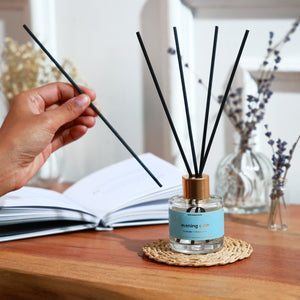
Passive capillary diffusion has no off switch — it is the design, not a shortcoming — so a reed bottle emits for every one of the twenty-four hours it exists in the room, including the fourteen when the building is sealed and nobody is in it. In a well-ventilated reception that is fine and often ideal, because the room clears continuously and the bottle simply holds a low plateau. In a sealed clinic it means the only way to stop the emission is to physically carry the bottle out at close and bring it back in the morning, and that habit does not survive contact with a busy practice. A machine with timers solves it structurally: a
Sukoon at ₹1,899 has 2H and 4H windows, and a
Vaayu at ₹11,999 takes 1h/4h/8h/24h run windows with day selection and a key-lock. The Vaayu is only defensible past roughly 320 sq ft of connected arrival zone, and it must stand freely in reception — never mounted into shared HVAC in a clinical building — and you must confirm refill supply with SOSA first, because no separate Vaayu cold-air refill oil is currently sold.
Part two — six things you notice, and what each one means
Six symptoms practices report, what each says about the air, and what a fragrance would do to it. The last column is not a warning against the products; it is a description of what addition does in a room that subtracts nothing.
Symptom by symptom
What each observation tells you about recirculation, and what fragrance would add to it
| What you notice |
What it usually indicates |
What an actual air change would do |
What adding fragrance would do |
| Heaviness that builds through the afternoon ★ |
Accumulation with little or no outside-air dilution — the signature of a closed loop |
Reset it. Fifteen minutes of cross-ventilation clears more than the system does all day |
Add to the accumulating total, and raise it further if the dose is increased |
| The room changes the moment the front door is propped open |
Confirms it directly: the fix is outside air, and you have just demonstrated it for free |
Make that the routine rather than the accident |
Nothing useful — the door did the work, and a scent cannot replicate it |
| A scent that seems stronger at four than at ten |
Continuous emission into a volume that is not clearing between hours |
Flatten the curve, because output is finally balanced by removal |
Compound it. This is the symptom people most often try to solve with a higher setting |
| A dusty or slightly burnt note at start-up |
Loaded filters or a coil that has not been serviced — ask your contractor rather than me |
Not much, until the filters are dealt with |
Sit alongside it, so the room now has both |
| A faint damp note that arrives with the cooling |
Condensate tray or drain pan holding water. This is a service item, not an ambience item |
Help, but the tray still needs attention |
Sit alongside it — and if the source is an ultrasonic machine, add humidity to a damp problem |
| Yesterday's occupancy still detectable this morning |
Overnight sealing on top of daytime recirculation — the two problems stacked |
An opening purge deals with the overnight half in twenty minutes |
Nothing, and a diffuser left running overnight makes the morning worse |
|
The honest caveat: the rows above are observations about odour and air movement, not an assessment of air quality, and nothing on this page is medical, clinical, ventilation, air-handling, infection-control or regulatory advice. Where a row points at your filters, coil, condensate drain or fresh-air provision it is pointing at your maintenance contractor and your practice's own clinical judgement, not at me — I have no standing to advise on ventilation design or standards and will not. A diffuser adds a scent to the air; it does not clean, purify, filter, neutralise or freshen it, and it removes nothing that is already there. Any fragrance decision applies to the arrival zone only; examination rooms, diagnostic areas, consultation cabins, the procedure suite and any post-operative area take nothing, in any format, at any level, at any hour. No claim is made in either direction about how any patient or member of staff perceives, tolerates or responds to fragrance, and no SOSA product or setting is described as safe or unsafe for any group. Some people are sensitive to airborne fragrance, which is why the clinical pathway stays fragrance-free and why a fragrance-free seat must genuinely exist. SOSA sells no air purifier and no dehumidifier. |
Shop this guide — only after the ventilation question is answered
Three formats, ranked by whether they can be told to stop
The SOSA principle
Fragrance is a finishing layer on a room that is already working. In a building where the air is not being changed, there is no finished room to put a layer on — and a layer applied to an unresolved surface is how you get something that looks worse than the bare version.
Answer the fresh-air question first. It is free, it takes a phone call, and it decides everything after it.
Part three — why this page argues for spending nothing
I want to state the position rather than imply it. If your clinic smells closed and you do not yet know whether your air handling brings in outside air, my recommendation is that you buy nothing from SOSA until you do. Not because a diffuser would be harmful — I make no safety claim in either direction, and that judgement belongs to your practice — but because it is the wrong instrument for the reading you have taken. A closed-smelling room is a room short of air exchange, and fragrance has no air-exchange mechanism at any price point in any format. Spending ₹899 on it wastes ₹899; spending ₹11,999 on it wastes ₹11,999 and distributes the mistake more evenly across two to three thousand square feet. The phone call to your maintenance contractor costs nothing and answers the question the purchase would only have postponed.
The harder version of this is the practice whose answer comes back as no. Sealed glazing, no openable window, a ducted system with no outside-air intake, and a front door opening onto an internal mall lobby rather than the street — that building has a ventilation limitation which is not going to be solved by anything on any shop's website, mine included. The honest sequence is to take it to your services engineer and, if you lease, to your landlord, because fresh-air provision is a building question with a building answer. Meanwhile the two things within your control are the purge routine and the sources. And meanwhile I would not add a scent at all, because that is the one room type where addition compounds rather than settles. I would rather lose the order than have a practice conclude six months later that our products make rooms heavier — which, in that building, they would.
There is also a version where the answer comes back well and a scent becomes reasonable, and it is worth describing so the permission is not read as blanket. You have a fresh-air path, the filters and drain are on a service schedule, two purges are in the working day, the closed quality has gone, and reception is a defined arrival zone with real distance or a door between it and the corridor to consultation. At that point the ordinary cluster recommendation applies: one source, arrival zone only, dry and unsweet, low, on a schedule rather than continuously, and set for the person waiting forty minutes rather than the person walking past the door. Ask your reception staff first — they are in that air for eight or nine hours against a patient's forty minutes, and if they would rather have nothing that is a complete answer. And keep the target in view: a practice is judged on competence, so the arrival zone should read as considered, never as scented.
A room that smells closed is asking for air, and there is no bottle on any shelf anywhere that contains air. The only thing that ventilates a building is ventilation.
— Sonal Sahani, SOSA
Part four — six questions for whoever maintains your system
Six questions, who answers each, roughly what it takes, what a bad answer tells you, and what it means for any fragrance decision. None of these is a question I can answer for you, and that is the point of putting them in a table.
Before you spend a rupee
Six questions, the likely cost, and what each answer changes
| The question to ask |
Who answers it |
Roughly what it takes |
What a bad answer tells you |
What it means for fragrance |
| Does this system bring in any outside air at all? ★ |
Your air-conditioning maintenance contractor |
A phone call, sometimes a site visit. Usually free |
"No" explains the entire complaint and is the most valuable sentence on this page |
If the answer is no, buy nothing until it changes |
| If there is a fresh-air path, is it open, and when? |
The same contractor, sometimes the installer |
A visit to check dampers and settings |
A path that exists but is shut is the cheapest fix in this whole family |
Reassess after a fortnight with it open — the room may need nothing |
| When were the filters last changed, and on what schedule? |
Contractor, and your own maintenance record |
Minutes to check; a service visit to act |
A start-up note you have been blaming on furniture or carpet |
Fragrance would sit alongside it, not replace it |
| Is the condensate tray and drain clear? |
Contractor |
Part of a routine service |
A damp note arriving with the cooling, and a moisture issue to take seriously |
Do not add an ultrasonic here — it adds humidity |
| Where does the return air draw from, and does it pass reception? |
Contractor, with your floor plan in hand |
One walk round the building |
A return that pulls reception air toward consultation is a boundary problem, not a scent problem |
Decides placement entirely — and rules out any HVAC mounting outright |
| Can the system run on fan without cooling, before and after hours? |
Contractor |
A setting, if the equipment supports it |
If not, your purges have to be doors and windows instead |
A purge before opening means any scheduled scent starts on renewed air |
Honest notes for buyers: every row above routes a question to your maintenance contractor, your services engineer or your practice's own clinical judgement, because none of them is a fragrance question and I have no standing in any of them. Nothing on this page is medical, clinical, ventilation, air-handling, infection-control or regulatory advice, and no assessment of air quality is offered or implied. No claim is made in either direction about how any patient or member of staff perceives, tolerates or responds to fragrance, and no SOSA product or setting is described as safe, unsafe or suitable for any group. No claim is made about comfort, anxiety, perceived waiting time, recovery, ratings, footfall or revenue. Some people are sensitive to airborne fragrance, which is why the clinical pathway stays fragrance-free and why a fragrance-free seat must exist somewhere a person would ordinarily sit.
A diffuser adds a scent to the air; it does not clean, purify, filter, neutralise or ventilate it, and it removes no stale, closed, damp or occupancy smell — those are ventilation, moisture and cleaning problems. SOSA sells no air purifier, no dehumidifier and no room spray; every SOSA spray is a car perfume. Strength figures are positions on SOSA's own internal scale
at six reeds, not an industry standard, a concentration or a quality ranking, and no bottle-life figure is published below six reeds. Replacement reeds are not sold separately. Honest gaps in the reed range: no oud, no musk-forward composition, no aquatic. Reed oil cannot go in an ultrasonic machine, water-based Hotel Collection cannot go in a reed bottle, and neither goes in a Vaayu. Ultrasonic machines add humidity. Oil-only reed refills are 300ml ₹2,399, which is ₹2,399 ÷ 300 = ₹8.00 a millilitre, and 500ml ₹3,499, which is ₹3,499 ÷ 500 = ₹7.00, against ₹849 ÷ 50 = ₹16.98 a millilitre for a 50ml bottle. Hotel Collection water-based fragrance is for ultrasonic machines only: 15ml ₹299, 100ml ₹999, 300ml ₹1,799, and a pack of seven 15ml at ₹1,799 — that pack is 7 × 15 = 105ml, so ₹1,799 ÷ 105 = ₹17.13 a millilitre against ₹1,799 ÷ 300 = ₹6.00 for the 300ml. A Boond at ₹899 with one 15ml at ₹299 is ₹899 + ₹299 = ₹1,198 to start. Coverage figures are manufacturer specifications and vary with ceiling height, air exchange and occupancy; Megh at ₹3,499 covers about 215 sq ft,
less than a Sukoon, so it is a runtime and humidity machine and never a coverage upgrade, and Safar at ₹3,999 has no published coverage figure at all.
SOSA does not currently sell a separate Vaayu cold-air refill oil; the 400ml supplied in the box lasts roughly 90+ days and is the whole supply available at the time of writing, so a practice planning continuous or multi-site use must confirm current refill availability with SOSA before committing, and the water-based Hotel Collection is never a substitute for it. SOSA publishes no bulk pricing, corporate account, maintenance contract, installation service, warranty term, delivery window or multi-site programme; ask through
the contact page before committing.
Never mount a diffuser into shared HVAC in a clinical building — a freestanding position in reception, away from the corridor to consultation, is the only correct placement. Free shipping above ₹499.
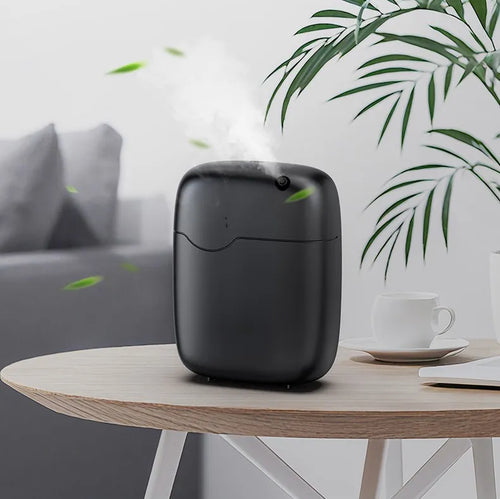
The machine people ask about here — and the two sentences that matter about it
SOSA Vaayu · waterless cold-air nebulisation ₹11,999
Cold-air nebulisation of undiluted oil, coverage up to 1000 m³ or roughly 2,000–3,000 sq ft, Bluetooth app with 1h/4h/8h/24h run windows, day selection, adjustable intensity and a key-lock; 5W, CE, RoHS and SGS certified, and under 38 dB, which is the specification that matters most in a room where a machine you can hear is worse than no fragrance at all. It adds no humidity, which is the one advantage it has over an ultrasonic in a sealed building. Two sentences before anyone buys one for this problem. First: it is only defensible past roughly 320 sq ft of connected arrival zone, and under that a Sukoon at ₹1,899 is the sized product — a Vaayu in a 180 sq ft reception is simply oversized. Second, and non-negotiable: it must stand freely in reception, never mounted into the building's shared HVAC, because ducting fragrance into central air is exactly how it reaches examination rooms, diagnostics and the procedure suite, which is the one outcome this whole cluster exists to prevent. And the commercial gap, stated plainly: SOSA does not currently sell a separate Vaayu cold-air refill oil. The 400ml supplied in the box lasts roughly 90+ days and is the whole supply available at the time of writing, so a practice planning continuous or multi-site use must confirm refill availability with SOSA before committing. The water-based Hotel Collection is never a substitute for it.
A note from Sonal
A clinic manager in a first-floor unit above a bank wrote to me in her third month of trying to fix an afternoon smell. She had bought a diffuser, then a second one, then moved both, then changed the scent. Her question was whether our strongest composition would finally do it, and she had already worked out which one that was.
I asked her to prop the front door open for fifteen minutes at three in the afternoon and write down what happened. She wrote back the next day: the room was completely different within about eight minutes, and stayed different for nearly two hours. That test cost nothing and it had already told her everything. The building had no fresh-air intake. Two diffusers had been trying to solve an air-change problem, and each one had been adding to the very accumulation she was fighting.
She put two purges into the day — eleven and three, fifteen minutes each, written on the desk rota so it did not depend on who remembered. Both diffusers went into a cupboard for a month. When she brought one back it was a single bottle at three reeds, and she told me it read completely differently in a room that had been aired. That is the whole argument of this page: the same product in the same room is a different experience depending on whether the air underneath it is moving. Composed and made in small batches in Pune, and a part of every order funds a girl's classroom through Nanhi Kali.
Frequently asked questions
Doesn't the air conditioning filter clean the air?
It removes particles — dust, some larger airborne matter — and that is genuinely useful. It does not remove the vapour-phase molecules that make a room read as closed, and it does not bring in anything new. This is the misunderstanding at the centre of the whole question: a filter is a subtraction of solids, whereas what a closed-smelling room needs is a replacement of air. I am not in a position to assess your filtration or to comment on air quality in any technical sense, and I will not; what I can tell you is that a filter has no bearing on whether a fragrance decision makes sense, because the two things act on different parts of the problem.
If I turn the diffuser up, will it at least make the room feel fresher?
No, and in a sealed building it does the opposite more reliably than anywhere else. Fresh is not a smell; it is the absence of accumulation, and it is produced by air leaving and being replaced. Adding more scent to a room that is not clearing gives you a heavier room with a stronger scent in it, and the heaviness is the thing you were trying to remove. If you find yourself increasing a setting because the room feels closed, treat that impulse as a diagnostic: it is telling you the problem is ventilation. Take the dose down instead, or off entirely, and open a door for fifteen minutes.
Can I duct a scent machine into our air conditioning so it spreads evenly?
No — not in a clinical building, and this is the one recommendation in this cluster I would call non-negotiable. The entire argument for scenting a clinic at all rests on fragrance staying in the arrival zone and never reaching examination rooms, diagnostics, consultation cabins, the procedure suite or any post-operative area. Ducting it into central air does precisely the opposite: it delivers it, evenly and reliably, to every room the system serves, including the ones that must stay fragrance-free. A Vaayu can be wall or HVAC mounted as a general product capability, and in a clinic you use the freestanding option, positioned in reception away from the corridor to consultation. If a vendor proposes a duct install in your practice, that alone is reason to decline.
Our building has no openable windows at all. What can we do?
Three things, none of which I sell. Establish through your maintenance contractor whether a fresh-air path exists or could be added, and if you lease, put the question to your landlord as a building matter rather than a preference. Reduce the sources inside the building — waste out in the evening, cardboard storage replaced with sealed boxes, pantry door shut, traps flushed, cleaning moved to close. And use the front door deliberately: even an internal-lobby door propped open for fifteen minutes twice a day moves air, and many practices find that the afternoon complaint largely goes with that alone. Until one of those changes, I would not add a fragrance to that room, and I would rather say so than take the order.
Is a reed diffuser or a machine better for a sealed clinic?
A machine, and the reason is scheduling rather than quality. A reed diffuser emits continuously by design — passive capillary diffusion has no off switch — so in a building that does not clear, it contributes for twenty-four hours a day including the fourteen when nobody is there. A Sukoon at ₹1,899 has 2H and 4H windows and a remote, a Boond at ₹899 exhausts a fill in about six hours and stops by itself, and a Vaayu at ₹11,999 takes 1h/4h/8h/24h windows with day selection and a key-lock. Note that both ultrasonic machines add humidity, which matters in monsoon and matters more if your closed smell has any damp character. And past 320 sq ft of connected arrival zone, before choosing a Vaayu, confirm refill supply with SOSA — no separate cold-air refill oil is currently sold.
Eye clinics · air quality
Answer the fresh-air question — then decide whether you need anything at all
A sealed clinic smells closed because the air is recirculated rather than renewed, and adding a scent to an under-ventilated room makes it heavier rather than fresher. Ask your maintenance contractor whether the system brings in outside air, get the filters and condensate drain seen to, and put two fifteen-minute purges into the working day. All of that is free and much of the time it is the whole answer. If you scent afterwards, choose a format that can be told to stop — a Sukoon at ₹1,899 on a short window — in the arrival zone only, freestanding and never ducted into shared HVAC. The clinical pathway stays fragrance-free. Free shipping above ₹499.
Ask before you buy anything → Sukoon ₹1,899
Continue the read
More on real odour problems in a clinic
Editorial standards & sources
About this guide: Written by Sonal Sahani, ISIPCA Versailles-trained founder and perfumer at SOSA Home & Body. It explains why a fully air-conditioned eye clinic can smell closed — recirculation without air exchange — and routes every technical question to the practice's own maintenance contractor and clinicians. It argues that adding fragrance to an under-ventilated room makes it heavier rather than fresher, and recommends spending nothing until the fresh-air question is answered. No claim of masking, neutralising, purifying, filtering or air-cleaning is made for any product, and no assessment of air quality is offered. Nothing in it is medical, clinical, ventilation, air-handling, infection-control or regulatory advice. SOSA sells no air purifier and no dehumidifier. A Vaayu is never HVAC-mounted in a clinical building, and no separate Vaayu refill oil is currently sold. No competitor is named or rated, and no hotel group is a SOSA customer, partner or reference.
SOSA range, specifications and prices used in this guide (verified August 2026): Vaayu ₹11,999 — waterless cold-air nebulisation of undiluted fragrance oil; no water, no heat, no added humidity, no white mineral dust. Coverage up to 1000 m³, about 2,000–3,000 sq ft. 400ml refillable tank lasting roughly 90+ days at a mid setting. Bluetooth app plus onboard controls, 1h / 4h / 8h / 24h run windows, day selection, adjustable intensity, auto-stop and key-lock.
Under 38 dB. DC 12V / 1A, 5W. Freestanding or wall / HVAC mount. CE, RoHS and SGS certified.
SOSA does not currently sell a separate Vaayu cold-air refill oil; the 400ml supplied in the box is the fragrance available at the time of writing, so a practice planning continuous or multi-site use should confirm current refill availability with SOSA before committing. The water-based Hotel Collection is made for ultrasonic machines and must not be used in a Vaayu. Other machines: Boond 300ml ₹899 (~150 sq ft, ultrasonic) · Sukoon 500ml ₹1,899 (270–320 sq ft, 16–18 hours on low, remote and steady/2H/4H timers, three 15ml fragrances included, ultrasonic) · Megh 6L ₹3,499 (
~215 sq ft — a runtime and humidity machine that covers less than a Sukoon, never a coverage upgrade) · Safar ₹3,999 (waterless cold diffusion, cordless, 20ml, about 6.9cm, three speeds, 1/2/3-hour auto-off — sold as a car and travel diffuser, personal-scale only;
SOSA publishes no coverage figure for it) · Aangan ₹25,999 (HVAC nebulising, ~8,000–10,000 sq ft) · Meenar ₹38,500 (commercial HVAC, 12,000–18,000 sq ft). Water-based Hotel Collection for ultrasonic machines: 15ml ₹299 · 100ml ₹999 · 300ml ₹1,799 · pack of seven ₹1,799; scents are
inspired by the atmosphere of well-known hotels — SOSA is an independent Indian brand and is not affiliated with, endorsed by or supplying any hotel group. Reed diffusers ₹749–₹1,349 (50ml 6–8 weeks, 130ml 14–18 weeks, six fibre reeds, no 100ml size; replacement reeds are not sold separately). Reed oil cannot be used in an ultrasonic machine and Hotel Collection oil cannot be used in reeds.
SOSA sells no room spray or home spray — every SOSA spray is a car perfume. Nothing in this guide is medical, clinical or safety advice. A fragrance diffuser adds a scent to the air. It does not clean, purify, filter, sanitise or disinfect air, does not remove or neutralise disinfectant, damp or occupancy smells, and has no effect on comfort, anxiety, waiting time, recovery or any clinical outcome. Some people are sensitive to airborne fragrance, which is why this guide recommends that examination rooms, diagnostic areas, consultation cabins, procedure suites and post-operative areas remain fragrance-free, that a fragrance-free seating option always exist, and that a diffuser is never mounted into shared HVAC in a clinical building. Decisions about clinical policy, ventilation standards, infection control and patient suitability rest entirely with the practice and its clinicians. A persistent stale, damp or disinfectant smell is a ventilation, moisture or cleaning problem — SOSA sells no dehumidifier and no air purifier, and fragrance should never be used to cover one. Coverage, runtime and longevity figures are manufacturer specifications and typical ranges, not guarantees, and vary with room volume, ceiling height, air exchange, occupancy and season.
SOSA publishes no commercial or bulk pricing, no corporate account, no annual maintenance contract, no installation service, no stated warranty term and no multi-location programme; warranty length, spare parts, servicing and app platform availability are unconfirmed, and larger or multi-site enquiries should go through
the contact page before any commitment. Composed and made in small batches in Pune, India. Free shipping above ₹499. A portion of every order supports girl-child education through Nanhi Kali. Prices subject to change — see the live product pages.


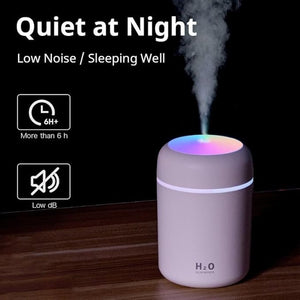
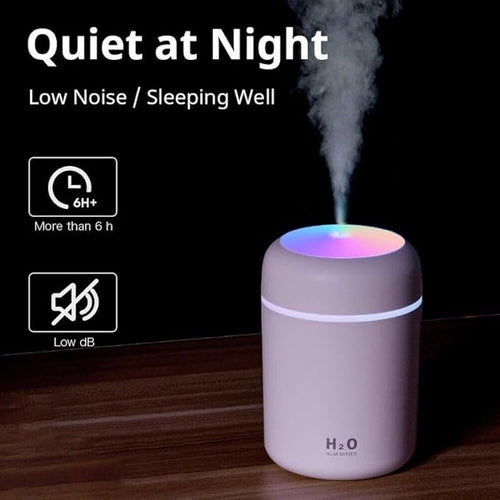 Boond · ends by itself₹899Shop →
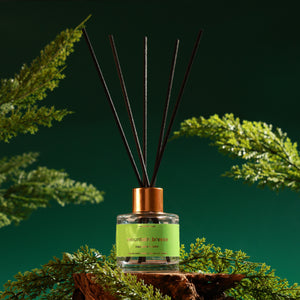
 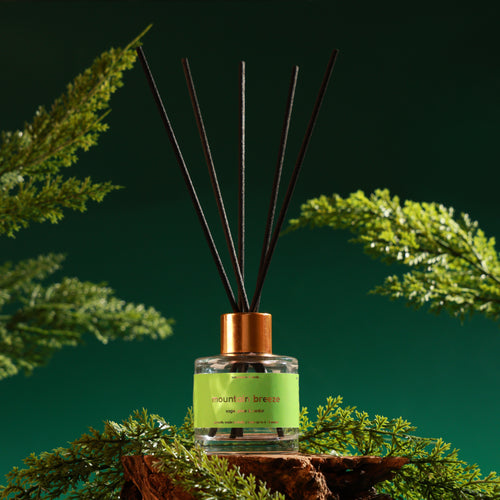 Mountain Breeze · no schedule at all₹849Shop →