




The storage: sheets, pillow, duvet and mattress absorb it. The mattress is the largest thing in your home that never goes in a washing machine.
The removal: at 0.2–0.5 air changes an hour with the door and window shut, effectively none. Ten minutes of two openings on waking changes more than anything you can buy.
2. Because a sleeping body emits continuously. Through the night a person releases moisture through breath and skin, and transfers skin lipids and their oxidation products onto whatever is in contact with them. This is entirely normal and it happens to clean people in clean rooms. It is not a hygiene failure; it is a ventilation and laundry question.
3. Because the bed stores it and gives it back slowly. Sheets, pillowcase, pillow, duvet and mattress are the largest fabric load in the house by a wide margin, and they are warm and slightly damp for eight hours. Porous materials absorb odour molecules and re-release them over days. The pillow is usually the strongest single source, and the mattress the most neglected, because it is the one large textile that never gets washed.
4. Because you wake up with a nose that has been in it all night. Olfactory adaptation is essentially complete in about twenty minutes, and you have had eight hours. What you notice on waking is the last flicker of a signal you are about to lose entirely. The honest test is to leave the room for twenty to thirty minutes, shut the door behind you, and judge the first breath when you go back in.
5. And fragrance is not the morning answer. Scent added to an unaired bedroom gives you a scented version of the same air. Air the room, get the bedding onto a weekly cycle, then add a reed diffuser or a Sukoon as a quiet background for a room that is already clean.
Made in India, composed by an ISIPCA Versailles-trained perfumer — and a portion of every order supports girl-child education through Nanhi Kali.
Eight hours, one small room, and nothing moving
Take the three variables that govern how a room smells — how much is being put into the air, how much material is there to store it, and how fast the air is replaced — and notice that a bedroom is the worst case on all three at once. It is generally the smallest habitable volume in the flat, so a given emission produces a higher concentration. It is occupied continuously for eight hours, which is longer than the kitchen, the living room or the bathroom ever manage. And it is the room most likely to be deliberately sealed, because people close bedroom doors for privacy and bedroom windows for noise, mosquitoes and cooled air. No other room in your home combines maximum input, minimum volume and minimum exchange.
The second half is sorption. Porous materials take odour molecules into the fibre and let them out again slowly over days — and a bed is an unusually effective version of this, because the fabric is warm, slightly humid and in direct contact with the source for the whole night. A pillow takes the concentrated version: it holds your face, your hair and your breath for eight hours, and the pillow itself under the washable case is very rarely dealt with. The mattress takes the diffuse version and holds it indefinitely. This is why changing the sheets produces such an obvious improvement and why that improvement fades — you replaced the top layer of a reservoir with several layers underneath it. Humidity makes all of it worse, which is why the same bedroom is noticeably heavier in the monsoon than in January.
Where the night actually goes
 Step four50ml ₹799Work down the bed in order of how often each layer is actually cleaned. The sheet and pillowcase go weekly if you are diligent. The pillow itself — the thing your face is in — goes almost never. The duvet or quilt inside its cover goes seasonally at best. The mattress goes never. Each layer holds and re-releases, and the deeper layers are the ones that make the smell come back three days after a change of sheets. Wash bedding weekly, wash or replace pillows on a schedule, and air the mattress in direct sunlight whenever the weather gives you a chance. Sunlight is genuinely effective here — heat and UV drive off absorbed volatiles far faster than airing in shade.
Symptom to cause: reading the morning bedroom
Wake up, notice what it smells of, then leave the room with the door closed for half an hour and come back and notice again. The difference between those two readings is what the rows below are built on.
| What you notice | Most likely cause | How to confirm it | What actually fixes it |
|---|---|---|---|
| Flat and closed on waking, completely gone by mid-morning ★ | Straightforward overnight accumulation with no air exchange | Open two openings for ten minutes on waking for three days and compare | Uncover the bed, ventilate on waking, then make the bed |
| Strongest right at the pillow, faint elsewhere | The pillow itself — skin and hair contact for eight hours, rarely washed | Smell the bare pillow against a fresh one from the cupboard | Wash or replace pillows on a schedule; use a washable pillow protector |
| Warm and slightly damp when you throw the covers back | Overnight moisture held in the duvet and mattress | Feel the sheet at the centre of the bed within a minute of getting up | Uncover the bed for 20–30 minutes before making it; air the mattress in sunlight |
| Comes back within days of a full bedding change | The deeper layers — pillow, quilt, mattress — not the sheets | Change only the sheets and time how long the improvement lasts | Deal with the layers that never get washed, not the one that always does |
| Noticeably worse in humid or rainy weather | Humidity raising perceived odour and stopping bedding from drying out | Compare the same room and same bedding on a dry week and a wet one | Ventilate in dry spells; dry bedding thoroughly; do not dry washing in the bedroom |
| Musty and earthy, worst near an external wall or the ceiling corner | Damp ingress or mould — a health issue, not an odour problem | Move the bed or wardrobe away from the wall and look behind it in daylight | Find the moisture source and remove the growth. Do not fragrance this. |
| If none of these fit: check whether the smell is actually coming from the attached bathroom. Close its door properly at night for a week and see whether the morning reading changes. | |||
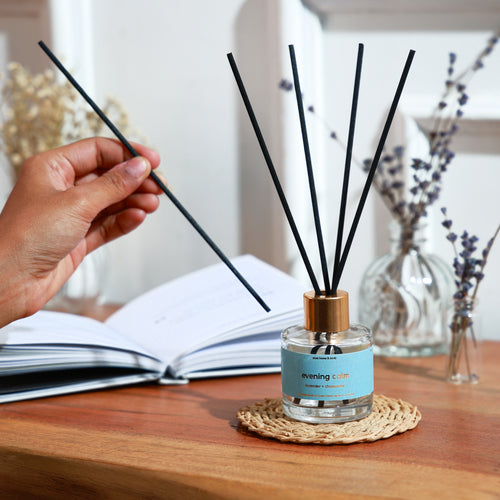
 Reeds · always-on roomsFrom ₹749Shop →
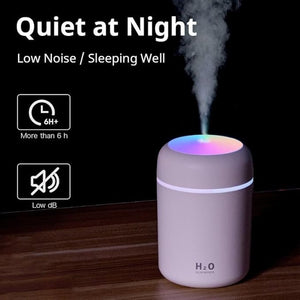
  Sukoon · when you want a switch₹1,899Shop →
  Hotel Collection · the scentFrom ₹299Shop →
The waking-up routine, in the order that works
First, uncover the bed before you leave the room. Throw the duvet or bedspread right back over the footboard so the sheet and the mattress surface are exposed to the air, and leave them like that while you shower and have breakfast. Making a bed immediately on rising seals eight hours of moisture into the layers and keeps it there until the evening. Twenty to thirty minutes uncovered is enough, and the difference on the following night is genuinely noticeable. This costs nothing and it is the step most people skip.
Second, move the air while the bed is open. Open the window and the bedroom door — two openings on different sides so air has a path through rather than a single window to lap against. Ten minutes is enough to take the room from roughly 0.2–0.5 air changes an hour to something in the range of 3 to 8, which is more air replaced than the entire night managed. If the room is air-conditioned, remember the AC is recirculating rather than ventilating, so it cools the same air it has been cooling since midnight and its filter should be washed monthly. If a window genuinely cannot be opened, run the attached bathroom's exhaust fan with the bedroom door open instead.
Third, put the laundry on a schedule rather than on a feeling. Sheets and pillowcases weekly. Pillow protectors weekly with the sheets. Pillows themselves washed or replaced on whatever cycle the manufacturer allows. Quilt covers monthly, quilts seasonally. Mattress vacuumed with the brush attachment and aired in direct sun when the weather permits. Curtains at least seasonally. Only now does fragrance make sense, and a bedroom wants restraint: a reed diffuser from ₹749 on four reeds rather than the full six, placed away from the bed rather than on the nightstand, gives a quiet background with nothing to switch off at 2am. Or the Sukoon at ₹1,899 with a Hotel Collection scent from ₹299 if you would rather run scent for an hour before bed and have none at all overnight.
What to do, in order
The bedroom is the room where the free steps have the largest effect, because the mechanism is so concentrated. Do them first. Then buy for a room that is already right.
| Step | What to do | When | Cost |
|---|---|---|---|
| 1. Remove the source | Check the attached bathroom drain and the wardrobe; move worn clothes out of the bedroom; water down unused drains | Before anything else | ₹0 |
| 2. Move the air | Uncover the bed on waking and cross-ventilate for ten minutes — window plus door, not a window alone | Daily, five to ten minutes | ₹0 |
| 3. Deal with what holds it | Sheets weekly, pillow protectors weekly, pillows and quilts on a schedule, mattress vacuumed and sunned, curtains seasonally | Weekly to monthly | ₹0 |
| 4. Then the always-on layer ★ | A SOSA reed diffuser — a quiet always-on background on four reeds rather than six, placed away from the bed | 50ml 6-8 weeks · 130ml 14-18 | from ₹749 |
| 5. Or the on-demand layer | Sukoon with a Hotel Collection scent — scent for an hour before bed and silence overnight; covers roughly 270–320 sq ft | Run it when you want it | ₹1,899 |
Versailles
People expect a perfumer to have a strongly scented bedroom. Mine is the least scented room in my home. I want a bedroom to smell of clean cotton and moving air, and if a fragrance is doing more than sitting quietly behind that, it is doing too much. A bedroom is the one room where under-scenting is almost always the right error to make.
The thing I would genuinely change first, before any purchase, is the bed-making habit. I grew up being told to make the bed the moment I got out of it, and it is the wrong instruction for an Indian climate. You are sealing eight hours of warmth and moisture under a bedspread for the day. Throw it back, open the window, go and shower, and make it when you come out. It takes no extra time at all.
When you do reach for a diffuser, use fewer reeds than the box suggests. Six is full strength for a living room; four is usually right for a bedroom and it makes the bottle last longer as well. Put it across the room rather than beside your head. And if the room smells musty rather than slept-in, stop and look for water before you do anything else — that is a different problem and fragrance has no business in it. A portion of every order funds a girl's classroom through Nanhi Kali.
Frequently asked questions
- Why does my AC bedroom smell stale after being closed all night? — recirculation is not ventilation.
- Why does my house smell stale even though I clean it every day? — the general case, in order.
- Why does a closed bedroom start smelling stuffy overnight? — the eight-hour occupancy load.
- Keeping it fresh once the smell is gone — the maintenance routine.
- Brand: the SOSA founder story.
SOSA products & prices (verified August 2026): Hotel Collection water-based ultrasonic diffuser fragrance 15ml ₹299 · 100ml ₹999 · 300ml ₹1,799 · Pack of 7 (15ml, all fragrances) ₹1,799; refills 100ml from ₹999. Seven scents: The Ritz-Carlton-inspired (white tea · bergamot · cedar), Westin-inspired (white tea · aloe · cedar), 1 Hotels-inspired (cedarwood · vetiver · green leaves), The St. Regis-inspired (amber · violet · woods), Shangri-La-inspired (jasmine · green tea · white tea), Four Seasons-inspired (citrus · floral · sandalwood), W Hotels-inspired (citrus · pepper · amber). Diffusers: Boond 300ml ₹899 · Sukoon 500ml ₹1,899 · Megh 6L ₹3,499. Water-based, phthalate-free, composed to IFRA standards for home diffusion; 3–6 drops per tank. Made in India, Pune. The Hotel Collection scents are SOSA's own interpretations inspired by the world's finest hotels; all hotel names are trademarks of their respective owners and are used only to describe the scent style — SOSA is an independent Indian fragrance house, not affiliated with or endorsed by any hotel brand. Prices and availability subject to change — see the live product pages.