


- The direct answer
- Why the aroma builds the way it does
- The three decisions that follow from how strong it already is
- Where the aroma is strongest, and where it thins out
- Where the aroma runs out and the zone rule takes over
- What to buy, only where the coffee aroma has already stopped
- A note from Sonal
- Questions about why coffee smells the way it does
2. Grinding multiplies the surface area exposed to air within seconds. A whole roasted bean holds most of its aroma sealed inside a comparatively small outer surface. Grinding shatters that surface into thousands of fragments almost instantly, and the volatiles that were sealed in are suddenly exposed to open air all at once, rather than leaking out gradually.
3. Hot water accelerates the release the moment brewing starts. Heat energy speeds up evaporation of the aroma compounds sitting in and around the grounds, which is why the smell peaks sharply during active brewing rather than while a bag sits closed on a shelf.
4. A café's indoor air doesn't exchange fast enough to disperse it quickly. Unlike an open street, a dining room recycles largely the same body of air for long stretches at a time, which lets the aroma concentrate and linger near the counter rather than dispersing the way it would outdoors.
5. The human nose sits at an unusually low detection threshold for several of coffee's specific aroma compounds. A handful of the compounds coffee produces during roasting register strongly even in very small concentrations, which is part of why the smell can dominate a room out of proportion to how much coffee is actually being ground or brewed at any one moment.
No part of this is a reason to add anything to that air — SOSA's role in a café built around an aroma this strong starts only where the coffee genuinely doesn't reach, not inside the room where it already works.
Why the aroma builds the way it does
Coffee's aroma is not one note but a genuinely complex mixture — roasting alone is widely described as producing one of the more complex aroma profiles in food science, with several hundred distinct volatile compounds forming inside the bean during the roast. That complexity is already in place before a single bean is ground; grinding and brewing don't create the aroma, they release what roasting already built. It's also why the smell rarely reads as one simple note the way a single-ingredient scent might — it reads as depth, which is a harder thing for any added fragrance to imitate or usefully sit alongside.
Grinding is the step that changes everything about how fast that aroma reaches a customer's nose. A whole bean's aroma leaks out slowly through a small outer surface; a ground bean's aroma is exposed across thousands of fresh surfaces within seconds, which is why the smell of grinding often reads as sharper and more immediate than the smell of a bag of whole beans sitting nearby. Hot water then accelerates the same release further, which is why the aroma peaks during active brewing rather than staying constant across the day. A café doing a steady run of orders across the morning is, in effect, releasing that burst repeatedly, which is part of why the smell can feel more consistent through a rush than the underlying chemistry alone would suggest.
None of that would matter as much in a space with fast-moving outdoor air. A café's enclosed dining room recycles largely the same air for long stretches, which lets the aroma concentrate near the counter and drift steadily through the seating rather than dispersing the way it would on an open street. This is precisely why the dining room is the last place in the building that needs any fragrance added to it — the physics of the room are already doing the work of holding the aroma in place, and a second aroma introduced into that same slow-moving air has nowhere to go but to sit alongside the coffee, competing for the same attention rather than adding anything new to it.
The three decisions that follow from how strong this aroma already is
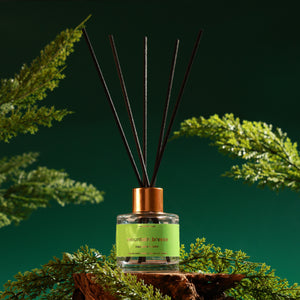
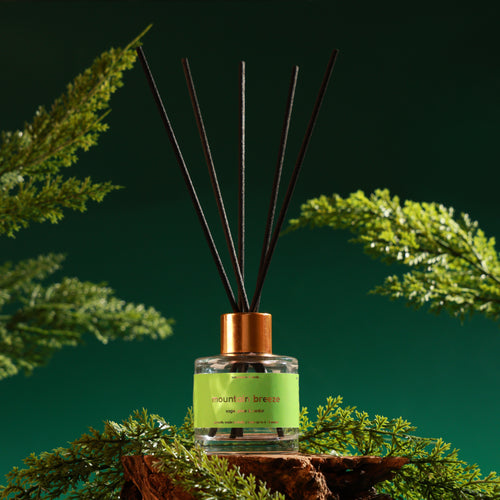
 Mountain Breeze₹849Ventilation, upholstery and any competing food odour are the real variables that affect how strongly a customer experiences the coffee smell — fragrance is not one of the levers available here, and shouldn't be reached for as if it were.
Where the aroma is strongest, and where it genuinely thins out
The strength of this aroma isn't uniform across a café — it depends on distance from the counter and on whether a real air boundary exists between one zone and the next.
| Zone | Coffee aroma present? | What to do | What it costs |
| Counter and grinder area | Strongest in the building | Leave entirely alone — this is the source | ₹0 |
| Dining and seating, any distance from the counter | Strong, reaches throughout the shared air | Leave alone — the same air as the counter | ₹0 |
| Separated entrance or vestibule with a real door | Faint to none, if the boundary genuinely holds | Candidate for a light, non-edible register | Reed ₹749–₹849 or Sukoon ₹1,899 |
| Washroom with its own door | None | The genuine opportunity in this cluster | Reed, Sukoon, or Vaayu depending on how many zones |
| Retail or merchandise selling packaged goods, separated from service | Little to none, if the boundary is real | Candidate zone, kept well clear of the counter | Reed, Sukoon or Vaayu depending on footprint |
| Aroma strength doesn't fall off gradually with distance the way heat or sound does — it depends far more on whether a genuine door and air boundary exist between one zone and the next, which is why a small washroom right next to the counter can be completely clear while a large dining room twenty metres away is saturated. | |||
Mountain Breeze · past the last trace of coffee₹849Shop →  Sukoon · a separated zone, self-contained₹1,899Shop →
  Vaayu · several zones, kept apart from the counter₹11,999Shop →
Where the aroma runs out and the zone rule takes over
Never scent the dining room, the counter, the tasting bar or the seating — the aroma this page describes already fills that air more thoroughly than anything a diffuser could add, and adding to it produces conflict, not enhancement, for a nose that's already processing a genuinely complex mixture. This holds regardless of how faint the added fragrance is set, because the underlying mechanism doesn't switch off at low intensity — it only registers less strongly.
Sometimes a genuinely separated entrance can carry a fragrance of its own — but only once the coffee aroma has verifiably stopped reaching it, which means walking the threshold and checking for a real door and a distinct air volume, not assuming distance alone has done the job. An archway, a half-wall or a few extra steps of floor space do not count as a boundary for this purpose, whatever the interior design plan calls them.
Usually the washroom and any retail or merchandise area are the honest opportunity, because there's no coffee aroma there to interfere with in the first place. Keep the register clean and non-edible in both — vanilla, caramel or anything that reads as coffee is the one direction to avoid everywhere in a café, whatever the zone. Intensity should stay low enough that a customer carrying a drink back from the washroom could not identify a fragrance at all, which is a stricter bar than most commercial scenting guides outside this cluster ask for.
What to buy, only where the coffee aroma has already stopped
Every route below applies exclusively to the zones this page's mechanism has no bearing on — nothing here is intended for the dining room or the counter.
| Route | Premises | Why | What it costs |
| Reed diffuser, Mountain Breeze, washroom | Under 300 sq ft, one washroom with its own door | No shared air with the counter or dining zone at any point | ₹749–₹849 |
| Sukoon ultrasonic, separated entrance | 300–750 sq ft, a genuinely separated arrival zone | Timers hold a light register in air the coffee aroma never reaches | ₹1,899 |
| Vaayu, wall or HVAC-mounted, per zone | 750 sq ft and above, several zones kept apart from service | Placement flexibility keeps every zone's reach clear of the counter | ₹11,999 |
| Vaayu, freestanding, retail counter | Any café with packaged goods sold apart from service | Runs on its own air, with no coffee aroma present to compete with | ₹11,999 |
| Aangan, HVAC-integrated, non-dining zones | Above roughly 3,000 sq ft, several separated zones | Distributes through ducting that stays out of the service air entirely | ₹25,999 |
I've stood in more café doorways than I can count where the smell of the grinder reached me before I'd even stepped inside, and I still find it worth pausing on — it's a genuinely rare thing for a product to announce itself that clearly, that consistently, without anyone designing it to. As a perfumer trained to build complex aroma profiles deliberately, I notice how much work roasting has already done for free, before a café spends a single rupee on scenting anything.
It's also why I'm cautious about being asked to 'enhance' that smell. Enhancing something this complex with a single added fragrance almost never reads as enhancement to the nose receiving it — it reads as two things competing for the same attention, and the coffee, which the customer actually came for, doesn't need the competition. I say this even when the fragrance being proposed is genuinely well made, because quality on its own doesn't resolve the underlying conflict.
So my honest advice in this part of the cluster is nearly always the same: leave the dining room alone, and put the effort into the zones the aroma has genuinely stopped reaching. That's not a smaller recommendation — it's the one that respects what the café already does well before I offer an opinion on anything else, and it's the version of this conversation I'd want if I were the one running the café rather than advising on it.
Questions about why coffee smells the way it does
- Is the Smell of Fresh Coffee Enough for a Café? — the direct follow-on question this page sets up.
- Why Scenting a Café Is Completely Different From Scenting a Hotel or Retail Store — the category-level reason this mechanism matters more here than elsewhere.
- Why Does My Café Smell Amazing While Coffee Is Brewing but Neutral Between Rush Hours? — the same mechanism, viewed across a working day.
- Should I Let Coffee Become the Natural Signature Scent of My Café? — the next question this page's answer leads to.
- Brand: the SOSA founder story.
SOSA products & prices (verified September 2026): Reed diffusers 50ml ₹749–₹849 (to 150 sq ft, 6–8 weeks at six reeds) · 130ml ₹1,249–₹1,349 (above 150 sq ft, 14–18 weeks) · reed refill 300ml ₹2,399. Ultrasonic: Boond ₹899 (~150 sq ft) · Sukoon ₹1,899 (270–320 sq ft, ships with three 15ml Hotel Collection fragrances) · Megh ₹3,499 (6L tank, ~100 hrs runtime, ~215 sq ft — a runtime machine, not a coverage upgrade). Waterless cold-air: Safar ₹3,999 (no published coverage figure) · Vaayu ₹11,999 (up to 1000 m³, roughly 2,000–3,000 sq ft; 400ml tank lasting about 90+ days; app and onboard control, 1h/4h/8h/24h run windows, adjustable intensity, key-lock, under 38 dB, freestanding or wall/HVAC mount, 5W, CE/RoHS/SGS) · Aangan ₹25,999 (8,000–10,000 sq ft). Hotel Collection water-based fragrance 15ml ₹299 · 100ml ₹999 · 300ml ₹1,799 is for ultrasonic machines; reed oil and Hotel Collection are not interchangeable. Reed diffusers are alcohol-free, phthalate-free, paraben-free, IFRA-compliant and low VOC, handmade in small batches in Pune. Every purchase funds a girl's education through Nanhi Kali. Prices and availability subject to change — see the live product pages.