


The tell: strong on the mezzanine, the landing or the stairs; absent on the sofa. If that describes your house, you have a stratification problem, not a strength problem.
The free fixes: lower the source to seating height, move it out of the sun, run the ceiling fan slowly or in reverse to break the layer, and scent in the evening rather than at the hottest part of the day.
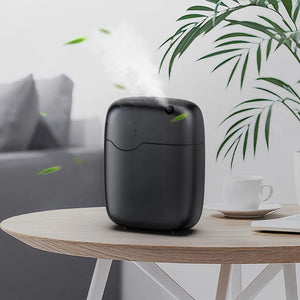
The paid fix: a source with propulsion, mounted low and aimed into the room. The Vaayu at ₹11,999 nebulises undiluted oil into a dry mist and can be wall-mounted at whatever height you choose — which in a tall room matters more than the specification does.
2. Which is why the landing smells better than the sofa. If your mezzanine, gallery or staircase is the best-smelling part of the house and the seating below it is the worst, you have confirmed the diagnosis without spending anything.
3. Sunlight makes it worse, and predictably. Double-height rooms usually have tall glazing. By mid-afternoon the upper air behind that glass is warmer than the air at floor level, the separation between layers is at its most stable, and the room is at its least receptive. The same room mixes far more willingly after sunset.
4. Height of the source is the lever nobody uses. A bottle on a tall console or a machine on a high shelf is releasing into the layer that is already leaving. Put the source at seating height — coffee-table to console, roughly waist level — so the fragrance has to cross the occupied zone before it rises.
5. Slow air movement is the second lever. A ceiling fan on its lowest setting, or in its reverse winter direction, mixes the layers gently and brings the upper air down. A fan on high does the opposite of what you want: it strips a reed diffuser and empties the bottle weeks early.
6. And the room is simply bigger. Stratification is the reason the fragrance is in the wrong place; volume is the reason there is not enough of it. Both are true at once in a double-height room, which is why it is the hardest domestic space in this whole category.
7. Only then consider a machine. A source with propulsion, mounted low, delivers into the occupied layer rather than releasing and hoping. Our reed range is composed and handmade in small batches in Pune, the machines are made in India, and a portion of every order supports girl-child education through Nanhi Kali.
Part one — how a tall room separates into layers
A single-height room mixes reasonably well. Air warmed at floor level rises, meets a ceiling less than three metres up, cools against it and comes back down, and the whole volume turns over often enough that a fragrance released anywhere in it eventually reaches everywhere in it. Give that room a double-height void and the return trip stops happening. The warm air has somewhere to go, so it goes there, and what it finds when it arrives is more warm air rather than a cool ceiling. The layer becomes self-sustaining, and the boundary between it and the cooler air below is surprisingly stable. Three things drive it, and all three are worth understanding before you spend anything.
 Mountain Breeze₹849 · place it lowAlmost every double-height living room in India was designed around a tall window, and that window is doing something to the air on a daily cycle. Sun on the upper glass warms the air behind it; that air rises and joins the layer; the layer thickens and warms through the afternoon and is at its most pronounced by the time the light goes. The practical consequence is that the same room is a different scenting problem at four in the afternoon and at nine at night, and if you are running a machine on a timer you should be running it into the cooler, more mixable part of the day. There is a second, less obvious effect: direct sun falling on a reed bottle or an oil reservoir heats the oil itself, which raises the evaporation rate and empties the bottle weeks early while giving you very little in the room. Keep the source out of the light, always.
Part two — where the fragrance actually is, floor to ceiling
This is the room described in horizontal slices rather than as one space, because that is how it behaves. The zone that matters is the one between roughly two and six feet from the floor — the only air anybody in the house ever breathes. Everything above that is, for scenting purposes, storage you are paying for.
| Height zone | What the air is doing there | How the fragrance behaves | The practical response |
|---|---|---|---|
| Seated to standing · 2–6 ft ★ | Coolest air in the room, moved mainly by people walking through it | The only zone that counts — and the one that reads empty | Put the source here. Waist to chest height, in the traffic route, out of the sun |
| Above head · 6–10 ft | Transitional; where a ceiling fan at normal mounting height is working | Fragrance passing through on its way up, briefly detectable | Fan on its lowest setting mixes this zone with the one below it |
| The gallery or landing · 10–14 ft | Warm air arriving and spreading sideways | Noticeably stronger — this is the false positive that confuses people | Do not judge the room from here. Judge it from the sofa |
| The void · 14 ft to ceiling | Warmest, most stable, least disturbed air in the house | Accumulates and stays; effectively lost to the occupied room | Nothing you place up here helps. Never mount a diffuser high |
| Against tall glazing | Heats through the afternoon and drives the whole upward cycle | Sun on an oil source also raises evaporation and shortens its life | Keep every source several feet clear of direct sunlight |
| The honest caveat: these zones are a description of ordinary buoyancy in a tall room, not measured strata in your house, and a room with strong forced ventilation may mix far more than this suggests. Nothing here is an air-quality claim — a fragrance diffuser adds scent to air; it does not clean, purify or remove anything. If the lower zone smells of something you would rather it did not, ventilate and clean first, then scent. | |||
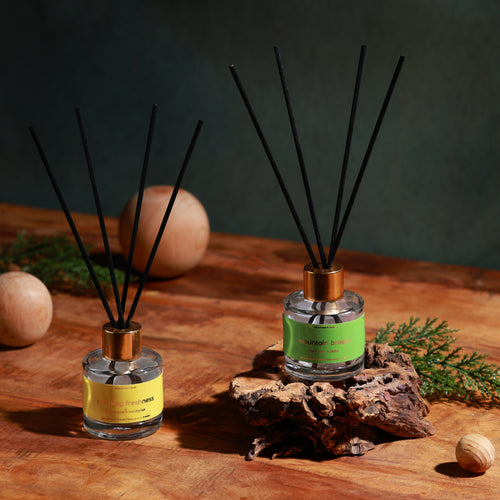 Two low sources · reed duo₹1,548Shop →
  Sukoon · timed, at table height₹1,899Shop → Vaayu · wall-mounted low₹11,999Shop →
Part three — when a machine is not the answer
A double-height room feels like the definitive case for spending money, and often it is not. Work through the free list properly first, because stratification responds to placement better than almost any other large-space problem responds to anything. Lower the source to seating height. Move it several feet clear of direct sunlight and of any AC vent. Run the ceiling fan on its slowest setting, or in its reverse winter direction, which pushes the warm upper air gently down the walls instead of drawing air up. Scent in the evening rather than the afternoon. Then leave it a fortnight — new upholstery and a large rug will absorb a meaningful share of the output for the first few weeks before the room settles. Four free changes and a fortnight of patience resolve a great many of these rooms, and none of them costs ₹11,999.
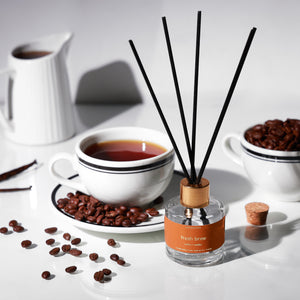
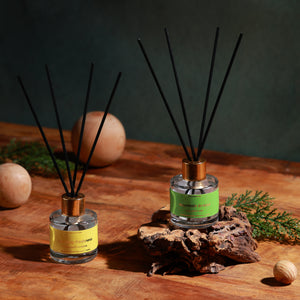
If the free list is exhausted, the next question is how large the occupied layer actually is, not how large the room is. A double-height living room with a 16 × 18 ft seating area is a small room with a lot of empty air above it, and a Sukoon at ₹1,899 placed at table height, running on its two-hour timer in the evening, will do more for it than anything three times the price placed badly. Two reed bottles from ₹849, one at each end of the seating and both low, is the cheapest genuine improvement — output per bottle is fixed, so a second source is the only way to raise the total. And a word about the Megh at ₹3,499, which people reach for in tall rooms because six litres sounds serious: it covers about 215 sq ft, less than the Sukoon. It is a runtime and humidity machine, never a coverage upgrade, and in a double-height room it will disappoint you at a higher price.
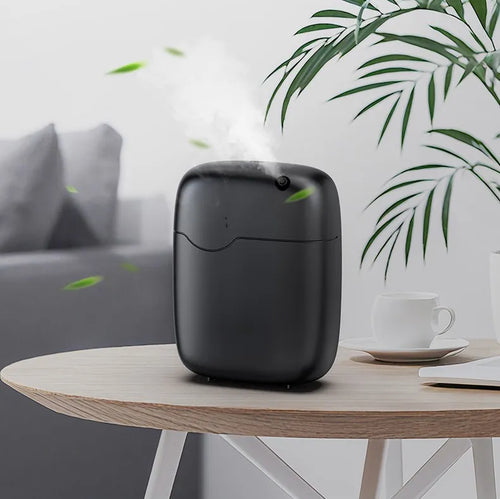
The Vaayu earns its place here only when the whole connected volume is genuinely large — a double-height living room open to a dining area, a stair hall and a gallery, adding up past roughly 800 to 1,000 sq ft of floor with height on top of it. If that is your house, the wall mount is the reason to buy rather than the coverage number, because it lets you put the output at two metres instead of wherever a sideboard sits. Before you commit ₹11,999, one honest thing to weigh: the machine ships with 400ml of cold-air oil — four Hotel Collection fragrances at 100ml each, 90 or more days at a mid setting — and SOSA does not currently sell a separate Vaayu refill. That is a real gap and I would rather name it than have you find it later. The water-based Hotel Collection sold for ultrasonic machines is a different product on a different carrier and does not go into a Vaayu, despite the shared scent names. If continuous supply is a condition of the purchase, ask SOSA where refills stand before you buy.
Part four — the fixes, cheapest first
Five of the eight moves below cost nothing, and in my correspondence they resolve more double-height rooms than every purchase combined.
| The move | What it does to the layers | What it will not fix | Price |
|---|---|---|---|
| 1. Drop the source to seating height ★ | Releases into the occupied layer instead of above it | Nothing — start here, it is the highest-value free change | Free |
| 2. Move it out of direct sun | Stops the source heating and racing through its oil | Will not add output, only stop wasting it | Free |
| 3. Ceiling fan on lowest, or reversed | Gently mixes the warm upper layer back down | A fan on high strips a reed diffuser instead | Free |
| 4. Scent in the evening, not the afternoon | Works with the room when the layers are least separated | Needs a timer or a machine to be practical | Free |
| 5. Wait a fortnight before judging | Lets new upholstery and rugs stop absorbing | Only patience; nothing to buy | Free |
| 6. Second reed source, low, at the far end | Raises total output, which placement alone cannot | Still no propulsion into a tall volume | From ₹849 · duo ₹1,548 |
| 7. Sukoon at table height, on a timer | Scent on demand into the lower layer | 270–320 sq ft; adds a little humidity | ₹1,899 |
| 8. Vaayu, wall-mounted low | Dry undiluted mist, delivered where you choose to mount it | 400ml supplied; no separate refill oil sold today | ₹11,999 |
Versailles
A customer in Nashik wrote to me two winters ago, quite reasonably annoyed, to say that our fragrance smelled beautiful on her first-floor landing and of nothing at all in the living room underneath. She had already replaced the bottle once, assuming a bad batch. What she had was a nineteen-foot void and a diffuser standing on a tall console at the foot of the stairs, which is to say she had built a very efficient delivery system to a part of the house nobody sits in.
We moved the bottle to the coffee table, and I asked her to run the fan on its lowest speed in the evenings. She wrote back a fortnight later to say it was a different room. Nothing had been bought.
I think about that exchange often, because it is the clearest example of something true across this whole cluster: in large spaces, placement is worth more than potency, and the specification on the box is the least useful part of the decision. When a machine genuinely is the answer — and in a big connected villa floor it sometimes is — I would still rather you arrived at it after the free experiments than instead of them. Our reeds are composed and handmade in small batches in Pune, the machines are made in India, and part of every order funds a girl's classroom through Nanhi Kali.
Frequently asked questions
- Why are large open rooms difficult to fragrance? — volume, air exchange and absorption, taken one at a time.
- Best fragrance machine for high-ceiling living rooms — mounting height, and why it decides more than the machine does.
- How to fragrance a villa with high ceilings — the same arithmetic across a whole house.
- The complete large open-space guide — this page and the eight around it, in one place.
- Brand: the SOSA founder story.
SOSA Vaayu specifications (verified from the live product page, August 2026): ₹11,999 (the product page displays a rounded ₹12,000). Waterless cold-air nebulisation — pressurised air atomises undiluted fragrance oil into a dry nano-mist; no water, no heat, residue-free. Coverage up to 1000m³, about 2,000–3,000 sq ft. 400ml refillable tank, 90+ days per fill at a mid intensity setting. Bluetooth app plus onboard buttons, 1h / 4h / 8h / 24h timers, adjustable mist intensity, auto-stop and key-lock. Under 38 dB. DC 12V / 1A, 5W. 165 × 80.5 × 215 mm, 0.9 kg, black or white. Freestanding or wall / HVAC mount. CE, RoHS and SGS certified. Ships with four SOSA Hotel Collection fragrances at 100ml each (400ml in total) in one of three combos chosen at checkout. SOSA does not currently sell a separate Vaayu refill oil; the 400ml supplied in the box is the fragrance available at the time of writing, and buyers who need long-term supply should confirm current refill availability with SOSA before purchasing. The cold-air oil supplied with the Vaayu is a different product from the water-based Hotel Collection sold for ultrasonic machines (15ml ₹299 · 100ml ₹999 · 300ml ₹1,799), which must not be used in a Vaayu despite sharing scent names. Other SOSA machines: Boond 300ml ₹899 (~150 sq ft) · Sukoon 500ml ₹1,899 (270–320 sq ft) · Megh 6L ₹3,499 (~215 sq ft — a runtime and humidity machine, not a coverage upgrade) · Aangan ₹25,999 (~8,000–10,000 sq ft) · Meenar ₹38,500 (12,000–18,000 sq ft) · Safar car diffuser ₹3,999. Reed diffusers 50ml ₹749–₹849 (6–8 weeks) · 130ml ₹1,249–₹1,349 (14–18 weeks) · duo sets ₹1,498–₹1,598 · oil-only refills 300ml ₹2,399 / 500ml ₹3,499. Runtime, consumption and coverage figures are manufacturer specifications and vary with intensity setting, run hours, ceiling height, ventilation and season; any per-month or per-day figure in this guide is arithmetic on those specifications, not a measurement. Electricity costs vary by state tariff. No claim is made that scenting affects ratings, reviews, bookings, occupancy, revenue, health, mood or air quality. Free shipping above ₹499. A portion of every order supports girl-child education through Nanhi Kali. Prices subject to change — see the live product pages.