


The commonest real fault: saturated reeds. Flip all six, once a week, with gloves on.
The second: placement. A reed diffuser needs gentle passing air. A dead corner gives you nothing; an AC vent strips it in a fortnight.
The honest ceiling: reeds are a constant, low background by design. If you want a room to smell strongly on demand, that is a Sukoon at ₹1,899, not more reeds.
2. Flip all six reeds. Not three, not the ones on top — all six, and once a week. Pull them out, turn them end for end, put them back. The saturated end goes down, the dry end comes up, and projection returns within a few hours. Wear gloves; the oil marks fingers.
3. Move the bottle before you add anything to it. Reeds throw scent on passing air. A closed cabinet, a low table behind a sofa or a still corner gives you almost nothing. An air-conditioning vent or open window does the opposite and empties the bottle early. You want a shelf or console near a doorway or walkway, roughly waist to chest height, out of direct sun.
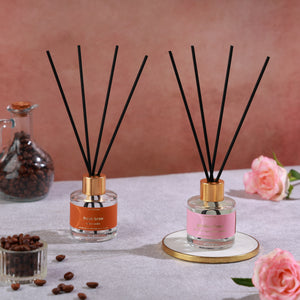
4. Check the bottle against the room. A 50ml is a bedroom, bathroom, study or entryway bottle and runs 6–8 weeks. A 130ml is the living-room bottle and runs 14–18 weeks. Asking a 50ml to carry an open living-dining space is not a fault, it is a mismatch — and the honest fix is the larger bottle or a second one, not more reeds.
5. Check the scent against your expectations. Not every fragrance is built to be loud. On the SOSA scale Fresh Brew is 9.5 and Mountain Breeze 9.4; Evening Calm is 8.9 and deliberately the softest thing we make, because it is meant to help you sleep rather than announce itself.
Everything is composed and handmade in small batches in Pune, and a portion of every order supports girl-child education through Nanhi Kali.
Part one — why a perfectly good reed diffuser goes quiet
Three mechanisms account for nearly every case, and only two of them are faults. It is worth understanding them in order, because the order tells you what to do — and the most likely explanation is also the only one that no purchase will solve. A reed diffuser is a passive, constant, deliberately low-level system. That is its whole design: it cannot surge, it cannot be turned up, and it works by being the same all day. Every complaint about strength is really a collision between that design and an expectation borrowed from something else.
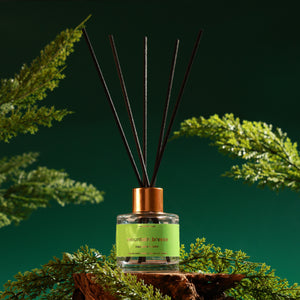
 Mountain Breeze₹849 · 6 fibre reedsA reed works by capillary action: oil climbs the fibre and evaporates off the exposed length. Over a few weeks the exposed end accumulates the heavier, less volatile part of the composition while the lighter molecules leave — and the top of the reed becomes a wick that is full but no longer moving much. The bottle is nowhere near empty; the delivery has stalled. Flipping is the entire fix, and it is free. Turn all six reeds end for end so the saturated section sits in the oil and a fresh surface is exposed to the air. Do it once a week — that is the cadence every SOSA bottle is calibrated around, not a chore we invented. Reeds also matter: SOSA ships six fibre reeds rather than rattan, because rattan's natural pores clog readily in Indian humidity, and a clogged rattan reed is the single most common reason an imported diffuser dies in week two.
Part two — the six causes, in the order they are actually the answer
Ranked by how often each turns out to be the real explanation in the messages we receive. Work down the list rather than jumping to the bottom of it — the top two are free, and between them they account for most cases.
| What you notice | What is actually happening | How often it is this | The fix | Cost |
|---|---|---|---|---|
| Guests comment on it but you smell nothing ★ | Olfactory adaptation — your nose has stopped reporting a constant | Most common by a distance | The doorway test. Nothing else. Rotate scents seasonally if it bothers you | Free |
| Strong on day one, faded by week two or three | Reeds saturated at the exposed end; capillary delivery has stalled | The commonest genuine fault | Flip all six reeds, weekly, with gloves | Free |
| You can only smell it standing next to the bottle | Dead air — no passing movement to carry the scent out | Very common in bedrooms and corner placements | Move to a console or shelf near a doorway, waist to chest height | Free |
| Weak and the oil is disappearing fast | Too much airflow — AC vent, fan, open window, or direct sun | Common in sealed AC flats | Move at least a few feet from the vent and out of the sun | Free |
| Fine in the bedroom, invisible in the living room | Bottle undersized for the volume — a 50ml asked to do a 130ml job | Common in open living-dining layouts | Move up to 130ml, or run two bottles at opposite ends | From ₹1,249 |
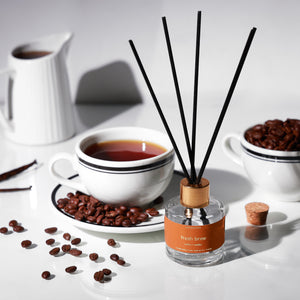
| It has always been gentle, from day one | The composition itself is a quiet one — by design, not by fault | Occasional, and usually with the softer scents | Move to Fresh Brew 9.5/10 or Mountain Breeze 9.4/10 | From ₹849 |
| And the seventh, which is not a fault either: the bottle is simply finished. A 50ml runs 6–8 weeks and a 130ml runs 14–18 weeks. If you are past that window and the level is low, nothing has gone wrong — a 300ml oil refill at ₹2,399 keeps the same vessel running for roughly 8–11 months at about ₹8 per millilitre, against ₹15–17 for a fresh 50ml bottle. It is the cheapest way to keep a scent you already like. | ||||
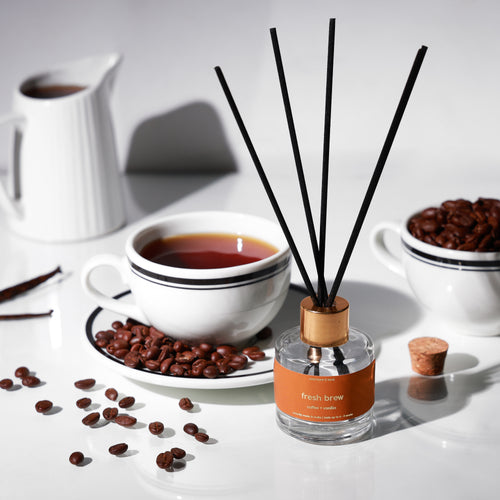
Fresh Brew · 9.5/10from ₹849Shop → 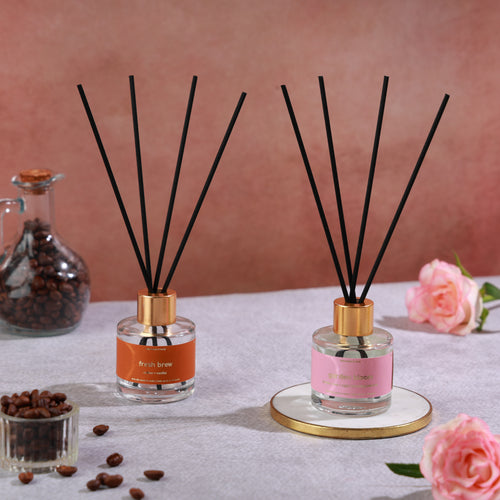 Refill · top up the same bottle₹2,399Shop →
  Sukoon · scent on demand₹1,899Shop →
Part three — the fix order, free things first
Start with the four that cost nothing, in this sequence. The doorway test comes first because it decides whether there is a problem at all: fifteen minutes out of the room, somewhere with its own smell, then attend to the first three seconds when you walk back in. The weekly flip is second — all six reeds, turned end for end, gloves on, and give it three or four hours before you judge the result. Placement is third, and it is the one people resist because the bottle is already where it looks nice: move it to a console or shelf near a doorway or walkway at roughly waist to chest height, at least a few feet from any AC vent or fan, and out of direct sun. Closing the door is fourth and is genuinely underrated — a reed diffuser cannot scent a room whose air is continuously replaced, so a bedroom with the door shut for two hours before bedtime will always outperform the same bottle in an open-plan space.
Then the cheap adjustments. Reed count is the lever most people reach for first and it should be the last: every SOSA bottle ships with six fibre reeds, which is the count the composition is dosed for. Using fewer — four, say — gives you a gentler room and a longer bottle. Adding more raises projection, but it is not free strength: throughput rises roughly in proportion, so ten reeds in a 50ml means a noticeably louder room and a noticeably shorter life, closer to four or five weeks than eight. That is a fair trade if you make it knowingly and a disappointment if you do not. A note on honesty here: SOSA sells the oil as a refill, but not the reeds on their own — the refill is oil only, and every diffuser arrives with its own six fibre reeds. Our own guidance is to refresh reeds every few months, so if yours have done a year of service the practical answers are a new bottle or plain reeds from any craft supplier, which work perfectly well even if they do not wick as evenly as fibre.
And then the two adjustments that involve buying something, in the order I would make them. Size before scent: if the room is the problem, no fragrance fixes it — a 50ml is a bedroom, bathroom, study or entry bottle and a 130ml is the living-room bottle, and a large open living-dining space is often better served by two bottles at opposite ends than by one bottle working too hard. Scent after size: if the room is right and you simply want more presence, move up the strength scale rather than up the volume. Fresh Brew sits at 9.5 and Mountain Breeze at 9.4; Morning Freshness is 9.0, Garden Bloom 8.9 and Evening Calm 8.9. If you are running Evening Calm in a living room and wishing it were louder, you have chosen a sleep fragrance to do a hosting job, and the scent is the thing to change.
Part four — when it is not a fault but the wrong tool
There is a version of this question that no reed diffuser answers, and it deserves to be said plainly rather than sold around. If what you want is a room that smells strongly when you decide it should — before guests arrive, in the twenty minutes after cooking, on a Friday evening and not on a Tuesday morning — that is not a reed diffuser's job and never will be. Reeds are constant and low. The machine that does surge, timing and control is an ultrasonic one, and moving to it is not an admission that the reed failed.
| Do this | What it addresses | When it is the right answer | Cost |
|---|---|---|---|
| 1. The doorway test ★ | Decides whether there is a fault at all | Always first. Resolves most cases outright | Free |
| 2. Flip all six reeds, weekly | Saturated reeds, stalled capillary delivery | Strong at first, faded by week two or three | Free |
| 3. Move the bottle | Dead air, or too much draught and sun | Only smellable up close, or emptying far too fast | Free |
| 4. Adjust reed count | Fine-tunes projection against bottle life | Four reeds for gentler and longer; more for louder and shorter | Free |
| 5. 300ml refill | The bottle is genuinely finished | Past 6–8 weeks on a 50ml or 14–18 on a 130ml, level low | ₹2,399 · 8–11 months |
| 6. Move up to a 130ml, or add a second bottle | Room volume, not fragrance strength | Open living-dining spaces a 50ml was never going to carry | From ₹1,249 |
| 7. Change to a louder scent | Composition pitched softer than you wanted | Right room, right size, still want more presence | From ₹849 |
| 8. Move to a Sukoon | You want control, not more constancy | When "strong on demand" is the actual requirement | ₹1,899 |
Versailles
This is the message I get more than any other, and it is the one I most enjoy answering, because the honest reply usually costs the customer nothing. Someone writes convinced their diffuser has failed, and what has actually happened is that it worked so steadily they stopped hearing it. I ask them to leave the room for a quarter of an hour. Most of them write back slightly embarrassed and entirely delighted, and I would rather have that exchange than a sale.
Where there is a real fault it is nearly always the flip. I did not appreciate for a long time how few people had ever been told to do it — it appears on our bottles and in our instructions now precisely because a stalled reed is such an avoidable way to lose a fragrance you paid for. And I would rather you knew the trade-off honestly: more reeds is more scent and a shorter bottle, not free strength. Six is where each composition is dosed to sit.
The part I insist on saying out loud is the last one. If you want a room to smell strong on demand, a reed diffuser is the wrong instrument and no amount of my fragrance will change that. Buy the machine, keep the reed, and let each do the thing it is good at. Everything we make is composed and handmade in Pune, and a part of every order funds a girl's classroom through Nanhi Kali.
Frequently asked questions
- Why is my reed diffuser not smelling strong enough? and why can I only smell it standing next to it? — the two closest neighbours to this page.
- How to make a reed diffuser smell stronger — every lever, ranked by what it costs you in bottle life.
- Should you flip reed diffuser sticks? and how many reeds should you use? — the two free levers in full.
- The airflow and placement guide — AC vents, fans, windows and where a bottle actually belongs.
- Brand: the SOSA founder story.
SOSA reed diffuser range & prices (verified August 2026): alcohol-free, phthalate-free and paraben-free compositions on a heat-stable coconut-derived CCT base, IFRA-compliant, supplied in a refillable glass bottle with six fibre reeds; 50ml lasts 6–8 weeks and 130ml lasts 14–18 weeks. Morning Freshness (Malabar lemon · peppermint · eucalyptus) 50ml ₹749 · 130ml ₹1,249 · 9.0/10; Garden Bloom (British rose · night-blooming jasmine) 50ml ₹799 · 130ml ₹1,299 · 8.9/10; Evening Calm (Himalayan lavender · chamomile) 50ml ₹799 · 130ml ₹1,299 · 8.9/10; Fresh Brew (Coorg coffee · Kerala vanilla) 50ml ₹849 · 130ml ₹1,349 · 9.5/10; Mountain Breeze (Himalayan pine · sage · Indian cedar) 50ml ₹849 · 130ml ₹1,349 · 9.4/10. Reed diffuser refills (oil only — vessel and reeds reused) 300ml ₹2,399, roughly 8–11 months · 500ml ₹3,499, roughly 14–18 months; about ₹7–8/ml against ₹15–17/ml for a 50ml bottle. Duo sets from ₹1,498 for 2 × 50ml. Strength figures are positions on SOSA's own internal strength scale, not an industry standard. Replacement reeds are not sold as a separate SKU; SOSA guidance is to refresh reeds every few months. The reed line is separate from the water-based Hotel Collection for ultrasonic machines (15ml ₹299 · 100ml ₹999 · 300ml ₹1,799) and the two are not interchangeable. Diffusers: Boond 300ml ₹899 · Sukoon 500ml ₹1,899 · Megh 6L ₹3,499. Composed and handmade in small batches in Pune, India; tested through 45°C summer heat and 85% monsoon humidity. Free shipping above ₹499. A portion of every order supports girl-child education through Nanhi Kali. Prices subject to change — see the live product pages.