
 Test bottle ₹749 Room over 150 sq ft ₹1,249
 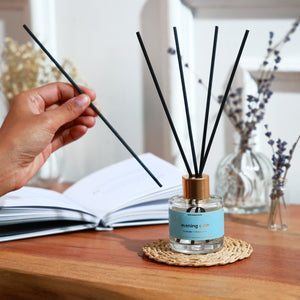 Bedroom option ₹799
  Living room option ₹849
  Year two ₹2,399
The test: leave the flat for two hours and walk back in, or ask someone arriving from outside. If they smell the room from the doorway and you don't, it's adaptation — the bottle is working. If nobody smells anything past a metre from the bottle, it's dead air.
If it's neither: check whether the top half of the reeds has gone dry while oil remains (the reeds are finished, not the oil), or whether the room is simply bigger than a 50ml is rated for — 150 sq ft is the line, and above it the fix is a 130ml at ₹1,249–₹1,349, not a second 50ml.
2. If nobody smells it past a metre from the bottle, the room's air is too still — dead air. A reed diffuser has no fan; it depends entirely on the room's own air movement to carry evaporated oil away from the fibres. In a sealed room with no cross-draught, scent forms a shallow pool around the bottle and never leaves it. Move the bottle into the path of the door swing, at the edge of a fan's reach, or near a threshold people actually cross — never a dead corner, a cabinet, behind a curtain or a low shelf wedged between furniture.
3. If your visitor smells it from the doorway and you don't, it's adaptation — and the bottle is working. The nose stops reporting a smell that never changes within days; nothing eliminates that, and a stronger bottle only becomes stronger for guests, not for you. Walking past the bottle briefly raises the concentration enough to break through, which is exactly why you notice it there and nowhere else. Placing the bottle near the entrance, where your nose is least adapted on arrival, does more than any upgrade.
4. Rule out the other two causes before you spend anything. If the top half of the reeds has gone dry while oil remains in the bottle, and flipping no longer helps, the reeds are finished, not the oil. And if the room is genuinely above 150 sq ft, a 50ml was never going to reach it — that's a sizing mismatch, not a fault, and the fix is a 130ml at ₹1,249–₹1,349 rather than a second 50ml.
5. Fix in order of cost. Three of the four real fixes cost nothing — repositioning the bottle, ten minutes of cross-ventilation a day, and moving it near the entrance. Try all three before spending a rupee on a bigger bottle.
Alcohol-free, IFRA-compliant, composed by an ISIPCA Versailles-trained perfumer and handmade in small batches in Pune — and every purchase funds a girl's education through Nanhi Kali.
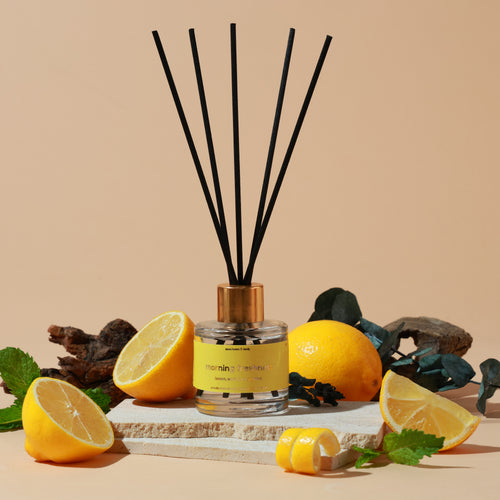
Why the identical complaint has two opposite causes
A reed diffuser has no fan, no mist and no way of pushing anything anywhere. Oil climbs six fibre reeds by capillary action and evaporates off the exposed ends at whatever rate the room allows — which means the room, not the bottle, is doing the work of carrying scent outward. In a sealed room with no cross-draught, that evaporated oil simply hangs in the air closest to where it left the reed and goes no further. Walk within a metre of the bottle and you are standing inside that shallow pool; step back to the sofa and you have stepped out of it. The bottle has not weakened. The room has nowhere for the scent to go.
The second mechanism has nothing to do with air movement and everything to do with your own olfactory system. A nose stops reporting a constant, unchanging signal within days — a basic feature of how smell works, not a flaw in you or the fragrance. Once the room's baseline concentration is fully adapted to, it effectively disappears from awareness while you're sitting still inside it. Walking past the bottle briefly increases the concentration you're exposed to, and that jump — the gradient, not the smell itself — is what breaks through the adaptation for a few seconds before it fades again. This is why the complaint is worded exactly the way it is: only when I walk past it.
Both mechanisms produce the identical sentence — "I can only smell it when I walk past it" — which is precisely why guessing is a bad strategy here. One cause needs airflow and a different spot in the room. The other needs nothing bought at all, and buying something anyway is the expensive mistake this post exists to prevent. The two-hour test, or a visitor's honest report from the doorway, is the fastest way to tell which one applies before a rupee is spent.
The four causes, and how to tell them apart
 Morning Freshness 50ml₹749A reed diffuser relies entirely on the room's own air movement to carry evaporated oil off the fibres — it has no fan of its own. In a closed room with no cross-draught, that oil hangs in a shallow pool immediately around the bottle and gets no further. The fix is not more reeds; it is putting the bottle where air actually moves — in the path of the door swing, at the edge of a fan's reach, near a threshold people walk through. Never in a dead corner, inside a cabinet, behind a curtain, or on a low shelf wedged between furniture — all four are where a bottle goes to be ignored. Ten minutes of two-opening cross-ventilation a day changes how the whole room behaves and costs nothing.
The diagnostic table
Run through this before buying anything. Match what you're actually observing to the row below, not to what seems most likely — the two most common causes produce an identical-sounding complaint, and only the test tells them apart.
| What you notice | Likely cause | The test | The fix |
|---|---|---|---|
| You smell it only within a metre, and a visitor standing there says the same | Dead air | Ask them to step back a metre | Move it into moving air — door swing, fan edge, a threshold. Free. |
| A visitor walking in from outside smells it before you do | Nose adaptation | Leave for two hours, walk back in | Nothing to fix. Move nearer the entrance if you want to notice it too. |
| Top half of the reeds is dry, oil is still visible in the bottle, flipping does nothing | Reeds finished | Check reed colour and remaining oil level | The reeds have reached the end of their life, not the oil — they need replacing |
| 50ml bottle in a room that's genuinely 200 sq ft or more | Room bigger than the bottle | Measure the room | 130ml, ₹1,249–₹1,349 — the room outgrew the bottle |
| Bottle stands in a cabinet, behind a curtain, or on a low shelf boxed in by furniture | Dead air by placement | Look at what's actually around it | Move to an open surface at chest height. Free. |
| Directly under an AC vent or on a windowsill, and the bottle empties within three weeks | Too much airflow — the opposite fault | Check its position against the vent or window | Move 300mm off the sill and out of the direct vent path |
| Note: the first two rows produce the exact same sentence from the reader — "I only smell it when I walk past it" — and are the reason this table exists. Everything else is rarer but worth a thirty-second check before you spend. | |||
Morning Freshness · the test bottle50ml ₹749Shop → Morning Freshness · room over 150 sq ft130ml ₹1,249Shop → 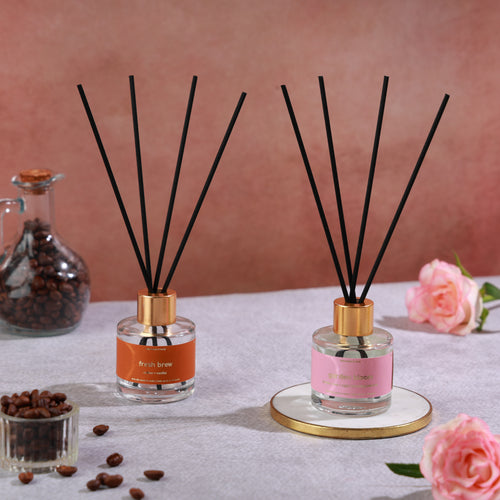 Refill · once you've found the right bottle300ml ₹2,399Shop →
Placement, height and the fixes that cost nothing
Placement is the entire fix for dead air, and it costs nothing. Stand the bottle in the path of the door swing, at the edge of where a ceiling fan or table fan actually reaches, or near a threshold people walk through several times a day — a hallway console, the edge of the kitchen counter, the shelf by the main door. Never in a dead corner, inside a cabinet, behind a curtain or on a low shelf boxed in between furniture; all four are chosen for looking tidy, not for having any air movement at all. Alongside repositioning, ten minutes of two-opening cross-ventilation a day — a window and a door, or two windows, open together — changes how the whole room behaves and does more for a stagnant flat than any amount of reed-swapping.
Height matters nearly as much as position. Stand the bottle at roughly chest height rather than on the floor: scent needs to reach breathing height to be noticed, and a bottle standing on the floor loses much of its throw to the stillest layer of air in the room, which sits low. A console, a sideboard, a bookshelf edge or a kitchen counter all work; a low shelf tucked beside a sofa or bed does not, however open the room otherwise feels.
None of this touches adaptation, because adaptation isn't in the room — it's in you. The only genuine mitigation is meeting the scent at a point where the nose hasn't had time to adapt, which is the entrance rather than the sofa or the bedside table where you sit still for hours. Reed count plays a supporting role too: three reeds gives a softer, steadier signal that's less likely to provoke rapid adaptation than six, and it happens to also run 10–14 weeks instead of 6–8. Flip the reeds every three to five days regardless of the cause — it's the one piece of maintenance every reed diffuser needs, and skipping it is a separate, third reason a bottle can seem to fade.
What it costs, in the order you should actually spend
Three of the four real fixes cost nothing at all, and all three are worth trying before a rupee changes hands. Only the fourth — sizing up because the room is genuinely too big — costs anything, and even then it's a one-time upgrade, not a subscription. The weekly running costs below are worked by hand from the reed counts SOSA actually quotes: 6–8 weeks a bottle at six reeds, 10–14 weeks at three.
| Fix | What it involves | Covers | Cost |
|---|---|---|---|
| 1. Run the test | Two hours out and back in, or ask someone arriving from outside | Tells you dead air from adaptation | ₹0 |
| 2. Reposition the bottle | Door swing, fan edge, or a threshold — chest height, not the floor | Dead air | ₹0 |
| 3. Move it near the entrance | Meets the scent on arrival, when the nose is least adapted | Nose adaptation | ₹0 |
| 4. Cost per week, current bottle | ₹749–₹849 divided by 6–8 weeks at six reeds, or 10–14 at three | What you're already paying, either way | ₹54–₹142 |
| 5. Size up ★ | 130ml, all six reeds — only if the room is genuinely over 150 sq ft | A room the bottle was never rated for | ₹1,249–₹1,349 |
Versailles
This question arrives in almost the same words every time: "I can only smell it when I walk past it — is it faulty?" It rarely is. I've traced this exact complaint back to a genuinely faulty bottle perhaps twice in years of doing this; the other hundred times it was either a room with nowhere for the scent to go, or a nose that had simply stopped reporting a smell that hadn't changed in a week.
What I want readers to take from this one is the order of operations, because it's the part people skip. Test first. Then diagnose. Only then consider spending anything — and even then, the honest answer for most flats is a few feet of repositioning, not a bigger bottle. I understand the instinct to buy your way out of a problem; it's just rarely the actual fix here.
The one case where spending is genuinely correct is a room that has outgrown its bottle — nothing wrong with either the bottle or your nose, just a mismatch in scale. For everything else, the two-hour test costs nothing and tells you exactly what to do next. Every purchase funds a girl's education through Nanhi Kali — not a percentage, not a quarterly cheque. Every one.
Frequently asked questions
- I want my home to smell good when I enter but I become nose-blind after a few minutes — the same test, worked through in full.
- Where should I put a reed diffuser in a small bedroom with one window? — the placement rules, room by room.
- Reed diffuser placement in a 2BHK apartment with an open balcony — dead air and draughts, mapped by room.
- My bed is near the AC — where should the reed diffuser go? — the opposite fault: too much airflow.
- Brand: the SOSA founder story.
SOSA products & prices (verified August 2026): Scented candles from ₹379 (small, ~15–18 hrs) · candle duos ₹664 (~30–36 hrs) · wax melts ₹474 · woodenwick and ceramic jar candles ₹949. Reed diffusers: Morning Freshness 50ml ₹749 · 130ml ₹1,249 · Evening Calm 50ml ₹799 · 130ml ₹1,299 · Garden Bloom 50ml ₹799 · 130ml ₹1,299 · Fresh Brew 50ml ₹849 · 130ml ₹1,349 · Mountain Breeze 50ml ₹849 · 130ml ₹1,349; six fibre reeds and refillable glass with every bottle, 50ml lasts 6–8 weeks at six reeds and longer at three, 130ml 14–18 weeks. Reed duo sets 2 × 50ml ₹1,498–₹1,598 · 2 × 130ml ₹2,498–₹2,598. Reed refills 300ml ₹2,399 · 500ml ₹3,499. Ultrasonic diffusers: Boond ₹899 (USB) · Sukoon ₹1,899 (ships with three 15ml fragrances) · Megh ₹3,499; Hotel Collection water-based fragrance 15ml ₹299 · 100ml ₹999 · 300ml ₹1,799 — a fragrance for a machine, not a standalone product. Reed oil and the water-based Hotel Collection are not interchangeable. Alcohol-free, phthalate-free, paraben-free, IFRA-compliant; composed and handmade in small batches in Pune. Every purchase funds a girl's education through Nanhi Kali. Prices and availability subject to change — see the live product pages.