


Patchy or one-sided darkening is a placement problem: sun on one face, or a draught drying one side faster than the other. Move the bottle before you replace anything.
Sticky, tacky or crusted dark residue is the end of a reed's life. That is heavy residue that no longer moves. Flipping will not clear it; fresh reeds will.
Reeds are the consumable and are not sold separately. SOSA guidance is to refresh them every few months — a new bottle arrives with six fresh fibre reeds; plain reeds from a craft supplier work too.
2. If one side is markedly darker than the other, look at the light and the air, not the oil. Direct sun on one face heats and oxidises that side faster; a fan or split AC blowing across the bottle dries the windward reeds and leaves the leeward ones wetter. Both produce a lopsided set. Move the bottle several feet clear and out of the sun, and the next set of reeds will shade evenly.
3. If the dark part is sticky, the reed is finished. Run a gloved finger down the exposed end. Slightly oily is right. Tacky, gummy, or leaving a brown smear is a reed whose pores are occupied by residue that will not move again. This is the one reading that means replace rather than flip.
4. Dark at the bottom, pale at the top, is not darkening at all — it is a stalled wet line. That is an absorption problem, and the fix is a flip first, then a look at reed count and immersion depth.
5. Speckling — small black or grey dots rather than an overall shade — is dust settled onto an oily surface. Homes near a main road, a building site or an open kitchen see it early. Cosmetic at first, a genuine blockage later.
6. No colour reading is ever a reason to throw away oil. The oil is the stable part of the system; the reeds are the consumable, and most people have that the wrong way round. We do not sell replacement reeds separately — the refill is oil alone — so refreshing means a new bottle, which arrives with six fresh fibre reeds, or plain reeds from a craft supplier.
Composed and handmade in small batches in Pune, and a portion of every order supports girl-child education through Nanhi Kali.
Part one — what the colour is actually made of
There is a persistent belief that a clear fragrance oil should leave a clear reed, and that anything else is contamination. It comes from thinking of fragrance as a single liquid. It is not. A composition is a structure of thirty or forty materials with wildly different molecular weights, and a reed diffuser is, in effect, a very slow separation column. The light materials climb and leave; the heavy materials climb and stay. Everything you can see on a used reed is the part of the fragrance that was never going to reach the far side of the room in the first place, deposited in the order it stopped moving. Three things drive the shade you end up looking at, and only one of them is a problem.
 Evening Calm₹799 · 8.9/10The exposed centimetres of a reed are a thin film of oil held on an enormous surface area, in permanent contact with air. That is close to ideal conditions for oxidation, and oxidation darkens most fragrance materials. Warmth accelerates it, which is why the same scent shades faster on a west-facing shelf in a Nagpur May than in a shaded Bengaluru hallway. This is the one normal process that a change of placement genuinely slows. Out of direct sunlight, several feet clear of an AC vent or fan, at waist to chest height in gently passing air — the placement we recommend for fragrance reasons happens to be the placement that keeps reeds palest, because sun and draught are the two accelerants for both problems at once.
Part two — the shade chart, and what each reading means
This is the table I wish I could put in every box. Work down it until you find the picture in front of you, then do only what the last column says. Note that timings assume six fibre reeds in an ordinary Indian room; a ten-reed bottle in a hot month will run through these stages considerably faster, and a four-reed bottle in a cool sealed room considerably slower.
| What you see | Typical timing | What it is | Does it matter | What to do |
|---|---|---|---|---|
| Pale straw, barely changed ★ | Weeks 1–2 | Fresh fibre with a light oil film | No — this is the start of the curve | Nothing. Flip weekly and let it settle |
| Warm honey, even on all six | Weeks 3–6 | Coloured base materials concentrating | No — the expected working state | Nothing. This is a healthy mid-life reed |
| Deep amber, even, still supple | Week 7 onwards, or earlier with Fresh Brew | Oxidation plus concentration, mature | No, provided a flip still lifts the room | Keep flipping. Plan a reed refresh in a month or two |
| Dark on one face, pale on the other | Any time | Direct sun, or a draught drying one side | Yes — it is costing you weeks of bottle life | Move out of the sun and clear of the AC or fan |
| Black or grey speckles near the tip | Any time, faster near traffic | Airborne dust settled onto an oily surface | Cosmetic first, then a real blockage | Refresh reeds; consider a less exposed surface |
| Dark, stiff, tacky, crust at the neck | After a few months | Residue that no longer moves | Yes — the reed has reached the end of its life | Fresh reeds. The oil is still perfectly good |
| The honest caveat: we do not sell replacement reeds as a separate product, and I will not pretend otherwise. The refill is oil only. Six fresh fibre reeds arrive in every new bottle, and plain undyed reeds from a craft or packaging supplier will do the job perfectly well between bottles. Our guidance is to refresh them every few months rather than to run them until they fail. | ||||
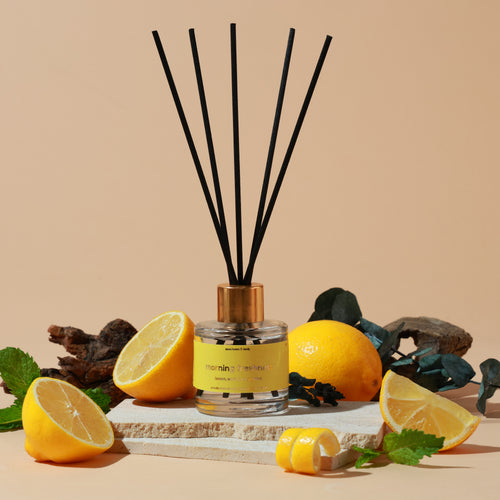 Morning Freshness · stays palestfrom ₹749Shop →
 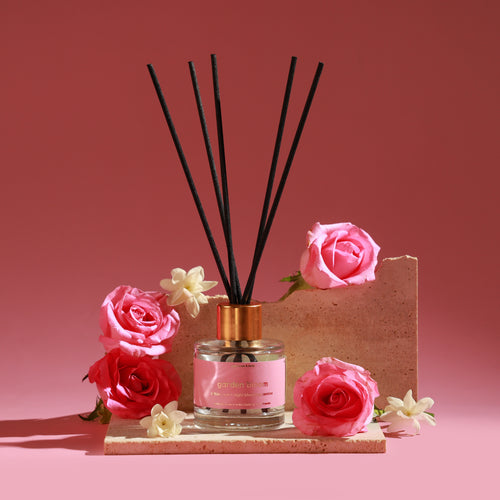 Garden Bloom · six fresh reedsfrom ₹799Shop →
 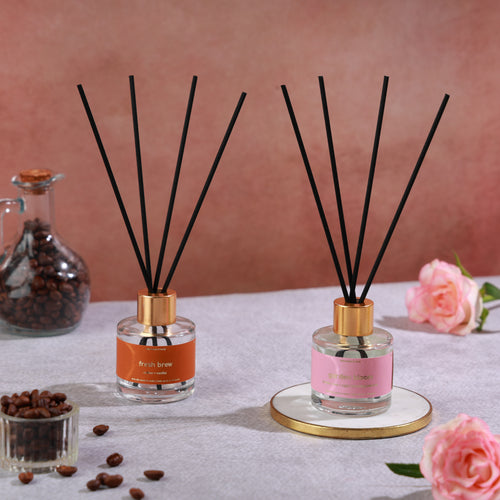 Oil refill · the oil is the stable part₹2,399Shop →
Part three — how fast is too fast, and what accelerates it
The question behind the question is usually not "why is it dark" but "why is it dark already". Speed is the more informative variable, and it is set almost entirely by conditions rather than by the fragrance. Heat is the largest single accelerant: warm oil is thinner, moves faster and oxidises faster, so a bottle on a shelf that catches afternoon sun through a west window will run its reeds through the whole shade chart in half the time of an identical bottle in an interior hallway. Reed count is the second. Ten reeds means ten surfaces accumulating residue, and each one is doing it at close to the same rate as six would, so the visible ageing arrives sooner and the bottle empties sooner — four to five weeks on a 50ml rather than six to eight. Neither of those is a fault. Both are choices, and both are reversible.
Humidity behaves differently, and this is where the material of the reed matters. Rattan is a natural cane with open pores, and in an 85% monsoon those pores swell and take on moisture, so the reed both darkens unevenly and wicks worse at exactly the same time — a genuinely miserable combination that accounts for a great many imported diffusers dying in their second week of July. SOSA reeds are fibre rather than rattan for precisely this reason: a synthetic fibre reed has a manufactured, consistent capillary structure that does not swell, so it keeps wicking through a monsoon and darkens evenly rather than in blotches. It still darkens. It simply darkens honestly, in a way you can read.
The third accelerant is one people rarely suspect: the room's own air. Dust, cooking aerosols and the particulate of a busy road settle on an oily surface and stay, and once they do they are inside the wicking path. A kitchen bottle or a windowsill bottle above a main road will speckle and stiffen months before an identical bottle in a bedroom. The sensible response is not to buy differently but to plan a reed refresh more often — and, in a kitchen, never to diffuse over live cooking. Fragrance layered onto cooking makes a third smell nobody designed.
Part four — what to do about it, in order
Everything above turned into a decision. The first three lines cost nothing at all, and most photographs I am sent are answered by the first line alone.
| The picture | The action | What it fixes | Cost |
|---|---|---|---|
| Even amber, flip still lifts the room ★ | Nothing at all — keep flipping weekly with gloves | Nothing needs fixing; this is the plateau you paid for | Free |
| Uneven, one face darker | Move out of direct sun and several feet clear of AC or fan | Stops the uneven drying that also empties the bottle early | Free |
| Dark low, pale high | Flip all six, then check immersion depth and reed count | A stalled wet line — an absorption issue, not a colour one | Free |
| Dark and tacky, flip does nothing | Fresh reeds — from a new bottle, or plain reeds from a craft supplier | Restores capillary flow through oil that is still perfectly good | Not a SOSA SKU — see the note below |
| Reeds spent and oil low together | A new bottle — it arrives with six fresh fibre reeds | Resets both halves of the system at once | From ₹749 · 50ml, from ₹1,249 · 130ml |
| Reeds spent, plenty of oil left | Refresh reeds now, and put a 300ml refill aside for later | Keeps you in oil at roughly half the per-millilitre price | ₹2,399 · about 8–11 months |
Versailles
I could make reeds that never discolour. There are two ways to do it, and I dislike both. The first is to strip the coloured naturals out of the composition and rebuild it from pale synthetics, which gives you a fragrance that looks tidy on a shelf and has no depth in a room. The second is to dye the reeds dark from the outset so you cannot see what is happening to them. The second is more common than people imagine, and it is a way of hiding the single most useful diagnostic you own.
Our reeds are left plain deliberately. When you can watch the fibre shade from straw to honey to amber, you can read the life of the bottle without measuring anything — where you are in the curve, whether one side of the room is hotter, and from a single gloved touch whether a flip will help this week or whether it is time for fresh reeds.
The part I am least comfortable with is that I cannot yet sell you those fresh reeds. It is a genuine gap in the range and I would rather name it than dress it up: the refill is oil, six reeds come with each new bottle, and plain reeds from a craft supplier work in the meantime. Everything we make is composed and handmade in small batches in Pune, and a part of every order funds a girl's classroom through Nanhi Kali.
Frequently asked questions
- How do you know when reeds need replacing? — the five signs, in the order they appear.
- Can reeds become clogged? and why have they stopped absorbing oil? — what dark residue does next.
- Should you use new reeds when refilling? — why not to pour a ₹2,399 refill over spent reeds.
- The complete reed replacement guide — this page and the eight around it, in one place.
- Brand: the SOSA founder story.
SOSA reed diffuser range & prices (verified August 2026): alcohol-free, phthalate-free, paraben-free and IFRA-compliant compositions on a heat-stable coconut-derived (CCT) carrier, low-VOC, supplied in a refillable glass bottle with six fibre reeds; 50ml lasts 6–8 weeks and 130ml lasts 14–18 weeks. Morning Freshness (Malabar lemon · peppermint · Nilgiri eucalyptus) 50ml ₹749 · 130ml ₹1,249 · 9.0/10; Garden Bloom (British rose · night-blooming jasmine) 50ml ₹799 · 130ml ₹1,299 · 8.9/10; Evening Calm (Kashmir lavender · chamomile) 50ml ₹799 · 130ml ₹1,299 · 8.9/10; Fresh Brew (Coorg coffee · Kerala vanilla) 50ml ₹849 · 130ml ₹1,349 · 9.5/10; Mountain Breeze (Himalayan pine · sage · Indian cedar) 50ml ₹849 · 130ml ₹1,349 · 9.4/10. Reed diffuser refills are oil only — you reuse your own vessel and reeds: 300ml ₹2,399 (roughly 8–11 months) · 500ml ₹3,499 (roughly 14–18 months), about ₹7–8 per ml against ₹15–17 per ml for a 50ml bottle. Duo sets ₹1,498–₹1,598 for 2 × 50ml and ₹2,498–₹2,598 for 2 × 130ml. Strength figures are positions on SOSA’s own internal strength scale, not an industry standard. Replacement reeds are not sold as a separate SKU; SOSA guidance is to refresh reeds every few months. The reed line is separate from the water-based Hotel Collection for ultrasonic machines (15ml ₹299 · 100ml ₹999 · 300ml ₹1,799) and the two are not interchangeable. Diffusers: Boond 300ml ₹899 · Sukoon 500ml ₹1,899 · Megh 6L ₹3,499 · waterless Vaayu ₹11,999. Composed and handmade in small batches in Pune, India; tested through 45°C summer heat and 85% monsoon humidity. Free shipping above ₹499. A portion of every order supports girl-child education through Nanhi Kali. Prices subject to change — see the live product pages.