
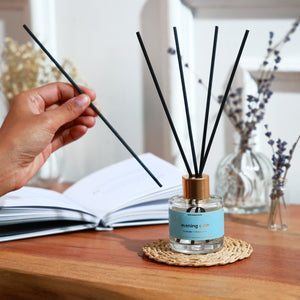




The four-question test. Do you need (1) roughly the same fragrance level across a whole volume rather than in a zone; (2) a dial — the ability to make it stronger or softer today rather than over weeks; (3) a clock — fragrance at the hours you choose and none at the hours you do not; (4) presence at a distance, so the fragrance finds you rather than you going to it? Yes to none: keep the reed. Yes to one: it is often still free. Yes to two or more: active diffusion is the honest answer.
Which active: Sukoon ₹1,899 — 500ml, 270–320 sq ft, 16–18 hours on low, three 15ml Hotel Collection scents included — is the first genuine coverage upgrade and should never be skipped on the way to something dearer. Waterless is the answer only when the water itself is your objection: dilution, added humidity, white mineral dust in hard-water cities, a tank to fill. Safar ₹3,999 is the waterless mechanism at personal scale, and it is named and sold as a car and travel diffuser, with no published room-coverage figure, a 1/2/3-hour timer and a battery to recharge.
The honest gap: between Safar ₹3,999 and Vaayu ₹11,999 there is no mid-sized waterless bedroom nebuliser in our range. Vaayu is rated to 1000 m³, roughly 2,000–3,000 sq ft, and is the wrong purchase for one bedroom.
2. When you want a dial and a clock. A reed has one setting per reed count, and changing it takes days to show. An active diffuser can be stronger this evening and softer tomorrow, on for the hours you are in the room and off for the hours you are not. If you have ever thought I want this at seven and not at three in the morning, that is a timing requirement and only a machine has a clock.
3. When you want presence at a distance rather than proximity. A reed rewards you for coming near it, and there is nothing wrong with that — it is the correct use of the format. But if the brief is that the fragrance should find you across the room, the bottle has no mechanism for it at any price or any size.
4. Not because of budget, and not because you have owned the reed a long time. There is no natural graduation here. Somebody in a small closed bedroom who sits near their bedside table is correctly served by a ₹799 bottle indefinitely, and would be worse served by a machine they have to fill, charge or listen to. Spending more is not progress if the requirement has not changed.
5. Choose waterless specifically when the water is your objection. An ultrasonic like Sukoon at ₹1,899 covers 270–320 sq ft, runs 16–18 hours on low and arrives with three 15ml Hotel Collection scents — and it dilutes the oil in water, adds humidity to the room, can leave a white mineral dust in hard-water cities, and needs filling. If none of that troubles you, it is very often the correct answer and you should not be walked past it. If it does, Safar at ₹3,999 shatters undiluted oil into a dry mist with no water at all — while being named and sold as a car and travel diffuser, with no published room-coverage figure, a timer that runs only 1, 2 or 3 hours, and a battery that needs recharging.
Alcohol-free, phthalate-free, made in Pune. A portion of every order supports girl-child education through Nanhi Kali.

The four requirements a passive source cannot meet, whatever you spend on it
These are the only honest reasons to move. Everything else — a deeper scent, a longer-lasting bottle, a nicer object, a better composition — is available inside the passive range and should be bought there, because it is cheaper, quieter and less trouble. Read the three cards below and count how many describe you. The counting is the method; the products come afterwards.
 Sukoon₹1,899A reed produces a concentration that is highest at the bottle and falls with distance. The falloff is smooth, but perception compresses it, so you experience a corner with an edge rather than a gentle slope. Nothing is faulty; that is the design. If your requirement is that the whole room should read alike, the only instrument that delivers it is one that puts fragrance into air already in motion, so that the room’s own circulation does the distributing rather than a gradient doing it badly. This is also why a second bottle does not solve it: two peaks, one valley, and the midpoint is the farthest point from both sources.
 Machine oils₹299Reed count is a real volume dial — six is full projection, three is a soft bedside level that roughly doubles the life — but it is a slow dial with about three positions, and each adjustment takes days to express itself. It also runs continuously whether or not anybody is in the room, which is the only genuine waste in a reed: oil evaporating into an empty flat is a placement and occupancy question rather than a product fault. An active diffuser gives you speeds you can change in a second and a timer you can set. Safar has three speeds and a 1, 2 or 3-hour auto-off; Vaayu has adjustable intensity with 1h, 4h, 8h and 24h windows and a choice of days.
 Evening Calm₹799This is the requirement that sends most people looking, and the one most often misdiagnosed as a weak product. If the fragrance is lovely beside the bottle and absent from the bed, nothing has failed — you are simply asking a point source for something a point source does not do. Before you accept that this is your requirement, though, rule out the cheaper explanation: you may not have stopped smelling it because it stopped working, but because you stopped noticing. Receptors adapt to a constant stimulus within minutes; the signal keeps arriving and the brain stops reporting it. Leave the room for fifteen minutes and walk back in, and ask somebody who does not live there. A visitor is a better instrument than you are, and if guests remark on it while you do not, there is nothing here to buy.
Waterless or water — the second question, and much the easier one
Once the four-question test says a machine is warranted, there is a second decision that people skip and then regret. Active diffusion comes in two forms in this range and they are not near-equivalents. An ultrasonic — Boond ₹899, Sukoon ₹1,899, Megh ₹3,499 — vibrates a mixture of water and oil into a visible wet mist. It moves air and covers a room, which is the genuine step up. The oil is diluted in water, the output adds humidity to the room, and in a hard-water city it can leave a fine white mineral dust on surfaces near it. A waterless cold-air nebuliser — Safar ₹3,999, Vaayu ₹11,999 — uses pressurised air to shatter undiluted oil into a dry micro-mist that travels on the room’s own airflow. No water, no dilution, no heat, no added humidity, no dust. It is the technology used to scent hotels, though I should say plainly that SOSA is an independent house and is not affiliated with any hotel brand.
The reason to pay the difference is therefore quite specific: you pay for waterless when the water is the thing you object to. In a Delhi winter the added humidity of an ultrasonic may be pleasant; in a Mumbai monsoon it may be exactly what you do not want. If your building runs hard water, the white dust is a real and recurring annoyance. If you dislike refilling a tank, waterless removes the tank — and replaces it with a battery to charge, which is not nothing. And there is a perfumery reason too: undiluted oil smells different from the same oil dispersed through water, because it is not competing with water for the droplet. Same material, different payload.
There is one warning I put on every page in this family, because it is the likeliest disappointment in the whole decision. Changing mechanism usually means changing scent. Reed oil cannot go into an ultrasonic machine. The water-based Hotel Collection cannot go into reeds, and there is no hotel-inspired reed diffuser. Safar takes pure fragrance oil, and thick, sticky or water-based blends can clog it. So if you love Mountain Breeze and you buy a machine expecting Mountain Breeze to come with you, you will be disappointed on day one for a reason that has nothing to do with the machine. The right instruction is nearly always add rather than switch: keep the reed where you sit, and let the machine handle the volume.
The test, scored — what your answers mean and what they cost
The four questions with the honest response to each score, including the two scores where the correct action is to spend nothing. I have included the free row and the missing-product row deliberately, because a decision table that only ever points at a purchase is not a decision table.
| Your requirement | Can a reed meet it? | Try this first, free | If free fails |
|---|---|---|---|
| Evenness across a whole room | No — a point source makes a gradient, and two make two peaks | Ceiling fan on low, door closed | Sukoon ₹1,899 |
| A dial you can change today | Partly — reed count is a slow dial with about three positions | Three reeds instead of six for a week, then judge | A machine with speeds |
| A clock — on at chosen hours, off at others | No — it runs continuously, occupied or not | Nothing free solves this | Safar 1/2/3h timer; Vaayu 1h/4h/8h/24h |
| Presence at a distance from the bottle | No — it has no transport at any size or price | Halve the distance; fan on low; fifteen-minute test | Sukoon, then Safar |
| A deeper or longer-lasting scent | Yes — this is what the passive range is for | Six reeds; go up the strength scale; 130ml | Stay passive. A machine is not the answer |
| None of the four | You do not have an upgrade problem | Keep the reed — ~₹13–₹15 a day, silent, never breaks | Spend nothing |
| Not this: Megh as the answer to any of them | Six litres, ~100h runtime, only ~215 sq ft — less than the ₹1,899 Sukoon | It is a runtime and humidity machine, not a coverage one | ₹3,499 spent on the wrong axis |
| The gap in our range | No mid-sized waterless bedroom nebuliser exists between Safar ₹3,999 and Vaayu ₹11,999 | Vaayu is 1000 m³, roughly 2,000–3,000 sq ft — wrong for a bedroom | Said plainly rather than stretched |
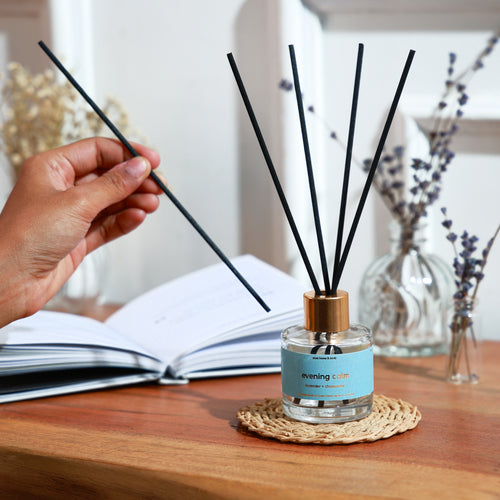 Stay passive · Evening Calm₹799Shop → Go active · Sukoon₹1,899Shop →
  Machine oils · not for reeds₹299 / 15mlShop →
The case nobody writes: when somebody who owns a machine should go back to a reed
I see this often enough that leaving it out would make the page dishonest. There is a real population of people who bought an active diffuser for good reasons and would now be better served by a bottle of oil and six sticks, and none of them feel able to say so, because going back looks like admitting a mistake. It is not a mistake; it is a requirement that changed, or that was never quite what it seemed. The clearest signal is that you only ever run it on the lowest setting. A machine kept permanently at its gentlest is not doing anything a well-placed reed could not do more quietly and for less, and the fact that you keep turning it down is your own honest verdict on how much output the room actually wanted.
The second signal is maintenance you have stopped doing. If the tank sits empty for a fortnight at a time, or the battery is flat whenever you reach for it, the device has failed the only test that matters in a home, which is whether it fits the way you actually live. A reed has no version of that failure: nothing to fill, nothing to charge, nothing to remember, and it goes on working through a power cut when everything with a plug in the flat has stopped. The third is sound. Under 38 dB is genuinely quiet for a machine, but a reed is silent, and in a bedroom that difference is not a specification, it is the difference between noticing an object and noticing an appliance.
There are two more, and both are seasonal or local rather than personal. If your city runs hard water, the fine white dust an ultrasonic can leave becomes a weekly chore you did not sign up for. And in a humid monsoon month, adding more moisture to a bedroom is the opposite of what most people want, so the machine sits switched off from June to September while the room smells of nothing. In both cases the honest move is to keep the machine for the months and rooms where it earns its place, and put a reed where you sit for everything else. That is not a downgrade. It is two instruments used properly, which is what I would do in my own flat and, in fact, what I do.
What to buy at each score — and the gap in our own range
Read down until you find your row. The first row is free and it is genuinely where most people should stop for a week; the last row is the product we do not make, which matters more to this decision than anything we do.
| Score | What to do | Why | Price |
|---|---|---|---|
| Yes to none ★ | Keep the reed, and run the free fixes | Silent, no power, no water, nothing to fill or charge, works in a power cut, never breaks, ~₹13–₹15 a day | ₹749–₹849 |
| Yes to one, and it is evenness | Ceiling fan on low, door shut, for a week | A fan supplies the transport the bottle lacks. It shortens the bottle’s life; that is the trade | Nothing |
| Yes to one, and it is depth or duration | Go up the strength scale, or buy 130ml or a 300ml refill | Both are passive answers to passive questions. 14–18 weeks, or roughly six 50ml fills | ₹1,249–₹1,349 / ₹2,399 |
| Yes to two or more ★ | Sukoon — 500ml, 270–320 sq ft, 16–18h on low, three 15ml scents included | The first genuine coverage upgrade and very often the correct bedroom answer. Water-diluted, adds humidity, needs filling | ₹1,899 |
| Yes to two or more, and water is the objection | Safar — undiluted oil, no water, 20ml bottle, 2000 mAh, Type-C, 10h continuous or ~30h intermittent, 3 speeds, 6.9 cm | Named and sold as a car and travel diffuser, with no published room-coverage figure, a timer that runs only 1, 2 or 3 hours and a battery to recharge — controllable, not set-and-forget | ₹3,999 |
| A whole floor, not a room | Vaayu — up to 1000 m³, 400ml, up to ~90+ days, app plus buttons, under 38 dB | Right for open-plan living-dining, a large home, a clinic, salon or reception. In one 120 sq ft bedroom nine-tenths of it is wasted, and the answer there is no | ₹11,999 |
| The gap: a bedroom-sized waterless machine | We do not make one. Between Safar ₹3,999 and Vaayu ₹11,999 there is nothing | If you want waterless diffusion sized to a single bedroom, the honest answer is that our range does not currently contain it | — |
Versailles
The word upgrade is doing something unhelpful in this question, and I would like to take it out. It implies a ladder, with a bottle at the bottom and a machine at the top, and a natural progression from one to the other as taste or income improves. There is no ladder. There are two instruments, and the reed wins several rows outright. I keep reeds in rooms where I could easily put a machine, because I want an object on a table rather than an appliance in the corner, and because a bedside that needs charging is a bedside I will resent within a month.
What changed my own thinking was noticing how many people describe a requirement they do not actually have. Somebody writes to say they need much more projection, and three questions later it turns out they sit within a metre of the bottle all evening and simply stopped noticing it, which is a thing noses do within minutes and no purchase repairs. Somebody else says the room is uneven, and the room has a ceiling fan that has never been switched on while the diffuser was in it. The four questions exist to separate a genuine specification from a general dissatisfaction, and the second is far commoner than the first.
When the specification is genuine, buy in order and do not be walked past Sukoon at ₹1,899 on the way to something dearer, because for one bedroom it is very often exactly right. Choose Safar at ₹3,999 when the water is your objection and when you have taken in that it is named and sold as a car and travel diffuser, that we publish no room-coverage figure for it, and that its timer runs only 1, 2 or 3 hours. And if you want waterless diffusion built for one bedroom, I have to tell you we do not make it. Everything is composed in Pune, and a part of every order funds a girl’s classroom through Nanhi Kali.
Frequently asked questions
- It only smells around the bottle — would Safar make more sense? — the free fixes in full, first.
- I like the fragrance but want much more projection — why “switch” is the wrong verb, and what carries across.
- Reed diffuser vs Safar across a bedroom — scored head to head, with the reed’s rows conceded.
- I don’t want to keep buying more reed diffusers — consumption and coverage are two different complaints.
- High projection in one personal room — Safar before a larger machine?
- Safar vs Vaayu for one weak room — why the larger machine is the wrong shape.
- Do I need Vaayu for one smaller space? — no, and what Vaayu is genuinely for.
- When Safar beats hunting for the strongest reed — why that product cannot exist.
- Reed, Safar or Vaayu — choose by the experience you want, not the product you searched for.
- Brand: the SOSA founder story.
SOSA products — facts verified August 2026: Reed diffusers, five scents, 50ml and 130ml only. Morning Freshness ₹749 / ₹1,249 · Evening Calm ₹799 / ₹1,299 · Garden Bloom ₹799 / ₹1,299 · Mountain Breeze ₹849 / ₹1,349 · Fresh Brew ₹849 / ₹1,349. 50ml suits rooms up to about 150 sq ft and lasts 6–8 weeks; 130ml suits above that and lasts 14–18 weeks; roughly ₹13–₹15 a day. SOSA strength scale, measuring perceived intensity rather than quality or reach: Evening Calm 8.9, Garden Bloom 8.9, Morning Freshness 9.0, Mountain Breeze 9.4, Fresh Brew 9.5. Refills 300ml ₹2,399 · 500ml ₹3,499, oil only. All reeds alcohol-free on a heat-stable CCT carrier rather than DPG, phthalate-free, paraben-free, IFRA-compliant, 0 ppm formaldehyde, six fibre reeds in a refillable glass bottle, climate-tested at 45°C and 85% RH, composed in Pune. Machines: Boond ₹899 (300ml, up to about 150 sq ft, ~6h, USB) · Sukoon ₹1,899 (500ml, 270–320 sq ft, 16–18h on low, three 15ml Hotel Collection scents included) · Megh ₹3,499 (6 litres, ~100h runtime, only about 215 sq ft — a runtime and humidity machine, never a coverage upgrade) · Safar ₹3,999, named and sold as a waterless car perfume diffuser, waterless cold diffusion of undiluted oil, 20ml bottle, 2000 mAh battery, Type-C, fully cordless, up to 10 hours continuous or about 30 hours intermittent per charge, 3 speeds, 1/2/3-hour auto-off timer, 6.9 cm, with no published room-coverage figure · Vaayu ₹11,999 (waterless cold-air nebuliser, up to 1000 m³ or roughly 2,000–3,000 sq ft, 400ml tank, up to about 90+ days, Bluetooth app plus onboard buttons, 1h/4h/8h/24h windows, adjustable intensity, key-lock, under 38 dB, 5W, CE, RoHS, SGS). Between Safar and Vaayu the range contains no mid-sized waterless bedroom nebuliser. Hotel Collection oils are water-based and for ultrasonic machines only: 15ml ₹299 · 100ml ₹999 · 300ml ₹1,799 · pack of seven ₹1,799; they cannot be used in reeds and reed oil cannot be used in an ultrasonic machine. There is no hotel-inspired reed diffuser, no room or home spray, and every SOSA spray is a car perfume. Free shipping above ₹499. A portion of every order supports girl-child education through Nanhi Kali. SOSA is an independent Indian fragrance house; the Hotel Collection is SOSA’s own interpretation inspired by the world’s finest hotels, and SOSA is not affiliated with or endorsed by any hotel brand. Prices subject to change — see the live product pages.