



The rule of thumb: if the bottle would fall inside the shadow the blades sweep out, it is too close. A foot or two beyond that circle is the sweet spot.
Height matters as much as radius: waist to chest on a console or sideboard, not a low table where the outward floor sheet runs fastest.
Other fans differ. An oscillating pedestal fan is forgiving because its air is intermittent; a fixed one is a vent. An exhaust fan is the worst of all — it sends your fragrance outdoors.
2. Waist to chest height. The outward sheet of air moves fastest close to the floor after the column lands, so a low coffee table under a fan is often windier than a sideboard at the same radius. Around ninety centimetres to a metre and a quarter is the working band, and it is also where noses are.
3. Verify with a tissue, not with a guess. Hold a short strip at the exact spot and height with the fan running as you normally run it. It should stir and settle. Continuous streaming means move further out or lower the speed.
4. Prefer the doorway side of the circle. Among the positions that pass, the one on the route people walk gets both the fan's circulation and the intermittent bursts that come from a door opening — the two forms of air movement this format is designed around.
5. Oscillating beats fixed for any standing fan. A pedestal or table fan set to oscillate delivers air in passes rather than continuously, which is much kinder to the reeds. A fixed fan pointed at a bottle is an air-conditioning vent by another name.
6. Keep it away from anything that exhausts outdoors. A bathroom or kitchen exhaust fan pulls room air out of the building. A bottle near one is being quietly ventilated to the street, and no placement adjustment fixes that except distance.
Composed and handmade in small batches in Pune, and a portion of every order supports girl-child education through Nanhi Kali.
Part one — the geometry of a fan's air
Everything on this page follows from one picture. A ceiling fan does not blow air about randomly; it drives a column downward through the space beneath the blades, that column strikes the floor and spreads outward as a fast, thin sheet, the sheet slows as it travels, climbs the walls, and drifts back across the ceiling to be drawn down again. The air in that loop is not the same speed everywhere, and the difference between the fastest part and the slowest usable part is the difference between a bottle that lasts and one that does not. Once you can see the loop, the placement answers itself.
 Mountain Breeze₹849 · 9.4/10A foot or two beyond the blade circle, and up off the floor, the air is doing exactly what a passive diffuser wants: moving steadily enough to clear the saturated layer that otherwise pools around the glass, but not fast enough to outrun the reeds. That is the whole target — moving, not fast. In practice it is almost always existing furniture: a sideboard against the wall, a chest of drawers, an entrance console. Raise the bottle to roughly ninety centimetres, leave clear air around it, keep curtains and cushions off it because soft furnishings absorb fragrance and return none, and stand it on a tray. Confirm with a tissue: stir and settle, good; continuous stream, move further out.
Part two — position by position around a ceiling fan
The same bottle moved outward from the hub, one position at a time. Reed condition in the fourth column is what you would see after about a month at that spot — lift a reed and look at the boundary between the oil-soaked part and the dry part.
| Position relative to the fan's axis | What the air is doing there | Throw into the room | Reed condition after a month | Use it? |
|---|---|---|---|---|
| Just outside the blade circle, chest height ★ | Turning outward, steady but unhurried | Even across the whole room | Wet line high, tips still supple | Yes — the position to aim for |
| Well beyond the circle, against a wall | Slow return, climbing the wall | Good, slightly less reach | Normal | Yes, especially near a door |
| Under the blade span, chest height | Falling column, continuous | Thin — carried off before it spreads | Tips going pale, wet line sinking | No |
| Directly beneath the hub, on a low table | Column landing and spreading fast | Poorest of any position | Dry, papery tips with oil still in the glass | No — the classic mistake |
| In a corner with no circulation reaching it | Effectively still | Pools at the glass, absent four feet away | Saturated and dark — stalled, needs a flip | No — dead air is the other failure |
| The honest caveat: blade sweep, ceiling height and fan speed all move these boundaries, so read the rows as patterns rather than measurements — they are SOSA working guidance from in-house testing and customer correspondence, not laboratory data. The tissue check at your own bottle's position is the authority. And placement cannot beat volume: past roughly 250–300 sq ft of connected open space, no single passive bottle fills the room wherever it stands. | ||||
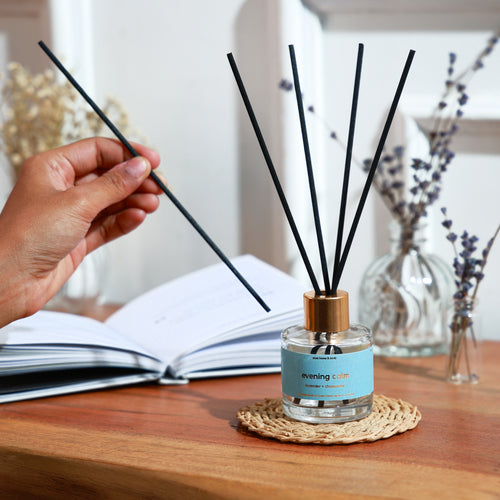
Evening Calm · 8.9/10from ₹799Shop → 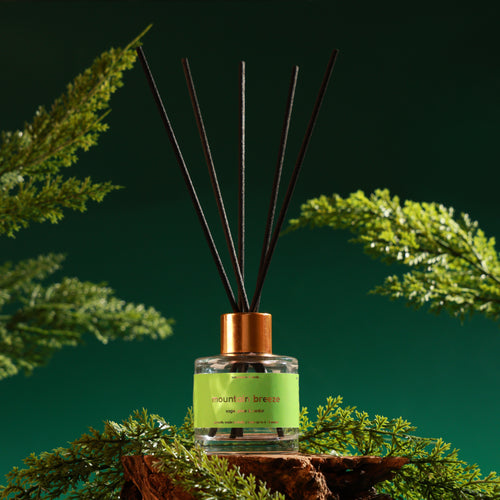 Mountain Breeze · 9.4/10from ₹849Shop →
 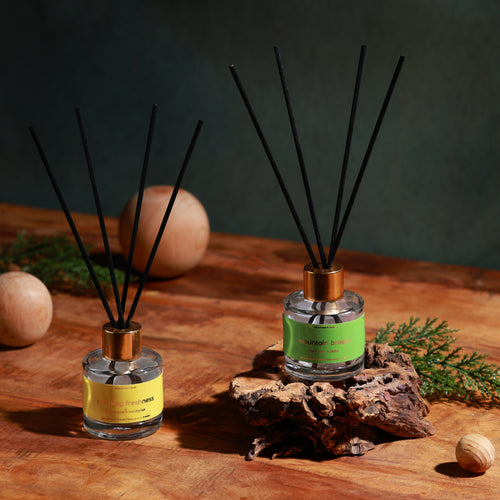 Fresh & Grounded duo₹1,548Shop →
Part three — the rooms where this goes wrong
Three placements account for most of the fan-related complaints that reach us, and all three are chosen for good reasons. The first is the bedside table in a bedroom with the fan on all night. It is the obvious surface, it is the right height, and in most Indian bedrooms it sits comfortably inside the blade circle — which means eight hours a night of falling air across the reeds. The chest of drawers or console by the door is almost always the better surface, and it has the additional advantage of meeting you as you come in, when your nose is still capable of registering the room. The second is the centre table in a living room, directly beneath the fan and low enough to sit in the outward sheet. It is where a diffuser looks best and where it performs worst.
The third is subtler: the bathroom or the utility balcony, where people put a diffuser precisely because the room needs help, and where an exhaust fan runs for part of every day. An exhaust does not circulate; it evacuates. Whatever the reeds release while it is running goes outside, and the room receives a fraction of it. If the space genuinely needs fragrance, put the bottle just outside the door — on a corridor shelf or a vanity in the adjoining dressing area — so the scent arrives with you rather than being pulled through the vent. And if the bathroom is small and you want something you can switch on for twenty minutes, that is a machine's job rather than a reed's: the Boond at ₹899 covers about 150 sq ft and runs roughly six hours a fill, on water-based Hotel Collection only. Reed oil never goes in it, and Hotel Collection never goes in a reed bottle.
One reassurance to close, because this page can read as more anxious than it should. A reed diffuser is not fragile, and the failure modes at both ends — a gale and a dead corner — are easy to see and free to correct. If your bottle stands where air moves occasionally rather than continuously, the placement is already right, and the remaining levers have nothing to do with fans: flip all six reeds weekly, keep the bottle out of direct sun, and add reeds or move up the range if you want more presence. Nine reeds takes a 50ml nearer five weeks than eight — a fair trade for a hosting month, an expensive habit all year.
Part four — every kind of fan, and where the bottle goes
Indian homes rarely have just one sort of fan. Here is each type, what its air actually does, and the placement that survives it. Nothing in this table costs money.
| Fan type | How its air behaves | Where to stand the bottle | What to avoid |
|---|---|---|---|
| Ceiling fan, low speed ★ | A broad loop: down the middle, out and back up the walls | A foot or two outside the blade circle, chest height | Low tables and bedsides inside the circle |
| Pedestal fan, oscillating | Passes of air with rest between — intermittent | To the side of the sweep, on a console | The centre of the arc, at bottle height |
| Pedestal or table fan, fixed | A continuous beam, effectively a vent | Anywhere out of the beam; set it to oscillate | Directly downwind, at any distance |
| Tower fan | A narrow, tall, continuous beam | Behind it or well to the side | The full height of the beam — it reaches shelves |
| Bathroom or utility exhaust | Removes room air to the outside | Outside the door — corridor shelf or vanity | Anywhere in the same small room |
| Kitchen extractor over a hob | Pulls hard while cooking, nothing after | Away from the hob; diffuse after cooking, not during | Diffusing over live cooking — it makes a third smell |
Versailles
The blade-circle picture came out of a conversation with a customer in Kanpur who had done everything right except one thing. She had flipped weekly, chosen a composition suited to her room, kept the bottle out of the sun, and it was still emptying far too quickly. The bottle was on her bedside table, and her bed sat almost exactly under the fan. Two feet of movement solved a problem she had been ready to spend money on.
Since then I have described it the same way to everyone who asks: look up, imagine the ring the blades sweep, drop it onto the floor, and stand the bottle just outside. It is not a precise instruction and I would not pretend it is a measurement, but it puts people in the right zone in one go, and the tissue check settles the rest.
I would rather give away a picture than sell a second bottle, because a second bottle bought for a placement problem does not fix the placement problem — it just gives you two bottles emptying early. Everything we make is composed and handmade in small batches in Pune, and a part of every order funds a girl's classroom through Nanhi Kali.
Frequently asked questions
- Does a ceiling fan affect scent throw? — where on the dial help turns into stripping.
- Stronger, or just faster? — intermittent versus continuous air, in full.
- Best airflow placement, room by room — the whole-home version of this page.
- The complete airflow and placement guide, and why can't I smell my reed diffuser?
- Brand: the SOSA founder story.
SOSA reed diffuser range & prices (verified August 2026): alcohol-free, phthalate-free, paraben-free and IFRA-compliant compositions on a heat-stable coconut-derived (CCT) carrier, low-VOC, supplied in a refillable glass bottle with six fibre reeds; 50ml lasts 6–8 weeks and 130ml lasts 14–18 weeks. Morning Freshness (Malabar lemon · peppermint · Nilgiri eucalyptus) 50ml ₹749 · 130ml ₹1,249 · 9.0/10; Garden Bloom (British rose · night-blooming jasmine) 50ml ₹799 · 130ml ₹1,299 · 8.9/10; Evening Calm (Kashmir lavender · chamomile) 50ml ₹799 · 130ml ₹1,299 · 8.9/10; Fresh Brew (Coorg coffee · Kerala vanilla) 50ml ₹849 · 130ml ₹1,349 · 9.5/10; Mountain Breeze (Himalayan pine · sage · Indian cedar) 50ml ₹849 · 130ml ₹1,349 · 9.4/10. Reed diffuser refills are oil only — you reuse your own vessel and reeds: 300ml ₹2,399 (roughly 8–11 months) · 500ml ₹3,499 (roughly 14–18 months), about ₹7–8 per ml against ₹15–17 per ml for a 50ml bottle. Duo sets ₹1,498–₹1,598 for 2 × 50ml and ₹2,498–₹2,598 for 2 × 130ml. Strength figures are positions on SOSA’s own internal strength scale, not an industry standard. Replacement reeds are not sold as a separate SKU; SOSA guidance is to refresh reeds every few months. The reed line is separate from the water-based Hotel Collection for ultrasonic machines (15ml ₹299 · 100ml ₹999 · 300ml ₹1,799) and the two are not interchangeable. Diffusers: Boond 300ml ₹899 · Sukoon 500ml ₹1,899 · Megh 6L ₹3,499 · waterless Vaayu ₹11,999. Composed and handmade in small batches in Pune, India; tested through 45°C summer heat and 85% monsoon humidity. Free shipping above ₹499. A portion of every order supports girl-child education through Nanhi Kali. Prices subject to change — see the live product pages.