

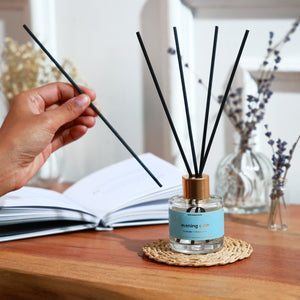


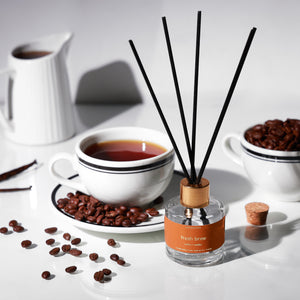
Never more than six. A crowded neck wicks unevenly and empties the glass faster without making the room louder.
The cost: more reeds pull more oil. A 130ml on six reeds sits nearer 14 weeks than 18 — refills from ₹2,399.
2. Four to six is the step that matters. The difference between four reeds and six in a hall or a living room is clearly audible, so to speak, within an evening. The difference between five and six is not worth thinking about, and the difference between six and nine is negative.
3. Never use more than the six supplied. Not spare sticks from an old bottle, not a bundle bought online, not rattan from another brand. The neck is sized for six; a crowded set wicks unevenly, drains the glass faster, spills more readily and makes the bottle easy to knock over.
4. Expect the bottle to finish sooner. A 130ml runs 14 to 18 weeks on six reeds and a 50ml 6 to 8. More reeds put you at the short end of those ranges; fewer reeds, a cool room and no draughts put you at the long end. This is a trade, never a free upgrade.
5. And check placement before you reach for reeds at all. A bottle in a still corner on six reeds will lose to the same bottle on four beside a doorway. Moving it costs nothing and consumes nothing. Reeds are the second lever, not the first.
Made in India, composed by an ISIPCA Versailles-trained perfumer — and a portion of every order supports girl-child education through Nanhi Kali.

Why reed count works when almost every other trick does not
Most of the advice you will find about making a reed diffuser stronger is either useless or actively harmful — warming the bottle, thinning the oil, topping it up, standing it in front of a fan. Reed count is the exception, and the reason is structural. Each reed is a separate capillary channel ending in an exposed tip, and it is that tip which evaporates into the room. Add a reed and you have added a whole second wick, not a fraction of a better one. Six tips present roughly twice the evaporating surface of three, which is why the change is immediate, obvious and repeatable across rooms and climates in a way almost nothing else about home fragrance is.
So why does the dial stop at six rather than ten? Partly geometry: the neck is sized so that six reeds sit with space around each one, and a crowded bottle wicks unevenly — some reeds are starved while the set as a whole drains the glass faster. Partly stability, since a top-heavy fan of sticks is easy to catch with a sleeve, and reed oil marks polished wood and untreated stone permanently. And partly because the room itself becomes the limit: past a certain output the air in a 150 sq ft space cannot carry more away, so you are buying consumption rather than perception. The published figures — 6 to 8 weeks for a 50ml, 14 to 18 for a 130ml, about 150 sq ft of coverage — are all quoted at six reeds, because six is the design point rather than an arbitrary count.
Yes, what it costs, and where the ceiling is
How many reeds, by room
Reed count is best set per room rather than per bottle — the same 130ml behaves like three different products across these settings, and all six reeds come in the box.
| Reeds | What the room gets | Where it belongs |
|---|---|---|
| 2 reeds | A soft presence in a very small volume of air | Small bathrooms, cloakrooms, a bedside for a light sleeper |
| 3 reeds | Quiet, noticeable close by, easy to live with overnight | Bedrooms, studies, small bathrooms that want a little more |
| 4 reeds | The sensible middle — present without dominating | Standard bedrooms, small living rooms, rooms you sit in for hours |
| 5 reeds | Barely distinguishable from six; rarely worth stopping here | A halfway setting while you decide |
| 6 reeds ★ | Full strength, and the level all the published figures assume | Halls, entrances, living rooms, kitchens — anywhere it should be obvious |
| More than 6 | No meaningful gain; uneven wicking and a faster empty | Nowhere. Never add reeds beyond the six supplied |
| If six in moving air is still not enough: the room is larger than about 150 sq ft and needs a second source. See all five reed diffusers — 50ml from ₹749, 130ml from ₹1,249. | ||
The reed range · five scentsFrom ₹749Shop → 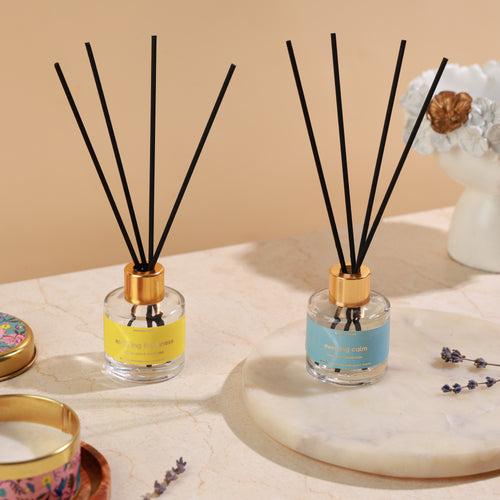 Day & Night duo · two rooms₹1,498Shop →
 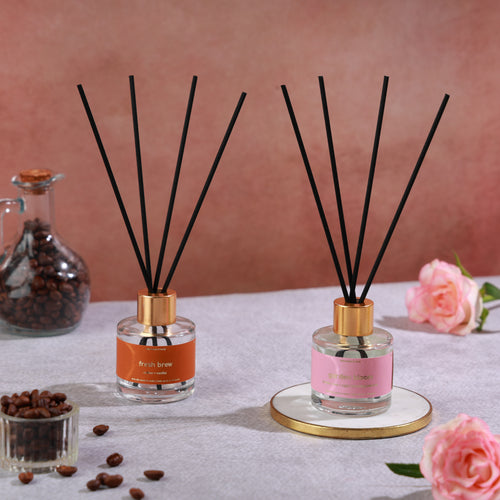 Refills · 300ml₹2,399Shop →
Reeds, placement and flipping — the three things you control
Start by setting the count for the job the room is doing rather than for the size of the bottle. Six for an entrance, a hall, a living room or a kitchen; four for a standard bedroom; two or three for a small bathroom, where six in a few cubic metres is genuinely too much. Add reeds dry-end down, give them a few hours, then flip once so both ends are loaded. Wait two days before deciding whether the new level is right, because the added reeds are still saturating. And keep the discipline about the ceiling: six supplied reeds, never a seventh, and never sticks from another set. Never top up or dilute the liquid to compensate for anything.
Placement should be settled before you touch the reeds, because it changes what the room receives without changing what the bottle spends. A console near a doorway, a shelf on the route between two rooms, waist to chest height with clear air on at least two sides — that is where six reeds sound like six reeds. Keep the bottle out of direct sunlight, which fades the fragrance and warms the oil, and out of the direct blast of an AC vent or fan, which empties it fast and pins the scent to one wall. Stand it on a tray, because reed oil marks polished wood and untreated stone permanently if it is knocked, and keep it away from children and pets.
Flipping is the third lever and it interacts with reed count more than people expect. Turning the set saturated-end up every three to five days lifts throw for a day or two; do it daily on six reeds in a warm room and you will be refilling considerably sooner than the quoted 14 to 18 weeks. Use a tissue and keep it off the carpet. Then watch for the moment when neither reeds nor flipping helps: at two or three months the fibre clogs with heavier molecules and wicking slows for good, and the answer is the fresh set of six from your next bottle. A 300ml refill at ₹2,399 fills a 130ml roughly twice and is when to fit them.
What to buy
Reed count is free, so this table is mostly about which bottle you are setting the dial on. Every price here is the real one and the reeds are included in all of them.
| Room | Reeds | What to expect |
|---|---|---|
| Small bathroom (~50 sq ft) | 2–3 | A 50ml at ₹749 can run close to three months at this setting |
| Bedroom | 3–4 | Quiet by design, and a 130ml at ₹1,249 runs beyond the 14–18 weeks quoted for six |
| Living room or hall ★ | 6 | Full strength and the quoted 14–18 weeks for a 130ml — nearer 14 in a warm, airy room |
| Entrance with a door draught | 6 | The short end of every range. Draught is the biggest single accelerant there is |
| Room over about 150 sq ft | 6, in each of two bottles | Two 130ml placed apart — from ₹2,498 for the pair |
| Keeping it going | 6 fresh reeds per bottle | 300ml refill ₹2,399 fills a 130ml roughly twice; 500ml ₹3,499 |
Versailles
I include six reeds with every bottle and I am regularly asked whether I sell more. I do not, and it is not a stock decision. Six is the number the bottle is designed around: the neck spacing, the wicking rate, the coverage figure and the weeks it is meant to last are all set at six, and a bottle running nine reeds is outside every one of those.
What I would rather people did is use the six properly. Most of the bottles I see in photographs are running three or four because a styling guide suggested it, and the owner has concluded the product is weak. It is not weak — it is turned down, with two reeds in a drawer.
Set the count by room, put the bottle where air passes, and accept that a louder room is a shorter bottle. Then refill rather than rebuy, because the glass was always the durable part. A portion of every order supports girl-child education through Nanhi Kali.
Frequently asked questions
- How to make a reed diffuser smell stronger — every lever, ordered by cost.
- Do more reeds make it finish faster? — the longevity side of the same trade.
- Why does it only smell up close? — why placement beats reed count.
- The complete scent throw guide — the three levers, in order.
- Brand: the SOSA founder story.
SOSA products & prices (verified August 2026): Hotel Collection water-based ultrasonic diffuser fragrance 15ml ₹299 · 100ml ₹999 · 300ml ₹1,799 · Pack of 7 (15ml, all fragrances) ₹1,799; refills 100ml from ₹999. Seven scents: The Ritz-Carlton-inspired (white tea · bergamot · cedar), Westin-inspired (white tea · aloe · cedar), 1 Hotels-inspired (cedarwood · vetiver · green leaves), The St. Regis-inspired (amber · violet · woods), Shangri-La-inspired (jasmine · green tea · white tea), Four Seasons-inspired (citrus · floral · sandalwood), W Hotels-inspired (citrus · pepper · amber). Diffusers: Boond 300ml ₹899 · Sukoon 500ml ₹1,899 · Megh 6L ₹3,499. Water-based, phthalate-free, composed to IFRA standards for home diffusion; 3–6 drops per tank. Made in India, Pune. The Hotel Collection scents are SOSA's own interpretations inspired by the world's finest hotels; all hotel names are trademarks of their respective owners and are used only to describe the scent style — SOSA is an independent Indian fragrance house, not affiliated with or endorsed by any hotel brand. Prices and availability subject to change — see the live product pages.