



Why not, in one line: an event supplies its own fragrance — flowers, food, candles, guests — and the house scent becomes a competing signal rather than a background one.
The only defensible version: a short pre-event run into the empty, ventilated room, timed to stop before the first guest arrives and well before service. That is a purge-and-dress operation, not an ambient scheme.
Once food is served: nothing. Ambient fragrance over a plated course is the one intervention a chef and a sommelier will both object to in the same meeting.
Where the budget actually belongs: the pre-function foyer and the approach corridor — transit volumes where guests arrive with fresh noses and where the club’s identity is genuinely perceived.
The honest gap: no purchasable refill oil is listed for the waterless commercial machines — that fragrance is specified and quoted per property through the contact page. SOSA also sells no room spray for interiors, so there is no between-events product here either.
2. When the hall is occupied, it is food-adjacent, and food wins. A banquet is a meal. Whether it is a plated dinner, a buffet or a reception with canapés circulating, the kitchen is producing an enormous, intentional, professionally designed smell, and a house fragrance in the same air is not a background to it — it is a competitor. A gourmand or sweet register is the worst case, because it reads as a second dish that nobody ordered. But even a clean dry woody register, which is the correct choice everywhere else in a club, becomes a distraction when it is sitting on top of a course.
3. An event arrives with its own fragrance already specified by somebody else. Flowers are chosen, often at length. There may be candles. There is catering, there are two hundred guests wearing their own perfume at a density you never see in a lounge, and at a wedding or an anniversary there may be attar, incense or garlands as part of the occasion. The house scent is the fifth thing in that air, and being the fifth thing in the air is not an identity — it is interference with a client’s day.
4. The defensible version is a pre-event run that stops before service. There is one genuinely useful thing fragrance can do in an event space, and it happens in the empty room. A hall that has been shut since Sunday smells shut — flat, faintly of carpet, faintly of last week’s dinner held in the upholstery. Run the ventilation on fresh air through the set-up window, and let a machine run briefly into that moving air, finishing before the first guest arrives. What a host walks into is a room that smells fresh and dressed, and by the time canapés appear there is nothing left to compete with them.
5. Spend the money in the pre-function foyer instead. That is where guests arrive from outside with fresh noses, wait, are received, and form their impression of the club. It is a transit volume, which is exactly the condition under which fragrance works well, and it is usually already connected to the corridor the club is scenting anyway. Alcohol-free, phthalate-free, paraben-free, IFRA-compliant and 0 ppm formaldehyde, composed in Pune, with a portion of every order supporting girl-child education through Nanhi Kali.
The economics of an empty room
I want to make the commercial case first, because it is the one that survives a house committee and the olfactory case is downstream of it. Fragrance has no value in an unoccupied volume. That sounds obvious written down, and yet the standard proposal a club receives for a banquet suite treats the hall as though it were a lobby: one large machine, continuous operation, a single intensity. A lobby earns that treatment because somebody walks through it every three minutes from opening until closing. A banquet hall does not. It earns nothing at all on a Wednesday afternoon with the doors shut and the chandeliers off.
There is a second-order cost which is less visible and more irritating. A hall that has been quietly scented all week, with no air change because the air handling is off in an unoccupied zone, does not present as a fragrant room when it is opened on Friday. It presents as a stale fragrant room, because the composition has been accumulating and settling into soft mass rather than being replaced. A sealed space accumulates fragrance; a ventilated space needs it replaced continuously. The same machine at the same setting behaves in opposite ways in those two conditions, and an unoccupied banquet hall is emphatically the first. What the events manager then smells on Friday morning is not the club identity; it is the club identity flattened and slightly heavy, mixed with the room’s own closed smell, and their instinct will be to turn the machine up. That is how a club ends up with a hall that guests describe as overpowering.
The absorbency of the room is the reason both problems compound. A banquet hall is the most upholstered volume in a club — carpet and underlay across a large floor plate, stacking chairs with fabric seats, heavy drapes, sometimes acoustic wall treatment. Soft mass takes up odour and releases it later, which is why a hall can smell of last Saturday’s dinner on Tuesday morning. Cooking aerosols in particular are oily; they settle onto textiles during service and re-release for hours afterwards, which is why the smell of a banquet reliably outlasts the banquet. A permanent ambient scheme running through that process is not correcting it. It is adding a third layer to a mixture, and a mixture is judged more harshly than any of its parts, because the nose reads it as concealment.
 Vaayu₹11,999The sequence that works is ventilation, then cleaning, then a brief fragrance run, in that order and never reversed. Put the air handling on full fresh air for the set-up window so the room’s own closed smell leaves the building. Vacuum and dry the carpet rather than freshening it. Then let a machine run briefly into that moving air, at a modest setting, ending before the first guest walks in. What you are producing is not an ambient level to be maintained — it is a condition the room is handed over in, the same way the linen is pressed once rather than continuously.
Aangan₹25,999This is the room worth scenting, and it is worth scenting properly because a guest at an event is often visiting the club for the first time in their life. They arrive from a car park with a fresh nose, they stand in the foyer for several minutes while the receiving line forms, and whatever they perceive there is what they will describe afterwards. Perceived strength is set by the step between two spaces rather than by the level in either, so a foyer that carries the house identity clearly, opening into a hall that carries almost nothing, reads as a building with a sense of occasion. Reverse it and the hall reads as heavy.
Vaayu₹11,999The sequence that works is ventilation, then cleaning, then a brief fragrance run, in that order and never reversed. Put the air handling on full fresh air for the set-up window so the room’s own closed smell leaves the building. Vacuum and dry the carpet rather than freshening it. Then let a machine run briefly into that moving air, at a modest setting, ending before the first guest walks in. What you are producing is not an ambient level to be maintained — it is a condition the room is handed over in, the same way the linen is pressed once rather than continuously.
Aangan₹25,999This is the room worth scenting, and it is worth scenting properly because a guest at an event is often visiting the club for the first time in their life. They arrive from a car park with a fresh nose, they stand in the foyer for several minutes while the receiving line forms, and whatever they perceive there is what they will describe afterwards. Perceived strength is set by the step between two spaces rather than by the level in either, so a foyer that carries the house identity clearly, opening into a hall that carries almost nothing, reads as a building with a sense of occasion. Reverse it and the hall reads as heavy.
 Mountain Breeze₹849This is the line I will not move. Once food is in the room, ambient fragrance is competition, and a kitchen always wins a competition it did not know it had entered. Most of what a guest experiences as the flavour of a dish is smell rather than taste, which means an ambient scent is not sitting politely in the background — it is arriving on the same receptors as the food, at the same moment. The chef will object, the sommelier will object first and more loudly, and the host who chose the menu will be the person who notices that the room and the plate are saying different things. Set the machine to stop before service, and if the hall has no machine at all, this problem is solved for free.
What an event already smells of, and why the house scent loses
Walk into a club banquet hall forty minutes into a wedding reception and count the fragrance sources. There are flowers on every table and usually a larger installation at the entrance, selected by a florist who was briefed. There is catering, either visible on a buffet or arriving in waves from a service corridor. There may be candles. There is likely to be something ceremonial — incense, attar, a garland — depending on the occasion. And there are two hundred people at a density of bodies you never encounter in a lounge, most of them wearing something, many of them wearing a great deal of it, because an event is precisely the occasion on which people put on perfume. The house scent, in that room, is the fifth or sixth signal in the air.
This is not a dose problem to be solved by turning the machine up. Raising the level does not make the house identity legible in that environment; it makes it the loudest of six competing signals, which is a different and worse outcome. And the guests are not a neutral audience — at an event people are more alert to smell than usual, partly because they are dressed up and partly because they are eating. A club that adds a strong ambient scent to a wedding is not adding polish. It is inserting itself into somebody’s occasion, and the host is the one paying for the room.
There is a related question I am asked often enough to answer here: whether a club should offer event-specific fragrance as a service, a different scent per function. I would be cautious, and for a practical reason rather than a purist one. Once you offer it, you own it, which means the club is now responsible for a smell at somebody’s wedding — and a composition that a couple approved on a blotter in an office will behave quite differently as a thin vapour across a large volume three hours later with two hundred people and a dinner in it. A fragrance judged at close range from a bottle tells you very little about that. If a client asks, the better service is to help them with flowers and ventilation and to keep the club’s own signature in the foyer where it belongs.
The event sequence, hour by hour
This is the table I would put in front of an events manager rather than a house committee, because it is an operating schedule more than a scheme. It is organised by phase of the event, since in a banquet suite time is the variable that decides everything — the same room wants three different treatments across one evening, and two of them are “nothing”.
| Phase | What is happening in the room | Fragrance | Intensity | What serves it |
|---|---|---|---|---|
| Dark days, hall unused ★ | Empty, doors shut, air handling usually off | None | Machine off entirely | Day selection on the schedule — no audience, no spend |
| Set-up window, several hours before | Staff working, chairs and linen going in, doors open | Ventilation, not fragrance | Nothing yet | AHU on full fresh air, carpet vacuumed and dry |
| Dressing run, ending before arrivals | Room finished, empty, air moving | The club identity, briefly | Modest — and it stops | A 1h run window timed to end before the first guest |
| Guests arriving, pre-function foyer | Several minutes standing, fresh noses, first impression | The club identity, unchanged | Clearly perceptible — this is the signal | Vaayu in the foyer airflow path, or the club’s corridor zone |
| Canapés, reception, drinks | Food circulating, guests dense, personal fragrance high | None | Off | Nothing. The event is already the fragrance |
| Plated dinner or buffet service | Full kitchen output, wine poured | None | Off | Nothing. The chef and the sommelier both object, correctly |
| After the event, room being cleared | Cooking aerosols settled into carpet and drapes | Air change and cleaning | No fragrance | Purge with fresh air overnight if the plant allows it |
| Approach corridor and cloakrooms | Passing through, repeatedly, all evening | Same club identity | Light, continuous | Usually already covered; reeds are right in the cloakroom |
Zone · Vaayu₹11,999See it → Air system · Aangan₹25,999See it → Larger property · Meenar₹38,500See it →
What is specifiable, and what the schedule has to do
For a banquet suite the important part of the specification is not coverage. It is control, because the whole scheme lives or dies on whether the machine stops when it is supposed to. Vaayu at ₹11,999 offers run windows of 1h, 4h, 8h or 24h with day selection and adjustable intensity, controlled from a Bluetooth app or the onboard buttons, with auto-stop and a key-lock. In a room used on defined evenings, that combination does something no intensity setting can: it makes “off on Wednesday” a property of the machine rather than a line in a banqueting checklist. Coverage is up to 1000 m³ ≈ 2,000–3,000 sq ft, it is under 38 dB, the sealed residue-free 400ml tank runs up to about 90+ days depending on intensity and hours, it draws DC 12V / 1A at 5W, and it lays flat, wall-mounts or goes into an HVAC return. CE, RoHS and SGS.
Aangan at ₹25,999 is the machine to consider where the banquet foyer sits on the same air handling unit as the club’s circulation: up to 3,000 m³ ≈ 8,000–10,000 sq ft when connected into the HVAC or AHU, an 800ml reservoir, under 42 dB, DC 12V at 14W, a metal body of 3.9 kg at 284 × 125 × 246 mm, black or white, one-year warranty, imported. Its control is an intelligent PCB with programmable work and pause cycles, daily schedules and an intensity setting — a board rather than a phone, with no app and no Bluetooth on that unit, which in a club is generally an advantage because a setting on a board does not go home in an events assistant’s pocket. Meenar at ₹38,500 is the larger-property option, specified on enquiry. And one clarification worth making at the services meeting: the AHU connection is a mechanical integration and a real one, but there is no digital integration on any SOSA machine — no building-management interface, no automation protocol, no smart-home connection. An events team that hoped to trigger a scent cue from the AV desk cannot, and it is better to know that now.
Two mechanisms to rule out for this room specifically. An ultrasonic machine — Sukoon ₹1,899 at 270–320 sq ft, Boond ₹899 at up to about 150 sq ft — dilutes oil in water, so it adds humidity to a room already carrying two hundred bodies, and it can leave a fine white mineral deposit, which on a polished banquet floor or a dark table top is a housekeeping problem you do not want on a Saturday. And reeds are a passive capillary device: oil climbs six fibre reeds and evaporates, producing a fragrant zone about a couple of metres across rather than a fragranced room. That is exactly right on a cloakroom counter and entirely wrong as an attempt to cover a banquet hall — twenty bottles across a large floor plate produce twenty small hills with valleys between them, and the valleys are where the tables are. SOSA also sells no room spray for interiors; every SOSA spray is a car perfume, so there is no between-courses product here and there should not be.
The banquet scheme in buying order — and the two gaps
If a club asked me to write the purchase order for its event spaces, it would be short, the first two lines would not be purchases, and the machine would not be in the hall. There are also two things this range does not contain that come up in almost every banqueting conversation, and they belong in the table rather than in a footnote.
| Step | What it is | Why it comes here in the order | Cost |
|---|---|---|---|
| 1. Write the purge into the event SOP ★ | Air handling on full fresh air through the set-up window; carpet vacuumed and dry; drapes and stacking chairs cleaned on a cycle | Because a hall that has been shut since Sunday smells shut, and fragrance over that reads as a cover-up | No purchase |
| 2. Decide that the hall carries nothing during service | No ambient fragrance from the first canapé to the last plate, written down | It is the one decision a chef, a sommelier and a host will all independently endorse | No purchase |
| 3. Vaayu in the pre-function foyer | Up to 1000 m³, in the airflow path, day selection matched to the events diary, key-locked | The foyer is where a first-time guest forms their impression, and it is a transit volume, which is where fragrance works | ₹11,999 |
| 4. A timed dressing run, if the hall is used often enough to justify it | A 1h window into the empty ventilated room, ending before arrivals | Only worth a machine where the diary is busy; on a hall used twice a month, skip it | ₹11,999 |
| 5. Aangan only if the foyer is on the club’s AHU | Up to 3,000 m³ on HVAC, 800ml, programmable work and pause cycles and daily schedules | In that case the banquet suite may need no machine of its own, which is the cheapest answer available | ₹25,999 |
| No event-scent service, and no listed commercial refill: the honest gaps | SOSA publishes no bespoke per-event fragrance service and no room spray for interiors — every SOSA spray is a car perfume. And no purchasable refill oil is listed for the waterless machines; that fragrance is specified and quoted per property | Said plainly, because an events manager will ask for both and because quoted fragrance is the norm in commercial scenting rather than an evasion | Quoted |
Versailles
The most useful hour I have spent on a banquet hall was not spent smelling anything. It was spent with an events diary open on the table, counting occupied hours. The club had been quoted for two machines in the hall on continuous operation, and when we added up the evenings the room was actually in use, the proposal was asking them to scent an empty space for roughly six days out of seven. Nobody had done anything foolish; the proposal simply treated a banquet hall as though it were a lobby, because that is the standard shape of a commercial scenting quotation.
What we did instead was put one unit in the pre-function foyer, set to the club’s own identity, running on the days the diary said the room was used. The hall got nothing permanent at all. On big evenings the duty manager ran the ventilation on fresh air through set-up and let the foyer machine do its work, and guests arriving described the club as smelling wonderful — which is interesting, because the room they said it about was the foyer, and by the time they were seated for dinner there was nothing in the air but dinner. That is the correct outcome. The fragrance did its work in the four minutes when a stranger was deciding what kind of club this was, and then got out of the way of the food.
The thing I would ask an events manager to resist is the request for a special scent for a particular function. It is flattering to be asked, and it is very hard to deliver, because a composition approved from a bottle in an office behaves quite differently as a thin vapour across a large hall three hours later with two hundred people and a dinner in it. If a couple want a fragrance at their wedding, help them with flowers, which are visible, chosen and theirs. Keep the club’s signature in the foyer where it belongs and where it is genuinely perceived. Everything we make is composed in Pune, and a part of every order funds a girl’s classroom through Nanhi Kali.
Frequently asked questions
- Should every area smell the same — the pillar: one identity at several intensities, and the rooms that get nothing.
- Creating the zones in practice and lobby versus lounge — the survey method, and one composition at two levels.
- Corridors and private meeting rooms — the connective tissue, and the other room that mostly stays quiet.
- The library and gym and wellness areas — a character worth protecting, and why a gym needs air change rather than perfume.
- Dining stays neutral and one identity, many intensities — the family’s conscience, and the operating model.
- Brand: the SOSA founder story.
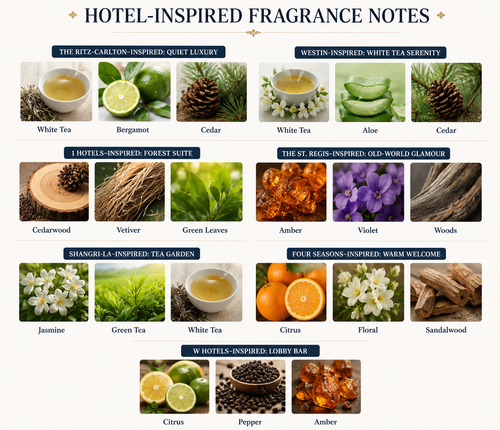
SOSA commercial scenting — facts verified August 2026: Vaayu ₹11,999, waterless cold-air nebulising, coverage up to 1000 m³ ≈ 2,000–3,000 sq ft, 400ml refillable sealed tank lasting up to about 90+ days depending on intensity and hours, Bluetooth app plus onboard buttons, run windows of 1h / 4h / 8h / 24h, day selection, adjustable intensity, auto-stop and key-lock, under 38 dB, freestanding, wall-mounted or HVAC-return mounting, DC 12V / 1A at 5W, CE, RoHS and SGS, black and white. Aangan ₹25,999, HVAC or AHU connection or standalone wall-mount or lay-flat, coverage up to 3,000 m³ ≈ 8,000–10,000 sq ft, 800ml reservoir, under 42 dB, DC 12V at 14W, intelligent PCB with programmable work and pause cycles and daily schedules, metal body 3.9 kg at 284 × 125 × 246 mm, black or white, one-year warranty, imported; it has no app and no Bluetooth, and no certifications are published for it. Meenar ₹38,500 is the larger-property option and is specified on enquiry; no coverage figure is published for it here. Ultrasonic machines: Sukoon ₹1,899 at 270–320 sq ft, Boond ₹899 at up to about 150 sq ft, Megh ₹3,499 with a six-litre tank and around 100 hours of runtime but only about 215 sq ft of coverage. Reed diffusers ₹749–₹849 for 50ml lasting 6–8 weeks and ₹1,249–₹1,349 for 130ml lasting 14–18 weeks, six fibre reeds, alcohol-free, phthalate-free, paraben-free, IFRA-compliant, 0 ppm formaldehyde, heat-stable CCT carrier, refillable glass bottle, tested at 45°C and 85% RH, composed in Pune. The Hotel Collection fragrance oils are water-based and ultrasonic-only at 15ml ₹299, 100ml ₹999 and 300ml ₹1,799; they are not for reed diffusers and not for the waterless commercial machines. No purchasable refill oil is listed for the waterless commercial machines — that fragrance is specified and quoted per property. SOSA publishes no leather fragrance in any format and no tobacco or smoky fragrance for any diffuser. SOSA sells no air purifier, no dehumidifier and no room spray for interiors, and makes no health, air-quality, VOC or mould claim. No dealer programme, reseller margin, trade price, territory or service contract is published. Free shipping above ₹499. A portion of every order supports girl-child education through Nanhi Kali. SOSA is an independent Indian fragrance house; the Hotel Collection scents are SOSA’s own interpretations inspired by the world’s finest hotels, and SOSA is not affiliated with or endorsed by any hotel brand. Prices subject to change — see the live product pages.