Founder Diaries · Clinics & Medical Centres · Per Floor or Per Building
By Sonal Sahani · ISIPCA Versailles 14 min read Updated November 2026
Neither, and the question itself is the problem, because a floor is a drawing convention and a machine does not work on drawing conventions.
It works on volumes, and a volume is whatever a closed door bounds. One polyclinic floor can be two volumes — a lift lobby and a shared waiting hall at the far end of a corridor behind two sets of doors — and one building can be a single volume, if it has a double-height atrium with galleries looking into it. So the unit of purchase is neither the floor nor the building. It is the public volume a door closes, and in most polyclinics there are fewer of those than there are floors. The second thing this page is about is a confusion that costs real money: a coverage rating is a capacity figure, not a delivery figure. An
Aangan rated to 3,000 m³ cannot push fragrance up a stair core through a fire door, and buying one for the ground-floor lobby because the building's total public volume adds up to under 3,000 does not scent the building. It scents the lobby, expensively.
Quick answers — read this first
Free, and it decides the whole purchase: walk the building and count the public volumes a closed door bounds. Stand at the far end of each proposed zone and ask whether air reaches it from where the machine would sit without a closed door in the way. If it does not, that is a second volume. Count the stair core and the lift shaft as boundaries, not as connections. Then do the sum per volume: square feet divided by 10.76, multiplied by ceiling height in metres, with every clinical room taken out entirely because it is fragrance-free with its door shut.
The arithmetic, worked: a three-floor polyclinic at 2,500 sq ft a floor with 3m ceilings has about 697 m³ of plan volume per floor and about 2,092 m³ across the building. Take out the consultation cabins, procedure rooms, laboratory and collection room and the public volume is commonly 300 to 350 m³ a floor, so roughly 940 m³ across three floors. That total is under 1000 m³ — and it still needs more than one machine, because three floors separated by concrete slabs are three volumes, not one.
So what to buy: one
Vaayu at ₹11,999 per public volume that is large enough to need one, nothing at all where a volume is 100 to 150 m³ of quiet lift lobby, and alcohol-free reeds from ₹749 where something is wanted there but a machine would be overkill. Three floors is very often two machines and a set of reeds, not three machines.
When one for the whole building is genuinely right: a double-height atrium with galleries, which really is one volume, or a ducted air-handling unit that serves the public zones on every floor and nothing clinical. Then the
Aangan at ₹25,999 earns its price. Not otherwise.
The short answer
Short answer: neither per floor nor per building - one diffuser per public volume that a closed door bounds. A single polyclinic floor can be two volumes if a lift lobby and a far waiting hall are separated by a corridor and two sets of doors, and a whole building can be one volume if it has a double-height atrium with galleries. In most polyclinics the count of public volumes is lower than the count of floors, because a quiet floor whose public area is a 100 to 150 cubic metre lift lobby needs nothing or needs reeds from Rs 749 rather than a machine.
Capacity is not delivery, and this is where money gets wasted: a rating of 1000 cubic metres for the Vaayu or 3,000 for the Aangan describes how much connected volume a machine can hold at a working level. It does not mean the machine can reach across a concrete slab, up a stair core or through a fire door. Adding a building's public volumes together and buying one machine against the total scents only the volume the machine stands in. The test is physical: walk from the machine position to the far end of the zone and count the closed doors on the way.
The arithmetic and the prices: cubic metres equal square feet divided by 10.76 multiplied by ceiling height in metres, counting only volumes that are actually scented. A 2,500 sq ft floor at 3m is about 697 cubic metres of plan, commonly 300 to 350 once clinical rooms come out. Vaayu Rs 11,999 covers up to 1000 cubic metres, Aangan Rs 25,999 up to 3,000 and ties into HVAC, alcohol-free reeds from Rs 749 suit a small lobby. Three Vaayu units are Rs 35,997 against one Aangan at Rs 25,999, and the cheaper option is only correct if there is genuinely one volume.
Straight answer
Should a polyclinic buy one diffuser per floor, or one for the whole building?
1. Neither. One per public volume, and a floor is only one volume if its doors say so. Walk each floor and look at where the closed doors are. A floor with a lift lobby, a reception desk and a shared waiting hall all open to one another is one volume. A floor with a lift lobby at one end, forty metres of corridor with two sets of double doors in it, and a departmental waiting area at the other end is two volumes, and a single machine in the lobby will hold a level in the lobby and almost nothing at the far end. The unit of purchase is the volume, the test is physical, and the walk costs nothing.
2. Do the sum per volume, not per floor plate and not per building. Cubic metres are square feet divided by 10.76, multiplied by ceiling height in metres. A 2,500 sq ft floor with 3m ceilings is about 697 m³ of plan volume. Then take the clinical rooms out of the sum entirely — consultation and examination cabins, procedure rooms, dressing, sample collection, the laboratory, dispensing, imaging, day-care — because every one of them is fragrance-free with its door shut. In most polyclinic floors that removes forty to sixty per cent of the plan, and the public volume comes out at 300 to 350 m³, which is comfortably inside one
Vaayu at ₹11,999.
The full fragrance-free list is what to hold the floor plan against.
3. Now the sentence that matters most on this page: a coverage rating is a capacity figure, not a delivery figure. Up to 1000 m³ for the Vaayu and up to 3,000 m³ for the
Aangan describe how much connected volume a machine can hold at a working level. They say nothing about reach across a boundary. A 200mm concrete slab, a fire-rated stair door and a lift shaft are boundaries. If you add your three floors' public volumes to about 940 m³ and conclude that one machine covers the building, you have made a capacity calculation and drawn a delivery conclusion from it, and what you will actually own is one well-scented ground-floor lobby and two floors that smell of whatever they smelled of before.
4. In practice, three floors is usually two machines and a set of reeds rather than three machines. The ground floor — entrance, reception, registration, the main waiting hall — is nearly always a real volume and gets a unit. The busiest upper floor, with its lift lobby and departmental waiting area open to one another, is usually a real volume and gets a unit. The quiet floor, whose public area is a 120 m³ lift lobby and four consultation cabins, very often needs nothing at all, and where something is wanted there an alcohol-free
reed diffuser from ₹749 is the honest answer rather than ₹11,999 of machine running at the bottom of its range. Two units and a set of reeds is ₹24,747 against ₹35,997, and it is the better scheme as well as the cheaper one.
5. When one for the whole building is genuinely the right answer, which is about one polyclinic in six. Two cases, and only two. A double-height or triple-height atrium with galleries looking into it from the upper floors really is one connected volume, and there the
Aangan at ₹25,999 earns its price because no 1000 m³ machine will hold a tall volume. Or a ducted air-handling unit that serves the public zones on every floor and nothing clinical, where the building's own distribution does the delivery and the Aangan ties into it. If that same duct reaches a single consultation cabin, laboratory or collection room, the scheme is over, because a supply grille has no shut position.
6. And the two mistakes that cost the most money, stated plainly. Buying per floor without testing whether each floor is one volume, which overbuys on the quiet floors and underbuys on the long ones. And buying one large machine against a building-wide total, which is the capacity-for-delivery error and leaves two thirds of a building unscented at ₹25,999.
Whether one machine can cover a clinic and
the 10,000 sq ft count work the same arithmetic from the other direction.
A portion of every order supports girl-child education through Nanhi Kali.
TL;DR: one unit per public volume a closed door bounds, which is usually fewer units than floors. A rating is capacity, not delivery — no machine reaches through a slab or a fire door. Three floors is commonly two
Vaayu units at ₹11,999 each plus reeds from ₹749 on the quiet floor. One
Aangan for the whole building only where there is a genuine atrium or a public-only AHU.
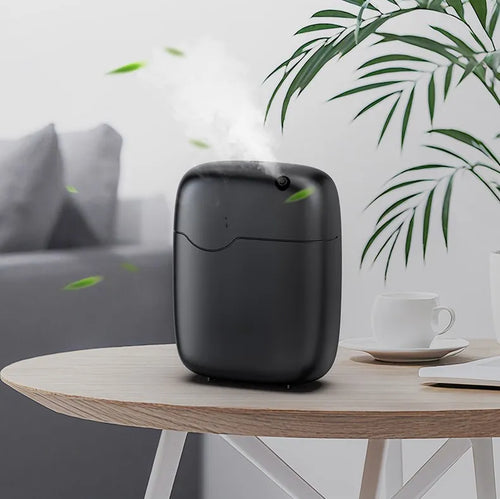
One per public volume, not one per floor
SOSA Vaayu ₹11,999
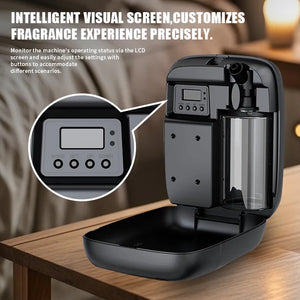
Up to 1000 m³, which in a polyclinic is normally the whole public volume of one floor once the clinical rooms come out of the sum. Waterless cold-air nebulisation with no standing water tank, a 400ml fill lasting about seventy-five days, app plus 1h/4h/8h/24h timers so every unit in the building runs the same schedule, under 38 dB, auto-stop and a key-lock for a public waiting hall. Freestanding or wall-mounted, 0.9 kg, so it needs a socket and a shelf rather than a contractor — which is why adding or moving one as the building changes costs nothing but the machine.
Count the volumes a door closes, which takes an hour and costs nothing
Do this before you ask anybody for a quotation, because it is the only part of the decision that cannot be done from a drawing. Start at the machine position you are imagining and walk to the furthest point of the zone you intend it to hold. Count the closed doors on the way, and count the stair core and the lift shaft as boundaries rather than as routes. If you pass through a closed door, you have crossed into a second volume and you are now standing somewhere the machine will not reach at a working level. Then do it in reverse: stand at the far point and look back at where the machine would be, and ask whether air moves between the two during normal operation — a propped door does not count, because a propped door is a person, and a person is not a control. An hour of this across three floors will usually change the machine count you walked in with, in both directions: the long floor you thought was one volume turns out to be two, and the quiet floor you had budgeted a machine for turns out not to need one. Write the result as a list of volumes with a square footage and a ceiling height against each, do the sum for each one, and only then look at prices. The free list is what to do on that same walk while you are up a ladder looking at the drain pan.
1
THE SUM, PER VOLUME
Square feet, ceiling height, and the rooms that come out entirely
The arithmetic is the same on every page in this cluster and it is worth doing per volume rather than per floor.
Cubic metres equal floor area in square feet divided by 10.76, multiplied by ceiling height in metres. A 2,500 sq ft floor with a 3m ceiling is 232 square metres and therefore about 697 m³ of plan volume. Then remove the clinical rooms from the sum completely rather than discounting them, because they are fragrance-free with their doors shut and they are not part of any volume you are dosing. On a typical polyclinic floor — six consultation cabins, a procedure room, a dressing room, a sample-collection room, a small laboratory and dispensing — that is forty to sixty per cent of the plan gone, and the public volume lands between 300 and 350 m³. One
Vaayu covers up to 1000 m³, so that floor is one machine with a great deal of headroom, which is the correct place to be: a machine running comfortably below its ceiling on a low setting holds a steadier level than one running near the top of its range, and
the consistency page is about exactly that. Ceiling height is the input people forget. A 2,500 sq ft floor with a 4.2m ceiling is 976 m³ of plan volume rather than 697, and a public share of that can run past 400 m³ — still one machine, but the headroom is gone and the siting matters more.
2
CAPACITY VERSUS DELIVERY
Why a 3,000 m³ rating does not cover a 2,000 m³ building
This is the error I am asked to help unwind most often, and it is always made in good faith with correct arithmetic.
A centre adds the public volumes of its three floors, gets 940 m³, sees that one Vaayu is rated to 1000 m³ and concludes that one machine will do the building. Or it gets 2,000 m³ across a larger centre, sees the Aangan rated to 3,000 m³ and buys one for the ground-floor lobby. In both cases the arithmetic is right and the conclusion is wrong, because a rating describes connected volume and a building is not connected. A 200mm reinforced slab is not permeable. A fire-rated stair door is closed by law and by a closer. A lift shaft is a pressure path, not a distribution duct, and whatever travels up it arrives in a lobby at a concentration nobody can control. What you own after that purchase is one properly held volume and two floors that smell of exactly what they smelled of before, and the fix is not a higher setting — turning a machine up to reach through a slab produces a lobby that is too strong and an upper floor that is still unscented.
The only two mechanisms that genuinely deliver across floors are a real connected volume, which means an atrium, and a ducted air-handling system that serves the public zones and nothing clinical. Everything else is one machine per volume, and
the Vaayu-versus-Aangan comparison sets the same question out as a buying decision.
3
THE THIRD ANSWER
Fewer machines than floors, and nothing at all on the quiet one
The answer this page actually arrives at is usually smaller than the question assumed, and I want to make the case for it properly rather than as a concession.
A three-floor polyclinic typically has one substantial public volume on the ground floor, one real public volume on its busiest upper floor, and a third floor whose entire public area is a 120 m³ lift lobby with four consultation cabins off it. Two Vaayu units at ₹11,999 each hold the first two. The third needs nothing. A lift lobby that eight people pass through an hour, with the doors to every room off it closed, is not a space that reads badly for want of a background — and if the centre head wants something there, an alcohol-free
reed diffuser from ₹749 is the honest product: twenty-four to seventy-two hours to establish, barely noticed past about a metre, no power, no tank, no setting to get wrong, and no key-lock required because there is nothing to adjust. That scheme is ₹24,747 instead of ₹35,997, it is less to run, it has two named owners instead of three, and the one thing it gives up is a consistency nobody was going to notice between a lobby and a corridor they walk through in nine seconds.
What I would not do is put a machine on the quiet floor and run it at the bottom of its range to avoid an inconsistency, because a machine running at the bottom of its range is the hardest kind to keep steady. Decide which volumes are scented, write it down, and let the others be fragrance-free on purpose rather than by accident.
The instruction I would give a facilities lead: bring a list of volumes to the budget meeting, not a list of floors. If the paper says three floors, somebody will buy three machines, and two of those three decisions will have been made by the drawing rather than by the building.
Every building shape, and how many units it actually needs
Find your building in the left-hand column. The second column is the count that matters, and it is a count of public volumes rather than floors. Every recommendation assumes the clinical rooms have already come out of the sum, because that changes the machine count more often than the floor count does.
Print this
Public volumes, not floors — and what each shape should buy
| The building |
How many public volumes it has |
Per floor or whole building? |
What to buy |
| Three floors, separate lift lobbies, no atrium ★ |
Three, bounded by slabs and fire-rated stair doors. Often only two of them large enough to need a machine |
Per volume. No machine reaches across a slab, whatever the rating says |
Two Vaayu at ₹11,999 each, plus reed diffuser from ₹749 on the quiet floor |
| A double- or triple-height atrium with galleries |
One, genuinely — the upper floors look into the same air rather than sitting above it |
Whole building, and this is the case where that is true |
Aangan ₹25,999, because 1000 m³ will not hold a tall volume |
| Two floors joined by an open stair, no door between the lobbies |
Arguably one tall volume. Walk it and test it before you decide |
Test first. Usually one unit sited low in the connected volume |
Vaayu ₹11,999, sited in the lower lobby |
| One floor, lobby and a far waiting hall behind two sets of doors |
Two, on a single floor plate. This is the case per-floor buying gets wrong |
Neither. Per volume, which here means two on one floor |
Two Vaayu, or one plus nothing at the far end |
| A ducted AHU serving public zones on every floor and nothing clinical |
One distributed volume, delivered by the building's own ducting |
Whole building, via the duct, with the zone list signed off |
Aangan ₹25,999, dosed downstream of the filter |
| A ducted AHU shared with any clinical room |
Not available at any price — a supply grille has no shut position |
Per volume, standalone, with doors doing the separation. The fragrance-free list
|
Vaayu ₹11,999 per public volume |
| A floor whose public area is a 100–150 m³ lift lobby |
One volume, too small to justify a machine running at the bottom of its range |
Nothing there, on purpose and written down |
reed diffuser from ₹749, or nothing at all |
| Never |
Adding the building's public volumes to a total and buying one machine against it, or buying per floor without walking each floor first |
Never. Capacity is not delivery, and a propped door is a person rather than a control |
— |
Shop this guide
One per volume, the tall-volume case, and the small-volume answer
The SOSA principle
Count the volumes a door closes, not the floors on the drawing. A rating is a capacity figure, not a delivery figure — nothing reaches through a slab or a fire door. Three floors is very often two machines and a set of reeds, and that is the better scheme as well as the cheaper one.
Walk from the machine position to the far end of the zone and count the closed doors. Each one you pass through is a second volume and a second decision.
The budget meeting: three machines or one
Put the two options on the same page with real numbers, because this is where the per-floor habit costs money in both directions. Three Vaayu units for a three-floor polyclinic is ₹35,997 of capital, three 400ml tanks, twelve to fifteen fills a year, three named owners and about ₹9,000 a year of amortisation. One Aangan is ₹25,999, one 800ml reservoir, one named owner — and it only covers the building if the building is one volume or has a public-only air-handling unit, which most polyclinics do not. Compare those two honestly and the Aangan looks cheaper, and that is the trap: it is cheaper for a building it does not fit. Against the scheme the walk actually produces — two Vaayu units and a set of reeds at ₹24,747 — the Aangan is more expensive and still wrong. So the order of operations is the walk, then the volume sums, then the prices. A budget paper that reaches the finance committee with three floors in the left-hand column has already made the decision by accident, and the full-year cost page is the sheet to build once the count is settled.
The second thing a budget meeting should settle is what happens on the volume you decide not to scent, because leaving a gap unaddressed is what produces the request for a fourth machine in month three. Write the zone list down: these volumes are scented, these volumes are deliberately fragrance-free, and here is the reason for each. A quiet upper-floor lift lobby is fragrance-free because it is 120 m³ with eight people an hour through it, not because the budget ran out, and those two explanations sound completely different to a centre head six weeks later. The same document should name the clinical areas that are fragrance-free as a rule rather than as a budget outcome — consultation and examination rooms, procedure and treatment rooms, day-care surgery, dressing rooms, blood and sample collection, the laboratory, dispensing, sterile stores, imaging, oncology day-care and paediatric clinical areas — which the departmental list covers in the form a medical director will ask for it. And it should name one person per scented volume. Three volumes with one group owner and no site owner is how a building ends up with two machines running and one empty since February, and the refill ownership page is the argument for naming it before the order rather than after the delivery.
Then the two building shapes where spending more is correct, because this page should not read as a page that always says buy less. A double-height atrium reception with galleries on the first and second floors genuinely is one volume, and it is a tall one: a 2,000 sq ft footprint at 7.5m is about 1,394 m³ in a single connected space, which is past the Vaayu's 1000 m³ and squarely where the Aangan at ₹25,999 earns its money — up to 3,000 m³, an 800ml reservoir, a metal body, programmable schedules, under 42 dB, HVAC-connected or standalone. Buying two or three Vaayu units into a tall atrium instead is the mirror-image error of the one this page opened with: you would be using three delivery points to do a job that needs one machine with the capacity for the volume, and the level would be uneven at every height. The second case is a genuine public-only ducted AHU, where the building's own distribution does the delivery across floors and the Aangan doses downstream of the filter with your AMC vendor present and the zone list written into the handover sheet. Before costing that, get the drawings and list every room on the unit, because one consultation cabin on the trunk ends the scheme — and ask for the Aangan's own consumption figure in writing, since an 800ml reservoir dosing up to 3,000 m³ should not be assumed to last twice as long as a 400ml tank dosing 1000.
A coverage rating tells you how much connected volume a machine can hold. It tells you nothing about whether it can reach a floor above it, and the answer to that is no. Count the volumes a door closes, and buy for those.
— Sonal Sahani, SOSA
The SOSA edit
The same decision as five tiers in the order a facilities meeting works through them, with the two free tiers first and the purchase nobody should sign at the bottom.
The SOSA edit
Walk it, sum it, then buy per volume
| Tier |
What is in it |
When it earns its place |
Cost |
| 1. The walk ★ |
From each proposed machine position to the far end of its zone, counting closed doors. Stair cores and lift shafts are boundaries, not routes. Write out a list of volumes |
Before any supplier call. An hour, and it changes the machine count in both directions |
₹0 |
| 2. The sum, per volume |
Square feet divided by 10.76, times ceiling height in metres, with every clinical room removed from the sum rather than discounted |
Immediately after the walk. Clinical rooms are 40 to 60 per cent of most polyclinic plans |
₹0 |
| 3. Vaayu — one per volume |
Up to 1000 m³, waterless with no standing water tank, 400ml ≈ 75 days, app and 1h/4h/8h/24h timers so every unit runs one schedule, under 38 dB, auto-stop, key-lock |
Every public volume large enough to need one. Usually two of three floors |
₹11,999 each |
| 4. reed diffuser — the quiet volume |
Alcohol-free, 24 to 72 hours to establish, barely noticed past about a metre, no power, no tank, nothing to set wrong |
A 100 to 150 m³ lift lobby where a machine would run at the bottom of its range |
From ₹749 |
| 5. Aangan — one genuine volume |
Up to 3,000 m³, 800ml reservoir, metal body, programmable, under 42 dB, HVAC-connected or standalone. Ask for its consumption figure in writing |
A double-height atrium, or a public-only AHU with the zone list signed off |
₹25,999 |
| Not at any price |
One machine bought against a building-wide volume total, a per-floor count made without walking each floor, or a setting turned up to reach through a slab |
Never. One machine is often enough, and often not for the reason assumed
|
— |
Honest notes for buyers: on this page specifically, a coverage rating of up to 1000m³ for the Vaayu or up to 3,000m³ for the Aangan is a capacity figure describing connected volume, not a delivery figure, and no machine reaches across a concrete slab, a fire-rated stair door or a lift shaft. Count the public volumes a closed door bounds, remove every clinical room from the sum entirely, and buy one unit per volume that needs one — which in most polyclinics is fewer units than floors. In general, fragrance in a medical facility is housekeeping and presentation, never treatment. Nothing here claims that a fragrance reduces anxiety, aids recovery, improves sleep, cleans or disinfects air, or has any clinical effect whatsoever, because it does not and a diffuser is not an air purifier. Scenting belongs to the entrance, reception, shared waiting areas, inter-departmental corridors and administrative rooms. Consultation and examination rooms, treatment and procedure rooms, day-care surgery, dressing rooms, blood- and sample-collection rooms, laboratories, pharmacy dispensing, sterile stores, imaging rooms, oncology day-care and paediatric clinical areas should be left fragrance-free. A persistent smell is information about a dry drain trap, a bin, a soiled-linen route or an air-conditioning drain pan: find it and fix it rather than covering it. On the machines: the
Vaayu at ₹11,999 is waterless cold-air nebulisation with no standing water tank, covering up to 1000m³ or roughly 2,000–3,000 sq ft, with a 400ml tank lasting about 75 days, app control, 1h/4h/8h/24h timers, under-38dB running, auto-stop and a key-lock for public areas. The
Aangan at ₹25,999 covers up to 3,000m³ and connects to HVAC for a whole floor or an atrium. The ultrasonic
Sukoon,
Boond and
Megh are water-based, hold standing water and add 30–50 ml of water an hour to the air, which suits a single administrative cabin with a named person emptying and drying the tank daily and is unsuitable for public clinical property. An alcohol-free
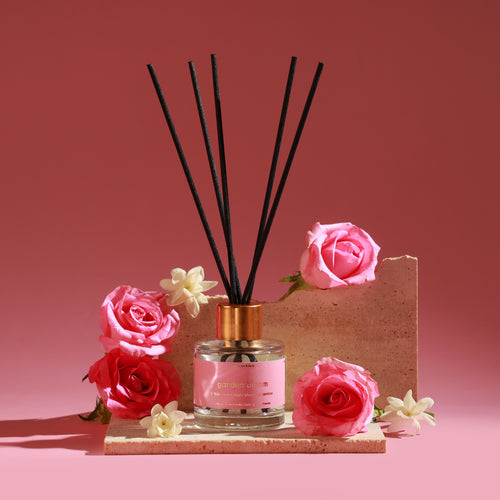
reed diffuser needs 24–72 hours to establish and suits a small lobby rather than a large waiting hall. Candles are not appropriate in a healthcare facility because an open flame is a fire-safety matter. SOSA does not make a room spray. The Hotel Collection scents are SOSA's own interpretations inspired by the world's finest hotels; SOSA is an independent Indian fragrance house, not affiliated with or endorsed by any hotel brand. A portion of every order supports girl-child education through Nanhi Kali.
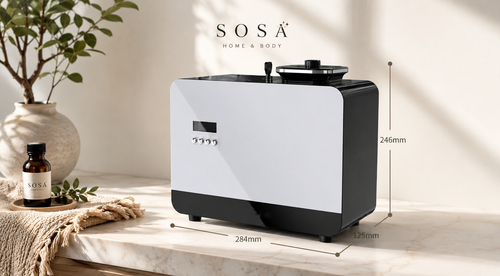
The whole-building answer, where there is one volume
SOSA Aangan ₹25,999
HVAC-connected or standalone, up to 3,000 m³ or roughly 8,000 to 10,000 sq ft, an 800ml reservoir, a metal body, programmable schedules and under 42 dB. It is the right machine in exactly two situations: a genuinely connected tall volume such as a double-height atrium reception with galleries, and a ducted air-handling unit that serves the public zones on every floor and nothing clinical. It is overselling in a 2,500 sq ft polyclinic, and buying it for a ground-floor lobby because the building's volumes add up to under 3,000 m³ scents the lobby and nothing else. Ask for its consumption figure separately and in writing.
A note from Sonal
The clearest version of this mistake I have seen was a four-floor polyclinic in Nagpur whose facilities lead had done the arithmetic better than most of my own customers. He had measured every floor, taken the clinical rooms out properly, arrived at about 1,180 m³ of public volume across the building, and concluded that one Aangan rated to 3,000 m³ would cover it with room to spare. Every number in that sentence was right. The conclusion was wrong, because the four floors shared nothing but a lift shaft and a fire-rated stair, and the machine he was about to buy would have held the ground-floor lobby beautifully and reached nothing above it. What made the conversation easy was that he had already done the hard part. We did the walk together over the phone, floor by floor, counting doors, and the scheme that came out was two machines and a set of reeds.
I have started asking for the walk before the measurements rather than after, because the walk is what tells you what to measure. The question that does the work is not how big is the floor. It is: if I stand where the machine would go and walk to the far corner of what I want it to hold, how many closed doors do I pass through — and a propped door does not count, because a propped door is somebody's habit and habits are not controls. Three floors has come back as two machines far more often than as three in my own order book, and the floor that drops out is almost always the quiet one with a small lift lobby, where the honest answer is reeds at ₹749 or nothing at all. I would rather write that down on a page than have a centre head discover it in month four and reasonably conclude that the arithmetic I sold them was shaped to suit me.
The other direction matters just as much, and I would not want this page read as a page that only ever says buy less. An atrium is one volume, it is a tall one, and three small machines in it would be a worse answer than one with the capacity for the job. Everything is made and supported from Pune, and a part of every order funds girl-child education through Nanhi Kali. You get a space that smells like somewhere looked after; a girl gets a classroom. That equation has always felt right to me.
Frequently asked questions
Should a polyclinic buy one diffuser per floor or one for the whole building?
Neither as a rule - one per public volume that a closed door bounds. A floor can be two volumes if a lift lobby and a far waiting hall are separated by a corridor and two sets of doors, and a building can be one volume if it has a double-height atrium with galleries. In most polyclinics the count of public volumes is lower than the count of floors, so three floors is commonly two Vaayu units at Rs 11,999 each plus alcohol-free reeds from Rs 749 on the quiet floor.
Our three floors add up to under 1,000 cubic metres of public volume. Can one machine do it?
No, and this is the commonest expensive mistake in this subject. A coverage rating describes how much connected volume a machine can hold at a working level - it is a capacity figure, not a delivery figure. A reinforced concrete slab, a fire-rated stair door and a lift shaft are boundaries. One machine against a building-wide total will hold the volume it stands in and reach nothing above it, and turning the setting up does not fix that: it produces a lobby that is too strong and an upper floor that is still unscented.
How do I work out the volume for one floor?
Cubic metres equal floor area in square feet divided by 10.76, multiplied by ceiling height in metres, and then every clinical room comes out of the sum entirely rather than being discounted - consultation and examination rooms, procedure and treatment rooms, dressing, blood and sample collection, laboratory, dispensing, sterile stores, imaging, day-care and paediatric clinical areas are fragrance-free with their doors shut. A 2,500 sq ft floor at 3m is about 697 cubic metres of plan, commonly 300 to 350 once the clinical rooms are removed, which is well inside one Vaayu.
When is one machine for the whole building genuinely correct?
In two cases. A double-height or triple-height atrium with galleries looking into it is one connected volume, and a tall one, so the Aangan at Rs 25,999 covering up to 3,000 cubic metres is the right machine rather than several smaller ones. Or a ducted air-handling unit that serves the public zones on every floor and nothing clinical, where the building's own distribution does the delivery. If that duct reaches a single consultation room, laboratory or collection room, the scheme is finished, because a supply grille cannot be shut like a door.
What should go on a floor whose public area is only a small lift lobby?
Often nothing, deliberately and written down as a decision rather than left as a gap. A 100 to 150 cubic metre lobby with eight people an hour through it and every door off it closed does not read badly for want of a background, and a machine there would be running at the bottom of its range, which is the hardest level to hold steady. Where something is wanted, an alcohol-free reed diffuser from Rs 749 is the honest product: 24 to 72 hours to establish, no power, no tank and nothing to set wrong.
Volumes, not floors
Count the volumes a door closes — and three floors will usually come back as two machines
The Vaayu is ₹11,999: waterless cold-air nebulisation with no standing water tank, up to 1000 m³ or roughly 2,000–3,000 sq ft, a 400ml tank lasting about seventy-five days, Bluetooth app control with 1h/4h/8h/24h timers so every unit in a building runs one schedule, under 38 dB, auto-stop and a key-lock, 0.9 kg at 165 × 80.5 × 215 mm, freestanding or wall or HVAC mounted. The Aangan is ₹25,999 for up to 3,000 m³ on an 800ml reservoir, HVAC-connected or standalone, for a genuine atrium or a public-only AHU. Alcohol-free reeds from ₹749. Free shipping above ₹499, prices subject to change, and a portion of every order supports girl-child education through Nanhi Kali.
See the Vaayu · ₹11,999 See the Aangan · ₹25,999
Continue the read
More from SOSA
Editorial standards & sources
Product facts used in this guide. SOSA Vaayu Rs 11,999: waterless cold-air nebulising diffuser, no water reservoir, coverage up to 1000m3 (approximately 2,000-3,000 sq ft), 400ml refillable tank lasting up to about 75 days per fill, Bluetooth app plus onboard control, 1h/4h/8h/24h timer scheduling, adjustable intensity, under 38 dB, DC 12V/1A at 5W, 165 x 80.5 x 215 mm and 0.9 kg, freestanding or wall or HVAC mounted, auto-stop and key-lock, CE, RoHS and SGS certified, supplied with four hotel-inspired fragrances. SOSA Aangan Rs 25,999: HVAC-connected or standalone commercial nebulising diffuser, coverage up to 3,000m3 (roughly 8,000-10,000 sq ft), 800ml reservoir, metal body, programmable schedules, under 42 dB. Ultrasonic machines are water-based, hold standing water and consume 30-50 ml of water an hour: Sukoon Rs 1,899 (500ml, 270-320 sq ft, 16-18 hours on low, three 15ml Hotel Collection scents included), Boond Rs 899 (300ml), Megh Rs 3,499 (6 litres). Hotel Collection water-based fragrance 15ml Rs 299, 100ml Rs 999, 300ml Rs 1,799. Alcohol-free reed diffusers from Rs 749, requiring 24-72 hours to reach their working level. Free shipping above Rs 499. Coverage arithmetic: cubic metres equal floor area in square feet divided by 10.76 and multiplied by ceiling height in metres, counting only the volumes that are actually scented. This guide makes no medical, therapeutic or clinical claim of any kind for fragrance: a diffuser does not purify, disinfect or clean air, and does not treat, calm or affect any patient or condition. Fragrance is housekeeping and presentation. Clinical areas should be left fragrance-free, and a persistent odour should be traced to its source and corrected rather than covered. SOSA is not affiliated with or endorsed by any hotel brand. Prices subject to change - see the live product pages.


 Reeds · the quiet lobbyfrom ₹749Shop →