
 Mountain Breeze ₹849
  Sukoon ₹1,899
 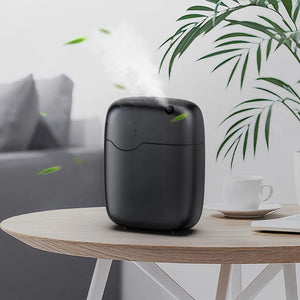 Vaayu ₹11,999
  Oil refill 500ml ₹3,499
  Hotel Collection 300ml ₹1,799
Five criteria decide the format: control, consistency, noise, authority and staff exposure. Not strength, not price, and not what the reception looks like.
Then one measurement decides the product. The arrival zone, taken with a tape, with every clinical room deleted. Under ~150 sq ft a reed diffuser; 150–320 sq ft Sukoon ₹1,899; above ~320 sq ft on one connected path Vaayu ₹11,999.
Two absolutes before any purchase. Never HVAC-mount a diffuser in a clinic — ducting is exactly how fragrance reaches the clinical pathway. And confirm current Vaayu refill availability with SOSA first: the 400ml supplied lasts roughly 90+ days and is the whole supply at the time of writing.
2. That leaves two formats, and the choice between them is operational rather than olfactory. A passive reed diffuser is constant, silent, unpowered, uncontrollable and incapable of being turned up. An active machine is controllable, schedulable, stoppable and, in the case of the Vaayu, lockable — and it has a power cable and a fan or pump inside it.
3. Judge them on five clinic criteria, in this order. Control: can the level be set and held. Consistency: is the room the same at four in the afternoon as at nine in the morning, and the same on Friday as on Monday. Noise: can a machine be heard in a room where people wait an hour with little to distract them. Authority: who may change it, and — separately — who may stop it. Staff exposure: does it work for the person on the desk for nine hours, not for the patient there for forty minutes.
4. Then take one measurement, and let it decide the product. Reception plus waiting, with a tape, on a working morning, with the doors in the position they hold during clinic — and with every clinical room deleted from the calculation. Workup, refraction, imaging, the visual field room, consultation cabins, the laser or procedure suite, any post-operative area, sterilisation, records and stores take nothing from us in any format, at any level, at any hour.
5. The sizing, stated once and properly. Under ~150 sq ft: a reed diffuser at ₹749–₹1,349, or a Boond at ₹899 if you want an off switch. 150–320 sq ft: Sukoon ₹1,899 is the sized product, and I will say so on a page about premium practices. Above ~320 sq ft on one connected public path: Vaayu ₹11,999. 3,000+ sq ft of connected public area: Aangan ₹25,999, and above that Meenar ₹38,500. Megh ₹3,499 covers about 215 sq ft — less than a Sukoon — so it is a runtime and humidity machine and never a coverage upgrade. Safar ₹3,999 has no published coverage figure at all.
6. Two absolutes that override every format preference. Never HVAC-mount a diffuser in a clinic, whatever an architect or air-conditioning contractor proposes: a central system serves your consultation cabins in the same breath as your reception, so ducting is an engineered method of delivering fragrance into the clinical pathway. And confirm current Vaayu refill availability with SOSA before committing — there is no separate cold-air refill oil on sale at the time of writing, the 400ml supplied lasts roughly 90+ days, and the water-based Hotel Collection is never a substitute.
7. The commercial position, stated rather than implied. SOSA publishes no bulk or commercial pricing, no B2B or corporate page, no annual maintenance contract, no installation service, no stated warranty term, no lead time and no multi-location programme; warranty length, spare parts, servicing and whether the Bluetooth app is iOS or Android are all unverified. Where you would reasonably expect one of those to exist, assume it does not until told otherwise in writing, and ask through the contact page before committing.
8. And the conditions that do not change with the format or the price. The clinical pathway stays fragrance-free. The correct intensity in a clinic is lower than in any retail or hospitality space — if a patient can name the fragrance, it is too strong, and the target is considered, never scented. A fragrance-free seat must genuinely exist somewhere a person would ordinarily sit. Reception staff set the level and may switch it off without asking anybody. No claim is made about comfort, anxiety, perceived waiting time, recovery, ratings, reviews, footfall, patient numbers, enquiries, conversion or revenue, and nothing here is medical, clinical, ventilation, air-handling, infection-control, accreditation or regulatory advice. Composed and made in small batches in Pune, and a portion of every order supports girl-child education through Nanhi Kali.

Part one — the spray question, answered plainly
A third of the title is a format I cannot sell you, and rather than quietly steering past that I want to deal with it first, at length, because the reasoning matters more than the fact. SOSA sells no room spray and no home spray; every SOSA spray in the range is a car perfume. That is the honest position, and the three cards below explain both why it is so and why, even from a supplier who did make one, a spray would be the wrong format for a premium eye clinic.
 Mountain Breeze₹849 · constant, silent, unpoweredSet the supply question aside for a moment and ask whether the format would be right if it existed. It would not, and the reason is the criterion a clinic should put first: a waiting room's character should be the same on Friday afternoon as on Monday morning, and a hand-applied format makes that impossible by construction. The level becomes a function of who applied it, how much, how recently, how close to the seating and how they were feeling about the room at the time — which produces a spike followed by a decay, several times a day, rather than a level. A patient arriving three minutes after an application meets a different room from one arriving forty minutes later, and neither of them meets the room you intended. There is a second problem specific to a medical setting. An intermittent application is an event: somebody is seen to do something to the air of a room in which other people are sitting, which draws attention to a decision that ought to be invisible. The target in a clinic is considered, never scented, and the surest way to fail that is to make the scenting a visible act. Both available formats avoid this — a reed bottle emits continuously and silently at a fixed rate, and a machine emits on a schedule nobody has to perform. That is the honest case for both of them and against the third.
Part two — the five criteria, format by format
The two available formats, and the one that is not, judged on the five things a clinic should actually care about. Read the fifth row twice: staff exposure decides more of these cases than anything above it.
| Criterion | Passive reed diffuser ₹749–₹1,349 | Ultrasonic machine ₹899–₹3,499 | Waterless cold-air machine ₹11,999 | Room spray |
|---|---|---|---|---|
| Consistency ★ | Excellent — a fixed rate, unchanged all day, with a long flat plateau after the first fortnight | Good — the same dose in the same water each fill, but the fill is a human step | Excellent — a set intensity on a set schedule, held by a lock | Poor — a spike and decay several times a day, dependent on whoever applied it |
| Control of level | Reed count only, and no published bottle-life figure below six reeds | Dose in the tank, plus a low mode and a remote | Adjustable intensity, key-locked so it holds across a season | None that survives the next person |
| Noise | Silent. No power, no fan, no pump, nothing to hear | Audible to some degree; no comparative decibel figure is published, so I will not invent one | Under 38 dB — the specification that decides most clinic cases | Silent between applications; the application itself is an event in the room |
| Who may change it | Anybody, by adding reeds — which is how levels quietly rise | Anybody at the desk, which is good for stopping and bad for drift | Locked against raising; must never be locked against stopping | Anybody holding the bottle, at any moment |
| Staff exposure over a nine-hour shift | Constant, with no way to pause it short of carrying the bottle out | Good — 2H and 4H modes give genuinely unscented stretches | Best — scheduled windows and day selection, off overnight and during cleaning | Worst — repeated peaks, and staff are nearest the point of application |
| Humidity added | None | Yes — it aerosolises water; a real consideration in a coastal August | None; undiluted oil, dry nano-mist, no water and no heat | Negligible |
| Availability from SOSA | Five compositions, 50ml and 130ml, refills 300ml ₹2,399 and 500ml ₹3,499 | Boond ₹899, Sukoon ₹1,899, Megh ₹3,499, on water-based Hotel Collection only | Vaayu ₹11,999 — no separate cold-air refill oil is currently sold | None. SOSA sells no room spray; every SOSA spray is a car perfume |
| The honest caveat: every column concerns the arrival zone — reception and waiting — only. Examination rooms, diagnostics, consultation cabins, the procedure suite, any post-operative area, sterilisation and stores take nothing, in any format, at any level, at any hour, and that boundary is the practice's own clinical judgement rather than a supplier's recommendation. Nothing on this page is medical, clinical, ventilation, air-handling, infection-control, accreditation or regulatory advice. No SOSA product or setting is described as safe or unsafe for any patient or staff group; some people are sensitive to airborne fragrance, which is exactly why the clinical pathway stays fragrance-free and why a fragrance-free seat must genuinely exist somewhere a person would ordinarily sit. No claim is made about comfort, anxiety, perceived waiting time, recovery, ratings, reviews, footfall, patient numbers, enquiries, conversion to any procedure, or revenue. Fragrance adds a scent alongside what is already in the air; it removes, masks, neutralises or purifies nothing. Coverage and noise figures are manufacturer specifications and vary with ceiling height, air exchange, occupancy and intensity. Never mount any diffuser into a clinic's shared HVAC. | ||||
Sukoon · 150–320 sq ft, most clinics₹1,899Shop → 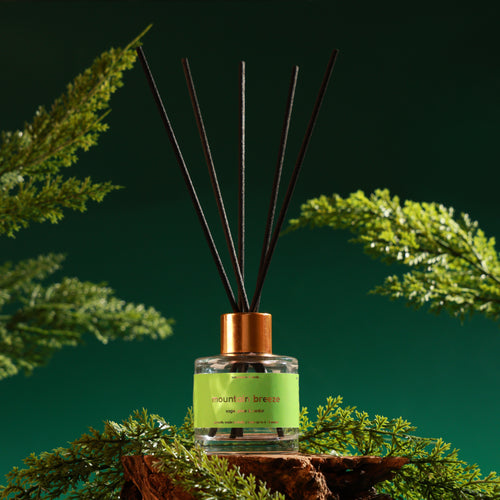 Mountain Breeze · under 150 sq ft₹849Shop →
 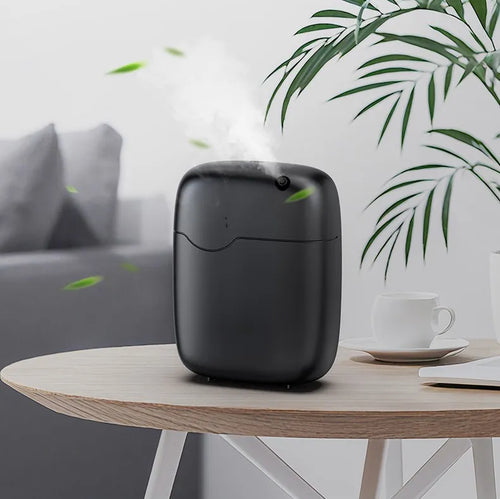 Vaayu · above 320 sq ft, freestanding₹11,999Shop →
Part three — where each format is the wrong answer
Both available formats have a configuration in which I would refuse to recommend them, and setting those out is the point of a pillar sitting at the end of a family rather than at its start. Take the passive reed diffuser first, because it is the one I recommend most often and therefore the one whose limits deserve the clearest statement. A reed bottle is a fixed-output device with no way to project what it makes, which means it produces a fragrant zone rather than a fragranced floor. In a compact reception that is exactly the right shape — present where people wait, absent by the time you reach the corridor to consultation. But it is structurally incapable of three things a clinic sometimes genuinely needs. It cannot be scheduled, so a practice whose cleaning shift overlaps opening hours cannot prevent fragrance from colliding with cleaning chemistry, and the collision makes a third smell worse than either. It cannot be stopped quickly from the desk; somebody has to lift the bottle and carry it out, after which the room clears at its own air-exchange rate. And it cannot be locked, so its level rises the way all uncontrolled levels rise — somebody decides the room has gone flat, adds a reed, and nobody records it. That last point is worth dwelling on, because practices imagine a passive source is drift-proof and it is not; it is simply drift-proof against the machine's failure modes and vulnerable to its own. Beyond roughly 250–300 sq ft of connected open volume the honest ceiling is reached: three bottles make three zones and three overlaps, and the answer at that point is one machine rather than a fourth bottle.
Now the machine, and there are three configurations in which I would not supply one to an eye clinic at any price. The first is the HVAC installation, and it is absolute. The Vaayu is capable of wall and duct mounting; an architect or air-conditioning contractor may well propose it, because it is the neat solution, it hides the hardware, and in a hotel it would be right. In a clinic it is wrong, because a central system serves your consultation cabins, your workup room and your imaging room in exactly the same breath as it serves your reception. Ducting fragrance into it is a reliable, engineered method of delivering fragrance into the clinical pathway, which is the one outcome every page in this cluster exists to prevent — and there is no intensity low enough to fix it, because the objection is about where the material goes rather than about dose. If a proposal on your desk only works with a duct, the proposal changes. The second refusal is the under-ventilated reception. If your patient-side space has no openable window, opens onto an internal corridor rather than the street, is served by one recirculating system and does not deliberately exchange air with outside between opening and closing, then everything added accumulates and very little leaves; a continuous source settles higher than intended and holds there, felt as weight rather than as fragrance. An ₹11,999 machine will deliver that outcome more efficiently than an ₹849 bottle, which is the opposite of what the money was meant to buy. The correct project costs nothing: two openings on opposite sides of the arrival zone held open together for ten to fifteen minutes twice a day for a fortnight, with a cold-nose check at four each afternoon. The third is the open clinical corridor. If the route to consultation opens off the waiting bank with no door and stays open through every session, a machine sized for that waiting bank will scent the corridor whatever anybody intends. In that building the options are all small — fit a door closer, reroute how patients are called, move the source twenty feet to the entrance end and drop it to the bottom of its range, or accept a reed diffuser at two of six reeds and nothing else. That last is not a consolation prize; it is a bounded fragrant zone that keeps its own promise.
There is a fourth case that belongs here because it cuts across both formats and because it is the most serious commercial constraint in this family. SOSA does not currently sell a separate Vaayu cold-air refill oil. The machine ships with four cold-air fragrances at 100ml each — 4 × 100ml = 400ml — which at a mid intensity lasts roughly 90+ days, or 400 ÷ 90 = 4.4ml a day, and that is the whole supply available at the time of writing. A household reads that as an inconvenience three months away. A practice reads it differently, and a practice with more than one site reads it differently again, because adopting a scent is adopting a standard rather than buying a consumable: reception learns it, returning patients associate it with the building, and a group that has committed three branches to one character cannot change it without visibly altering the thing it deliberately made invariant. So the instruction comes before the order rather than after: ask SOSA, through the contact page, what cold-air fragrance supply is currently available and on what basis, and get the answer before committing. Two related warnings. The water-based Hotel Collection sold for ultrasonic machines is never a substitute, despite shared scent names — it is a different product for a different mechanism and must not be used in a Vaayu. And for a signature intended to hold for years or across sites, the reed range is the steadier base, with oil-only refills at 300ml ₹2,399, which is ₹2,399 ÷ 300 = ₹8.00 a millilitre, and 500ml ₹3,499, which is ₹3,499 ÷ 500 = ₹7.00, against ₹749 ÷ 50 = ₹14.98 for the smallest bottle.
The last thing to refuse is the one that has run under this whole family, and it is not a product at all. Do not buy any format to answer a question that is really about the building or the operation. A practice that has just completed a fit-out and finds the reception smells of adhesive and new MDF has a curing building, not a fragrance problem, and should ventilate and wait two to three months. A practice whose waiting area feels ordinary despite an expensive interior usually has a sound problem, a lighting-temperature problem, a seating-geometry problem or a cluttered counter, and all four of those are cheaper and more powerful than anything I sell. A practice that wants a signature identity should be told that the technique is restraint and silence — one composition, held for years, at a level nobody can name, never mentioned in anything the practice publishes. And a solo practitioner with a 130 sq ft reception should be told that the machine's key-lock and schedules are governance features for a problem a one or two-person practice does not have, so a bottle at ₹849 is not the modest version of the right answer; it is the right answer. On every one of those, the honest recommendation is smaller than the enquiry that prompted it, and this family exists to make each of them explicitly rather than to let the largest product carry the argument.
Part four — the owner's family, resolved
Every question this family has asked, the criterion that actually decides it, and the honest answer. Note how many rows end in something smaller than the enquiry, or in nothing at all.
| The question you arrived with | What actually decides it | The honest answer | The format it lands on |
|---|---|---|---|
| "We spent heavily on interiors — is scent worth adding?" ★ | Whether you can cost it as a running line rather than a capital one | Yes, as a finishing half-tone. No return is claimed and none exists to claim | A bottle at ₹849, or a Sukoon at ₹1,899 if the zone runs 150–320 sq ft |
| "What small details make a clinic feel considered?" | Sound, seating, light temperature, clutter and air temperature — before scent | Fix the first five. A great many practices never reach the sixth | Often none at all, and that is a complete outcome |
| "Can we have a signature without feeling commercial?" | Whether you ever mention it anywhere you publish | Yes — one composition, held for years, at a level nobody can name, never announced | Reeds, because invariance matters more than control here |
| "Should every branch use the same fragrance?" | Whether you can keep buying it — supply, not preference | Yes on the oil, no on the hardware. Confirm resupply before the second site | One composition; the machine varies with each arrival zone |
| "How do we standardise across locations?" | Whether the level is written as an outcome rather than a dial position | Five lines, one named owner, central ordering, a quarterly cold-nose audit | Mixed by site — and a site that cannot hold it runs nothing |
| "When should we plan scenting for a new clinic?" | The layout drawing, because the boundary is made of walls and doors | Plan at layout stage; buy two to three months after opening | Decided after opening, from a tape measurement of the real room |
| "Should the architect plan the placement?" | Whether HVAC integration gets ruled out in writing | Yes — a socket, a surface, a sightline, marked return grilles, one prohibition | Freestanding only. Never ducted, in any format |
| "How do we match scent to our interior?" | The dominant material, then light temperature, then palette | Read the room, then go one step drier, because it is a clinic | Dry woody for stone; dry citrus-green for white; softest for warm timber |
| "Is this worth it for a solo practice?" | Arrival-zone size, how many people touch the setting, cleaning overlap | Usually not. A bottle at ₹849, or nothing | Reeds. The machine argument starts at a size solo receptions rarely reach |
| "Reeds, sprays or a machine?" | Control, consistency, noise, authority, staff exposure — then the tape | No spray exists here; every SOSA spray is a car perfume | Reeds under ~150 sq ft; Sukoon 150–320; Vaayu above ~320 on one path |
| "Someone offered us a Megh as the upgrade." | ~215 sq ft — less coverage than a Sukoon | A runtime and humidity machine. Never a coverage upgrade | Not comparable; a different job entirely |
Versailles
The enquiry that eventually made me write this page came from the administrator of a premium eye centre, and it was one line: send us your best room spray for a reception. I did not have one to send, and the honest reply took three paragraphs to write because the short version — we do not make one — sounds like a company being unhelpful rather than a company being accurate.
What I wrote was that every spray we make is a car perfume, that there is no ambient room spray in the range at all, and that even if there were I would have argued against it for their building. Then I gave the reason, which is the one this page is built on. A waiting room's whole value to a clinic is that it is the same every time — same on a Friday afternoon as on a Monday morning, same for the person arriving at nine as for the person still sitting there at eleven. A hand-applied format cannot deliver that by construction, because the level becomes a function of who last picked up the bottle. What you get is a series of spikes and decays that nobody designed, in a room where people are already sitting still for a long time with very little to occupy them.
They measured their arrival zone at three hundred and sixty square feet on one connected path, with four people rotating on the desk and a housekeeping shift that began at half past five while patients were still waiting. That is one of the few clinic profiles where the expensive machine is genuinely right, and it is right for reasons that have nothing to do with strength: under 38 dB in a quiet room, a lock so four sincere people cannot each raise the level a little, and a schedule that keeps fragrance and cleaning chemistry apart. They confirmed refill supply with us in writing before they ordered, which is the sequence I ask every practice to follow and which almost nobody does. If this whole family of pages has one lesson, it is that: ask the awkward question before the invoice, not after. Composed and made in small batches in Pune, and a part of every order funds a girl's classroom through Nanhi Kali.
Frequently asked questions
- Scent after a heavy interiors spend, the six small details and identity without feeling commercial.
- One scent across every branch and how to standardise across locations.
- When to plan scenting for a new clinic and what to brief the architect.
- Matching scent to the interior and whether it is worth it for a solo practice.
- Brand: the SOSA founder story.
SOSA range, specifications and prices used in this guide (verified August 2026): Vaayu ₹11,999 — waterless cold-air nebulisation of undiluted fragrance oil; no water, no heat, no added humidity, no white mineral dust. Coverage up to 1000 m³, about 2,000–3,000 sq ft. 400ml refillable tank lasting roughly 90+ days at a mid setting. Bluetooth app plus onboard controls, 1h / 4h / 8h / 24h run windows, day selection, adjustable intensity, auto-stop and key-lock. Under 38 dB. DC 12V / 1A, 5W. Freestanding or wall / HVAC mount. CE, RoHS and SGS certified. SOSA does not currently sell a separate Vaayu cold-air refill oil; the 400ml supplied in the box is the fragrance available at the time of writing, so a practice planning continuous or multi-site use should confirm current refill availability with SOSA before committing. The water-based Hotel Collection is made for ultrasonic machines and must not be used in a Vaayu. Other machines: Boond 300ml ₹899 (~150 sq ft, ultrasonic) · Sukoon 500ml ₹1,899 (270–320 sq ft, 16–18 hours on low, remote and steady/2H/4H timers, three 15ml fragrances included, ultrasonic) · Megh 6L ₹3,499 (~215 sq ft — a runtime and humidity machine that covers less than a Sukoon, never a coverage upgrade) · Safar ₹3,999 (waterless cold diffusion, cordless, 20ml, about 6.9cm, three speeds, 1/2/3-hour auto-off — sold as a car and travel diffuser, personal-scale only; SOSA publishes no coverage figure for it) · Aangan ₹25,999 (HVAC nebulising, ~8,000–10,000 sq ft) · Meenar ₹38,500 (commercial HVAC, 12,000–18,000 sq ft). Water-based Hotel Collection for ultrasonic machines: 15ml ₹299 · 100ml ₹999 · 300ml ₹1,799 · pack of seven ₹1,799; scents are inspired by the atmosphere of well-known hotels — SOSA is an independent Indian brand and is not affiliated with, endorsed by or supplying any hotel group. Reed diffusers ₹749–₹1,349 (50ml 6–8 weeks, 130ml 14–18 weeks, six fibre reeds, no 100ml size; replacement reeds are not sold separately). Reed oil cannot be used in an ultrasonic machine and Hotel Collection oil cannot be used in reeds. SOSA sells no room spray or home spray — every SOSA spray is a car perfume. Nothing in this guide is medical, clinical or safety advice. A fragrance diffuser adds a scent to the air. It does not clean, purify, filter, sanitise or disinfect air, does not remove or neutralise disinfectant, damp or occupancy smells, and has no effect on comfort, anxiety, waiting time, recovery or any clinical outcome. Some people are sensitive to airborne fragrance, which is why this guide recommends that examination rooms, diagnostic areas, consultation cabins, procedure suites and post-operative areas remain fragrance-free, that a fragrance-free seating option always exist, and that a diffuser is never mounted into shared HVAC in a clinical building. Decisions about clinical policy, ventilation standards, infection control and patient suitability rest entirely with the practice and its clinicians. A persistent stale, damp or disinfectant smell is a ventilation, moisture or cleaning problem — SOSA sells no dehumidifier and no air purifier, and fragrance should never be used to cover one. Coverage, runtime and longevity figures are manufacturer specifications and typical ranges, not guarantees, and vary with room volume, ceiling height, air exchange, occupancy and season. SOSA publishes no commercial or bulk pricing, no corporate account, no annual maintenance contract, no installation service, no stated warranty term and no multi-location programme; warranty length, spare parts, servicing and app platform availability are unconfirmed, and larger or multi-site enquiries should go through the contact page before any commitment. Composed and made in small batches in Pune, India. Free shipping above ₹499. A portion of every order supports girl-child education through Nanhi Kali. Prices subject to change — see the live product pages.