


Examination room: no, and no version of the question turns into a yes. Not a discreet bottle, not a machine on a schedule, not a weaker composition, not "only between patients". The clinical pathway stays fragrance-free.
What decides it is not the smell — it is choice and duration. A person in your waiting area chose to sit there, can move seats, and leaves when called. A person at the slit lamp is positioned, still, close, and cannot step outside for a minute.
Then size to the arrival zone, never to the clinic. Under ~150 sq ft of reception, a reed diffuser from ₹749. From 150 to 320 sq ft, a Sukoon ₹1,899. Past that, a freestanding Vaayu ₹11,999 — never ducted into shared air-conditioning.
2. The examination room takes nothing, and the answer does not soften with a smaller product. A 50ml bottle is not a compromise version of a machine; it is the same decision at a lower volume.
3. The reason is choice. A person in your waiting area chose the seat, can move to another, and can step outside without consequence. A person at a slit lamp has been positioned and asked to hold still. Ambience is only ever offered to someone who can decline it.
4. The second reason is your own staff. An optometrist works in one cabin for eight or nine hours; a patient is in it for eight or nine minutes. The constant belongs to your colleague, not to the visitor.
5. The third is that a clinical room is where competence is demonstrated, and ambience must never compete with that signal. The target for an eye practice is considered, not scented.
6. Some people are sensitive to airborne fragrance. That is why the clinical pathway stays clear and why a fragrance-free seat should exist in the waiting area — not a claim that anything is harmful, and not a claim that anything is safe. Both belong to the practice and its clinicians.
7. Check the boundary is real before buying. If cabin doors stand open onto the waiting area, you have one room with a partition rather than two — fix the door first.
8. Then size to the arrival zone, never to the clinic. Under about 150 sq ft, a reed diffuser from ₹749. From 150 to 320 sq ft, a Sukoon at ₹1,899. Past roughly 320 sq ft of open reception, a freestanding Vaayu at ₹11,999 — never mounted into shared HVAC. Made in small batches in Pune, and a portion of every order supports girl-child education through Nanhi Kali.

Part one — the three differences that carry the argument
Ten variables separate these two rooms and the full list is in Part two, but three of them do almost all the work. If you remember three sentences from this page, make them these — each can be checked against your own building in an afternoon rather than argued about.
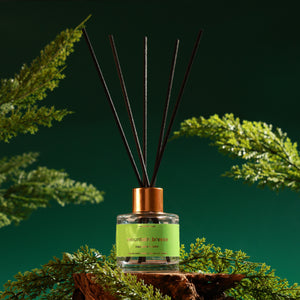
 Mountain Breeze₹849 · arrival zone onlyPractices debate this as though the patient were the only person in the room, and the patient is in it for the shortest time. A consulting ophthalmologist or an optometrist occupies one cabin for eight or nine hours; the patient occupies it for eight or nine minutes. Anything constant in that room is a decision about your colleague's whole working day, taken on the strength of a few minutes of somebody else's. The same asymmetry exists in reception, which is why the level there is set for the person at the desk rather than the visitor passing through — but there the exposure sits in a large, ventilated, shared volume and the person at the desk is a party to the decision. In a cabin the volume is small, the door is closed, and the exposure is concentrated. Ask the people who work in a room before you change its air, and treat one objection as a no.
Part two — the two rooms compared on ten counts
Here they are side by side. The point is not that the examination room loses on one count; it is that every variable resolves the same way, which is what distinguishes a genuine boundary from a preference somebody will relitigate in six months.
| The variable | Reception and waiting | Examination room | What that decides |
|---|---|---|---|
| Why the person is in the room ★ | They arrived and have not been called yet | They were sent, as a step in the clinical visit | Arrival is hospitality space; everything caused by the visit is clinical space |
| Whether they can decline the room's air | Yes — they can change seats or step outside | No — they are positioned at an instrument and asked to hold still | Ambience is only defensible where opting out costs nothing |
| Typical patient occupancy | 15–45 minutes, often longer at a busy clinic | 6–12 minutes per patient, repeated all day | Sets the dose in reception; rules the cabin out entirely |
| Staff occupancy of the same air | The desk team, all day, in a large shared volume | One clinician, all day, in a small closed volume | The cabin concentrates exposure onto one employee |
| Door state during the working day | Open to the street and to the waiting bays by design | Closed, or closed for the working part of the visit | A closed small room holds a constant; a lobby dilutes one |
| Distance between people | Chairs, a counter, a metre or more | Face to face across an instrument at arm's length | Close-range work is not a setting for an added constant |
| Equipment and records present | A desk, a queue screen, files behind the counter | Optics, electronics, calibrated instruments | Ultrasonic machines add humidity — a second reason to keep them out |
| What the patient's eyes are doing | Reading, waiting, looking at a phone | Under examination, often dilated, sometimes after drops | Not a claim about harm — a reason the practice, not a brand, decides |
| Whether a clinical decision is being taken | No — the room is administrative and social | Yes, continuously, and it is the room's entire purpose | Ambience must not compete with the competence signal |
| Who owns the decision about the room | The practice, as a hospitality choice, with staff consulted | The practice and its clinicians, as clinical judgement | SOSA specifies the first and declines to advise into the second |
| The honest caveat: this is an ambience comparison and nothing more, and not medical, clinical or regulatory advice. No SOSA product is described as safe or as unsuitable for any patient group, procedure or room, and no claim is made that fragrance harms or benefits anyone. Occupancy figures are typical ranges and will differ in your practice. Clinical policy, infection control, ventilation standards, accreditation and patient suitability rest entirely with the practice and its clinicians. | |||
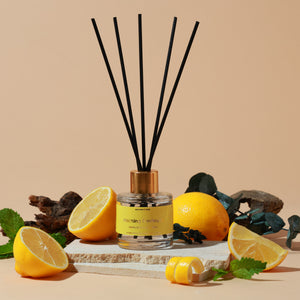
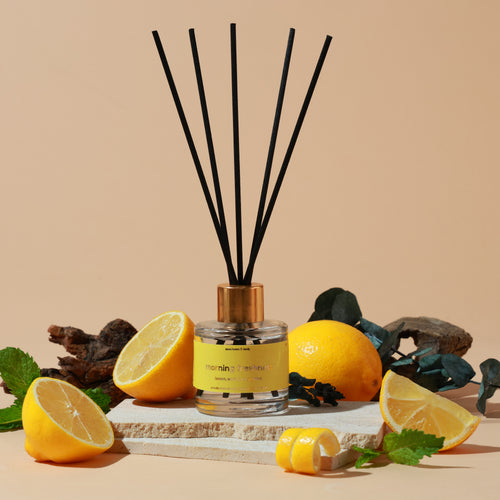 Morning Freshness · under ~150 sq ft₹749Shop → Sukoon · 150–320 sq ft₹1,899Shop →
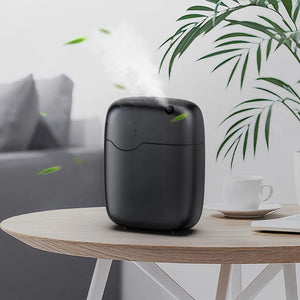
 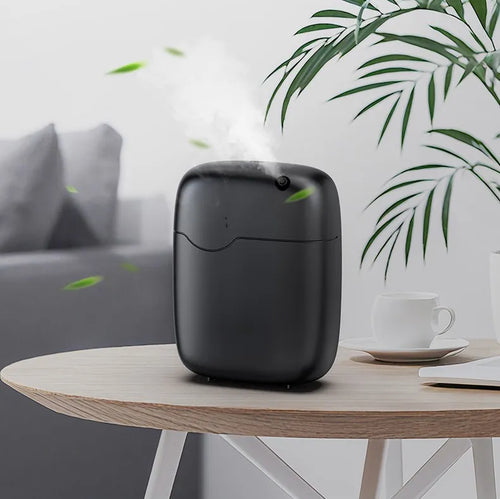 Vaayu · past ~320 sq ft₹11,999Shop →
Part three — the four arguments for scenting an examination room, answered
Four versions of the case for putting something in a clinical cabin come up regularly, and all four sound reasonable. The first is that a smaller product is a smaller decision. A 50ml reed bottle looks so modest on a windowsill that it does not feel like a policy — and that is exactly how it ends up in rooms nobody agreed to. Format is not scale. A reed diffuser is constant, passive and has no off switch, so a bottle in a small closed cabin is a twenty-four-hour decision with no way to interrupt it short of carrying it out of the building. The second is "only between patients", usually proposed with a timer. Air does not clear on the schedule a timer implies; a small closed room holds what has been put into it, and the next patient walks into the tail of it. A timer controls when a zone is scented, not whether a clinical room becomes temporarily eligible.
The third is that the cabin smells of something else, and fragrance would deal with it. This is where the whole category oversells itself. Fragrance adds a scent alongside what is already in the air. It removes nothing. It does not mask, neutralise, purify, sanitise or clean, and layering a composition over a cleaning agent or a stuffy afternoon produces a third smell worse than either of the two you started with. If a cabin smells of disinfectant, that is a cleaning-protocol and ventilation question for your housekeeping supervisor and your clinicians. If it smells closed, it is under-ventilated, and more fragrance in an under-ventilated room reads as heavier rather than fresher. The order never changes: find the source, fix the ventilation or the cleaning, and only then — and only in the arrival zone — consider fragrance. The fourth is that a premium practice should feel premium throughout. It should, and the way a clinical room does that is with good light, quiet equipment, clean surfaces and a technician who explains what is about to happen.
There is a fifth position that is not an argument but a situation, and it decides whether this page applies to you at all. If your consultation cabins open directly onto the waiting area, or their doors are propped open all day, you do not have two rooms — you have one volume with a partition in it. In that building the reception decision is silently a clinical decision, and the honest move is to change the door before spending anything on fragrance. A self-closing hinge costs a few hundred rupees and is the most useful thing on this page. Where that is not possible, leave the building unscented for now and revisit after the next refurbishment.
Part four — what reception actually costs, worked out
Having ruled out most of the building, the remaining question is small and answerable: what the one room in scope costs to run. The examination rooms are a ₹0 line in every row below.
| Your reception and waiting zone | What I would put in it | Setting or reed count | Cost, with the arithmetic |
|---|---|---|---|
| Every examination room, cabin and lane ★ | Nothing, in any format | Not applicable | ₹0 — and this row is the point of the page |
| Under ~100 sq ft — a desk and four or five chairs | One 50ml reed bottle, on a tray, away from the corridor mouth | Start at four reeds of six, not six | ₹749 over 6–8 weeks ≈ ₹94–₹125 a week (₹749 ÷ 8 = ₹94; ₹749 ÷ 6 = ₹125) |
| ~100–150 sq ft — a small clinic front of house | One 130ml reed bottle for the longer plateau, not for more reach | Six reeds, flipped weekly with gloves | ₹1,249 over 14–18 weeks ≈ ₹69–₹89 a week (₹1,249 ÷ 18 = ₹69; ₹1,249 ÷ 14 = ₹89) |
| ~150–320 sq ft — the commonest Indian arrival zone | Sukoon, behind the desk line, far end from the corridor | Lowest setting, 2H or 4H timer rather than steady | ₹1,899 once, three 15ml fragrances in the box; a 100ml Hotel Collection refill is ₹999, so ₹1,899 + ₹999 = ₹2,898 for the opening kit |
| ~320–800 sq ft open reception, or two connected waiting bays | Vaayu, freestanding only — never wall- or HVAC-mounted in a clinic | Lowest intensity, run window set to opening hours, key-lock on | ₹11,999 · under 38 dB · 400ml in the box lasts roughly 90+ days — confirm refill supply first |
| Three branches wanting the same reception scent | Three identical machines rather than one large one per site | Same setting written down and locked at each site | ₹1,899 × 3 = ₹5,697 · no bulk price, slab or account is published — ask before assuming one |
Versailles
The first eye practice that asked me this question asked it the other way round. They had already put a small bottle in each consultation cabin — one per doctor, chosen by each doctor — and reception had nothing at all, because nobody had thought of it as a room.
One conversation with an optometrist explained why that was exactly the wrong answer. She said something I have quoted ever since. "I am in that room for nine hours. My patient is in it for nine minutes. Why does the nine-minute person get to choose what I breathe?" Nobody had asked her. Nobody asks the people who work in the room, because the question always gets framed as being about patients — and the patients are the ones with the shortest exposure and the most polite instinct to say nothing.
We moved everything to the front of the building, at a lower level than they had been running in the cabins, and left the clinical side alone. That is the whole recommendation and it has not changed since. I would rather sell one bottle for a reception than six for a corridor of cabins. Composed and made in small batches in Pune, and a part of every order funds a girl's classroom through Nanhi Kali.
Frequently asked questions
- The full zone list for an ophthalmology practice — every room, with a yes or no.
- Why examination rooms get nothing and why diagnostics stay fragrance-free.
- Keeping procedure areas clear while scenting arrival and stopping reception fragrance travelling.
- Handling people who are sensitive to strong fragrance and the most conservative way to introduce fragrance at all.
- Brand: the SOSA founder story.
SOSA range, specifications and prices used in this guide (verified August 2026): Vaayu ₹11,999 — waterless cold-air nebulisation of undiluted fragrance oil; no water, no heat, no added humidity, no white mineral dust. Coverage up to 1000 m³, about 2,000–3,000 sq ft. 400ml refillable tank lasting roughly 90+ days at a mid setting. Bluetooth app plus onboard controls, 1h / 4h / 8h / 24h run windows, day selection, adjustable intensity, auto-stop and key-lock. Under 38 dB. DC 12V / 1A, 5W. Freestanding or wall / HVAC mount. CE, RoHS and SGS certified. SOSA does not currently sell a separate Vaayu cold-air refill oil; the 400ml supplied in the box is the fragrance available at the time of writing, so a practice planning continuous or multi-site use should confirm current refill availability with SOSA before committing. The water-based Hotel Collection is made for ultrasonic machines and must not be used in a Vaayu. Other machines: Boond 300ml ₹899 (~150 sq ft, ultrasonic) · Sukoon 500ml ₹1,899 (270–320 sq ft, 16–18 hours on low, remote and steady/2H/4H timers, three 15ml fragrances included, ultrasonic) · Megh 6L ₹3,499 (~215 sq ft — a runtime and humidity machine that covers less than a Sukoon, never a coverage upgrade) · Safar ₹3,999 (waterless cold diffusion, cordless, 20ml, about 6.9cm, three speeds, 1/2/3-hour auto-off — sold as a car and travel diffuser, personal-scale only; SOSA publishes no coverage figure for it) · Aangan ₹25,999 (HVAC nebulising, ~8,000–10,000 sq ft) · Meenar ₹38,500 (commercial HVAC, 12,000–18,000 sq ft). Water-based Hotel Collection for ultrasonic machines: 15ml ₹299 · 100ml ₹999 · 300ml ₹1,799 · pack of seven ₹1,799; scents are inspired by the atmosphere of well-known hotels — SOSA is an independent Indian brand and is not affiliated with, endorsed by or supplying any hotel group. Reed diffusers ₹749–₹1,349 (50ml 6–8 weeks, 130ml 14–18 weeks, six fibre reeds, no 100ml size; replacement reeds are not sold separately). Reed oil cannot be used in an ultrasonic machine and Hotel Collection oil cannot be used in reeds. SOSA sells no room spray or home spray — every SOSA spray is a car perfume. Nothing in this guide is medical, clinical or safety advice. A fragrance diffuser adds a scent to the air. It does not clean, purify, filter, sanitise or disinfect air, does not remove or neutralise disinfectant, damp or occupancy smells, and has no effect on comfort, anxiety, waiting time, recovery or any clinical outcome. Some people are sensitive to airborne fragrance, which is why this guide recommends that examination rooms, diagnostic areas, consultation cabins, procedure suites and post-operative areas remain fragrance-free, that a fragrance-free seating option always exist, and that a diffuser is never mounted into shared HVAC in a clinical building. Decisions about clinical policy, ventilation standards, infection control and patient suitability rest entirely with the practice and its clinicians. A persistent stale, damp or disinfectant smell is a ventilation, moisture or cleaning problem — SOSA sells no dehumidifier and no air purifier, and fragrance should never be used to cover one. Coverage, runtime and longevity figures are manufacturer specifications and typical ranges, not guarantees, and vary with room volume, ceiling height, air exchange, occupancy and season. SOSA publishes no commercial or bulk pricing, no corporate account, no annual maintenance contract, no installation service, no stated warranty term and no multi-location programme; warranty length, spare parts, servicing and app platform availability are unconfirmed, and larger or multi-site enquiries should go through the contact page before any commitment. Composed and made in small batches in Pune, India. Free shipping above ₹499. A portion of every order supports girl-child education through Nanhi Kali. Prices subject to change — see the live product pages.