



Mechanism two: water condensing on the evaporator coil runs into a drain pan. Coil, fins and pan stay wet and dusty all season, and biofilm grows there.
Mechanism three: an AC recirculates. It cools and dries; it does not ventilate. A closed AC bedroom still exchanges only 0.2–0.5 of its air an hour.
2. Because the room re-humidifies faster than you think. Your mattress, wardrobe, curtains and rug have all been absorbing moisture through the wet season, and they release it back into a dry room until they reach balance with it. Add the rest of the flat leaking in under the door, and outside air through gaps around an old window frame. Eight hours of AC does not undo six weeks of monsoon in the materials; it dries the air, and the materials refill it.
3. Because the indoor unit is a permanently wet object. This is the part most people never look at. The evaporator coil sits below dew point whenever the unit runs, which is precisely why it collects water. That water carries dust off the fins into a drain pan underneath. Coil, fins and pan then sit damp in the dark for the rest of the day, and biofilm — bacteria and mould on a wet surface with organic dust to eat — is exactly what grows in that situation. It smells musty, and the unit then blows that smell across the room.
4. Because the drain line may not be draining. The condensate has to get out of the building. If the drain line is blocked with silt or biofilm, or has been run with a poor fall, water sits in the pan permanently rather than emptying, and in bad cases backs up into the unit. Standing water inside an indoor unit is a service call, not an odour. The simple check: while the AC is running hard, go and look at where the drain pipe discharges. It should be dripping steadily.
5. And an AC does not ventilate, so nothing is being carried away. A split unit recirculates the air already in the room. It changes its temperature and its moisture content; it does not replace it. A closed air-conditioned bedroom is still exchanging only about 0.2–0.5 of its air an hour, so anything released into it stays. That is a separate problem from the damp and it needs a separate answer: ten minutes of genuine cross-ventilation whenever the weather allows.
Made in India, composed by an ISIPCA Versailles-trained perfumer — and a portion of every order supports girl-child education through Nanhi Kali.
Why eight hours of drying does not stick
The dehumidification an air conditioner performs is real and substantial. Air is pulled across an evaporator coil that is well below the dew point of that air, water condenses out onto the fins exactly as it does on a cold bottle, and it runs down into a pan and out through a drain pipe. A couple of hours in a closed bedroom will drop the relative humidity noticeably. The catch is that this only happens while the compressor is running — set the thermostat high, run the unit in fan mode, or let an inverter unit idle at minimum output and you get cooling with very little moisture removal. And it stops entirely the moment you switch off.
What happens next is the part that explains the complaint. Every porous material in that bedroom — the mattress core, the pillows, the clothes in the wardrobe, the curtains, the rug — has spent the wet season absorbing moisture, and materials release moisture back into dry air until they balance with it. So overnight the AC dries the air and the materials quietly resupply it; and once the AC is off in the morning, the room comes back to ambient within hours. Add air leaking in from the rest of the flat and from outside, and you have a bedroom that is dry at 6am and damp again by noon, every day, all season. The AC is treating the air. The moisture is stored in the things. Until you dry the things, the air keeps refilling.
The three things to check, in order
 Step fourFrom ₹749Switch the AC on after a day off and stand in the airflow for the first two minutes — if a musty note arrives with the air and then fades, the unit is the source. Open the front and take the filters out; they should be washed monthly through the season and they are usually far dirtier than people expect. Look at the coil fins behind them, and at the drain pan below. Then go outside and check that the drain pipe is dripping steadily while the unit runs. If it is not, water is sitting somewhere it should not be, and that is a service call.
Symptom to cause: reading an AC bedroom in monsoon
The timing tells you which mechanism you are dealing with. A smell that arrives with the airflow is the unit; a smell that builds while the AC is off is the room; a smell that is constant is both.
| What you notice | Most likely cause | How to confirm it | What actually fixes it |
|---|---|---|---|
| Musty note arrives in the first minutes of the AC starting ★ | Biofilm on the evaporator coil, filter or drain pan | Switch on after a day off and smell the first two minutes of airflow | Wash filters monthly; have the coil and drain line professionally cleaned |
| Room feels dry at 6am and damp again by midday | The room re-humidifying from its own materials once the AC stops | A hygrometer left in the room, read on waking and again at noon | Dry the mattress, wardrobe and curtains; the air only stays dry once the things are |
| Air feels stale and close rather than damp exactly | Recirculation — the AC cools but does not ventilate, so air change stays at 0.2–0.5 an hour | Open the room fully for ten minutes on waking and see whether it clears | Cross-ventilate ten minutes each morning, then close up and run the AC |
| Water dripping inside the room, or no drip outside while running | A blocked or badly fallen drain line — standing water in the unit | Watch the outdoor drain discharge while the AC runs hard; it should drip steadily | A service call. Do not fragrance a unit with standing water in it. |
| Damp smell strongest near the wardrobe or the bed, not the AC | Stored moisture in cotton and foam rather than anything to do with the unit | Smell the inside of the wardrobe and the cushion seams rather than the room | Empty and dry the cupboard, fan the mattress, wash and fully dry all linen |
| Dark speckling on the wall behind the AC or on the ceiling above it | Mould — a health issue, not an odour problem | Torch the wall behind and below the indoor unit at a raking angle | Remove growth safely, fix the leak or condensation causing it, get advice. |
| If none of these fit: check whether the bathroom door opens into the bedroom. An en-suite with weak extraction will keep an air-conditioned bedroom damp all season regardless of what the AC is doing. | |||
Reeds · always-on roomsFrom ₹749Shop →  Sukoon · when you want a switch₹1,899Shop →
  Hotel Collection · the scentFrom ₹299Shop →
Getting an AC bedroom genuinely dry
First, deal with the unit, because it is both a dehumidifier and a suspect. Take the filters out and wash them; do it monthly through the season rather than annually. Look at the coil fins and the drain pan behind them, and check that the drain pipe is discharging steadily outside while the unit runs hard. If it is not, or if there is standing water in the pan, book a service — a blocked drain line is a mechanical fault and it is where the worst smells come from. An annual professional coil and drain clean before the season is genuinely worth the money in a coastal city.
Second, dry the room's materials while the AC is running, rather than expecting the AC to do it alone. Strip the bed and fan the bare mattress for a couple of hours a side. Empty the wardrobe, wipe and dry the interior, loosen the rail and leave the doors open while the unit runs — the cupboard interior only dries when it is connected to drier air. Wash the curtains and dry them fully. Take towels, damp clothes and any drying rack out of the bedroom entirely. This is the step that makes the difference stick, because the materials are the reservoir that keeps refilling your air.
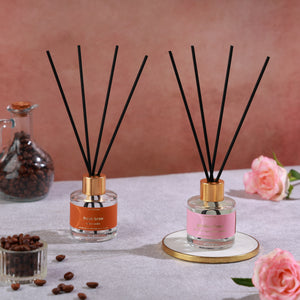
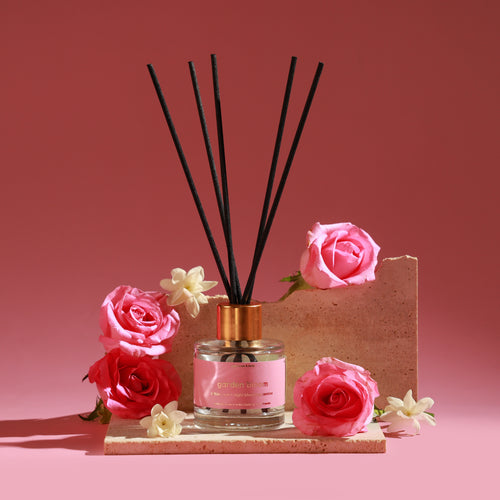
Third, ventilate separately, because the AC does not. A split unit recirculates: it cools and dries the air already in the room, it does not replace it. Give the bedroom ten minutes of genuine cross-ventilation each morning when the rain has paused — two openings, not one — then close up and cool. Fourth, once the unit is clean, the materials are dry and the room holds a sensible humidity, add fragrance. A bedroom wants restraint: a reed diffuser from ₹749 with four of the six reeds, something calm like Evening Calm, placed away from the AC airflow rather than in it. In an air-conditioned room the cooler, steadier air slows the capillary evaporation that drives a reed, which means a quieter throw and a longer bottle. If you would rather have scent only before bed, the Sukoon at ₹1,899 with a Hotel Collection scent from ₹299 gives you a switch.
What to do, in order
The AC is doing more work than you think and less than you hoped. The first three steps fix the gap, and only the fourth is something you buy.
| Step | What to do | When | Cost |
|---|---|---|---|
| 1. Remove the source | Wash the filters monthly, inspect the coil and drain pan, and confirm the drain line is dripping outside while the unit runs | Before anything else | ₹0 |
| 2. Move the air | Ten minutes of cross-ventilation each morning — an AC recirculates, it does not ventilate — then close up and cool | Daily, five to ten minutes | ₹0 |
| 3. Deal with what holds it | Fan the bare mattress, empty and dry the wardrobe with the doors open while the AC runs, wash and fully dry the curtains | Weekly to monthly | ₹0 |
| 4. Then the always-on layer ★ | A SOSA reed diffuser — a quiet bedroom background at four reeds, placed out of the AC airflow, lasting longer in cool air | 50ml 6-8 weeks · 130ml 14-18 | from ₹749 |
| 5. Or the on-demand layer | Sukoon with a Hotel Collection scent — scent for the hour before bed rather than all night, with a switch | Run it when you want it | ₹1,899 |
Versailles
The AC question comes up constantly in monsoon and the honest answer has two halves. Your air conditioner is genuinely helping — it is the best dehumidifier most people own and I would run it more, not less. But it is also a wet, dark object with dust on it, sitting on your bedroom wall, and if the damp note arrives in the first two minutes of switching on, the unit is the source rather than the cure.
The second half is that an AC dries air and not things. Your mattress and your wardrobe have been loading up with moisture since June, and they will keep resupplying the room every time the cooling stops. That is why eight hours of AC never quite settles it. Dry the materials with a fan while the unit runs and the whole problem shifts. And if you find water dripping inside the room or nothing coming out of the drain pipe outside, stop and call a technician — standing water in an indoor unit is a mechanical fault, and any growth around it is a health matter rather than a smell.
When it is all sorted, an air-conditioned bedroom is actually the best possible home for a reed diffuser. The air is cool and steady, which slows the evaporation that drives the reeds, so the scent is quieter and the bottle lasts longer than it would in a hot hall. Four reeds, not six. Something you can sleep through rather than something that announces itself. A portion of every order funds a girl's classroom through Nanhi Kali.
Frequently asked questions
- Why a split AC makes a bedroom smell musty — coil and filter biofilm in detail.
- Why a bedroom smells damp after days of rain — drying rate and the bed as reservoir.
- Why the wardrobe area smells damp — the enclosed cupboard micro-climate.
- Should I use a reed diffuser for a damp smell? — the honest answer, which is not yet.
- Brand: the SOSA founder story.
SOSA products & prices (verified August 2026): Hotel Collection water-based ultrasonic diffuser fragrance 15ml ₹299 · 100ml ₹999 · 300ml ₹1,799 · Pack of 7 (15ml, all fragrances) ₹1,799; refills 100ml from ₹999. Seven scents: The Ritz-Carlton-inspired (white tea · bergamot · cedar), Westin-inspired (white tea · aloe · cedar), 1 Hotels-inspired (cedarwood · vetiver · green leaves), The St. Regis-inspired (amber · violet · woods), Shangri-La-inspired (jasmine · green tea · white tea), Four Seasons-inspired (citrus · floral · sandalwood), W Hotels-inspired (citrus · pepper · amber). Diffusers: Boond 300ml ₹899 · Sukoon 500ml ₹1,899 · Megh 6L ₹3,499. Water-based, phthalate-free, composed to IFRA standards for home diffusion; 3–6 drops per tank. Made in India, Pune. The Hotel Collection scents are SOSA's own interpretations inspired by the world's finest hotels; all hotel names are trademarks of their respective owners and are used only to describe the scent style — SOSA is an independent Indian fragrance house, not affiliated with or endorsed by any hotel brand. Prices and availability subject to change — see the live product pages.