


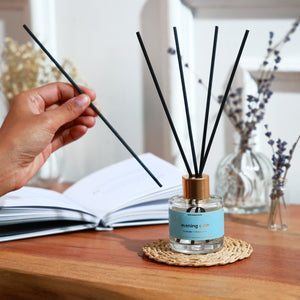
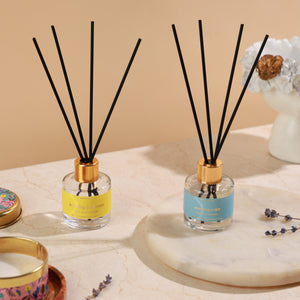

What to do first, and it is free: open two openings on different walls for ten minutes as soon as the stick is out. That is the only step that actually moves anything, and doing it at eight is worth more than doing it at eleven.
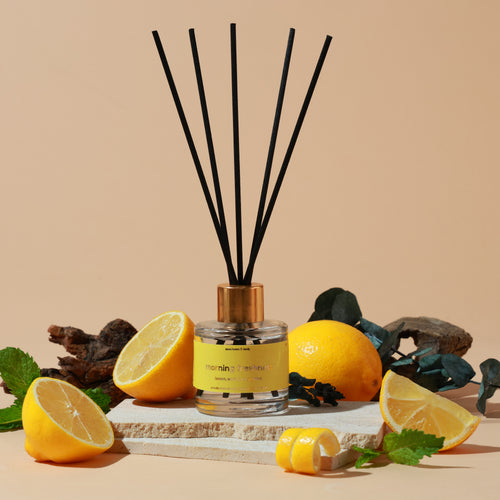
What to run later: Morning Freshness at ₹749 — Malabar lemon, peppermint and eucalyptus. Bright citrus is the cleanest contrast against a warm, woody residue, and its eucalyptus base is what keeps a citrus running 6–8 weeks rather than a fortnight.
The honest gap: nothing you can buy shortens the deposited fraction. Airing the room and washing the fabric do; fragrance does not. SOSA sells no air purifier and no odour eliminator, and a diffuser does not clear smoke — it sits alongside it.
2. Ventilate immediately after, not eventually. Ten minutes with two openings on different walls, as soon as the stick is out, is the single most effective thing on this page and it costs nothing. The earlier it happens, the less material is still airborne and available to settle. Doing it at eleven o'clock is largely closing the gate afterwards.
3. Then treat the diffuser as an afternoon and evening product. That is the honest scope. A reed diffuser cannot compete with combustion and does not need to; it needs to give the aired room a character of its own for the ten or twelve hours when nothing is burning. Morning Freshness at ₹749 is my lead here because bright citrus is the cleanest line to draw under a warm residue.
4. Flip the reeds in the evening. Flipping produces a short burst of projection as the dry ends saturate, so put that burst where it is useful — into an aired room at seven in the evening rather than into a smoky one at eight in the morning. Every three to five days, not daily.
5. Accept what fragrance cannot do, and say it plainly. A diffuser does not remove smoke, clear the air or shorten the deposited fraction. Adding a pleasant odour to a persistent one produces a mixture, not a cancellation. If the residue genuinely bothers you, the effective steps are airing, washing the curtains and cushion covers, and closing the door of the room where the incense burns while it burns.
Alcohol-free, phthalate-free, composed in Pune. A portion of every order supports girl-child education through Nanhi Kali.
The two fractions, and why only one of them leaves
A burning agarbatti is a small, efficient machine for putting material into a room quickly. It converts a bamboo core, a wood-powder and charcoal base and a fragrance load into smoke, and that smoke contains both particulate matter and a heavy quantity of resinous and woody volatiles. Some of it stays airborne and some of it lands. The airborne portion behaves exactly as you would expect: open a window and it goes, open two windows on different walls and it goes faster, because air needs somewhere to leave as well as somewhere to enter. Within ten or fifteen minutes of proper cross-ventilation, that part of the problem is over.
The portion that lands is the one nobody accounts for. Soft surfaces are enormous in a way that is easy to underestimate — a pair of full-length curtains, a three-seater sofa, cushion covers, a rug, bedding in an adjoining room — and every one of them is a reservoir. Material that condenses onto them re-releases slowly, at a rate set by temperature and airflow, over the hours that follow. This is why a house can be aired at eight and still read distinctly of incense at two. It is also why the smell seems to intensify when the afternoon warms up, or when a fan is switched on and starts moving air across the fabric.
The consequence for what you buy is the important bit. Fragrance does not remove a smell — it joins it. Adding a pleasant odour to a persistent one produces a mixture, and a mixture is frequently harder to live with than either component, because the nose now has two things to resolve instead of one. The sequence that works is the same sequence for cooking, for damp and for everything else in a home: deal with the source, ventilate, then fragrance. Here the source is something you are keeping deliberately, which is entirely reasonable, and it simply means the ventilation step and the laundry step carry more of the load than they would elsewhere.
Three things the clock decides for you
 Morning Freshness₹749Airing the room while the smoke is still airborne removes material that would otherwise land and stay. Airing it three hours later removes a much smaller share, because the rest is already in the fabric. Two openings on different walls is the arrangement that works, because air has to leave somewhere; a single window is a compromise. If the puja space has a door, closing it during the burn keeps a large part of the material out of the rest of the flat entirely. None of this is a purchase and all of it outperforms one. A diffuser is what makes the aired room pleasant afterwards, not what does the airing.
 Mountain Breeze₹849Write down the hours the room genuinely matters. In most households that is the evening, and in a working household it may be two or three hours after eight. A reed diffuser runs continuously and cannot be switched off, so the honest way to think about the cost is that you are paying for twenty-four hours in order to be present for four of them — which is fine, at roughly ₹13 to ₹15 a day, provided you know that is the deal. Where the room is empty for most of the day, three reeds rather than six halves the rate and roughly doubles the life of the bottle, and the room still reads clearly in the hours you are there.
 Evening Calm₹799Turning the reeds brings the dry ends down into the oil, and for a day or so afterwards projection lifts noticeably. That burst is worth spending deliberately. In an incense household the obvious place to spend it is the evening, when the room is aired, occupied and no longer contested. Cadence is every three to five days for Morning Freshness and every five to seven for Garden Bloom — not daily, which only empties the bottle faster. This is also the answer to a diffuser that feels quieter in week three than it did in week one: the lightest materials leave first and what you are smelling is the composition settling into its designed shape. Flip it and you restore projection without opening a new bottle.
The day, hour by hour
A shape rather than a schedule, because every household's timings differ. What matters is the order of operations and the recognition that the morning is not a problem to be solved with a purchase.
| When | What is happening in the room | What to do | What a diffuser is doing |
|---|---|---|---|
| During the puja | Combustion — smoke and resinous volatiles far above anything a diffuser releases | Nothing. Keep all fragrance oil and candles away from the flame | Running, and entirely inaudible. That is expected |
| The ten minutes after | The airborne fraction is still available to be removed | Open two openings on different walls; close the puja space door if it has one | Still not the point |
| Mid-morning | Airborne fraction gone; deposited fraction beginning to re-release from fabric | Close up as usual; this is where the diffuser starts to matter | Reads as a light background beside the residue |
| Afternoon | Warmth increases release from soft furnishings; a fan makes it more noticeable | Nothing to buy. Washing curtains and covers is the only step that shortens this | Contrast register reads most clearly here |
| Evening | Residue much reduced; the room is occupied and the air is settled | Flip the reeds every 3–5 days at this hour | Doing its actual job — this is what you bought |
| Night | A closed bedroom, low air exchange, high occupancy | Three reeds, not six, in a sealed room | Evening Calm at 8.9 is the softest option |
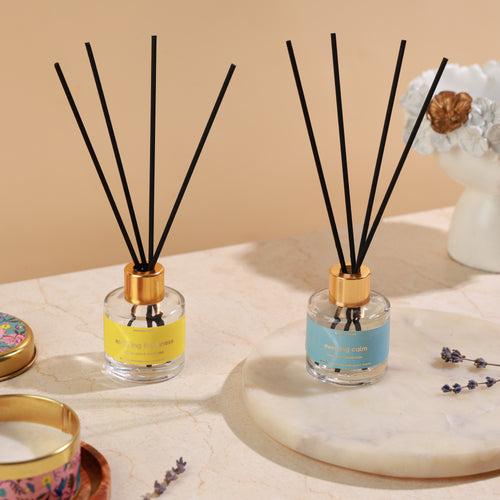
Contrast · Morning Freshness₹749Shop → 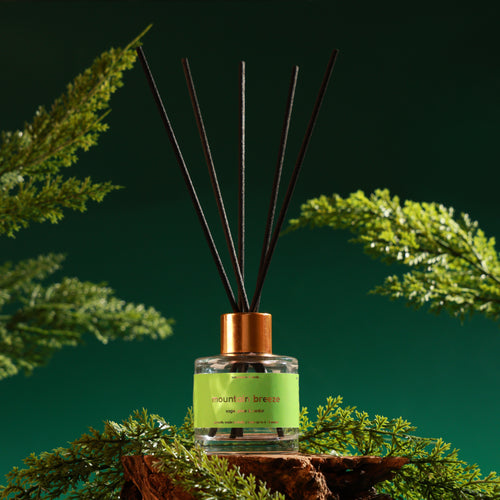 Continuity · Mountain Breeze₹849Shop →
 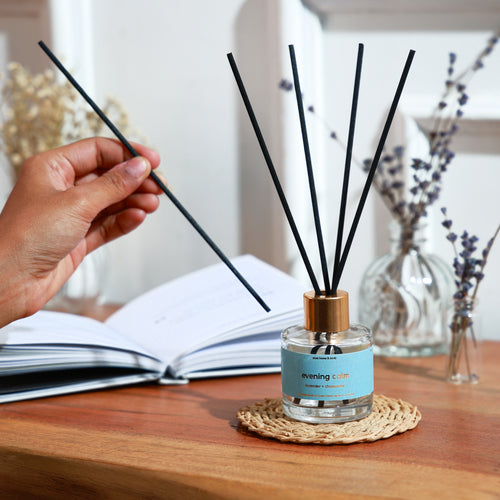 Night · Evening Calm₹799Shop →
Why you may be judging your own house wrongly
There is a real chance the word "strongly" in this question came from somebody else. Olfactory receptors adapt to a constant, unchanging stimulus within minutes — the signal keeps arriving, but the brain stops reporting it because nothing about it has changed. In a house that burns incense every single morning at the same hour, adaptation to that specific smell is nearly complete for the people who live there. You notice it on the days you come home late; a visitor notices it every time. If you want a reliable reading of what your flat smells like at four in the afternoon, leave for fifteen minutes and walk back in, or ask whoever arrives next. A guest is a better instrument than you are.
The same effect works against the diffuser, and it explains a purchasing mistake I see constantly in incense households. People assess the diffuser during the one part of the day when combustion is drowning everything, conclude it is too weak, and buy something stronger or add reeds. Neither works, because nothing was ever going to be perceptible in that window. Then, for the remaining fifteen hours, the room is over-scented and somebody in the family starts describing it as too much. A home fragrance you can detect continuously has overshot the room; it is designed to be noticed on arrival and at transitions — walking in from outside, coming out of a bathroom, sitting down in the evening. Constant perception is a dose signal, and the fix is fewer reeds rather than a different bottle.
Finally, placement. Put the diffuser in the room's natural airflow path rather than in a corner, at or slightly below nose height, out of the direct draught from a window or a fan, and away from direct sun, which accelerates evaporation without improving the room. And keep it, and any candle, physically clear of wherever the agarbatti or a diya is lit. Fragrance oil is flammable and a reed diffuser is an open vessel of it with six wicking fibres in the neck — different surface, out of the ash path, no exceptions.
What to buy for the afternoon — and the gap
In buying order for a household where the morning is fixed and the rest of the day is the part you can actually change. Note the first row seriously: if what you want is for the incense smell to be gone by lunchtime, no fragrance purchase delivers that and I would rather you spent the money on having the curtains washed.
| Buy | What it is | When it is the right answer | Price |
|---|---|---|---|
| 0. Air the room and wash the fabric | Ten minutes of cross-ventilation, and curtains and covers through the machine | If what you actually want is less residue rather than a different smell | ₹0 |
| 1. Morning Freshness 50ml ★ | Malabar lemon, peppermint, eucalyptus at 9.0 — bright | The default for the hours after the incense clears. Cleanest contrast to a warm residue | ₹749 |
| 2. Morning Freshness 130ml | The same, sized for a room above about 150 sq ft, 14–18 weeks | Open-plan living rooms, or where 50ml has read as thin by evening | ₹1,249 |
| 3. Mountain Breeze 50ml | Himalayan pine, sage and Indian cedar at 9.4 — dry, resinous | If you would rather the day felt continuous than divided | ₹849 |
| 4. Evening Calm 50ml | Kashmir lavender and chamomile at 8.9, the softest in the range | A closed bedroom at night, with three reeds rather than six | ₹799 |
| Nothing removes smoke: the honest gap | No SOSA product clears smoke, purifies air or shortens the deposited fraction. There is also no sandalwood, oud, vetiver or amber reed diffuser in the range, and no air purifier or odour eliminator of any kind | Stated plainly, because the alternative is a disappointed buyer | — |
Versailles
The thing I want readers of this page to take away is that the afternoon smell is not a failure of ventilation and not a failure of the incense. It is fabric doing what fabric does. Textiles are the largest surface area in most Indian living rooms and they absorb and release everything — cooking, incense, damp, the road outside. Understanding that changes what you buy, because it stops you looking for a product that will make a smell disappear. Nothing in this category does that, mine included.
What a good reed diffuser does instead is give the aired room a shape of its own. In this particular house I lead Morning Freshness, and the reason is structural rather than aesthetic. Citrus is the register that reads most cleanly against something warm and woody, but ordinary citrus in a reed diffuser dies in ten to fourteen days because the molecules that carry it are the smallest and lightest in perfumery. The eucalyptus globulus base underneath slows that evaporation by three to four times. That single decision is the difference between a fortnight and six to eight weeks, and it does not appear anywhere on a note list.
And the timing point, which costs nothing and is the one people write back to tell me worked. Flip your reeds in the evening. You get a lift in projection for a day or so afterwards, and there is no sense at all in spending that lift on a room that is full of smoke at eight in the morning. Everything is composed in Pune, and a part of every order funds a girl's classroom through Nanhi Kali.
Frequently asked questions
- Agarbatti every morning — what will not clash, and why timing beats register.
- Near the puja room? — not in it, not for it, and the flame reason why.
- Notes that pair with sandalwood agarbatti — and why there is no sandalwood reed.
- Jasmine incense — should the diffuser also be floral?
- Hotel-inspired scents in an incense house — yes, by time separation.
- Traditional versus modern taste — one fragrance for a divided household.
- The best reed for a daily-agarbatti home — both answers, and when each applies.
- Morning incense to a fresh evening — the practical daily sequence.
- Sukoon and incense in one home — the machine question, answered honestly.
- Brand: the SOSA founder story.
SOSA reed diffusers — facts verified August 2026: Five scents, all alcohol-free, on a heat-stable CCT (caprylic/capric triglyceride) base rather than DPG, phthalate-free, paraben-free, IFRA-compliant, 0 ppm formaldehyde, six fibre reeds in a refillable glass bottle, composed and made in Pune, India, and climate-tested through 45°C heat and 85% RH monsoon humidity. Morning Freshness (Malabar lemon · peppermint · eucalyptus globulus) 50ml ₹749 · 130ml ₹1,249 · 9.0 on the SOSA strength scale; its eucalyptus globulus base slows lemon evaporation three to four times, giving 6–8 weeks rather than the usual 10–14 day citrus fade. Evening Calm (Kashmir lavender · chamomile · soft musk) 50ml ₹799 · 130ml ₹1,299 · 8.9, the softest in the range. Garden Bloom (British rose · night-blooming jasmine) 50ml ₹799 · 130ml ₹1,299 · 8.9. Mountain Breeze (Himalayan pine · sage · Indian cedar) 50ml ₹849 · 130ml ₹1,349 · 9.4. Fresh Brew (Coorg coffee · Kerala vanilla · caramel) 50ml ₹849 · 130ml ₹1,349 · 9.5. Longevity 6–8 weeks on 50ml and 14–18 weeks on 130ml; six reeds give full projection and three give a soft level at roughly double the life. Reed flip cadence every 3–5 days (Morning Freshness) or 5–7 days (Garden Bloom). Cost per day approximately ₹13–₹15 on a 50ml. Duos: Day & Night ₹1,498, Fresh & Grounded ₹1,548, Warmth & Bloom ₹1,598. Refills 300ml ₹2,399 · 500ml ₹3,499, oil only. The reed line contains no oud, no sandalwood, no vetiver and no amber. SOSA sells no room spray — every SOSA spray is a car perfume — and no air purifier, dehumidifier or odour eliminator. Reed oil and the water-based Hotel Collection are separate systems and are not interchangeable. Fragrance oil is flammable: keep all diffusers, candles and oils away from lit agarbatti, diyas and open flame. Free shipping above ₹499. SOSA is an independent Indian fragrance house and is not affiliated with or endorsed by any hotel brand. Prices subject to change — see the live product pages.