





The seven places, in order: external walls behind furniture, under the sink, ceiling and wall corners, inside wardrobes, window reveals, under the mattress, behind the fridge.
The line: this is a health matter, not an odour to be covered. Find the moisture, remove the growth, then dry the surface and keep it dry.
2. The cabinet under the sink, kitchen and bathroom both. Enclosed, unventilated, full of cardboard and cleaning cloths, and containing pipework that runs cold. A slow joint weep can go unnoticed for a year down there. Empty the cupboard completely, put a torch on the floor of it pointing upward, and look at the back corners, the underside of the basin, and the board itself. Swollen or dark particle board is a leak, not a smell.
3. Ceiling corners and the top of walls. Warm moist air rises and the junction where a ceiling meets an external wall is a thermal weak point. Look at the corners of shaded rooms, bathrooms, top-floor rooms, and any room below a terrace or a water tank. Early growth here is a faint grey bloom that flat overhead light hides almost perfectly. This is also where a slab or terrace leak announces itself, and that is a building matter rather than a housekeeping one.
4. Inside the wardrobe, the shoe cabinet, and under the mattress. Enclosed volumes with no air exchange, packed with cotton, leather and paper — all excellent food. Smell the inside of the wardrobe rather than the room. Lift the mattress off the base and look at its underside and at the slats; a mattress on a solid platform base with no ventilation is a classic site. Check the back wall of the wardrobe, which is usually the external wall of the flat.
5. And do not fragrance any of it. Mould is a health issue. Fragrance adds molecules and removes nothing, so it cannot touch a colony; what it does is take away the smell that was telling you to look. Find the moisture source, remove the growth properly, keep the surface dry, and call a damp specialist for a wall or ceiling that is still wet in dry weather. Fragrance is for afterwards.
Made in India, composed by an ISIPCA Versailles-trained perfumer — and a portion of every order supports girl-child education through Nanhi Kali.
Why the smell arrives long before the sight
Mould does not need to be large to be smelled. A colony a few centimetres across, on the back of a wardrobe against an external wall, releases enough volatile compounds to scent a whole room — those compounds are what the word musty actually describes. Meanwhile the visual signal lags badly. Early growth on painted plaster looks like faint grey shading, on grout like slight discolouration, and on the back of a plywood panel like nothing at all under normal light. Your nose is a far more sensitive instrument than your eye for this particular problem, which is why "I can smell it but I cannot see it" is a completely coherent situation and not a sign that you are imagining things.
The other half of the answer is geometry. Growth requires three conditions to overlap: a surface that spends part of the day colder than the dew point of the air touching it, so moisture condenses on it; air that does not move, so the moisture never evaporates again; and organic material to feed on, which in practice means dust, skin cells, paper, textile finishes, wood or paint binder. In a flat, the places where all three coincide are systematically the places you never see: the far side of furniture, the inside of cupboards, the back corners of cabinets, the junction of ceiling and external wall, the underside of a mattress on a solid base. The search method is simply a list of those places, in descending order of likelihood.
How to search a flat properly
 Only afterwardsFrom ₹749Give yourself an hour and a torch. Overhead light flattens a surface and hides early growth; a torch held almost parallel to the wall throws every speck into relief. Work from the coldest and stillest parts of the flat outward: north and shaded external walls first, then anything enclosed, then anything at ceiling level. Move the furniture rather than peering behind it. And use your nose deliberately — put it close to the surface. A wall smells of nothing at arm's length and unmistakably of mould at two inches.
Symptom to cause: narrowing the search
Where in the flat the smell is strongest, and when, narrows the list considerably. Use this before you start moving furniture, and you will usually find it in the first two places you check.
| What you notice | Most likely cause | How to confirm it | What actually fixes it |
|---|---|---|---|
| Musty smell strongest along one wall ★ | Growth on a cold external wall behind furniture | Move the furniture out a foot and torch the wall at a raking angle, nose at two inches | Remove growth properly, keep furniture a few inches off the wall permanently |
| Smell strongest at floor level in the kitchen or bathroom | The under-sink cabinet — a slow weep, damp board, wet cloths | Empty the cupboard, torch the back corners, press the board for softness | A leak is a plumbing job. Fix it, dry the cabinet, then keep it ventilated |
| Smell strongest high up, or the ceiling corner looks shaded | Condensation or ingress at a thermal weak point — possibly a slab or terrace leak | Torch the corner at a low angle; check whether it is damp in dry weather too | Persistent ceiling damp is a building fault. Get it inspected. |
| Clothes smell of it before the room does | Growth inside the wardrobe, usually on the back panel against an external wall | Open the wardrobe after two closed days and smell inside it, not the room | Empty it, clean and dry the interior, loosen packing, leave doors open on dry days |
| Smell appears when the AC runs, not otherwise | Biofilm on the evaporator coil, filter or drain tray — not wall mould | Switch the AC on after a day off and smell the first two minutes of airflow | Wash the filter monthly, have the coil and drain line cleaned; check the tray |
| You find dark speckling anywhere on the list | Mould — a health issue, not an odour problem | Nose close to the surface confirms it; raking torchlight shows the extent | Remove it properly, find the moisture source, and never fragrance over it. |
| If none of these fit: check the drains. A sharp sewer note is not mould at all — it is usually a dry P-trap in a rarely used floor drain, which is a plumbing matter and is fixed by pouring a mug of water down every unused drain weekly. | |||
Reeds · always-on roomsFrom ₹749Shop →  Sukoon · when you want a switch₹1,899Shop →
  Hotel Collection · the scentFrom ₹299Shop →
What to do once you have found it
First, deal with the growth safely. Open the windows in that room. Wear a mask and gloves. Do not brush or vacuum a dry colony, because that lifts spores into the air of the whole flat; wipe it wet instead, work in one direction, and bag the cloth rather than rinsing it in the sink. Hard, non-porous surfaces — tile, glass, painted plaster in good condition — can be cleaned. Porous items that are visibly colonised are usually a discard: a mouldy cardboard box, a colonised particle-board cabinet base, a mattress with growth on its underside. If anyone in the household has asthma, allergies or a respiratory condition, do this sooner rather than later and consider getting someone else to do it.
Second, remove the reason the surface was wet, or you will do this again in six weeks. Work through it honestly: is there a leak, a failed silicone seal, a blocked balcony drain, a bathroom or terrace above? Is there furniture flat against a cold external wall? Is the room simply humid because the flat is humid and nothing is drying? Each has a different fix — a plumber, a sealant, a few inches of gap, or a drying plan for the whole flat. A wall or ceiling that stays damp during dry weather is a building fault and needs a damp specialist, not a cleaning routine.
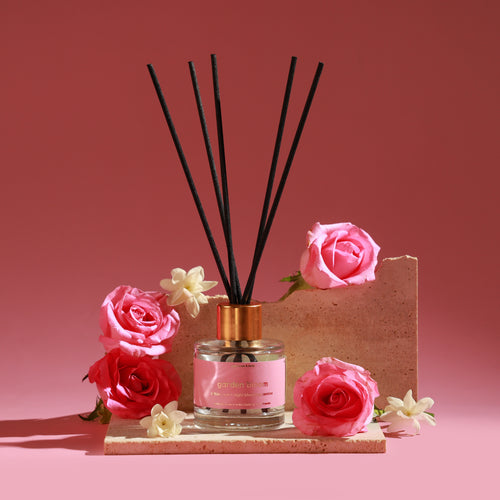
Third, keep the surface dry and keep watching it. Ventilate that room deliberately, keep furniture off external walls, and check the spot again after two weeks and after the next wet spell. Fourth, and only when the surface has been clean and dry through a full wet week, fragrance becomes appropriate — as a finishing layer on a room that is genuinely sound. A reed diffuser from ₹749 gives a hall or a bedroom a continuous background with no electricity; the Sukoon at ₹1,899 with a Hotel Collection scent from ₹299 gives you a switch for a living room. Neither is a treatment, and I would not want either sold to you as one.
What to do, in order
The first three steps are the entire job here, and none of them is a purchase. The fourth exists, but it is genuinely irrelevant until the third is finished.
| Step | What to do | When | Cost |
|---|---|---|---|
| 1. Remove the source | Search the seven places with a torch at a raking angle; remove any growth wet, masked and gloved, and bag the cloth | Before anything else | ₹0 |
| 2. Move the air | Find and fix the moisture — leak, seal, blocked drain, or furniture flat against a cold external wall | Daily, five to ten minutes | ₹0 |
| 3. Deal with what holds it | Keep the surface dry: gap behind furniture, ventilation, and a recheck after the next wet spell | Weekly to monthly | ₹0 |
| 4. Then the always-on layer ★ | A SOSA reed diffuser — a background scent for a room that has been clean and dry through a full wet week | 50ml 6-8 weeks · 130ml 14-18 | from ₹749 |
| 5. Or the on-demand layer | Sukoon with a Hotel Collection scent — scent on demand in a living room, once the search has come back clean | Run it when you want it | ₹1,899 |
Versailles
I want to be as clear as I can be here, because this is the article in the set where the commercially convenient answer and the correct answer point in opposite directions. If your home smells musty, something is growing in it, and that is a health matter rather than a fragrance one. I would like you to find it and deal with it, and I would rather you bought nothing from me while you do.
The reason I feel strongly about it is that fragrance is additive. It adds molecules; it removes nothing at all. So a diffuser next to a mould colony gives you a scented mould colony, and — much worse — it removes the smell that was going to make you move the wardrobe. People live for years with a musty flat because they got good at covering it. That is the outcome I do not want. Anyone in the house with asthma or allergies makes it more urgent, not less.
When you have found it, cleaned it, fixed the water and watched the spot stay dry through a wet week, then a home fragrance is a genuinely nice thing to add, and the contrast will be dramatic. I would go for something clean and dry-smelling in that room rather than anything sweet — a pine and cedar profile like Mountain Breeze reads as fresh air rather than as perfume. A portion of every order funds a girl's classroom through Nanhi Kali.
Frequently asked questions
- Why a coastal flat smells musty every monsoon — the humidity reading behind it.
- Why the wardrobe area smells damp — the enclosed micro-climate inside a cupboard.
- Why a ground-floor flat smells more musty — the cooler slab and what sits under it.
- Should I use a reed diffuser for a damp smell? — the honest answer, which is not yet.
- Brand: the SOSA founder story.
SOSA products & prices (verified August 2026): Hotel Collection water-based ultrasonic diffuser fragrance 15ml ₹299 · 100ml ₹999 · 300ml ₹1,799 · Pack of 7 (15ml, all fragrances) ₹1,799; refills 100ml from ₹999. Seven scents: The Ritz-Carlton-inspired (white tea · bergamot · cedar), Westin-inspired (white tea · aloe · cedar), 1 Hotels-inspired (cedarwood · vetiver · green leaves), The St. Regis-inspired (amber · violet · woods), Shangri-La-inspired (jasmine · green tea · white tea), Four Seasons-inspired (citrus · floral · sandalwood), W Hotels-inspired (citrus · pepper · amber). Diffusers: Boond 300ml ₹899 · Sukoon 500ml ₹1,899 · Megh 6L ₹3,499. Water-based, phthalate-free, composed to IFRA standards for home diffusion; 3–6 drops per tank. Made in India, Pune. The Hotel Collection scents are SOSA's own interpretations inspired by the world's finest hotels; all hotel names are trademarks of their respective owners and are used only to describe the scent style — SOSA is an independent Indian fragrance house, not affiliated with or endorsed by any hotel brand. Prices and availability subject to change — see the live product pages.