



Free before anything paid, and much of the time it is enough: a ceiling fan on low in a closed room — the best free fix there is, because a fan supplies the transport a reed lacks. Then halve the distance to where you sit; nose height, on a surface; out of the draught but not in a dead corner; close the door; and check whether you have simply stopped noticing it.
If the requirement really is projection: Sukoon ₹1,899 — 500ml, 270–320 sq ft, 16–18 hours on low, three 15ml Hotel Collection scents included. Then Safar ₹3,999, which is named and sold as a car and travel diffuser, has no published room coverage figure, and runs on a 1, 2 or 3-hour timer with a battery to recharge.
Two things not to do: do not buy Vaayu ₹11,999 for one bedroom — 1000 m³, roughly 2,000–3,000 sq ft, nine-tenths wasted — and do not assume your reed scent transfers to a machine. It does not.
2. The third bottle is the tell, and it is a useful one rather than an embarrassing one. The first was for ambience. The second is often defensible on geometry — a long room with two ends you actually occupy. By the third, in one room, you are almost always buying for the space between the other two, and a point source cannot fill the space between point sources. Two passive sources make two peaks with a valley in the middle; three make three peaks and a busier middle.
3. Before spending, do the free things properly. A ceiling fan on low with the door closed is the best free fix in this whole subject, because a fan is precisely the transport a reed structurally lacks — it does shorten the life of the bottle, and you should know that rather than discover it. Halve the bottle-to-person distance. Put it at or just below nose height, on a surface. Keep it out of a direct draught but not in a dead corner. And leave the room for fifteen minutes and walk back in, because adaptation, not the product, is a common cause of this whole cycle.
4. If projection really is the requirement, buy the mechanism at ₹1,899 and not more. Sukoon vibrates a water-and-oil mixture into a cool mist and pushes it out: 500ml, 270–320 sq ft, 16–18 hours on low, three 15ml Hotel Collection scents in the box. It moves air. In exchange the oil is diluted in water, the room gains humidity, the tank needs filling, hard water can leave a fine white dust, and it needs a socket. Safar at ₹3,999 is the waterless alternative — undiluted oil as a dry mist — and it is named and sold as a car and travel diffuser, with no published room coverage figure and a 1, 2 or 3-hour timer.
5. Keep the reeds, and expect the scent to change if you switch mechanism. The bottles you own are not wasted; put them in the rooms that have none, which is what three bottles are genuinely good at. And plan for the machine to run a different fragrance: reed oil cannot go into an ultrasonic, the water-based Hotel Collection cannot go into reeds, and Safar takes pure fragrance oil.
Alcohol-free, phthalate-free, paraben-free, IFRA-compliant, 0 ppm formaldehyde, six fibre reeds in a refillable glass bottle, composed in Pune. Free shipping above ₹499, and a portion of every order supports girl-child education through Nanhi Kali.
How the requirement changed, without anybody noticing
Almost nobody sets out to buy projection. People set out to buy a nice-smelling home, which is a description of ambience, and a reed diffuser answers it very well. Then something small happens. You sit down at the far end of the room and cannot smell it. Or a guest walks in and remarks on it and you realise you had not noticed it for a week. Or the bottle is on the console by the door and the sofa is six paces away and you find yourself wishing the sofa smelled the way the console does. None of those is a complaint about the fragrance — every one of them is a compliment attached to a location. And each one nudges the requirement a little further from a room with a character towards fragrance where I am.
The reason the drift is invisible is that the obvious remedy at every step is more of the same thing. More reeds, then a bigger bottle, then a second bottle, then a third. Each of those is a sensible response to the previous disappointment, and each of them acts on the same variable — emission, how much fragrance leaves the glass — while leaving transport, how far it gets, exactly where it was. Transport for a passive device is zero, and zero multiplied by three is still zero. That is the whole mechanism of this cluster stated in one line, and it is why the disappointment repeats identically rather than diminishing.
So the honest reading of your position is not that you made three mistakes. It is that you ran a well-controlled experiment without meaning to, and it has produced a clean result. Dose has been ruled out, because you increased it. Maintenance has been ruled out, if you have been flipping the reeds every three to five days. Placement is worth one more test, and it is free. What remains is the mechanism, and knowing that is worth more than the third bottle would have been.
Ambience and projection, defined — because the whole decision sits here
These two words get used interchangeably in home fragrance and they describe genuinely different products. Deciding which one you want is the entire choice, and it takes about a minute.
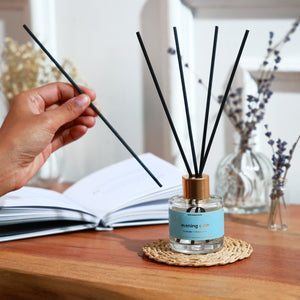
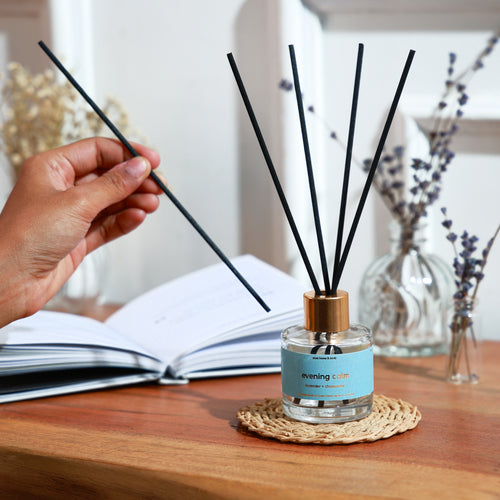
 Garden Bloom₹799This is what a reed diffuser is for, and it is not a lesser ambition. A fragrant zone near a console, a bedside, an entryway or a desk gives a room a signature you meet as you come in and at every transition through the day. It is meant to be noticed intermittently — a fragrance you can smell continuously is set too strong for the room, which is a useful sentence for anybody who has been buying towards permanent detectability. Ambience is also where the reed's advantages are worth most: silence, no power, no maintenance, an object rather than an appliance, and a bottle that simply keeps working while you forget about it.
 Sukoon₹1,899This is a delivery requirement rather than a collection one, and it needs moved air. An ultrasonic vibrates a water-and-oil mixture into a visible cool mist; a waterless cold-air nebuliser shatters undiluted oil into a dry micro-mist that travels with the room's own currents. In both cases the fragrance is introduced into the air rather than released from an object on a table, which is why it can be present where the machine is not. It is also why you can rarely find the diffuser in a well-scented hotel room — there often is not one in the room to find, and there is no gradient to walk up.
 Morning Freshness₹749The reason I put a ceiling fan above every product on this page is that it sits exactly in the overlap. It does not change the bottle at all; it changes the room, by supplying the one component a reed does not have. Run it low, door closed, bottle a metre or two out of the direct downdraught rather than beneath the blades, all six reeds in, and give it a full day. A running AC in a closed room does something similar by recirculating, which is why a bedroom often reads strongest at night, while drying the air and speeding evaporation. The one placement to avoid outright is directly in the AC blast, which strips the reeds and throws everything at one wall. And an open window or balcony door does the opposite: air that leaves takes the fragrance with it.
Everything free, first — and much of the time it is enough
I would rather lose the sale than have you spend ₹3,999 on something a rearrangement would have fixed, so here is the complete free list in the order I would run it, and it deserves a week. Reed count: all six for full projection; three if you want soft and roughly double the life. If a room has ever felt cloying rather than fragrant, that is over-dosing rather than a wrong scent, and the reeds are the dial. Distance: halve it. Nothing else on this page does as much. Height: at or slightly below nose height, on a surface, not the floor and not a high shelf. Airflow: out of a direct draught, but not in a dead corner where the air never turns over. Containment: close the door — it is half the equation and costs nothing. Maintenance: flip the reeds every three to five days, not daily; a flip restores output for hours, though it adds no range. And the fan, on low, in a closed room.
Then the diagnostic that ends a surprising number of these buying cycles. Receptors adapt to a constant stimulus within minutes: the signal keeps arriving and the brain stops forwarding it, so it is entirely possible to sit in a correctly scented room and honestly report smelling nothing. Leave for fifteen minutes and walk back in. Better still, ask somebody who does not live there — a visitor is a far better instrument than you are in your own home. If guests notice it and you cannot, the room is working for everybody but you, and the answer is not a third bottle.
One last free thing, which is really a re-allocation. If you already own two bottles and are about to buy a third, try the arrangement three bottles are genuinely good at: one in each of three rooms. Three zones in three rooms is a home that smells considered and varied; three zones in one room is a room with a complicated middle. It costs nothing to test, it takes ten minutes, and a household that smells identical everywhere stops registering as smelling of anything within about a week.
The three honest paths, laid side by side
This is the family's whole answer in one table: what each path gives, what it takes, and the two rows at the bottom that name the thing I would talk you out of and the gap in our own range.
| Path | Mechanism | What it gives you | What it costs you |
|---|---|---|---|
| Ceiling fan on low + the bottles you own ★ | Passive source, borrowed transport | The biggest free improvement available, and often enough | Free; a shorter bottle |
| One reed, well placed | Passive capillary, no transport | One properly fragrant zone. Silent, no power, no maintenance, never breaks | ₹749–₹849 every 6–8 weeks, roughly ₹13–₹15 a day. Zero control, and a zone rather than a room |
| A third reed in the same room | Three passive sources | A third peak. No evenness, because none of them moves air | Roughly ₹39–₹45 a day in one room, indefinitely. This is the purchase this page exists to question |
| Sukoon ultrasonic ★ | Water-and-oil mist, moves air | 270–320 sq ft, 16–18h on low, three 15ml scents included. Presence rather than a corner | ₹1,899 once; diluted oil, added humidity, filling, possible white dust, a socket, some sound |
| Safar waterless | Undiluted oil as a dry micro-mist | The mechanism at personal scale, with no water, dilution, humidity or mineral dust. No coverage figure is published and none is quoted | ₹3,999 once; named and sold as a car and travel diffuser; 1/2/3-hour timer; needs recharging; buy one, never several |
| Megh 6-litre ultrasonic | Water-and-oil mist, very large tank | About 215 sq ft — less than the ₹1,899 Sukoon, on six litres and about 100 hours | ₹3,499 for runtime and humidity, never for reach. Capacity is not coverage |
| What I would talk you out of: Vaayu in one bedroom | Waterless cold-air nebulising | 1000 m³, roughly 2,000–3,000 sq ft. Nine-tenths wasted in 120 sq ft | ₹11,999. It earns its price on a whole floor, an open-plan home or a commercial room |
| The honest gap: nothing between Safar and Vaayu | — | SOSA has no mid-sized waterless bedroom nebuliser. Nothing in the range is “a Vaayu for one room” | Named rather than sold around |
Ambience · Evening Calm₹799Shop →  Projection · Sukoon₹1,899See it →
  Ultrasonic only · Hotel Collection₹299See it →
The gap in our own range, and the compatibility warning
If the honest answer to your question is a machine, then you deserve the honest map of what we sell. Between Safar at ₹3,999 and Vaayu at ₹11,999, SOSA has no mid-sized waterless bedroom nebuliser. Nothing in the range is a Vaayu for one room. Vaayu is rated to 1000 m³, roughly two to three thousand square feet, and it earns its price on a whole floor, an open-plan living-dining space, a large home, a clinic, a salon or a reception — in a 120 sq ft bedroom nine-tenths of it is wasted, and I would rather say that than take the order. That gap is real, it shapes the advice on dozens of these pages, and pretending otherwise would be the easiest sale in this catalogue.
Which is exactly why Sukoon at ₹1,899 deserves its place at the front of the recommendation rather than as a consolation. It covers 270 to 320 square feet, runs sixteen to eighteen hours on low from a 500ml tank, and includes three 15ml Hotel Collection scents so there is nothing further to buy on day one. Its costs are honest and worth repeating: the oil is diluted in water rather than delivered undiluted, the output adds humidity — a benefit in a dry AC bedroom, a nuisance in a humid August — the tank must be filled, hard water can leave a fine white mineral dust, and it needs a socket and makes some sound. For one bedroom that is very often the correct purchase, and it should never be skipped on the way to something dearer.
And the warning that catches more people than any other in this cluster. Switching mechanism may mean switching scent. Reed oil is formulated for capillary wicking on a heat-stable CCT carrier and cannot go into an ultrasonic machine. The water-based Hotel Collection is made for ultrasonic diffusion and cannot go into reeds — there is no hotel-inspired reed diffuser, in either direction. Safar takes pure fragrance oil and can be clogged by anything thick, sticky or water-based. And the ₹299 Hotel Collection 15ml is a machine refill rather than a cheap way in; without hardware it does nothing, and the cheapest genuine entry to SOSA is a 50ml reed at ₹749. If you have fallen for a particular reed, treat the machine as an addition rather than a replacement, and keep the bottle.
What to buy, and what not to
In order, free first, with the disclosures attached where they belong and the gap named at the bottom.
| Buy | What it is | When it is the right answer | Price |
|---|---|---|---|
| 1. Fan on low, door closed, all six reeds, bottle moved closer ★ | Every free lever at once, on the bottles you already own | Always first, for a week. A meaningful share of readers stop here and spend nothing | Free |
| 2. Spread the bottles across rooms | One zone per room, rather than three zones in one room | Immediately. It is the arrangement several passive sources are genuinely good at, and it costs nothing | Already paid for |
| 3. Sukoon ultrasonic | 500ml, 270–320 sq ft, 16–18h on low, three 15ml Hotel Collection scents included. Moves air | When the requirement really is projection and one bedroom is the whole job. Never skip it for something dearer | ₹1,899 |
| 4. Safar waterless | Undiluted oil as a dry mist. 20ml, 2000 mAh Type-C, cordless, 6.9 cm, up to 10h continuous or ~30h intermittent, three speeds, 1/2/3-hour timer. Named and sold as a car and travel diffuser; no published room coverage figure; not set-and-forget | When water, dilution, humidity or mineral dust are the objection and you will switch it on deliberately. Buy one, never several | ₹3,999 |
| 5. Keep a reed alongside it | Silent, no socket, nothing to fill or charge, works in a power cut, never breaks, roughly ₹13–₹15 a day | Alongside the machine, never instead of it. The two do different jobs and the reed does one the machine cannot | ₹749–₹849 |
| 6. The right oil for the mechanism | Reed oil cannot go into an ultrasonic; the water-based Hotel Collection cannot go into reeds; Safar takes pure fragrance oil. The ₹299 15ml is a machine refill, never a first purchase | Before you order. Switching mechanism may mean switching scent, and this is the likeliest disappointment of the lot | 15ml ₹299 · 100ml ₹999 |
| The honest gap, and what I would talk you out of: Vaayu for one bedroom | Nothing at SOSA sits between Safar ₹3,999 and Vaayu ₹11,999, and Vaayu at 1000 m³ — roughly 2,000–3,000 sq ft — wastes nine-tenths of itself in 120 sq ft. Megh ₹3,499 is six litres and only about 215 sq ft, less than the ₹1,899 Sukoon | Named rather than sold around. Capacity is runtime, never room | ₹3,499 / ₹11,999 |
Versailles
If you have read this far with a third bottle in a basket, I want to say the plainest version of it. Nothing about your judgement has been poor. You liked a fragrance enough to keep buying it, which is the nicest thing that can happen to a perfumer, and every step you took followed logically from the step before. What was missing was one sentence, and it should have come from us: a reed diffuser gives you a fragrant zone, not a fragranced room, and that is its design rather than its limitation.
The reason I care about the ambience-and-projection distinction is that we sell both and they are priced very differently, so the temptation to blur them is obvious. I would rather be explicit. If you want a room that has a character — something that greets you at the door and makes a guest ask — then keep the reeds, spread them across rooms, run all six sticks, and put the money you were about to spend into a second scent for a second room rather than a second bottle for this one. If you want to sit in the middle of a room and be inside the fragrance, then no number of bottles gets you there and Sukoon at ₹1,899 does.
Two last honesties. Between Safar and the ₹11,999 Vaayu we have nothing for a single bedroom, and Vaayu is the wrong purchase for one — I would refuse that order rather than take it. And whatever you buy, keep a reed somewhere in the house. It is silent, it needs no socket, it works when the power does not, it costs about thirteen or fifteen rupees a day, and it never breaks. That is not the consolation prize; it is a genuinely different pleasure from a machine, and the two belong in the same home. Everything is composed in Pune, and a part of every order funds a girl's classroom through Nanhi Kali.
Frequently asked questions
- Should I buy two if one isn't filling my bedroom? — two hills, not a plateau.
- One on the opposite side of the room? — what actually happens in the middle.
- Two smaller bottles or one active diffuser? — and the sizes SOSA really sells.
- One by the bed, one by the door — a reasonable setup, and its limit.
- Better coverage, or two strong corners? — the clearest statement of the geometry.
- I keep buying more to make it stronger — a rational response to a misdiagnosis.
- Cheaper long-term: several reeds or a waterless machine? — the arithmetic, with the counterweights.
- Two reeds against Safar — the head-to-head, scored honestly.
- How many before a machine is more practical? — a real decision rule.
- Brand: the SOSA founder story.
SOSA facts verified August 2026: Reed diffusers in 50ml and 130ml only — Morning Freshness ₹749 / ₹1,249, Evening Calm ₹799 / ₹1,299, Garden Bloom ₹799 / ₹1,299, Mountain Breeze ₹849 / ₹1,349, Fresh Brew ₹849 / ₹1,349. 50ml suits rooms up to about 150 sq ft and runs 6–8 weeks; 130ml suits above 150 sq ft and runs 14–18 weeks; roughly ₹13–₹15 a day. Six reeds is full projection; three is a soft level that roughly doubles the life of the bottle; flip every 3–5 days. Six fibre reeds, not rattan, in a refillable glass bottle, on a heat-stable CCT carrier rather than DPG, alcohol-free, phthalate-free, paraben-free, IFRA-compliant, 0 ppm formaldehyde, tested at 45°C and 85% RH, composed in Pune. Duos: Day & Night ₹1,498, Fresh & Grounded ₹1,548, Warmth & Bloom ₹1,598 (50ml × 2). Refills 300ml ₹2,399, roughly six 50ml fills, and 500ml ₹3,499 — oil only, never a first purchase. Machines: Boond ₹899 (300ml, up to about 150 sq ft, about 6 hours, USB), Sukoon ₹1,899 (500ml, 270–320 sq ft, 16–18h on low, three 15ml Hotel Collection scents included), Megh ₹3,499 (6 litres, about 100 hours runtime, only about 215 sq ft), Safar ₹3,999 (waterless cold diffusion of undiluted oil, 20ml, 2000 mAh Type-C battery, up to 10 hours continuous or about 30 hours intermittent per charge, three speeds, 1/2/3-hour auto-off timer, 6.9 cm — named and sold as a car and travel diffuser, with no published room coverage figure), Vaayu ₹11,999 (up to 1000 m³, roughly 2,000–3,000 sq ft, 400ml tank, under 38 dB, Bluetooth app plus onboard buttons). Between Safar and Vaayu SOSA has no mid-sized waterless bedroom machine, and this guide names that gap rather than stretching a product to cover it. Hotel Collection oils are water-based and ultrasonic-only: 15ml ₹299, 100ml ₹999, 300ml ₹1,799; the 15ml is a machine refill and never a first purchase. Reed oil and the Hotel Collection are not interchangeable in either direction, and there is no hotel-inspired reed diffuser. No health, air-quality, allergy or sleep claims are made for any SOSA product, and fragrance does not remove an unwanted smell — deal with the source, then ventilate, then fragrance. Free shipping above ₹499. A portion of every order supports girl-child education through Nanhi Kali. SOSA is an independent Indian fragrance house; the Hotel Collection is SOSA's own interpretation inspired by the world's finest hotels, and SOSA is not affiliated with or endorsed by any hotel brand. Prices subject to change — see the live product pages.