
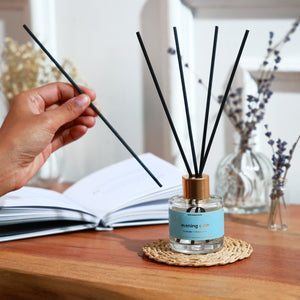



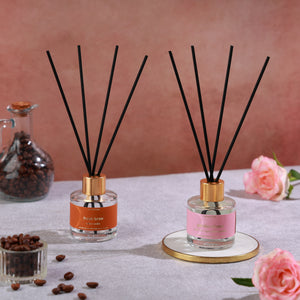
What to use: one correctly sized reed diffuser from ₹749 with all six fibre reeds, placed inside the room and away from the doorway. If you want the whole volume at one level on demand, Sukoon ₹1,899 covers a published 270–320 sq ft — comfortably more than one bedroom, which is exactly why it works at a low setting.
What not to use: Vaayu ₹11,999. It is rated to 1000 m³, roughly 2,000–3,000 sq ft, and it is designed to do precisely the thing you have asked it not to do. Megh ₹3,499 is not a coverage upgrade either — it covers about 215 sq ft, less than Sukoon.
The escape routes: the under-door gap, the corridor draught, and a bathroom exhaust fan pulling air out of your bedroom. Containment fails at the openings, not at the walls.
The honest gap: between Safar ₹3,999 — personal scale, waterless, named and sold as a car and travel diffuser, no published room coverage — and Vaayu, SOSA makes no mid-sized waterless bedroom nebuliser.
2. Close the door and treat it as the main piece of equipment. A closed door raises the concentration inside and lowers it everywhere else, simultaneously, for nothing. It is the only intervention in this subject that improves both halves of your brief at once, and it is free.
3. Place the diffuser inside the room, not near the doorway. A doorway is the most turbulent point in any home: air exchanges every time it opens, so anything sitting there is repeatedly stripped and then hit at close range. Put the bottle a good way into the room, in the path air already takes, and away from the direct blast of a split AC, which strips top notes within days.
4. Find the leaks before you spend anything. The under-door gap is the obvious one. Less obvious: a bathroom or kitchen exhaust fan running elsewhere in the flat can pull air out of your bedroom continuously, and an open balcony door in the next room can turn the whole floor into a wind tunnel. Containment fails at openings, never at walls.
5. Accept what containment costs. A closed door means the rest of the flat gets nothing, and it means the room is at its best when you walk into it rather than while you sit in it, because you adapt to a constant smell within minutes. Both of those are features of what you asked for. If you also want the hallway to smell of something, that is a second bottle in the hallway — two zones, not one machine.
Free shipping above ₹499, and a portion of every order supports girl-child education through Nanhi Kali.
Why a small closed room reaches a hotel-like level far faster
Two numbers decide what a room smells like, and neither of them is on the bottle. The first is the volume the fragrance has to fill. The second is the air exchange rate — how often that volume is replaced with unscented air from outside or from the rest of the flat. Concentration is the release rate divided by both. That is the whole model, and it explains almost every complaint in this category, including the ones people blame on the oil.
 Garden Bloom₹799A bedroom is a small box. An open-plan living-dining is a large one, and a whole floor with the internal doors open is one enormous connected volume with several sources of outside air. The same diffuser put into each of them produces the same amount of fragrance and three completely different results, because the fragrance is being asked to fill three different quantities of air. This is why a 50ml reed reads as weak in a 300 sq ft living room while performing exactly to specification — it is built for up to about 150 sq ft, and the 130ml exists for above that. It is also why Sukoon’s 270–320 sq ft is comfortable rather than marginal in a bedroom: you are running a machine inside its range rather than at the edge of it.
 Mountain Breeze₹849Continuous cross-ventilation always costs projection, because every cubic metre of air that leaves the room takes its fragrance with it and arrives replaced by air that has none. A bedroom with the windows open all day is not a home-fragrance environment during those hours — it becomes one the moment they close. Height matters too: wind speed rises with altitude, so a twentieth-floor balcony door is a far more aggressive exchange than a second-floor window, and nothing about the diffuser has changed. Closing the door slows the exchange to a trickle, which is why a closed bedroom both reaches its level quickly and holds it for a good while after the source stops.
 Sukoon₹1,899Recirculation is not ventilation. A running split AC in a closed room moves the same air around rather than replacing it, which distributes fragrance evenly through the volume without letting any of it escape — the exact combination a containment brief wants. It is why an air-conditioned bedroom with the door shut is the easiest room in an Indian home to scent, and why so many readers find their setup works beautifully at night and disappointingly at four in the afternoon. The trade is that dry air speeds evaporation, so the bottle empties faster. Better distribution and shorter life, in the same season.
Where containment actually fails, and what to do about it
Walls do not leak. Openings do, and there are usually three. The under-door gap is the first and the most persistent, because it is open all night and it is at floor level where the coolest, densest air sits. You will not seal it and you should not try; what you can do is stop treating the doorway as a place to put the diffuser, which people do constantly in the hope of catching the arrival moment. An entrance is the most turbulent point in a home. Anything left there is stripped by the draught and then encountered at close range, which is the worst of both.
The second is pressure. A bathroom or kitchen exhaust fan running elsewhere in the flat lowers the pressure in that part of the home, and air is drawn towards it — including the air in your bedroom, under the door, continuously, for as long as it runs. If your fragrance seems to vanish from the bedroom and appear faintly in the corridor, that is usually what is happening, and the fix is to run the fan when you need it rather than as a habit. The third is the rest of the flat’s ventilation. An open balcony door two rooms away can turn the whole floor into a single moving volume; your closed bedroom door is then working against a genuine pressure gradient rather than still air.
And there is one leak that is not physical. If you want the bedroom to smell distinct from the rest of the flat, it has to be distinct: one scent in one room, and either nothing or a clearly different register elsewhere. A home that smells identical everywhere stops registering as a smell within a week, because your receptors adapt to an unchanging stimulus and simply stop reporting it. The contrast between the corridor and the bedroom is a large part of what you are remembering from a hotel, and it costs nothing to reproduce. A duo — two 50ml bottles of two different registers, from ₹1,498 — is the cheapest way to build that contrast deliberately rather than by accident.
| Option | Published coverage | Right size for one bedroom? | What it does to the rest of the house | Price |
|---|---|---|---|---|
| 50ml reed ★ | Up to ~150 sq ft, 6–8 weeks | Yes — specified for exactly this | Nothing. A reed produces a zone; with the door closed it stays in the room | ₹749–₹849 |
| 130ml reed | Above 150 sq ft, 14–18 weeks | Over-specified — use three reeds rather than six | Nothing, but you are paying for coverage you are containing | ₹1,249–₹1,349 |
| Boond | Up to ~150 sq ft, ~6 hours, 300ml | Yes, at the small end | Little, on a low setting behind a closed door | ₹899 |
| Sukoon ★ | 270–320 sq ft, 16–18 hours on low | Comfortably over-specified, which is the point — run it low | Contained if the door is shut; it adds humidity to that room | ₹1,899 |
| Megh | ~215 sq ft — less than Sukoon | No reason to choose it here | A great deal of humidity in a small closed room | ₹3,499 |
| Safar | None published — personal and small-space scenting | Yes in principle, waterless and timed; named and sold as a car and travel diffuser | Contained, and it adds no humidity at all | ₹3,999 |
| Vaayu | Up to 1000 m³, roughly 2,000–3,000 sq ft | No. Nine-tenths wasted in a bedroom | It is built to scent the whole floor — the opposite of this brief | ₹11,999 |
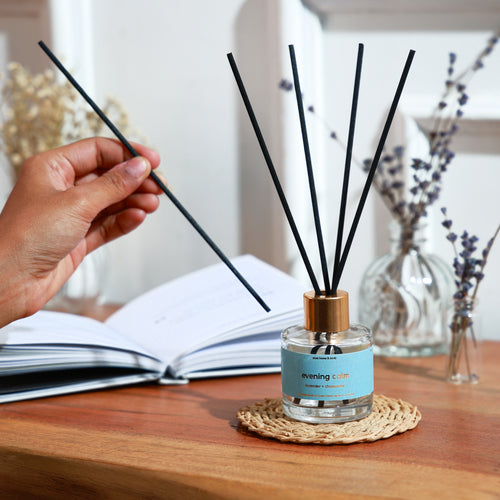
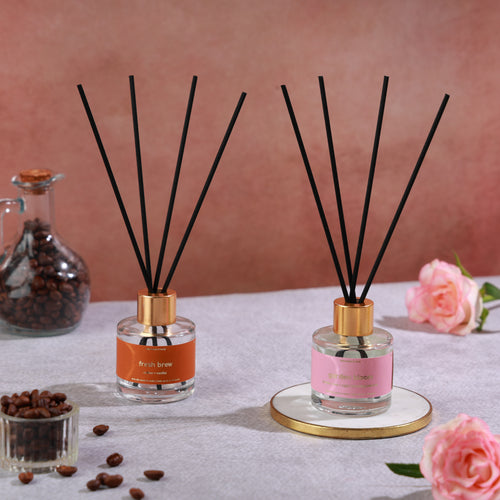
The suite scent · Evening Calm₹799Shop →  The contrast · Garden Bloom₹799Shop →
  The whole volume · Sukoon₹1,899Shop →
What a hotel suite is actually doing, and how much of it you can copy
A hotel lobby and a hotel suite are different engineering problems, and conflating them is the reason people overbuy. A lobby is an enormous volume scented by a commercial machine feeding the ventilation system continuously. A suite is a small, closed, well-controlled box, usually scented lightly, often by carry-over from the corridor rather than by anything in the room at all — which is precisely why you can never find the diffuser when you look for it. There is often nothing to find. The scent is introduced into the building’s moving air, so there is no gradient to walk up and no source to locate, and that absence of a findable source is a large part of why it reads as designed rather than added.
The reproducible parts are simpler than the mystique suggests. Consistency: one scent, kept for a long time, is the strongest luxury signal available and it costs nothing extra. Dryness and cleanliness first: a hotel room is aired and cleaned before it is scented, and fragrance layered onto a stale room produces scented staleness rather than freshness. Fragrance does not remove a smell; source, then ventilation, then fragrance, in that order. Restraint: almost any composition at too high a concentration flattens into a single sweet or sharp impression, which is what people mean when they call something an air freshener. The same oil at a lower dose reads as layered because the nose has room to resolve the separate materials.
The part you cannot copy is that you arrive at a hotel un-adapted, from outside, into a room you have never smelled before. You will never experience your own bedroom that way, no matter what you buy. What you can do is engineer the closest available version: keep the door shut, keep the scent to that one room, and let the transition from corridor to bedroom do the work. The arrival is the moment worth optimising, and containment is what creates it.
What to buy for one contained room, in order
Containment first, correct sizing second, machine only if you want the whole volume at one level during chosen hours. The last row is the honest gap, and it matters here because the ideal device for this brief — waterless, room-sized, contained, scheduled — is the one product SOSA does not make.
| Step | What it is | When it is the right answer | Price |
|---|---|---|---|
| 1. Door closed, diffuser inside the room, six reeds in ★ | Containment plus placement — the two adjustments that raise the level inside and drop it outside at once | Always first, and free. Most containment complaints end here | ₹0 |
| 2. One 50ml reed ★ | Up to ~150 sq ft, 6–8 weeks, six fibre reeds, flipped every 3–5 days, about ₹13–₹15 a day | The default for a single bedroom, and the only format that leaks nothing because it moves no air | ₹749–₹849 |
| 3. A duo, two registers | Two 50ml bottles, two rooms — the bedroom distinct from the corridor by design rather than by accident | When the contrast between rooms is what you are actually trying to create | from ₹1,498 |
| 4. Sukoon | 270–320 sq ft, 16–18 hours on low, three 15ml Hotel Collection scents included | When you want the whole bedroom at one level on demand, and can accept water, dilution, humidity and filling | ₹1,899 |
| 5. Safar | Waterless, undiluted, 3 speeds, 1/2/3-hour auto-off, cordless, 20ml bottle, 6.9 cm | When humidity in a small closed room is the objection. Named and sold as a car and travel diffuser; no published room coverage | ₹3,999 |
| The honest gap, and the thing not to buy | Vaayu ₹11,999 is rated to 2,000–3,000 sq ft and is the wrong purchase here. And between it and Safar, SOSA makes no mid-sized waterless bedroom nebuliser — so “waterless, contained, room-sized” has no perfect answer in this range | Stated plainly, because the next machine up is not the answer to a containment brief | — |
Versailles
Almost every question I get in this cluster is somebody asking how to do something difficult. This one is somebody asking how to do something easy and not realising it. A small closed room is the ideal case for home fragrance — small volume, slow air exchange, one door. If you have been struggling in an open-plan flat, moving the ambition into a bedroom is not a downgrade; it is choosing the winnable version of the problem.
The mistake I see most is buying upwards. Somebody wants their bedroom to smell like a suite, does not get there with a reed, and looks at the next machine in the range. But Vaayu is rated to 1000 m³, which is a whole floor, and buying it for a bedroom is paying ₹11,999 to solve the containment problem you were trying to avoid. If the answer is a machine at all, it is Sukoon at ₹1,899, run low, behind a shut door.
And I would try the free version for a week first. Six reeds instead of three, the bottle moved off the doorway and into the room, the door closed from the evening onwards. Then judge it by walking in, not by sitting inside — your own nose stops reporting a constant smell within minutes, and a great many people replace equipment that was working. Everything is composed in Pune, and part of every order funds a girl’s classroom through Nanhi Kali.
Frequently asked questions
- Just the bedroom, not the house — zoning as a strategy rather than a compromise.
- 100 sq ft and 10 × 10 — the same footprint, two different questions.
- A 10 × 12 bedroom — the closed-door hours rather than the size.
- Do I really need a machine? — often no, and here is the test.
- Waterless vs reed — undiluted oil plus moved air.
- Only while I’m in the room — the control page.
- Small room, big projection — the vocabulary you need to search properly.
- Reed vs Safar — the head-to-head, scored honestly.
- Brand: the SOSA founder story.
Facts verified August 2026: Passive capillary — SOSA reed diffusers, five scents, 50ml ₹749–₹849 for rooms up to ~150 sq ft lasting 6–8 weeks, 130ml ₹1,249–₹1,349 above 150 sq ft lasting 14–18 weeks, six fibre reeds included (six for full projection, three for a soft bedside level and roughly double the life), flipped every 3–5 days, about ₹13–₹15 a day, heat-stable CCT carrier, alcohol-free, phthalate-free, paraben-free, IFRA-compliant, 0 ppm formaldehyde, refillable glass, tested at 45°C and 85% RH, composed in Pune; duos ₹1,498–₹1,598 for two 50ml bottles and ₹2,498–₹2,598 in 130ml; refills 300ml ₹2,399 and 500ml ₹3,499, oil only and never a first purchase. Ultrasonic water mist — Boond ₹899 (300ml, up to ~150 sq ft, ~6 hours, USB, night light), Sukoon ₹1,899 (500ml, 270–320 sq ft, 16–18 hours on low, three 15ml Hotel Collection scents included), Megh ₹3,499 (6L tank, ~100 hours, ~215 sq ft — less than Sukoon, and never a coverage upgrade). Waterless cold-air nebulising — Safar ₹3,999 (20ml bottle, 2000 mAh Type-C, up to 10 hours continuous or around 30 hours intermittent per charge, 3 speeds, 1/2/3-hour auto-off, 6.9 cm, named and sold as a car and travel diffuser with bedside and hotel room among its stated uses, no published room-coverage figure) and Vaayu ₹11,999 (up to 1000 m³ or roughly 2,000–3,000 sq ft, 400ml tank lasting up to about 90+ days, Bluetooth app plus onboard buttons, 1h/4h/8h/24h run windows, choice of days, adjustable intensity, key-lock, under 38 dB, freestanding or wall/HVAC mount, 5W, CE, RoHS, SGS). Between Safar and Vaayu there is no mid-sized waterless bedroom nebuliser in the SOSA range. Hotel Collection oils are water-based and ultrasonic-only — 15ml ₹299 (a refill), 100ml ₹999, 300ml ₹1,799, pack of 7 ₹1,799 — and cannot be used in reed diffusers or waterless nebulisers, nor reed oil in ultrasonic machines; there is no hotel-inspired reed diffuser. No health, air-quality, allergy or antimicrobial claims are made, and fragrance does not remove a smell: source, ventilation, then fragrance. Free shipping above ₹499. A portion of every order supports girl-child education through Nanhi Kali. SOSA is an independent Indian fragrance house; the Hotel Collection scents referenced here are SOSA’s own interpretations inspired by the world’s finest hotels, and SOSA is not affiliated with, endorsed by or a supplier to any hotel brand. Prices subject to change — see the live product pages.