



I Cook Before My Friends Arrive — How Do I Transition From Kitchen Smells to a Fresh-Smelling Living Room?

I Cook Before My Friends Arrive — How Do I Transition From Kitchen Smells to a Fresh-Smelling Living Room?

★ Friends coming over tonight · the thirty-minute version and the every-weekend versionCandle ₹379 · reed ₹749 · Boond ₹899 · Sukoon ₹1,899 · free shipping above ₹499A portion funds girl-child education
★ SOSA · when people are coming over
Six people are arriving at eight and it is currently seven. Here is what actually moves the needle in an hour, in order
★ ★ ★ ★ ★
★★★★★
"Thirty minutes, six people on the way. Windows open, dishes out of the sink, candle lit. That order mattered more than what I bought."
Rohan T. Friends over, Mumbai
30-minute fix
★★★★★
"I cook before everyone arrives and the flat always smelled of it. Extractor on while cooking, twenty minutes of open window after, then the Sukoon. Completely different evening now."
Priya K. Hosts weekly, Bengaluru
Cook → air → scent
★★★★★
"Ten people in a 2BHK gets warm and stuffy fast. Was told to run it lower than usual, not higher. Counterintuitive and completely right."
Vikram S. House party, Gurgaon
Lower, not higher
★★★★★
"I host most Saturdays. Worked out a Sukoon at ₹1,899 was cheaper over a year than candles every weekend, and I stopped thinking about it."
Ananya P. Weekly host, Pune
Sukoon over candles
★★★★★
"Friends smoke on the balcony and it drifts back in. The honest answer was airflow and closing the door, not more fragrance. Fixed it."
Sameer H. Balcony smokers, Delhi
Airflow first
★★★★★
"Wanted the flat to feel premium without anyone clocking a scent. Clean and low, run early, off before people arrive. That was the trick."
Tanvi R. Small gatherings, Kolkata
Off before they arrive
★★★★★
"Thirty minutes, six people on the way. Windows open, dishes out of the sink, candle lit. That order mattered more than what I bought."
Rohan T. Friends over, Mumbai
30-minute fix
★★★★★
"I cook before everyone arrives and the flat always smelled of it. Extractor on while cooking, twenty minutes of open window after, then the Sukoon. Completely different evening now."
Priya K. Hosts weekly, Bengaluru
Cook → air → scent
★★★★★
"Ten people in a 2BHK gets warm and stuffy fast. Was told to run it lower than usual, not higher. Counterintuitive and completely right."
Vikram S. House party, Gurgaon
Lower, not higher
★★★★★
"I host most Saturdays. Worked out a Sukoon at ₹1,899 was cheaper over a year than candles every weekend, and I stopped thinking about it."
Ananya P. Weekly host, Pune
Sukoon over candles
★★★★★
"Friends smoke on the balcony and it drifts back in. The honest answer was airflow and closing the door, not more fragrance. Fixed it."
Sameer H. Balcony smokers, Delhi
Airflow first
★★★★★
"Wanted the flat to feel premium without anyone clocking a scent. Clean and low, run early, off before people arrive. That was the trick."
Tanvi R. Small gatherings, Kolkata
Off before they arrive
Candle: scent in the room in 15–20 minutes · Sukoon: about 20 minutes from cold A reed diffuser needs 24–72 hours — the wrong buy when guests arrive tonight Ventilate first · fragrance is the finishing layer, never the cover-up


Founder Diaries · Home Fragrance · Hosting Friends
By Sonal Sahani · ISIPCA Versailles 11 min read Updated August 2026
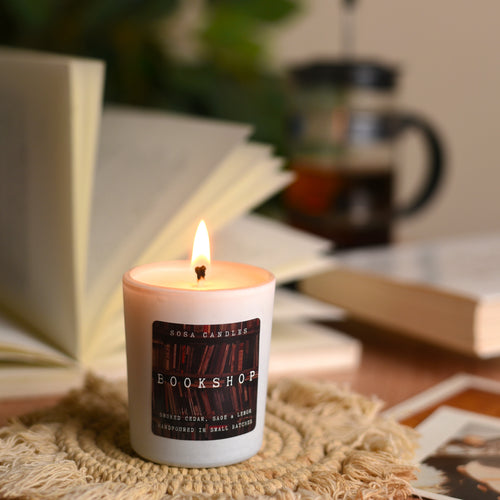
Almost everybody who asks this has already tried the obvious thing, which is to open a window and light something, and almost everybody has found that the flat smells of dinner again by nine. That is not a ventilation failure and it is not a product failure. It is that a cooking smell has two halves, and opening a window only removes one of them. The airborne half goes in about twenty minutes. The other half has already condensed onto surfaces — the chimney filter, the wall behind the hob, the curtain nearest the kitchen, the cushion covers, and the shirt you are still wearing — and it releases itself back into the room slowly for hours. Deal with both halves in the right order and the transition takes twenty-five minutes. Then, and only then, a Bookshop candle at ₹379 or the Sukoon at ₹1,899 has something clean to sit on.
Quick answers — read this first
The sequence: extraction on before the pan is hot and for ten minutes after it comes off; kitchen door shut; two openings on opposite walls for twenty minutes; change your shirt; then fragrance.

Why the window is not enough: frying puts a fine oil aerosol into the air that condenses on filters, walls, curtains, cushions and clothing. Ventilation clears the vapour and leaves the film, and the film re-releases for hours.

The product, once the air has turned over: a Bookshop candle at ₹379 for scent in the room in 15–20 minutes, or the Sukoon at ₹1,899 for about twenty minutes from cold with timers so it starts at a fixed hour. The dry 1 Hotels-inspired Forest Suite at ₹299 sits beside food better than anything sweet or floral.
The short answer
Short answer: do not fragrance the transition, complete it. Extractor on before the pan is hot and for ten minutes after, kitchen door shut, then two openings on opposite walls for twenty minutes, then a clean shirt. Fragrance goes on last, once the air has actually turned over, and the test is simple: cook, wait twenty minutes, and then smell the room before you decide anything.
The pick: the 1 Hotels-inspired Forest Suite (cedarwood, vetiver, green leaves, ₹299) in the Sukoon at ₹1,899, four drops, started twenty minutes after the windows close. If people are arriving tonight and you own nothing, a Bookshop candle at ₹379 puts scent in the room in fifteen to twenty minutes. A reed diffuser needs 24–72 hours and is the wrong buy for an evening with a clock on it.
Shop: Hotel Collection scents ₹299 for 15ml, ₹999 for 100ml, ₹1,799 for 300ml at about ₹6 per millilitre. The Sukoon is ₹1,899 for 270–320 sq ft with steady, 2H and 4H timers and three 15ml scents included; the Boond is ₹899. Candles from ₹379 (~15–18 hours). Free shipping above ₹499.
Straight answer
How do I get from a kitchen that smells of cooking to a living room that smells fresh, in the hour before friends arrive?
1. Start the extractor before the pan is hot, and leave it on for ten minutes after you finish. Most people switch it on when the smell arrives, which is already late — an extractor catches a plume at source and is far less use once that plume has spread across a room. The ten minutes afterwards matter as much as the hour before: a hot pan, a hot oven and hot oil carry on releasing after the flame is off.

2. Shut the kitchen door while you cook, if you have one. It costs nothing and it is the difference between one room to fix and three. If the kitchen opens straight into the sitting room, put a fan in the kitchen window blowing outwards rather than a fan in the room blowing the air around.

3. Then twenty minutes of cross-ventilation, with two openings on opposite walls. One window is a hole. Two openings facing each other is a current, and a current is what actually exchanges the volume of air in a flat. Twenty minutes is enough in almost every Indian apartment; an hour is not four times better.

4. Change your shirt. This is the step everybody skips and it works. Frying oil condenses onto fabric, and you have been standing in the plume. You will greet people at the door and hug some of them, and the smell they meet first is not the room, it is you. Sixty seconds, and it removes an entire source from the flat.

5. Only now, fragrance. A Bookshop candle at ₹379 gives you scent in the room in fifteen to twenty minutes and must be attended and put out. The Sukoon at ₹1,899 reaches a steady level in about twenty minutes from cold, runs unattended on a timer and does the same thing next Saturday. A reed diffuser needs 24–72 hours and is the wrong purchase for an evening with a clock on it.

6. Apply the test before you spend anything. Cook what you normally cook, wait twenty minutes, walk out of the flat, come back in and smell it honestly. If it still smells of dinner, the problem is the second half — filter, walls, fabrics, clothes — and no bottle will solve it.

A portion of every order supports girl-child education through Nanhi Kali.

TL;DR: a cooking smell has two halves. Twenty minutes of cross-ventilation removes the airborne one; the oily one has landed on your filter, curtains and shirt and needs wiping, washing and changing. Extraction on early and ten minutes late, door shut, windows open, clean shirt — then a ₹379 candle or the Sukoon at ₹1,899.
SOSA Sukoon
The machine you switch on last, not first
SOSA Sukoon ₹1,899
A 500ml BPA-free tank rated for 270–320 sq ft, about twenty minutes from cold to a steady level, 16–18 hours per fill on low at 30–50 ml/h, a 2.4MHz cool-mist plate, remote, auto shut-off and steady, 2H and 4H timers — with three 15ml Hotel Collection scents of your choice included. For a cook the useful specification is the timer, because it lets you start the room at a fixed hour rather than at the moment you remember, and the hour is the whole argument of this page. Set it for twenty minutes after the windows close, not for twenty minutes after the pan goes on.

The half a window removes, and the half it leaves behind

The reason this question keeps getting answered badly is that the answers treat a cooking smell as one thing when it is two, with completely different behaviour and completely different remedies. Everything a hot pan produces divides into what is floating and what has landed. Ventilation is excellent at the first and does absolutely nothing about the second, which is why a flat can be aired properly at seven and smell of dinner again at nine. Once you can see the two halves separately, the whole sequence below stops being a checklist somebody handed you and starts being obvious.

1
THE FIRST HALF
Airborne, and gone in twenty minutes
The floating half is the easy one and it is the half people mean when they say a room smells of food. Volatile aromatic compounds come off hot oil, spices, onion, garlic, fish and anything caramelising, they mix into the room's air, and they leave with that air. That is the whole mechanism, and it is why ventilation beats every product ever sold for this particular problem. What matters is doing it correctly. A single open window in a still evening exchanges very little; two openings on opposite walls create a path, and air takes the path. Twenty minutes of that will turn over the volume of a normal two-bedroom flat several times, and beyond twenty minutes you are into diminishing returns rather than a better result. The one refinement worth knowing is direction. If you have an exhaust fan or a window fan in the kitchen, it should be pushing air out of the building, not stirring it round the flat. A pedestal fan in the living room aimed vaguely at a window is doing something quite different from an extractor: it is distributing the smell more evenly, which feels like progress for about four minutes. And the extractor over the hob only works on what it can catch, which means it has to be running before the plume exists. On before the pan is hot, off ten minutes after the pan comes off. Nothing about that costs money, and it removes more of the problem than anything else on this page.
2
THE SECOND HALF
Condensed onto the filter, the wall, the curtain and your shirt
Now the half nobody mentions, which is where the nine o'clock smell comes from. Frying does not only release vapour. It throws a fine aerosol of oil into the air, and an aerosol does what aerosols do — it travels a short distance, cools and lands. It lands on the chimney filter first and most heavily, then on the wall and tiles behind and above the hob, then on anything soft within a few metres: the curtain nearest the kitchen, the cushion covers on the sofa nobody thinks of as being near the kitchen, a rug, and the clothes of whoever was standing at the stove. That film is not inert. It holds the smell of what produced it and it re-releases slowly into the room for hours, which is exactly why a flat that was aired at seven has gone back to smelling of dinner by nine, and exactly why ventilation appears to have failed when it has not. The remedies for this half are all physical, and none of them is a fragrance. Degrease the chimney filter on a schedule rather than a suspicion — every four to six weeks in a house that fries, and if you cannot remember the last time, that is your answer. Wipe the wall and tiles behind the hob while they are still warm, when the film comes off with a cloth instead of an argument. Wash cushion covers and the kitchen-end curtain on a rotation. And take the kitchen bin out before people arrive rather than after they leave, because a bin with this evening's trimmings in it is a source running the whole time your guests are in the room.
3
THE STEP EVERYBODY SKIPS
Change your shirt, and do it before you open the door
This is the one I get thanked for, and it is free. You have spent forty minutes standing in the plume from your own pan. Your shirt, your hair and to a lesser extent your trousers now carry the condensed half of the smell, and you are about to stand at the door greeting people at a distance of about thirty centimetres. The first thing your friends smell when they arrive is very often not the flat at all. It is the host. A clean shirt takes a minute and removes a mobile source from the room, and if you have somewhere to put the cooking shirt other than draped over a chair in the same room, better still. The same logic extends to the apron nobody takes off and the tea towel over your shoulder. I would rather a reader did this and bought nothing than bought a diffuser and kept the shirt on, and I say that in the knowledge that it is a strange thing for somebody who sells fragrance to write. It is true, though, and it is the sort of thing you only learn by standing in other people's kitchens at seven in the evening, which I have done a great deal of.
The honest test, and it costs nothing: cook what you normally cook, wait twenty minutes with the windows open, then step out onto the landing for a moment and walk back in. Your nose resets in that short absence and reports the room the way a guest will receive it. If it still smells of dinner after that, the second half is what you are smelling, and no bottle in the world is going to fix it.

The transition, minute by minute

Here is the whole sequence as a timetable rather than a list of principles, on the assumption that people are arriving at eight. The right-hand column is the one to read if you only have half an hour: it says which half of the cooking smell each step actually removes, because a step that addresses neither half is a step you can drop when you are short of time. Fragrance is deliberately at the bottom, and the reason is not modesty.

The cooking-to-living-room transition
What each step removes, and when to do it
Step When Which half it removes How long it takes
Extractor on early, off ten minutes late ★ Before the pan is hot, until ten minutes after it comes off Most of the airborne half, and a large share of the aerosol before it can land — this is the single highest-value step Free. No extra time at all
Kitchen door shut while you cook Throughout Neither, directly — it confines both halves to one room instead of three, which changes everything afterwards Free. Two seconds
Cross-ventilation, two openings on opposite walls The twenty minutes after you finish cooking The rest of the airborne half. Nothing at all of the condensed half 20 minutes
Wipe the hob wall and tiles while warm Immediately after cooking The condensed half, at its heaviest point of deposit 2 minutes
Change your shirt, bin out Before you open the door The condensed half on the two sources that move around the flat by themselves 3 minutes
Fragrance — Bookshop candle ₹379 or Sukoon ₹1,899 Once the windows are closed and the air has turned over Neither. It is the finishing layer on air that is already clean, and it will not cover either half 15–20 minutes to reach the room
Shop this guide
What to run once the air has actually turned over
The SOSA principle
Ventilation removes what is floating. It does nothing about what has already landed — and the thing that has landed is the reason your flat smells of dinner again at nine.
The chimney filter, the wall behind the hob, the curtain nearest the kitchen, the cushion covers and the shirt you cooked in. Five surfaces, all of them re-releasing slowly, none of them reachable by an open window or a bottle.

What to run afterwards, at what dose, and when

Start with the hour, because for a cook it decides more than the scent does. The Sukoon reaches a steady level in about twenty minutes from cold and a candle puts noticeable fragrance into a normal room in fifteen to twenty, so both are same-evening products — but the instruction that matters is not how early to start them, it is what to start them after. Switch the machine on while the pan is still going and you have not scented a room, you have mixed a scent into a cooking smell and then ventilated the mixture, which wastes the fragrance and leaves you with a room that reads as confused. So the order is fixed: cook, extract, shut, air, close the windows, and then start. Twenty minutes later the room has arrived. If people come at eight and you finish cooking at seven, that puts the windows shut at about twenty past and the machine on immediately after, which is comfortable. The timers on the Sukoon are genuinely useful to a cook for a reason that has nothing to do with convenience: they let you commit to an hour in advance, so the decision is not being made by somebody with four pans going. A 500ml BPA-free tank covers 270–320 sq ft, gives 16–18 hours per fill on low at 30–50 ml/h against 9–12 on high, has a 2.4MHz cool-mist plate, a remote, auto shut-off and steady, 2H and 4H timers, and it arrives with three 15ml scents of your choice. A Boond at ₹899 is the smaller version of the same idea for a compact sitting room.

Then the dose and the bottle, and here the choice narrows in a way it does not on other pages. The Hotel Collection is composed at three to six drops per tank and a living room after cooking takes four — and it should be one of the dry ones rather than one of the soft ones. The 1 Hotels-inspired Forest Suite at ₹299 is cedarwood, vetiver and green leaves, and dry woods occupy a different part of the nose from hot oil, so they stand beside whatever trace of food remains rather than blending into it. The Ritz-Carlton-inspired Quiet Luxury at ₹299 — white tea, bergamot and cedar — is the next best and slightly brighter. What I would avoid in a flat that has just been cooked in is anything soft, floral or sweet, and the useful thing about this range is that the last of those three is not available to get wrong: there is nothing sweet in any of the seven, no vanilla, no caramel, no tonka. Sugar over frying oil is the most recognisable bad smell in domestic life and the collection cannot produce it. On placement: waist height or above, at the far end of the room from the kitchen, out of the path of a fan or an air-conditioning vent, and never in the doorway between the two spaces, where it simply gets swept back and forth. Cool mist falls rather than rises, so a machine on the floor is scenting a rug rather than a room.

Then the constraints, and the part about your own nose. You have been in the flat all evening with the cooking, so you are the single least reliable judge of how it smells, and after a fortnight of running the same scent you will be an unreliable judge of that too — a nose reports change and discards constants. The instinct that produces is to add drops, which is how a room ends up strong for everybody except the person who set it. Ask one friend to be honest rather than polite, once, and believe them. On what goes where: the Hotel Collection is water-based and runs in the Sukoon, the Boond and the Megh only. It does not go into a reed diffuser, which is a separate alcohol-free line with its own scents, and it does not go into the waterless Vaayu at ₹11,999, which takes its own undiluted oil. Never put raw essential or carrier oils into an ultrasonic machine, because they clog the 2.4MHz plate, and rinse the tank when you change scent. Buy a 15ml at ₹299 before a 300ml 300ml refill at ₹1,799. And the principle, which is the reason this page spends four sections on housekeeping before it mentions a bottle: fragrance is a finishing layer on air that is already clean. Put it over a live cooking smell and you have made two smells where there was one, and your guests will smell both.

Fragrance is a finishing layer, not a lid. Put it over a cooking smell that is still working and you have made two smells where there was one.
— Sonal Sahani, SOSA

The SOSA edit

In buying order for somebody who cooks properly before people arrive. The first row is the machine, because the timer is what makes the sequence repeatable rather than remembered, and the last row is the step that costs nothing and outperforms everything above it.

The SOSA edit
For the host who cooks first, in buying order
Buy What it is When it earns its place Price
1. Sukoon 500ml ultrasonic for 270–320 sq ft, about 20 minutes from cold, steady/2H/4H timers, three 15ml scents included First. The timer lets you fix the hour in advance instead of deciding it with four pans going ₹1,899
2. 1 Hotels-inspired 15ml Cedarwood, vetiver and green leaves — the driest of the seven Four drops, started once the windows are shut. Dry woods stand beside food rather than blending into it ₹299
3. Bookshop candle 80g, roughly 15–18 hours, scent in the room in 15–20 minutes Tonight, if you own no machine. Must be attended and put out ₹379
4. Ritz-Carlton-inspired 15ml White tea, bergamot and cedar — clean and a little brighter than the cedar-vetiver one As the second bottle, for evenings you have not cooked. One machine, two moods ₹299
5. Boond 300ml ultrasonic, same three-to-six-drop dose, less output per hour For a compact sitting room, or as a second machine at the far end of an open-plan flat ₹899
Free, and better than all of the above: extraction, twenty minutes of cross-ventilation, and a clean shirt The three steps that address both halves of a cooking smell rather than one Always. If you do only one thing from this page, do these ₹0
Honest notes for buyers: fragrance is the last step, not the first — it layers on air that is already clean and moving, and it will not cover cooking, damp or a room that has been shut for weeks. Timing matters as much as product: a candle scents a room in fifteen to twenty minutes and a Sukoon in about twenty, which is why both work when people are arriving tonight, while a reed diffuser needs a day to three days before it is doing its job properly — it is the wrong buy for a deadline and the right buy for a room you want to hold a steady scent for months. SOSA does not make a room spray for the home; the sprays in the range are formulated and sized for a car. The Hotel Collection is water-based and runs in the Sukoon, Boond and Megh only — not in reeds, and not in the waterless Vaayu. Reed diffusers are a separate alcohol-free line with their own scents. Candles must be attended and put out before guests leave a room unattended. The Hotel Collection scents are SOSA's own interpretations inspired by the world's finest hotels; SOSA is an independent Indian fragrance house, not affiliated with or endorsed by any hotel brand. A portion of every order supports girl-child education through Nanhi Kali.
1 Hotels-inspired · Forest Suite
The bottle that does not try to join in with dinner
1 Hotels-inspired · Forest Suite ₹299 / 15ml
Cedarwood, vetiver and green leaves — the driest of the seven and the one I would give to anybody who cooks properly before people arrive. Dry woods sit at a different address in the nose from hot oil, so instead of blending with whatever is left of the food they stand apart from it, and the room reads as two separate things rather than one confused one. There is nothing sweet in it, or in any of the other six, which matters more here than anywhere: sugar over frying oil is the single most recognisable bad smell in a flat. ₹299 for 15ml, ₹999 for 100ml, ₹1,799 for 300ml at about ₹6 per millilitre.
SS
ISIPCA
Versailles
A note from Sonal

I have been asked this question in a lot of kitchens, and the conversation almost always goes the same way. Somebody tells me they aired the flat thoroughly and it still smelled of dinner later, and they want to know which fragrance is strong enough to deal with it. The answer is that none of them is, and that the question has an incorrect assumption inside it: they did not fail at ventilating, they ventilated perfectly and then were defeated by the half of the smell that had already stopped being airborne. Once I explain the aerosol and where it lands, people go quiet for a second and then say, the curtain. It is usually the curtain, or the cushion covers.

The shirt is the part I insist on, and it is the part that gets the most resistance, because it feels too small to matter. It is not small. It is a source that walks to the door and stands next to each of your guests in turn, at the exact moment they are forming their impression of the flat. A minute in the bedroom fixes it. I would rather write a page that sends somebody to their wardrobe than one that sends them to a checkout for a problem a wardrobe would have solved, and I think that is also, in the end, the better way to run a fragrance house. The bottle is worth buying afterwards, when there is clean air for it to sit in, and it will do a great deal more for you then.

Everything is made and supported from Pune, and a part of every order funds girl-child education through Nanhi Kali. You get a home that smells like somewhere you chose; a girl gets a classroom. That equation has always felt right to me.

Frequently asked questions

How long should I ventilate after cooking before using home fragrance?
Twenty minutes, with two openings on opposite walls so the air has a path rather than a hole. That clears the airborne half of a cooking smell in a normal flat. Then close the windows and start the fragrance, because running a diffuser into a room you are actively ventilating just sends the scent outside.
Why does my flat smell of cooking again a couple of hours later?
Because frying puts a fine oil aerosol into the air that condenses onto the chimney filter, the wall behind the hob, curtains, cushion covers and your clothes, and that film re-releases slowly for hours. Ventilation cannot reach it. Degreasing the filter, wiping the hob wall while warm and washing the fabrics is what removes it.
Should I light a candle or start the diffuser while I am still cooking?
No. Fragrance added to a live cooking smell produces a mixture rather than a replacement, and you then ventilate away the fragrance you paid for. Cook, extract, air for twenty minutes, close the windows, and start the Sukoon or light the Bookshop candle after that.
Which SOSA scent works best in a flat where somebody cooks a lot?
The 1 Hotels-inspired Forest Suite at ₹299 — cedarwood, vetiver and green leaves. Dry woods sit at a different address in the nose from hot oil, so they stand apart from any trace of food rather than joining in. Nothing in the Hotel Collection is sweet, which matters here more than anywhere.
Will a reed diffuser stop my living room smelling of cooking?
Not on the evening you buy it, and not really on any evening. A reed diffuser needs 24–72 hours before it is working properly, so it is the wrong product for a deadline, and no reed removes a cooking smell — it gives a room a steady background once the air is already clean. For tonight, a candle at ₹379 or the Sukoon at ₹1,899.
Cook, extract, air, change, then scent
Twenty minutes of cross-ventilation — and twenty minutes for the machine after that
The Sukoon is ₹1,899 for 270–320 sq ft, about twenty minutes from cold, 16–18 hours per fill on low, with steady, 2H and 4H timers and three 15ml Hotel Collection scents of your choice included. Individual scents are ₹299 for 15ml, ₹999 for 100ml and ₹1,799 for 300ml at about ₹6 per millilitre. The Bookshop candle is ₹379 for roughly 15–18 hours. Free shipping above ₹499, and a portion of every order supports girl-child education through Nanhi Kali.
See the Sukoon · ₹1,899 Shop the seven scents →
Continue the read
More from SOSA
Editorial standards & sources
About this guide: Written by Sonal Sahani, ISIPCA Versailles-trained founder and perfumer at SOSA Home & Body, on why a cooking smell divides into an airborne half that twenty minutes of cross-ventilation removes and a condensed oil-aerosol half that settles on chimney filters, hob walls, curtains, cushion covers and clothing and re-releases for hours, the minute-by-minute sequence that deals with both, and which fragrance to start once the air has actually turned over.

Facts verified August 2026: Timings in this guide: a scented candle puts noticeable fragrance into a normal room in roughly 15–20 minutes; a Sukoon ultrasonic diffuser reaches a steady level in about 20 minutes from cold; a reed diffuser needs roughly 24–72 hours for the oil to travel the reeds and the room to settle, so it is not a same-day solution. SOSA products and prices: Sukoon 500ml ultrasonic diffuser ₹1,899 (270–320 sq ft, 16–18h on low, 9–12h high, 30–50 ml/h, 2.4MHz cool mist, 7-colour LED, remote, steady/2H/4H timers, BPA-free, auto shut-off, includes three 15ml Hotel Collection scents of your choice); Boond 300ml ₹899; Megh 6-litre ₹3,499; waterless Vaayu ₹11,999 (up to 1000m³); Aangan ₹25,999; Meenar ₹38,500. Hotel Collection water-based fragrance 15ml ₹299, 100ml ₹999, 300ml ₹1,799, Pack of 7 at 15ml ₹1,799 / 100ml ₹5,999 / 300ml ₹10,799; dose 3–6 drops per tank. Reed diffusers (separate alcohol-free line): Morning Freshness from ₹749, Garden Bloom and Evening Calm from ₹799, Fresh Brew and Mountain Breeze from ₹849; 130ml from ₹1,249; duos from ₹1,498; 300ml refills ₹2,399. Scented candles: Bookshop 80g ₹379 (~15–18 hours), Bookshop + Cozy Corner ₹664 (~30–36 hours), Amber Rose 130g ₹599 (~25–30 hours) and 220g ₹799 (~40–50 hours), ceramic jar candles ₹949, Pure Calm wax melt set ₹854. Free shipping above ₹499. SOSA does not make a room or linen spray for the home — the sprays in the range are car perfumes. The Hotel Collection scents are SOSA's own interpretations; SOSA is not affiliated with or endorsed by any hotel brand. Prices subject to change — see the live product pages.
Retour au blog