

Why it works: a junction has traffic through it all day, so the air moves; and it opens onto several spaces at once, so one source feeds a set of rooms rather than one.
The arithmetic: four 130ml bottles at ₹1,349 is ₹5,396 and lasts 14–18 weeks. Nine of them is ₹12,141 and nine weekly flips.
When it fails: if your doors are usually closed, junctions feed nothing and each room needs its own source. Say that to yourself honestly before you rearrange anything.
2. At the foot of the stairs. A stairwell moves air continuously, and the bottom of it sits between the entrance, the living space and the route upward. It is the busiest air in the house.
3. At the head of the stairs, or the first-floor landing. Scent does not climb reliably, so the upper floor needs its own start point. The landing is to the bedrooms what the entrance is to the ground floor.
4. At any corridor crossing. Wherever two circulation routes meet — a passage that opens onto three doors, the gap between hall and dining — you have a position that feeds several rooms from one bottle.
5. Not in the middle of rooms, and not beside seating. A source inside a room serves that room only, and a source beside a sofa gives one seat a hot spot. Junctions are more useful than centres.
6. Not in a draught, however tempting it looks. Several feet clear of any AC vent or fan. A direct draught strips the reeds, empties the bottle weeks early and leaves the air smelling of almost nothing — the exact opposite of what people expect when they place a bottle in front of a vent.
7. And be honest about your doors. This whole method depends on air being able to move between spaces. If your bedrooms and study stay shut all day, junctions feed corridors and nothing else, and you are back to a source per room — which is fine, and cheaper per room than you think.
Our reed compositions are made by hand in small batches in Pune and the Vaayu is made in India; a portion of every order supports girl-child education through Nanhi Kali.
Part one — how to find the junctions in your own house
Every house has them and no two houses have them in the same places, so this is a twenty-minute exercise rather than a rule you can copy from a floor plan. What you are looking for is not the largest room or the prettiest console. You are looking for the places the whole house has in common — the handful of positions that most of your air passes through on its way to somewhere else, and that open onto several spaces at once.
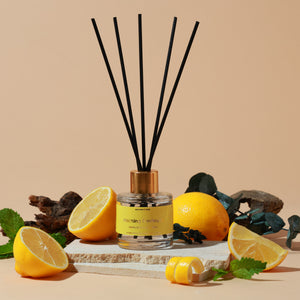
 Morning Freshness₹749 · 9.0/10A villa's air is also moved by machinery — split units, a central system, ceiling fans, an open stairwell acting as a chimney on a warm afternoon. Here the advice inverts depending on what you are placing. For a reed diffuser, strong airflow is a hazard rather than a help: a bottle in front of a vent has its reeds stripped, empties weeks early and leaves the space smelling of little, so keep several feet between the glass and any vent or fan and rely on incidental foot traffic instead. For a nebulising machine the same airflow is the distribution system, which is why the Vaayu can be wall or HVAC mounted rather than only stood on a table. If your villa has ducted air conditioning, the junction that matters may not be a room at all — it may be the point where the system takes air in and sends it back out.
Part two — the junction inventory
Here are the positions worth having in a typical two-storey Indian villa, what each one actually feeds, and what I would put there. Not every house has all six; most have four, and four is enough.
| Junction | What it feeds | What to put there | What kills it |
|---|---|---|---|
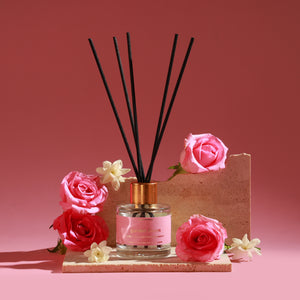
| Entrance console, inside the front door ★ | The hall, and every first impression of the house | Garden Bloom 130ml — rounded, not insistent | A door left open to the porch all afternoon |
| Foot of the staircase | Hall, living space and the route upward | The same composition as the entrance, 130ml | Being tucked under the stair rather than beside it |
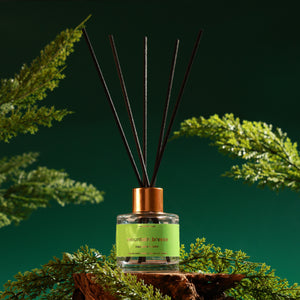
| Upper landing, head of the stairs | Bedroom corridor and the first floor generally | Mountain Breeze 130ml, six reeds | Expecting the ground floor to scent it instead |
| Corridor crossing with three or more doors | Whichever of those rooms are open | A 50ml at waist to chest height | Closed doors — it then feeds only the corridor |
| Opening between hall and dining | Both, as one connected volume | One source at each end if the run is long | Live cooking — never diffuse over it |
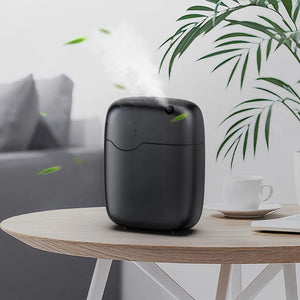
| The main open floor as a whole | Everything with an open door on that level | Vaayu, freestanding or wall-mounted | Buying it for a house of closed rooms |
| The honest caveat: junctions distribute; they do not multiply. A source at the foot of the stairs is still one 50ml bottle releasing at its ordinary rate, and placing it well changes where that output goes rather than how much of it there is. In a very large or double-height volume, a perfectly placed bottle can still be too small for the space it is feeding — placement is the first move, not a substitute for capacity. | |||
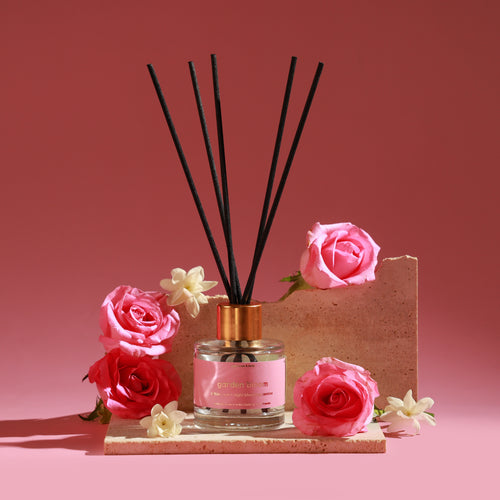
Garden Bloom · the entrancefrom ₹799Shop → 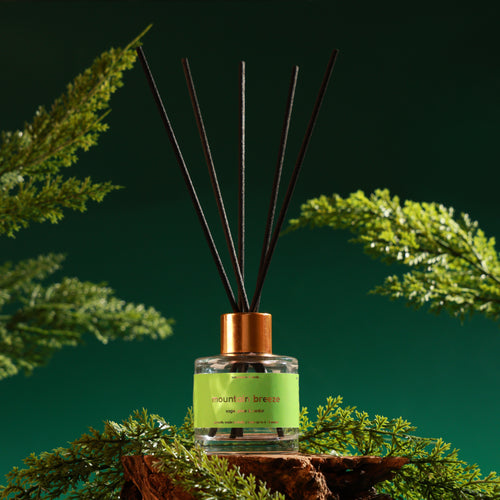 Mountain Breeze · the landingfrom ₹849Shop →
 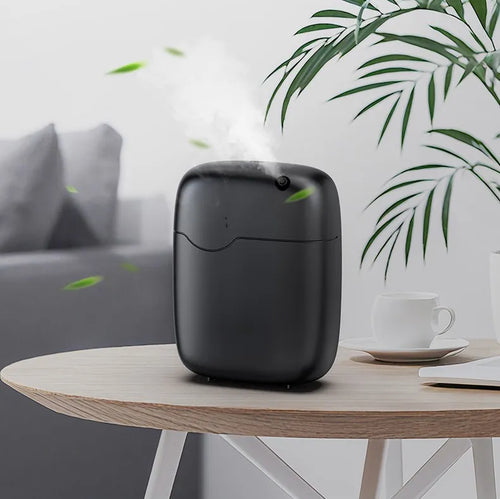 Vaayu · the whole open floor₹11,999Shop →
Part three — the arithmetic, and the houses this does not suit
Set the two approaches beside each other. A nine-room villa scented room by room in 130ml takes nine bottles: at ₹1,349 that is ₹12,141 every fourteen to eighteen weeks, and nine bottles to flip every Sunday. The same villa scented at four junctions takes four: ₹5,396 for the same fourteen to eighteen weeks, and four flips. The saving is real but it is not the main prize — the main prize is that four positions can actually be maintained, and nine quietly cannot. Bottles you do not flip stall; bottles you replace at different times drift out of phase with each other; and a villa running nine sources will, within a year, be running nine sources in different states of health. Fewer, better-placed, better-maintained sources give a more even house than more neglected ones, which is the whole argument compressed into a sentence.
Now the honest limits, because this method is oversold wherever I see it repeated. It does not work in a house of closed doors — I have said it twice already and I will say it here a third time, because it is the failure mode that wastes people's money. It does not work where the junction is enormous: a double-height entrance hall in a large villa can hold more air than four ordinary rooms put together, and a single 50ml standing in it is feeding a volume far outside its range no matter how cleverly it is positioned. It does not work upward — scent does not climb a staircase in any reliable way, so an upper floor needs its own junction rather than a share of the one below. And it does not survive a strong draught: a beautifully chosen position directly under a split unit will empty a bottle in three weeks and scent nothing, which is the most common self-inflicted wound in this whole subject.
Which brings me to when not to spend more. If four junctions with four bottles gives you a house that reads pleasantly on arrival and in the corridors, you are finished — that is roughly ₹5,400 a season and there is nothing an ₹11,999 machine adds that you have asked for. If only the entrance matters to you, buy one 130ml, place it properly, and ignore the rest of this article. If your villa is a closed-door house, spend on a modest bottle per room instead and enjoy the fact that it needs no electricity. The case for a single machine at a junction is narrow and specific: a large, genuinely connected floor, doors habitually open, where you want one identity everywhere without touching anything weekly. There the Vaayu at ₹11,999 does something the bottles cannot — up to 1000m³ of undiluted cold-air mist, timed and locked, standing or wall-mounted at the junction you identified. Before you commit: we do not currently sell a separate Vaayu refill oil, so the 400ml in the box is the supply available today, and the water-based Hotel Collection for ultrasonic machines is a different product that must not go in it. Ask us where refill availability stands first.
Part four — the four-source villa plan
This is what I would actually buy for an open two-storey villa, in order of how much difference each position makes. Stop wherever the house feels right; almost nobody needs all of it.
| Position | What goes there | What it covers | Cost |
|---|---|---|---|
| 1. Entrance console ★ | Garden Bloom 130ml, six reeds, waist to chest height | The hall and everyone's first thirty seconds | ₹1,299 · 14–18 weeks |
| 2. Upper landing | Mountain Breeze 130ml on a console, not a windowsill | The bedroom corridor and first floor | ₹1,349 · 14–18 weeks |
| 3. Foot of the stairs | Same composition as the entrance, so there is no seam | Hall, living space, the route upward | ₹1,299 |
| 4. Corridor crossing | A 50ml — smaller position, smaller bottle | Whichever rooms off it are open | From ₹749 · 6–8 weeks |
| Keep it running | One 300ml oil refill, whole house on one afternoon | Roughly 8–11 months in one vessel | ₹2,399 · 500ml ₹3,499 |
| If one room wants strength on demand | Sukoon on a timer before guests arrive | 270–320 sq ft, switchable, three scents in the box | ₹1,899 |
| If the whole open floor must read as one | Vaayu at the main junction, standing or wall-mounted | Up to 1000m³ · 400ml · 90+ days a fill | ₹11,999 |
| Not a position: the middle of each room | Nine bottles, nine flips, nine start dates | One room each, and a house that drifts apart | ₹12,141 in 130ml |
Versailles
I learned this from watching how people describe houses rather than from any technical source. Nobody says "the study smelled wonderful". They say "the moment I walked in", or "coming down the stairs". The memory of a house is formed in its passages, not in its rooms, and once I noticed that, the placement advice I had been giving for years — one bottle per room, count your square feet — started to look like the wrong shape of answer for a large home.
It is also the advice that costs us the most money, which is worth saying plainly. A villa owner who buys four bottles instead of nine has spent ₹5,396 rather than ₹12,141 with us, and will have a better-smelling house for it. I would rather that than sell five bottles that end up unflipped in rooms nobody enters.
The one thing I would ask is that you be truthful with yourself about your doors before you rearrange anything. If your villa runs closed and air-conditioned, none of this applies and you want a small source in each room instead. If it runs open, four positions will surprise you. Everything is composed in Pune, the Vaayu is made in India, and a part of every order funds a girl's classroom through Nanhi Kali.
Frequently asked questions
- How do you get consistent fragrance across a large villa? — holding one smell once you have placed the sources.
- Fragrancing a villa with multiple floors — why the ground floor under-scents and the top over-scents.
- Why can't I smell my diffuser across my villa? and is my reed diffuser too weak for it?
- The complete large-villa guide — this page and the eight around it in one place.
- Brand: the SOSA founder story.
SOSA Vaayu specifications (verified from the live product page, August 2026): ₹11,999 (the product page displays a rounded ₹12,000). Waterless cold-air nebulisation — pressurised air atomises undiluted fragrance oil into a dry nano-mist; no water, no heat, residue-free. Coverage up to 1000m³, about 2,000–3,000 sq ft. 400ml refillable tank, 90+ days per fill at a mid intensity setting. Bluetooth app plus onboard buttons, 1h / 4h / 8h / 24h timers, adjustable mist intensity, auto-stop and key-lock. Under 38 dB. DC 12V / 1A, 5W. 165 × 80.5 × 215 mm, 0.9 kg, black or white. Freestanding or wall / HVAC mount. CE, RoHS and SGS certified. Ships with four SOSA Hotel Collection fragrances at 100ml each (400ml in total) in one of three combos chosen at checkout. SOSA does not currently sell a separate Vaayu refill oil; the 400ml supplied in the box is the fragrance available at the time of writing, and buyers who need long-term supply should confirm current refill availability with SOSA before purchasing. The cold-air oil supplied with the Vaayu is a different product from the water-based Hotel Collection sold for ultrasonic machines (15ml ₹299 · 100ml ₹999 · 300ml ₹1,799), which must not be used in a Vaayu despite sharing scent names. Other SOSA machines: Boond 300ml ₹899 (~150 sq ft) · Sukoon 500ml ₹1,899 (270–320 sq ft) · Megh 6L ₹3,499 (~215 sq ft — a runtime and humidity machine, not a coverage upgrade) · Aangan ₹25,999 (~8,000–10,000 sq ft) · Meenar ₹38,500 (12,000–18,000 sq ft) · Safar car diffuser ₹3,999. Reed diffusers 50ml ₹749–₹849 (6–8 weeks) · 130ml ₹1,249–₹1,349 (14–18 weeks) · duo sets ₹1,498–₹1,598 · oil-only refills 300ml ₹2,399 / 500ml ₹3,499. Runtime, consumption and coverage figures are manufacturer specifications and vary with intensity setting, run hours, ceiling height, ventilation and season; any per-month or per-day figure in this guide is arithmetic on those specifications, not a measurement. Electricity costs vary by state tariff. No claim is made that scenting affects ratings, reviews, bookings, occupancy, revenue, health, mood or air quality. Free shipping above ₹499. A portion of every order supports girl-child education through Nanhi Kali. Prices subject to change — see the live product pages.