Founder Diaries · Clinics & Medical Centres · Procurement & Vendor Evaluation
By Sonal Sahani · ISIPCA Versailles 14 min read Updated November 2026
A scenting system is a small purchase with an unusual number of ways to go wrong, and almost all of them sit in the vendor's answers rather than in the machine. This page is the evaluation I would hand a procurement head on the day the first brochure arrives, and it is twelve questions long. Send all twelve as one email, on the same day, to every vendor on your list including this one; ask for the replies in writing; read them side by side. Then look for six specific replies, each of which should end a conversation before price is discussed: a health claim, an air-purification claim, a patient-satisfaction percentage, a refusal to say what is in the oil, no key-lock on a machine destined for a public waiting hall, and a standing water tank with nobody named to empty it. Not one of those six requires you to know anything about fragrance, and not one of them is about price. They are the questions a tender file is actually made of, and three of them will reduce your shortlist by more than any demonstration will. I sell one of the machines on this market and I would still rather you ran the list on me, because a vendor who will not answer in writing has told you something more useful than a quotation would.
Quick answers — read this first
Free, and do it before you request a single quotation: write your own specification first. One page, two lists. List one is the rooms that will be scented: entrance, reception and registration, shared and departmental waiting, inter-departmental corridors, lift and stair lobbies, administration, the cafe corner, staff rooms if the staff want them. List two is the rooms that stay fragrance-free, signed by your quality lead or medical director. Every reply you receive gets read against that page, and a vendor who argues with list two has failed before pricing starts.
The email, in short: what exactly does this claim to do, in one sentence · does it hold standing water, and how many handling events a year does that create · what is the consumable, what does a year of it cost at our opening hours, and is the machine locked to your consumable · ingredient disclosure, IFRA conformity and a safety data sheet for every oil quoted · which rooms do you tell us to leave out, in writing · is there a key-lock · measured sound level, at a stated distance · CE, RoHS, SGS and the power draw · the cubic-metre rating, with the arithmetic done on our drawings and the clinical rooms removed · warranty, spares lead time and who attends site · minimum term, auto-renewal, locked cartridge or rental clause · and three facilities like ours where you told them to buy less than they asked for.
The six replies that disqualify: any clinical or therapeutic effect · any air-cleaning claim · any satisfaction percentage · any refusal to disclose the oil · no key-lock for a public area · a water tank with no named owner. Housekeeping and presentation, and no clinical claim of any kind.
The short answer
Short answer: evaluate a scenting system on twelve written questions and six disqualifying answers rather than on a demonstration. Send the same email to every vendor, including SOSA, and insist on replies in writing. Disqualify any vendor who offers a clinical or therapeutic effect, claims the machine purifies or disinfects air, quotes a patient-satisfaction percentage, refuses to disclose what is in the oil, offers a machine with no key-lock for a public waiting hall, or proposes a standing water tank without naming the person who will empty, rinse and dry it daily. Vaayu Rs 11,999 is waterless; Aangan Rs 25,999 is the large-centre machine.
Write the specification before you read a brochure, and it costs nothing: list the rooms that stay fragrance-free - consultation and examination rooms, treatment and procedure rooms, day-care surgery, dressing rooms, blood- and sample-collection rooms, laboratories, pharmacy dispensing, sterile stores, imaging, oncology day-care and paediatric clinical areas - and have your quality lead sign it. Then do the volume sum on what is left: square feet divided by 10.76, multiplied by ceiling height in metres, counting only the volumes a door closes. A centre that thought it needed two machines usually needs one, and that single page changes the quotation more than negotiation does.
The commercial questions, in the order a purchase order needs them: capital cost, consumable cost for a year at your own opening hours, handling events a year, power draw, warranty, spares lead time, exit terms. Vaayu Rs 11,999 - waterless cold-air nebulisation, no standing water tank, up to 1000 m3 or roughly 2,000-3,000 sq ft, 400ml lasting about 75 days so four refill events a year, app plus 1h/4h/8h/24h timers, under 38 dB, 5 W, 0.9 kg, auto-stop, key-lock, CE, RoHS and SGS, four scents in the box. Aangan Rs 25,999 - up to 3,000 m3, 800ml, metal body, programmable, under 42 dB. Free shipping above Rs 499.
Straight answer
How should a medical centre's procurement team evaluate a scenting system?
1. Write your own specification before you read anybody's brochure, because whoever writes the specification controls the comparison. One page. The top half is the zones that will be scented: entrance, reception and registration, shared and departmental waiting areas, inter-departmental corridors, lift and stair lobbies, administrative and back-office rooms, the cafe or refreshment corner, and staff rooms if the staff ask for them. The bottom half is the rooms that stay fragrance-free, and it is the longer list: consultation and examination rooms, treatment and procedure rooms, day-care surgery and recovery, dressing rooms, blood- and sample-collection rooms, diagnostic laboratories, pharmacy dispensing, sterile stores and CSSD, imaging and radiology rooms, oncology and chemotherapy day-care, paediatric clinical areas, and any room where a patient undresses. Get your quality lead or medical director to sign the bottom half.
The reason for every entry on that list is worth reading before you circulate it, because you will be asked.
2. Then send one email, with twelve questions in it, to every vendor on the same day. Not a phone call, not a meeting, not a demonstration in your lobby. Procurement's advantage here is the written reply, because a scenting market that is used to selling on atmosphere is not used to being asked to put its claims in a document that somebody will keep. Twelve questions: what exactly does this product claim to do, in one sentence; does the machine hold standing water, and how many handling events a year does that create; what is the consumable, what does a year of it cost at our opening hours, and is the machine locked to your consumable; will you supply an ingredient disclosure, IFRA conformity and a safety data sheet for every oil you quote; which rooms do you tell us to leave out, in writing; is there a key-lock; what is the measured sound level and at what distance; what electrical certification does it hold and what is the power draw; what is the cubic-metre rating, and will you do the arithmetic on our drawings with the clinical rooms removed; what is the warranty, the spares lead time and who attends site; what are the exit terms; and name three facilities like ours where you told them to buy less than they asked for.
3. Read the replies for the six disqualifiers before you read them for price. A health claim of any kind - reduces anxiety, aids recovery, improves sleep, helps patients relax - ends it, because a supplier who will write that to a procurement team will also put it on a brochure that ends up in your waiting hall with your name beside it. An air-purification or disinfection claim ends it, because a diffuser is not an air purifier and a vendor who says otherwise either does not understand the product or is counting on you not to. A patient-satisfaction percentage ends it, because nobody has run that study in your building and a number without a method is decoration. A refusal to disclose what is in the oil ends it, in a facility where somebody will eventually ask. No key-lock ends it for any machine going into a public area. And a standing water tank proposed without a named person to empty, rinse and dry it ends it, every time.
4. Only then compare the three numbers that actually differ between compliant vendors. Capital cost. Consumable cost for a year at your own opening hours, not at an eight-hour office day. And handling events a year, which is the number nobody quotes and the one your housekeeping lead will care about most.
A waterless machine on a 400ml fill that lasts about seventy-five days is four to five refill events a year. A water tank in a building open twelve hours a day is a daily empty, rinse and dry, which is two handling events a day across roughly three hundred and ten opening days and therefore in the region of six hundred a year. Who owns that task, and what happens in the week they are on leave is the question that decides which of those two numbers you are buying.
5. Check the operating details a facilities team will actually live with, because they are cheap to ask about and expensive to discover. Is the refill at waist height or up a ladder behind a ceiling panel. Is there a timer that runs your opening hours and stops, so nobody is switching anything on and off. Is the sound level quoted as a measurement at a stated distance or as an adjective. Can it be freestanding, wall-mounted and duct-mounted, so a relocated reception desk is not a new purchase. What is the spares lead time in weeks, and does a part come from within India. Is the certification claim specific - CE, RoHS, SGS - or is it the word
certified on its own.
6. And run the whole list on us, because that is the point of publishing it. The
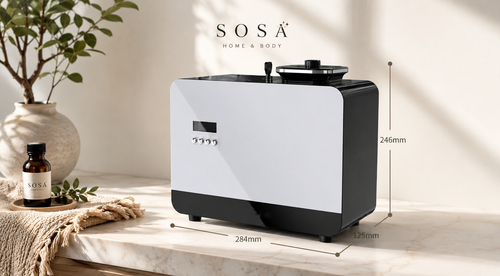
Vaayu at ₹11,999 is waterless cold-air nebulisation with no standing water tank, up to 1000 m³, 400ml for about seventy-five days, app plus 1h/4h/8h/24h timers, under 38 dB, 5 W, 0.9 kg at 165 × 80.5 × 215 mm, freestanding, wall or HVAC mounted, auto-stop, key-lock, CE, RoHS and SGS, four hotel-inspired scents in the box. It claims to hold a low background fragrance in a public area. It claims nothing else. We cannot give you a satisfaction percentage because we do not have one, our ultrasonic machines would fail our own water-tank test in a public clinical area, we do not make a room spray, and candles are out of scope in a healthcare facility because an open flame is a fire-safety matter. If a rival answers those twelve questions better than that, buy theirs.
A portion of every order supports girl-child education through Nanhi Kali.
TL;DR: write your own two-list specification first, then send twelve written questions to every vendor on the same day. Six replies disqualify: a health claim, an air-purification claim, a satisfaction percentage, a refusal to disclose the oil, no key-lock for a public area, or a water tank with no named owner. Then compare only three numbers - capital, consumable for a year at your hours, and handling events a year. Four to five for a waterless machine, about six hundred for a tank.
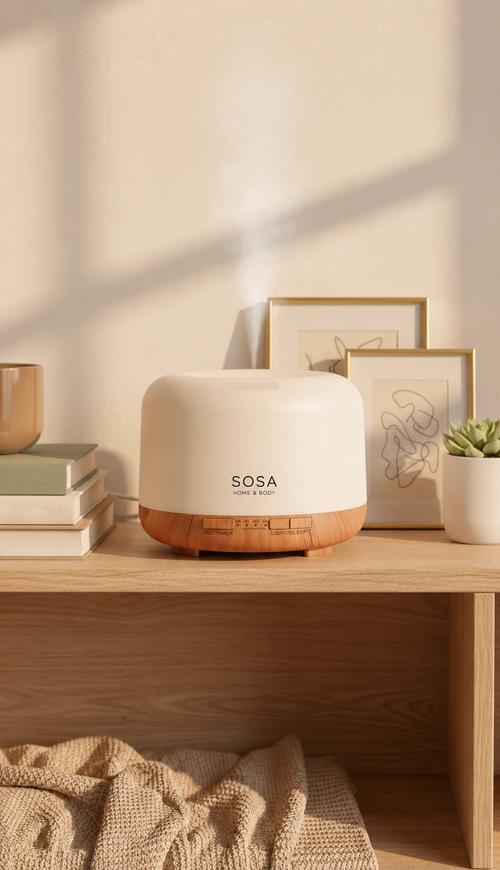
What a procurement file should contain before a quotation does
SOSA commercial scenting from ₹899
Two signed lists, a volume sum, twelve written questions and six disqualifying answers.
Everything in that file is free, it is all produced inside your own building, and it decides the purchase more completely than any negotiation on price. The rooms that stay fragrance-free are the half of the specification vendors do not expect, and a supplier who argues with them has answered the only question that matters. The
Vaayu is ₹11,999 and waterless, the
Aangan is ₹25,999 where the volume sum genuinely calls for it, and an alcohol-free
reed diffuser from ₹749 covers an administrative cabin. Housekeeping and presentation, not treatment, and
a good deal of what you are about to buy may not be needed at all.
The email, and the six replies that end the conversation
The reason this works as an email rather than as a meeting is that a scenting market used to selling on atmosphere is not used to putting its claims in a document somebody will keep. Send it to everybody on the same day, give a deadline, ask for the answers in the body of the reply rather than as an attached brochure, and say plainly that the replies will be read side by side by a procurement committee. What comes back divides into three groups within about a week. One group answers all twelve plainly, including the uncomfortable ones, and those are the vendors worth a site visit. One group answers nine and goes quiet on the oil disclosure, the exit terms or the three reference facilities, which is informative rather than fatal and is worth one follow-up. And one group replies with a deck about patient wellbeing, a number nobody can source and an offer to install a trial unit this week, and that group has disqualified itself without your committee having to form an opinion about fragrance at all. The twelve questions below are written so that you can paste them straight into an email. The six disqualifiers are written so that a junior buyer can apply them without needing to understand the product, which is the whole purpose of a disqualifier.
1
THE EMAIL
Twelve questions, sent to every vendor on the same day, to be answered in writing
Paste this into the body of one email. One: what exactly does this product claim to do? Give it to me in one sentence that I can put in a tender file. Two: does the machine hold standing water? If it does, how many handling events a year does that create at our opening hours, and who in our building do you expect to perform them? Three: what is the consumable, what does a year of it cost at our hours, and is the machine locked to your consumable or can we buy oil elsewhere? Four: will you supply an ingredient disclosure, an IFRA conformity statement and a safety data sheet for every oil you quote? Five: which rooms in our facility do you tell us to leave fragrance-free, in writing? Six: is there a key-lock or any physical means of stopping an unauthorised person changing the setting in a public hall? Seven: what is the measured sound level, and at what distance was it measured? Eight: what electrical and material certification does the unit hold, named specifically, and what is the power draw in watts? Nine: what is the coverage rating in cubic metres, and will you do the arithmetic on our drawings with every clinical room removed from the sum? Ten: what is the warranty, the spares lead time in weeks, and who attends site? Eleven: what are the exit terms - minimum period, auto-renewal, locked cartridge, rental clause, anything that makes stopping harder than starting? Twelve: name three facilities like ours where you advised the client to buy less than they had asked for, and give me a contact at one of them. Question twelve is the one that produces the most revealing silence, and it costs you nothing to ask.
2
THE SIX DISQUALIFIERS
Replies that should end a conversation before price is discussed
These are written so that a buyer who knows nothing about fragrance can apply them.
One: any clinical, therapeutic or physiological effect. Reduces anxiety, calms patients, aids recovery, improves sleep, helps children settle, reduces perceived waiting time. A supplier who will write that to a procurement committee will also print it, and the brochure ends up in your waiting hall with your name beside it. Two: any air-cleaning claim. Purifies, sanitises, disinfects, neutralises pathogens, improves air quality. A diffuser adds a small quantity of fragrance to air; it is not an air purifier and it is not an infection-control device, and a vendor who blurs that line is either confused or counting on you being. Three: a satisfaction percentage. Any sentence of the form
a stated proportion of patients reported feeling something should be met with one question - whose study, what method, how many facilities, published where - and in my experience the question is not answered. Nobody has run a controlled study in your building.
Four: a refusal to say what is in the oil. You are putting this in a building where a patient, a nurse or a pharmacist will eventually ask, and “proprietary blend” is not an answer you can give them. Five: no key-lock, for any machine going into a public area. Without one, your setting is whatever the last person to walk past decided it should be. Six: a standing water tank proposed without a named person to empty, rinse and dry it every day.
Standing water in a diffuser tank in a clinic is its own page, and the short version is that a tank is a daily task, not an occasional one.
3
SCORING THE REPLIES
One page, three columns, and the instruction that goes with it
Do not build a weighted matrix.
Three columns on one page: capital cost, consumable cost for a year at your opening hours, handling events a year. Then a fourth narrow column headed disqualified, with a yes or a no and the reason in four words. That page fits on a screen in a purchase meeting, and it has the useful property that the two columns vendors compete on are the two that matter least. Capital differs by a few thousand rupees between serious machines. Consumables differ by a little more. Handling events differ by two orders of magnitude, between four or five a year for a waterless unit on a seventy-five-day fill and something close to six hundred a year for a tank in a building open twelve hours a day, and that is the column your housekeeping lead should be allowed to veto on.
Then add one row at the bottom that is not a vendor: do nothing this quarter. The list of what to fix before spending anything on fragrance belongs in the file as a genuine option, and
the order a clinic should spend in puts fragrance fourth behind housekeeping, ventilation and seating. If a line above fragrance is outstanding, the correct procurement decision is to defer, and a committee that has that row on the page in front of it will sometimes take it.
The instruction I would give a procurement head: circulate the two-list specification and the twelve questions before you accept a single demonstration. A vendor who installs a trial unit in your lobby before you have written down which rooms stay fragrance-free has set the terms of the evaluation, and you will spend the rest of it reacting.
The twelve questions, and how to score what comes back
Send the left-hand column. Score with the right-hand one. The middle columns are there so that whoever in your team reads the replies does not need to know anything about fragrance to apply them correctly.
Print this
Twelve written questions, and the six answers that disqualify a vendor
| The question to send |
Why procurement asks it |
A compliant reply sounds like |
Disqualify if the reply is |
| 1. What exactly does this claim to do? One sentence, for our tender file ★ |
A written claim is the only claim you can hold a supplier to later, and it is the fastest filter you have |
It holds a low, consistent background fragrance in your public areas during opening hours. Housekeeping and presentation |
Any clinical, therapeutic or air-cleaning effect, or any patient-satisfaction percentage |
| 2. Does it hold standing water, and how many handling events a year at our hours? |
It is the difference between four or five tasks a year and roughly six hundred, and it lands on housekeeping |
Waterless, no reservoir, 400ml for about seventy-five days, so four to five refill events a year |
A tank proposed with no named owner, or the handling number not given. Name the owner first
|
| 3. What is the consumable, what does a year cost at our hours, is the machine locked to it? |
A low capital price attached to a locked cartridge is a rental agreement wearing a purchase order's clothes |
A named bottle, a stated annual quantity at your hours, and no lock. About ₹7,200 a year on one machine |
A cartridge only you can supply, a minimum monthly spend, or a year's cost that cannot be stated |
| 4. Ingredient disclosure, IFRA conformity and a safety data sheet for every oil quoted |
Somebody in your building will ask, and “proprietary blend” is not an answer you can give a patient |
Disclosure supplied, IFRA conformity stated, safety data sheet attached per oil, before the order |
A refusal, a delay past the order date, or disclosure offered only under a non-disclosure agreement |
| 5. Which rooms do you tell us to leave fragrance-free, in writing? |
The reply tells you whether the vendor has ever worked in a medical facility or only in a hotel lobby |
The clinical list, unprompted and longer than you expected. The fragrance-free list
|
“Anywhere you like”, a shorter list than yours, or an argument with your quality lead's page |
| 6. Key-lock, timer, measured sound level at a stated distance, certification, power draw |
These are the five details a facilities team lives with daily and the five that are cheapest to verify |
Key-lock and auto-stop, 1h/4h/8h/24h timers, under 38 dB, CE, RoHS and SGS, 5 W |
No key-lock for a public area, sound given as an adjective, or the word certified on its own |
| 7. Coverage on our drawings, warranty, spares lead time, site attendance, exit terms |
A rating is a laboratory number; your building is a volume sum with the clinical rooms taken out |
Square feet divided by 10.76, times ceiling height, clinical rooms excluded. Costed for a year
|
A machine count quoted from floor area alone, or an exit clause longer than the warranty |
| Never |
A trial unit installed in your lobby before the specification is written, or a scheme priced from a photograph |
Never. The vendor who sets the terms of the evaluation wins it regardless of the product |
— |
Shop this guide
What a compliant reply is actually quoting you
The SOSA principle
Six replies disqualify a scenting vendor and not one of them is about price. A health claim, an air-purification claim, a satisfaction percentage, a refusal to disclose the oil, no key-lock in a public area, a water tank with no named owner. Apply them to me as well, because a list you only apply to rivals is marketing.
The two columns vendors compete on are capital and consumables. The column that decides whether the thing survives in your building is handling events a year.
The commercials, and the clauses I would not sign
Once the disqualifiers have done their work you are usually comparing two or three compliant vendors, and the commercial comparison is smaller than procurement expects. Capital: one machine for a public volume under 1000 m³ at ₹11,999, or ₹25,999 where the volume sum genuinely exceeds it. Consumable: four refills a year at ₹1,799 for a 300ml bottle, which is about ₹7,200, and usually less than that because a facility running at the bottom of the intensity range uses less. Electricity: 5 W over a twelve-hour day across roughly three hundred and ten opening days is about eighteen kilowatt-hours, call it ₹150. So year one is in the region of ₹19,000 on one machine and every year after that is about ₹7,350, which is an ordinary facilities consumable line sitting next to mop heads and hand towels rather than anything that needs a business case. The full-year cost for a medical centre does this arithmetic for several facility sizes, and whether it is worth the cost at all is the page I would read before the purchase meeting rather than after it. Note what is not in the comparison: there is no installation cost on a freestanding machine, no contractor, no shutdown, and no AMC implication, which removes most of the hidden lines that make small facilities purchases annoying.
Then the clauses, because the commercial risk in this category is almost entirely contractual rather than technical. I would not sign a minimum term on a consumable. I would not sign an auto-renewal. I would not buy a machine locked to a cartridge only one supplier can fill, at any capital price, because that is a rental agreement written as a purchase order and your exit cost is the whole installation. I would not accept a maintenance contract on a machine with no moving parts to maintain. And I would not accept a key performance indicator expressed as patient satisfaction, which is the clause that does the real damage. That last one deserves a sentence of its own, because it is the mechanism by which an honest purchase becomes a dishonest one. If the purchase order says the system will improve a satisfaction score, then somebody has to report against it, and the only way to report against it is to assert an effect that fragrance does not have. The claim did not come from the vendor in that case; it came from your own procurement paperwork, and it will be quoted back at you by a patient, a regulator or a disgruntled former employee. Which budget line this belongs in is the page that keeps that from happening, and the short version is facilities, not marketing.
And here is where SOSA fails parts of its own list, because a page like this is worthless if it only disqualifies other people. Our ultrasonic machines - the Sukoon at ₹1,899, the Boond at ₹899 and the Megh at ₹3,499 - are water-based, hold standing water and add thirty to fifty millilitres of water an hour to the air. They would fail question two in any public clinical area, and I will not quote them for one. They are honest for a single administrative cabin where one person owns the daily empty, rinse and dry, and nowhere else in your building. We cannot answer a question about patient-satisfaction improvement with a number, because we do not have one and would not trust one if we did. We do not make a room spray, so if your shortlist includes a spray-based service from somebody else, that is a genuine difference rather than a weakness you can ask us to fix. Candles are out of scope in a healthcare facility and I will not soften that, because an open flame is a fire-safety and insurance matter before it is a fragrance one. An alcohol-free reed diffuser from ₹749 needs twenty-four to seventy-two hours to establish and is barely noticed past about a metre, so it is right for an admin cabin or a small lobby and wrong for a forty-seat waiting hall, whatever the price looks like next to ₹11,999. And the honest last line: if any item on the free list is still outstanding in your facility, the correct answer to all twelve questions is to buy nothing this quarter.
Twelve questions, six disqualifiers, and three numbers. If a vendor will not answer the twelve in writing, you have learned more from the refusal than you would have from the quotation.
— Sonal Sahani, SOSA
The SOSA edit
The same evaluation as five tiers, in the order a purchase committee works through them, with the one thing nobody should sign at the bottom.
The SOSA edit
Specify, ask, disqualify, then compare three numbers
| Tier |
What is in it |
When it earns its place |
Cost |
| 1. Your own specification ★ |
Two lists on one page: the zones to be scented, and the rooms that stay fragrance-free, signed by the quality lead or medical director |
Before a single brochure is read. Whoever writes the specification controls the comparison |
₹0 |
| 2. The twelve questions |
One email to every vendor on the same day, answers in the body of the reply rather than as an attached deck, with a deadline |
Before any demonstration or trial unit. The SOP that the replies have to fit
|
₹0 |
| 3. The volume sum and the trial month |
Area divided by 10.76, times ceiling height, clinical rooms removed; then the four scents in the box, tried one a week in the lobby |
Before choosing between the machines. The trial costs nothing because the scents are supplied |
₹0 |
| 4. Vaayu — the compliant answer |
Waterless, no standing water tank, up to 1000 m³, 400ml ≈ 75 days, app and 1h/4h/8h/24h timers, under 38 dB, 5 W, auto-stop, key-lock, CE, RoHS, SGS |
Four to five handling events a year, one named owner, public zones only, opening hours only |
₹11,999 |
| 5. Aangan — only on the arithmetic |
HVAC-connected or standalone, up to 3,000 m³, 800ml, metal body, programmable, under 42 dB |
Only where the public volume sum exceeds 1000 m³. Which of the two your sum points to
|
₹25,999 |
| Not to be signed at any price |
A locked cartridge, an auto-renewal, a minimum consumable term, a satisfaction-score KPI, or a trial unit installed before the specification is written |
Never. A satisfaction KPI forces your own paperwork to assert an effect fragrance does not have |
— |
Honest notes for buyers: on this page specifically, the six disqualifying answers are applied to SOSA as well as to everyone else, which is why this page states plainly that our ultrasonic machines hold standing water and should not be quoted for a public clinical area, that we hold no patient-satisfaction figure of any kind, that we do not make a room spray, and that candles are out of scope in a healthcare facility. In general, fragrance in a medical facility is housekeeping and presentation, never treatment. Nothing here claims that a fragrance reduces anxiety, aids recovery, improves sleep, cleans or disinfects air, or has any clinical effect whatsoever, because it does not and a diffuser is not an air purifier. Scenting belongs to the entrance, reception, shared waiting areas, inter-departmental corridors and administrative rooms. Consultation and examination rooms, treatment and procedure rooms, day-care surgery, dressing rooms, blood- and sample-collection rooms, laboratories, pharmacy dispensing, sterile stores, imaging rooms, oncology day-care and paediatric clinical areas should be left fragrance-free. A persistent smell is information about a dry drain trap, a bin, a soiled-linen route or an air-conditioning drain pan: find it and fix it rather than covering it. On the machines: the
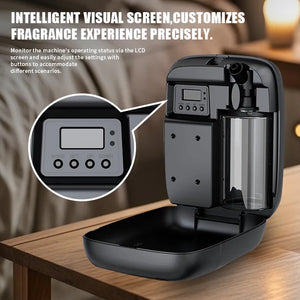
Vaayu at ₹11,999 is waterless cold-air nebulisation with no standing water tank, covering up to 1000m³ or roughly 2,000–3,000 sq ft, with a 400ml tank lasting about 75 days, app control, 1h/4h/8h/24h timers, under-38dB running, auto-stop and a key-lock for public areas. The
Aangan at ₹25,999 covers up to 3,000m³ and connects to HVAC for a whole floor or an atrium. The ultrasonic
Sukoon,
Boond and
Megh are water-based, hold standing water and add 30–50 ml of water an hour to the air, which suits a single administrative cabin with a named person emptying and drying the tank daily and is unsuitable for public clinical property. An alcohol-free
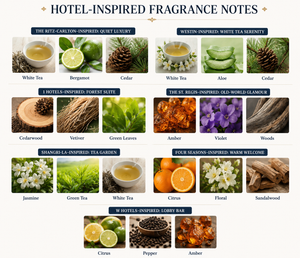
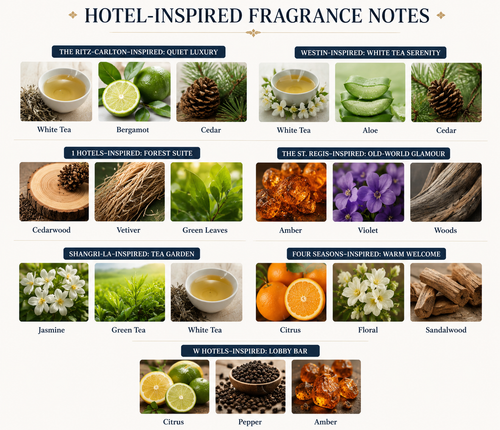
reed diffuser needs 24–72 hours to establish and suits a small lobby rather than a large waiting hall. Candles are not appropriate in a healthcare facility because an open flame is a fire-safety matter. SOSA does not make a room spray. The Hotel Collection scents are SOSA's own interpretations inspired by the world's finest hotels; SOSA is an independent Indian fragrance house, not affiliated with or endorsed by any hotel brand. A portion of every order supports girl-child education through Nanhi Kali.
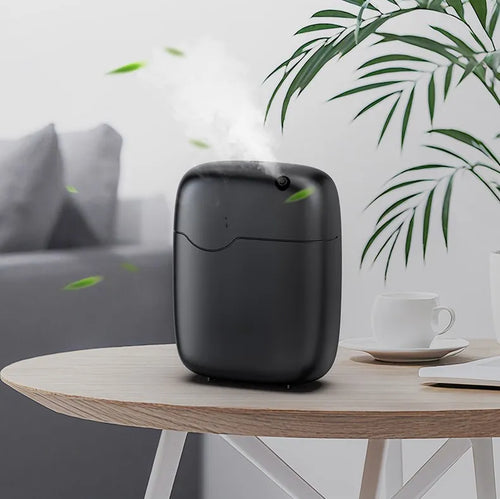
The reply, written out as a specification
SOSA Vaayu ₹11,999
Waterless cold-air nebulisation with no standing water tank, coverage up to 1000 m³ or roughly 2,000 to 3,000 sq ft, a 400ml fill lasting about seventy-five days so four to five refill events a year, Bluetooth app plus 1h/4h/8h/24h timers, under 38 dB, 5 W, 0.9 kg at 165 × 80.5 × 215 mm, freestanding or wall or HVAC mounted, auto-stop, key-lock, CE, RoHS and SGS certified, four hotel-inspired scents in the box. What it claims to do is hold a low background fragrance in a public area during opening hours. It claims nothing else, and that sentence is the one to put in your tender file.
A note from Sonal
I wrote the twelve questions for somebody else's tender, which is why they read the way they do. A procurement lead at a four-branch group in Chennai sent me a request for quotation with a line in it that I could not answer: the system shall demonstrably improve patient comfort. I told him I could not sign that, that nobody honest could, and that I would rather lose the order than have that sentence in a contract with my company's name on it. He asked me what he should have written instead, and I spent an evening writing down the questions I would want asked if I were sitting on his side of the table. He used them. Two of the four vendors on his list did not reply at all, one replied with a wellbeing deck and a percentage, and we and one other supplier answered all twelve. I do not know whether that made us look good or simply made us look like the only people who had read the email.
What I have noticed since is that the questions are more useful to the buyer than to me, which is the right way round. Question two, about standing water and handling events, has lost me every ultrasonic sale into a public clinical area that I might otherwise have made, and I think that is correct. Question twelve, about three facilities where you told a client to buy less, is the one I am most pleased to be asked, because the page that tells clinics to buy nothing yet has cost this company a number of orders I can name. And question three, about whether the machine is locked to the consumable, is the one I would press hardest on if I were buying rather than selling, because a low capital price attached to a cartridge nobody else can fill is the only structure in this market that can genuinely trap a facility. Ask it of everybody, including us, and ask for the answer in writing.
Everything is made and supported from Pune, and a part of every order funds girl-child education through Nanhi Kali. You get a space that smells like somewhere looked after; a girl gets a classroom. That equation has always felt right to me.
Frequently asked questions
How should a medical centre's procurement team evaluate a scenting system?
Write your own specification first - one page listing the zones to be scented and the rooms that stay fragrance-free, signed by the quality lead - then send the same twelve written questions to every vendor on the same day and read the replies side by side. Score on three numbers only: capital cost, consumable cost for a year at your own opening hours, and handling events a year. Apply the six disqualifying answers before you look at price at all.
Which vendor answers should disqualify a scenting supplier outright?
Six of them. Any clinical or therapeutic effect, such as reducing anxiety or aiding recovery. Any air-purification, sanitising or disinfection claim, because a diffuser is not an air purifier. Any patient-satisfaction percentage, since no controlled study has been run in your building. A refusal to disclose what is in the oil. No key-lock on a machine destined for a public waiting area. And a standing water tank proposed without naming the person who will empty, rinse and dry it daily.
What is a handling event, and why does it matter more than price?
It is one occasion on which a member of staff has to physically attend to the machine. A waterless unit on a 400ml fill lasting about seventy-five days needs four to five refill events a year. A water tank in a facility open twelve hours a day needs emptying, rinsing, drying and refilling, which is two events a day across roughly three hundred and ten opening days, or in the region of six hundred a year. Capital differs by a few thousand rupees between serious machines; handling events differ by two orders of magnitude.
Should procurement accept a patient-satisfaction target in the purchase order?
No, and this is the clause I would push back on hardest. If the order says the system will improve a satisfaction score, somebody has to report against it, and the only way to do that is to assert an effect that fragrance does not have. The claim then originates in your own paperwork rather than in a supplier's brochure. Fragrance is housekeeping and presentation, it belongs in the facilities line, and the deliverable is a stated level in stated zones during stated hours.
What does SOSA answer to its own twelve questions?
The Vaayu at Rs 11,999 is waterless with no standing water tank, up to 1000 cubic metres, a 400ml fill lasting about seventy-five days, app and 1h/4h/8h/24h timers, under 38 dB, 5 W, auto-stop, key-lock, CE, RoHS and SGS certified, four scents included. It claims only to hold a low background fragrance in public areas during opening hours. We hold no satisfaction figure, our ultrasonic machines would fail our own water-tank test in a public clinical area, we do not make a room spray, and candles are out of scope in a healthcare facility.
Specify, then ask, then compare
Send the twelve questions before you take a demonstration — and apply the six disqualifiers to every vendor, this one included
The Vaayu is ₹11,999: waterless cold-air nebulisation with no standing water tank, up to 1000 m³ or roughly 2,000–3,000 sq ft, a 400ml tank lasting about seventy-five days for four refills a year, Bluetooth app control with 1h/4h/8h/24h timers, under 38 dB, 5 W, auto-stop and a key-lock for public areas, 0.9 kg at 165 × 80.5 × 215 mm, CE, RoHS and SGS certified, supplied with four hotel-inspired fragrances. The Aangan is ₹25,999 for up to 3,000 m³, HVAC-connected or standalone, 800ml, metal body, programmable, under 42 dB. Free shipping above ₹499, and a portion of every order supports girl-child education through Nanhi Kali.
See the Vaayu · ₹11,999 All commercial scenting
Continue the read
More from SOSA
Editorial standards & sources
Product facts used in this guide. SOSA Vaayu Rs 11,999: waterless cold-air nebulising diffuser, no water reservoir, coverage up to 1000m3 (approximately 2,000-3,000 sq ft), 400ml refillable tank lasting up to about 75 days per fill, Bluetooth app plus onboard control, 1h/4h/8h/24h timer scheduling, adjustable intensity, under 38 dB, DC 12V/1A at 5W, 165 x 80.5 x 215 mm and 0.9 kg, freestanding or wall or HVAC mounted, auto-stop and key-lock, CE, RoHS and SGS certified, supplied with four hotel-inspired fragrances. SOSA Aangan Rs 25,999: HVAC-connected or standalone commercial nebulising diffuser, coverage up to 3,000m3 (roughly 8,000-10,000 sq ft), 800ml reservoir, metal body, programmable schedules, under 42 dB. Ultrasonic machines are water-based, hold standing water and consume 30-50 ml of water an hour: Sukoon Rs 1,899 (500ml, 270-320 sq ft, 16-18 hours on low, three 15ml Hotel Collection scents included), Boond Rs 899 (300ml), Megh Rs 3,499 (6 litres). Hotel Collection water-based fragrance 15ml Rs 299, 100ml Rs 999, 300ml Rs 1,799. Alcohol-free reed diffusers from Rs 749, requiring 24-72 hours to reach their working level. Free shipping above Rs 499. Coverage arithmetic: cubic metres equal floor area in square feet divided by 10.76 and multiplied by ceiling height in metres, counting only the volumes that are actually scented. This guide makes no medical, therapeutic or clinical claim of any kind for fragrance: a diffuser does not purify, disinfect or clean air, and does not treat, calm or affect any patient or condition. Fragrance is housekeeping and presentation. Clinical areas should be left fragrance-free, and a persistent odour should be traced to its source and corrected rather than covered. SOSA is not affiliated with or endorsed by any hotel brand. Prices subject to change - see the live product pages.

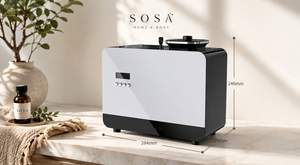
 Aangan · large centres₹25,999Shop →
 Refills · the annual line₹1,799Shop →