


The six things the zoning depends on: connected volume taken from the section rather than the plan, ceiling height where it is non-standard, which internal doors are genuinely shut during opening hours, whether the property runs on one air handling unit or several independent systems, how many hours each space is actually occupied, and the written list of spaces that will receive nothing at all.
The deliberate silences at this size: the dining rooms, private dining and bar counters; the gym floor; spa treatment rooms; the boardroom and private meeting rooms; and a heritage library or card room. On a 20,000 sq ft plan that is frequently five or six thousand square feet of the building receiving no fragrance by design, and saying so early is what makes the rest of the scheme survive a house committee.
What is specifiable: Vaayu ₹11,999 — up to 1000 m³, 400ml sealed tank lasting up to about 90+ days, under 38 dB, DC 12V / 1A at 5W, freestanding, wall-mounted or into an HVAC return, auto-stop and key-lock, CE, RoHS and SGS. Aangan ₹25,999 — up to 3,000 m³ on HVAC, 800ml reservoir, under 42 dB, DC 12V at 14W, metal body 3.9 kg at 284 × 125 × 246 mm, programmable work and pause cycles and daily schedules, one-year warranty. Meenar ₹38,500 is the larger-property option, specified on enquiry.
The honest gap: I will not publish a machine count for 20,000 sq ft, because any count I gave you without seeing the drawings would be a guess dressed as a specification. Send the plan, the section and the plant schedule to the contact page and the number becomes a real number. No purchasable refill oil is listed for the waterless commercial machines either — that fragrance is specified and quoted per property.
2. Draw the zones from the section, not the plan. Coverage is published in volume, in cubic metres, and a floor plan tells you nothing about volume. A 20,000 sq ft club very often contains a double-height entrance hall, a galleried stair, a banquet room with a raised ceiling and a lounge with an exposed soffit — and each of those consumes coverage that the square-foot figure hides completely. Take the ceiling heights off the section drawing, multiply them properly, and you will usually find the building holds appreciably more air than the area suggested. That is the number a specification has to work with.
3. A zone is a boundary, not an intention. This is the part that goes wrong most often. A closed door is a genuine boundary for fragrance; an open plan is a single volume however irregular its shape; and two small rooms with a door between them are two zones even if they are on the same plan sheet with the same floor finish. So walk the property at six in the evening on a busy day and note which internal doors are actually shut. Not which doors exist — which doors are shut. A pair of beautiful timber doors that are wedged open every evening for service is not a boundary, it is a decoration, and any zoning scheme drawn on the assumption that they are closed will behave in ways nobody predicted.
4. Write the unscented list before you write anything else. On a property of this size the list is long, and it should be. The dining rooms, private dining and the bar counter stay neutral, because ambient fragrance competes with the kitchen, flattens wine and is the one intervention a chef and a sommelier will both object to in the same meeting. The gym floor needs air change rather than perfume. Spa treatment rooms already carry the therapist’s own oils. The boardroom and private meeting rooms are small closed volumes holding people who are captive for two hours and did not choose the smell. And a heritage library or card room whose paper-and-timber character is genuinely part of what the membership fee buys is protected, not overwritten. Write those spaces down, take them to the committee, and get them agreed as exclusions before any machine is discussed.
5. Then, and only then, ask how many machines — of somebody who has seen the drawings. One identity, several intensities, descending from the threshold inward: the arrival sequence may be plainly perceptible, the circulation spine carries it lightly and continuously, and the rooms members sit in for hours sit below the level anyone would think to name. Once the zones are drawn and the intensities assigned, the count is a short conversation about connected volume and mounting positions. Send the plan, the section and the plant schedule to the contact page, and I will give you a count for your building rather than a formula for somebody else’s. Everything is alcohol-free, phthalate-free, paraben-free and IFRA-compliant, composed in Pune, and a portion of every order supports girl-child education through Nanhi Kali.

The zoning method, walked with a drawing on the table
What follows is the sequence I would go through with a general manager and, if there is one on the project, the services engineer. It takes an afternoon and it costs nothing, and it is the difference between a scheme that reads as one building and a scheme that reads as six suppliers. The output of this exercise is a zone drawing with intensities written on it. The machine count is the last line, and it is the easiest line, because by then every question that would have made it a guess has been answered.
 Vaayu₹11,999Coverage is published in cubic metres and not in square feet, and the reason is exactly the situation a 20,000 sq ft club presents. Walk the section and write the ceiling height beside every space: the entrance hall at double height, the gallery that opens over the lobby, the banquet room with its raised ceiling, the lounge under an exposed soffit, and then the ordinary heights in the corridors and the meeting rooms. Multiply each properly. Two spaces of identical area on the plan can differ by a factor of two in the volume they hold, and the taller one will read as under-fragranced at a setting that is correct for the other. This is also where a 20,000 sq ft club discovers that its arrival sequence alone is a zone in its own right — a generous double-height hall with a mezzanine over it can consume most of a unit’s rating on its own, and should be specified as such rather than lumped in with the corridor behind it.
Aangan₹25,999A closed door is a real boundary for fragrance, and an open plan is a single volume however irregular its shape. That sentence does almost all the work in a large club. Two forty-square-metre meeting rooms with a door each are two zones; a lounge that flows into a bar area through a wide cased opening is one zone, and setting two different machines into it produces a seam that members read as inconsistency. So take a highlighter to the plan and mark the doors that are shut at seven in the evening on a full Friday. Service doors that are wedged open for the whole shift are not boundaries. Sliding partitions in a banquet suite are boundaries some days and not others, which means the banquet suite has to be specified for both states. The test is behavioural, not architectural, and it is worth doing twice — once on a quiet weekday morning and once on a busy evening, because a 20,000 sq ft club is genuinely two different buildings at those two times.
SpecifiedPer propertyAsk for the plant schedule, not a verbal answer. A 20,000 sq ft club built as one project with a central plant room and real ductwork is a candidate for Aangan on the air handling, because the machine introduces its mist into air the building already moves and the ductwork does the distribution for free. A 20,000 sq ft club that grew over thirty years into a collection of split units, cassette fan coils and a couple of ducted zones has nothing central for a machine to distribute through, and for that property the scheme reverts to waterless zone units placed volume by volume. Both answers are legitimate; they produce very different drawings. Note also that air conditioning cuts both ways: it distributes fragrance evenly through a volume, and it also removes it faster than a still room would, so a heavily ventilated zone needs its fragrance replaced continuously while a sealed one accumulates it. The same machine at the same setting behaves oppositely in those two rooms, which is why the schedule matters as much as the intensity.
Vaayu₹11,999Coverage is published in cubic metres and not in square feet, and the reason is exactly the situation a 20,000 sq ft club presents. Walk the section and write the ceiling height beside every space: the entrance hall at double height, the gallery that opens over the lobby, the banquet room with its raised ceiling, the lounge under an exposed soffit, and then the ordinary heights in the corridors and the meeting rooms. Multiply each properly. Two spaces of identical area on the plan can differ by a factor of two in the volume they hold, and the taller one will read as under-fragranced at a setting that is correct for the other. This is also where a 20,000 sq ft club discovers that its arrival sequence alone is a zone in its own right — a generous double-height hall with a mezzanine over it can consume most of a unit’s rating on its own, and should be specified as such rather than lumped in with the corridor behind it.
Aangan₹25,999A closed door is a real boundary for fragrance, and an open plan is a single volume however irregular its shape. That sentence does almost all the work in a large club. Two forty-square-metre meeting rooms with a door each are two zones; a lounge that flows into a bar area through a wide cased opening is one zone, and setting two different machines into it produces a seam that members read as inconsistency. So take a highlighter to the plan and mark the doors that are shut at seven in the evening on a full Friday. Service doors that are wedged open for the whole shift are not boundaries. Sliding partitions in a banquet suite are boundaries some days and not others, which means the banquet suite has to be specified for both states. The test is behavioural, not architectural, and it is worth doing twice — once on a quiet weekday morning and once on a busy evening, because a 20,000 sq ft club is genuinely two different buildings at those two times.
SpecifiedPer propertyAsk for the plant schedule, not a verbal answer. A 20,000 sq ft club built as one project with a central plant room and real ductwork is a candidate for Aangan on the air handling, because the machine introduces its mist into air the building already moves and the ductwork does the distribution for free. A 20,000 sq ft club that grew over thirty years into a collection of split units, cassette fan coils and a couple of ducted zones has nothing central for a machine to distribute through, and for that property the scheme reverts to waterless zone units placed volume by volume. Both answers are legitimate; they produce very different drawings. Note also that air conditioning cuts both ways: it distributes fragrance evenly through a volume, and it also removes it faster than a still room would, so a heavily ventilated zone needs its fragrance replaced continuously while a sealed one accumulates it. The same machine at the same setting behaves oppositely in those two rooms, which is why the schedule matters as much as the intensity.
The deliberate silences, named on the plan
A 20,000 sq ft club has more room types than a small hotel, and the temptation that arrives with the budget is to scent all of them. I would ask you not to, and I would ask you to write the refusals onto the zone drawing as a hatched area with the word unscented across it, so that nobody rediscovers the argument in eighteen months. Naming the exclusions is what makes the rest of the scheme believable — to the chef, to the sommelier, to the wellness manager and to the long-standing member who will notice the library first.
The dining rooms, private dining and the bar counter stay neutral, without exception. A gourmand or edible note near food service does not read as luxury; it reads as competition, and the kitchen wins every time. The gym floor needs air change rather than perfume; fragrance laid over exertion is a mixture rather than a correction and it smells like one, so put the light setting in the wellness reception and the changing-room lobby instead. Spa treatment rooms carry therapy oils chosen by the therapist for the treatment, and a house fragrance arriving under the door is an interference. Boardrooms and private meeting rooms are small closed volumes holding people for two hours who did not choose the smell — default to unscented and let the corridor outside carry the identity, which it does perfectly well, because the nose reports change rather than constancy and the walk in from a lightly scented corridor registers far more clearly than a scented room ever would.
And in an older club, the library, the reading room or the card room whose smell of paper, timber and decades of use is the character is an asset to protect rather than a gap to fill. Scent the circulation around it and leave the room alone. On a typical 20,000 sq ft plan these exclusions together frequently account for five or six thousand square feet — a quarter to a third of the property receiving nothing at all, by design and in writing. That is not an under-specification. It is the specification.
A 20,000 sq ft club divided into zones
This is the shape of the drawing, organised the way I would organise it: by how long a member stays in the volume, because that single variable decides more than the room’s function does. The areas are indicative of a property of this size rather than prescriptive, and the last three rows are the silences. Note that the “what serves it” column describes a kind of provision and not a quantity, because the quantity is the one thing this page will not invent.
| Zone | What makes it a zone | Dwell | Intensity | What serves it |
|---|---|---|---|---|
| Arrival: porch, vestibule, double-height hall ★ | A pressure break at the outer doors; often its own volume on the section | Seconds, fresh nose | Clearly perceptible — the signal | A waterless zone unit in the airflow path, or an HVAC-return mount |
| Reception and desk approach | Usually continuous with the hall — one volume, not two | Half a minute, standing | One step below arrival | The arrival provision, positioned away from the desk |
| Circulation spine: corridors, lift lobbies, stair halls | Connected to everything; the one zone that touches every other | Passing through, repeatedly | Light and continuous | Often the best value on the whole drawing |
| Members’ lounge and bar lounge | One volume if the cased opening between them is open | Two to four hours, seated | Below the level anyone would name | A zone unit set low, or Aangan on the air system |
| Business floor, coworking, writing room | Open plan — a single volume however partitioned by furniture | Half a day, seated | Lounge rules, not lobby rules | Shared with the circulation spine where the air is shared |
| Banquet pre-function and foyer | Boundary depends on whether the partitions are closed that day | Event-driven | Pre-event only, if at all | No permanent ambient; the room is food-adjacent |
| Wellness reception, changing-room lobby | Doors to the gym floor and treatment rooms must actually shut | Minutes, in transit | Very light | A zone unit shared with the corridor outside |
| Cloakrooms and washrooms | Small closed volumes, individually doored | A few minutes | Light | Reeds are genuinely right at this scale — six fibre reeds, a couple of metres |
| Dining rooms, private dining, bar counter | Excluded by decision, not by geometry | An hour or more, eating | Unscented | Nothing. The kitchen is the fragrance |
| Gym floor, spa treatment rooms | Excluded by decision | Thirty to ninety minutes | Unscented | Air change on the gym floor; the therapist’s own oils in treatment |
| Boardroom, meeting rooms, heritage library | Excluded by decision — captive volumes and protected character | One to three hours | Unscented by default | The corridor outside carries the identity instead |
Zone · Vaayu₹11,999See it → Air system · Aangan₹25,999See it → Larger property · Meenar₹38,500See it →
What is specifiable, and why the machine count is not
There are three mechanisms and they are different physical systems rather than grades of the same thing. A reed diffuser is a passive capillary device: oil climbs six fibre reeds and evaporates, with no energy used and no air moved, which makes it a fragrant zone of roughly a couple of metres rather than a fragranced room. On a 20,000 sq ft plan that is exactly the right device for a cloakroom, a console in a secretary’s office or a small lobby off the circulation spine, and exactly the wrong device for a members’ lounge — not because it is underperforming but because two passive sources in one large room do not make a plateau, they make two hills with a valley between them, and the valley is where the armchairs are. An ultrasonic machine — Sukoon ₹1,899 at 270–320 sq ft, Boond ₹899 at up to about 150 sq ft — dilutes oil in water and throws a wet mist, so what reaches the room is mostly water. It covers a real small room, but it adds humidity and can leave a fine white mineral deposit on dark surfaces, and in an Indian club humidity is generally the adversary rather than the tool.
Waterless cold-air nebulising is the commercial answer at this size. Pressurised air shatters undiluted oil into a dry nano-mist that the room’s own airflow carries; no water, no dilution, no added humidity, no residue. Undiluted oil delivers far more fragrance per unit of mist than the same oil diluted in water, which is the whole reason commercial scenting went waterless in the first place. Vaayu at ₹11,999 is the zone machine: up to 1000 m³, a 400ml sealed refillable tank lasting up to about 90+ days depending on intensity and hours, under 38 dB, DC 12V / 1A at 5W, freestanding or wall-mounted or into an HVAC return, a Bluetooth app plus onboard buttons, 1h / 4h / 8h / 24h run windows, day selection, adjustable intensity, auto-stop, key-lock, CE, RoHS and SGS. Aangan at ₹25,999 is the air-system machine: up to 3,000 m³ when connected to the HVAC or AHU, an 800ml reservoir, under 42 dB, DC 12V at 14W, a metal body of 3.9 kg measuring 284 × 125 × 246 mm, black or white, one-year warranty, imported, with an intelligent PCB carrying programmable work and pause cycles, daily schedules and an intensity setting. It has no app and no Bluetooth; that belongs to Vaayu. Meenar at ₹38,500 is the larger-property option and is specified on enquiry.
What I will not give you is a machine count as a formula, and I want to be precise about why rather than vague about it. The count for a 20,000 sq ft club depends on six things, all of which are properties of your building and none of which are properties of its area: the connected volume taken from the section; the ceiling heights where they are non-standard; which internal doors are genuinely shut during opening hours; whether one air handling unit serves the zones you want scented or the property is a collection of independent systems; how many hours each space is actually occupied; and the written list of spaces receiving nothing. Change any one of those and the count changes, sometimes by several units in either direction. A supplier who quotes you a number of machines per square foot over the telephone is selling rather than specifying, and the way you can tell is that they did not ask you about the section drawing. Send the plan, the section and the plant schedule to the contact page and you will get a count for your building, which is worth considerably more than a rule of thumb for somebody else’s.
The scheme in buying order — and the two gaps
If a 20,000 sq ft club asked me to write the order of work, this is the sequence, and the first three lines involve no purchase at all. There are also two things this range does not contain which come up in nearly every first conversation about a property of this size, so they go in the table rather than in a footnote where a committee would find them later.
| Step | What it is | Why it comes here in the order | Cost |
|---|---|---|---|
| 1. Fix the building first ★ | Moisture, air change, drain traps, carpet drying, a fresh-air purge before opening | Because fragrance laid over a stale building produces a mixture that reads as concealment, and members say so by name | No purchase |
| 2. Draw the zones from the section | Volumes in cubic metres, ceiling heights marked, the doors that are actually shut highlighted | Because every later decision is made against this drawing, and a plan without heights is not enough | No purchase |
| 3. Agree the unscented list at committee | Dining and bar counter, gym floor, spa treatment rooms, boardroom and meeting rooms, heritage library | Because it is frequently a quarter of the property and it is far easier to agree before a machine is bought than after | No purchase |
| 4. Vaayu at the arrival zone | Up to 1000 m³, in the airflow path or an HVAC return, DC 12V point on the drawing, key-locked after setting | The threshold carries the whole signal, so it is the first machine on any plan of any size | ₹11,999 |
| 5. Aangan where one air system genuinely serves a zone group | Up to 3,000 m³ on HVAC, 800ml, programmable cycles and daily schedules, under 42 dB | Only worth it where the ductwork actually reaches the spaces you want scented — confirm from the plant schedule | ₹25,999 |
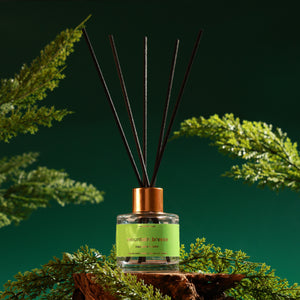
| 6. Reeds where a two-metre zone is the whole brief | Mountain Breeze and the rest, 50ml or 130ml, six fibre reeds, refillable glass | Cloakrooms, consoles, a secretary’s office — small closed volumes where a passive device is correct rather than second-best | ₹749–₹1,349 |
| No published count, and no listed commercial refill: the honest gaps | There is no published machines-per-square-foot figure for a property of this size, and no purchasable refill oil is listed for the waterless commercial machines — that fragrance is specified and quoted per property | Said plainly, because a committee will test both, and because a count drawn from your section is worth more than a formula while quoted fragrance is the norm in commercial scenting rather than an evasion | Quoted |
Versailles
The largest club I have walked was a little over twenty thousand square feet, and the general manager began our meeting by asking me how many machines it needed. I asked him for the section drawing and he produced a floor plan, which is entirely normal — almost nobody has the section to hand, because nobody has needed it before. We spent the next two hours walking with a tape measure and a highlighter instead, and by the end of it the question he had opened with had dissolved, not because I refused to answer it but because he no longer wanted a single number. He wanted seven zones, three of them silent, and a setting written down for each.
What surprised him was where the volume was. The entrance hall was double height with a gallery over it, and by itself it held more air than the entire business floor behind it. Two rooms of almost identical area on his plan differed by half again in cubic metres, and the taller of the two was the one the house committee had been describing as “never quite smelling of anything”. Nothing was wrong with the fragrance in that room. There was simply a great deal more room than the plan had admitted to.
The other thing that afternoon taught him concerned doors. He had drawn his zones on the assumption that the lounge and the bar were separate, because there is a pair of doors between them on the drawing. Those doors are hooked back every evening from six o’clock, which means that for the busiest four hours of the club’s day the lounge and the bar are one volume of air, and any scheme that treats them as two will behave unpredictably precisely when the members are there. So walk your building during service, not during a site visit. And whoever ends up setting the intensity will be a member of staff who has been in the building since seven in the morning and stopped registering the fragrance long before the first member arrived — so set it once, turn the key-lock, write the setting on the zone drawing, and judge it only by walking in from the car park with somebody who has not been inside all day. Everything we make is composed in Pune, and a part of every order funds a girl’s classroom through Nanhi Kali.
Frequently asked questions
- Scenting 2,000 sq ft — one zone, honestly, and a budget that stays largely unspent.
- The 5,000 sq ft fork and the 10,000 sq ft case — zones or one air system, and the HVAC precondition stated plainly.
- The multi-floor club — lift shafts and open stairs behave as chimneys, and vertical airflow governs everything.
- How many machines a large club needs — the six inputs, and why the honest answer is a method rather than a number.
- One large machine or several zones — the closed-door boundary decides it, not the budget.
- Double-height lobbies and central AC, corridors, lifts and stairs — the volume a plan hides, and where air actually goes.
- When reeds stop being enough — the crossover, in connected volume and dwell time.
- Brand: the SOSA founder story.
SOSA commercial scenting — facts verified August 2026: Vaayu ₹11,999, waterless cold-air nebulising, coverage up to 1000 m³ ≈ 2,000–3,000 sq ft, 400ml refillable sealed tank lasting up to about 90+ days depending on intensity and hours, Bluetooth app plus onboard buttons, run windows of 1h / 4h / 8h / 24h, day selection, adjustable intensity, auto-stop and key-lock, under 38 dB, freestanding, wall-mounted or HVAC-return mounting, DC 12V / 1A at 5W, CE, RoHS and SGS, black and white. Aangan ₹25,999, HVAC or AHU connection or standalone wall-mount or lay-flat, coverage up to 3,000 m³ ≈ 8,000–10,000 sq ft when connected, 800ml reservoir, under 42 dB, DC 12V at 14W, intelligent PCB with programmable work and pause cycles and daily schedules, metal body 3.9 kg at 284 × 125 × 246 mm, black or white, one-year warranty, imported; it has no app and no Bluetooth, and no certifications are published for it. Meenar ₹38,500 is the larger-property option and is specified on enquiry; no coverage figure is published for it here. Ultrasonic machines: Sukoon ₹1,899 at 270–320 sq ft, Boond ₹899 at up to about 150 sq ft, Megh ₹3,499 with a six-litre tank and around 100 hours of runtime but only about 215 sq ft of coverage. Reed diffusers ₹749–₹849 for 50ml lasting 6–8 weeks and ₹1,249–₹1,349 for 130ml lasting 14–18 weeks, six fibre reeds, alcohol-free, phthalate-free, paraben-free, IFRA-compliant, 0 ppm formaldehyde, heat-stable CCT carrier, refillable glass bottle, tested at 45°C and 85% RH, composed in Pune. The Hotel Collection fragrance oils are water-based and ultrasonic-only at 15ml ₹299, 100ml ₹999 and 300ml ₹1,799; they are not for reed diffusers and not for the waterless commercial machines. No purchasable refill oil is listed for the waterless commercial machines — that fragrance is specified and quoted per property. SOSA publishes no leather fragrance in any format and no tobacco or smoky fragrance for any diffuser. SOSA sells no air purifier, no dehumidifier and no room spray for interiors, and makes no health, air-quality, VOC or mould claim. No dealer programme, reseller margin, trade price, territory or service contract is published. Free shipping above ₹499. A portion of every order supports girl-child education through Nanhi Kali. SOSA is an independent Indian fragrance house; the Hotel Collection scents are SOSA’s own interpretations inspired by the world’s finest hotels, and SOSA is not affiliated with or endorsed by any hotel brand. Prices subject to change — see the live product pages.