


Daily is a real trade: louder room, materially shorter bottle. Do it before guests rather than as a routine.
What it cannot do: rescue clogged reeds. At two or three months fit the fresh six from your next bottle — replace reeds, never liquid.
2. Once at the very beginning, then leave it alone. Flip the set a few hours after you first stand the reeds in the bottle, so both ends load. Then wait the full forty-eight hours before judging anything — the reeds are still saturating along their length.
3. Flip on purpose before people arrive. This is the one moment a reed comes closest to having a switch. Flip in the morning for an evening — the lift is real, it peaks within a few hours and it fades over the following day or two.
4. Do not flip daily unless you accept the bill. Daily flipping keeps the most saturated fibre permanently exposed, so evaporation runs high continuously. The room is louder and the bottle is materially shorter. That is a trade to make deliberately, not a maintenance routine.
5. Never flip to fix a clogged set. If throw has been declining for weeks and a flip no longer lifts it, the fibre has loaded up with heavier molecules and both ends are equally tired. Fit the fresh six that came with your last bottle instead.
Made in India, composed by an ISIPCA Versailles-trained perfumer — and a portion of every order supports girl-child education through Nanhi Kali.
What a flip actually does inside the reed
A reed that has been standing in a bottle for a few days is not uniformly loaded. The submerged end is fully saturated; the exposed end has been evaporating continuously and has given up much of its lightest, most volatile fraction; and there is a gradient in between. Inverting it puts the heavily loaded end into open air, where it immediately begins evaporating at a higher rate — that is the lift you notice, and it is entirely real. Meanwhile the tired end goes back into the liquid and begins drawing oil up again. Nothing has been created; a well-stocked surface has simply been exchanged for a depleted one. Within a day or two the newly exposed end has itself begun to deplete, and the room settles back towards its previous level.
That cycle is why three to five days is the sensible interval, and why daily flipping produces diminishing returns as well as a bill. Flip too often and the end you are inverting has not been down there long enough to reload properly, so you get a smaller lift each time while running the whole set at a permanently high evaporation rate. The quoted lifespans — 6 to 8 weeks for a 50ml, 14 to 18 for a 130ml on six reeds — assume a sensible rhythm rather than a daily one. Understood properly, flipping is not a strength control at all: it is a timing control. It lets you decide which evening gets the best of a bottle, which is a genuinely useful thing and a different thing from making the bottle stronger.
The schedule, the cost, and how to do it without ruining a sideboard
Flipping schedules compared
Every one of these is a legitimate choice — provided you make it knowingly. The starred row is what the quoted lifespans assume, and what I would suggest for most rooms.
| How often you flip | What you get | What it costs |
|---|---|---|
| Never | A slow decline as the exposed ends deplete and never recover | Nothing, but you are wasting a free lever |
| Once a week | A modest lift each time; a quiet, even room | Very little — a good rhythm for a bedroom on three or four reeds |
| Every 3–5 days ★ | A genuine refresh, with time for the submerged end to reload fully | Built into the quoted 6–8 and 14–18 weeks |
| Every other day | A consistently louder room | A shorter bottle, and each flip delivers less than the last |
| Daily | The loudest a reed gets without adding reeds | Materially fewer weeks; diminishing lift per flip |
| Once, before guests | The closest a reed comes to a switch — peaks in a few hours | Negligible, and the best use of flipping there is |
| If flipping stops working altogether: the reeds have clogged, which takes two or three months. Fit the fresh six from your next bottle and use a 300ml refill at ₹2,399 for the glass. | ||
The reed range · five scentsFrom ₹749Shop → 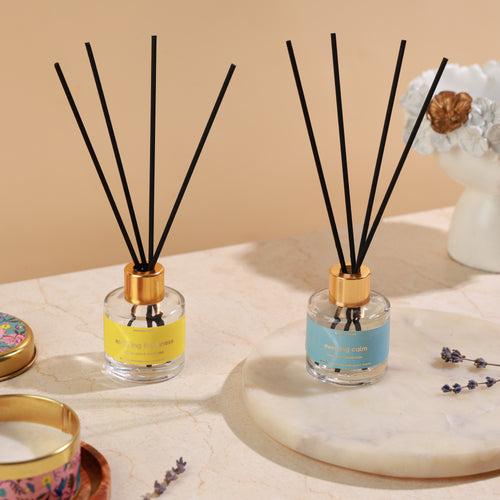 Day & Night duo · two rooms₹1,498Shop →
 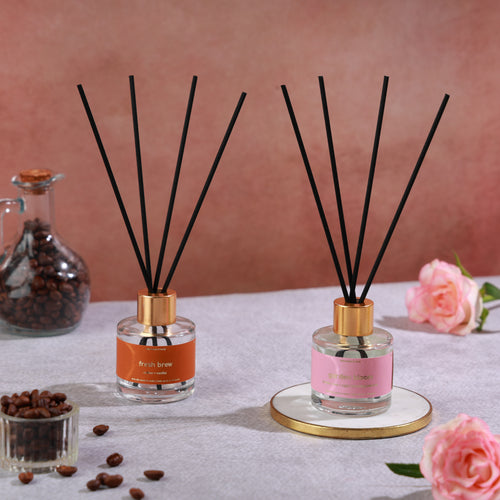 Refills · 300ml₹2,399Shop →
Reeds, placement and flipping — the three things you control
Of the three levers, reed count is the one that sets your everyday level, and it should be settled before you think about a flipping habit. Six fibre reeds come with every bottle: six for a hall, an entrance, a living room or a kitchen; four for a bedroom; two or three for a small bathroom. If you find yourself flipping every day to keep a room where you want it, the real answer is another reed or two rather than a daily ritual — the reeds are already in the box. Never go beyond the six supplied, and never top up or dilute the liquid to try to stretch what is left.
Placement decides how much of each post-flip lift ever reaches you. A bottle standing where air passes — a console near a doorway, a shelf on a route between rooms, waist to chest height — turns that lift into a scented room; a bottle in a still corner turns it into a slightly richer pocket of air around the glass. Keep it out of direct sunlight, which fades the fragrance and warms the oil, and out of the direct blast of a vent or fan, which empties it fast and pins everything to one wall. Stand it on a tray for the flipping alone, and keep it well out of reach of children and pets.
Then the flip itself, which is the only routine maintenance a reed diffuser asks for. Every three to five days, whole set at once, tissue in hand, over the tray. Expect the peak within a few hours and a return to the baseline within a day or two — that is the system working, not fading. Watch for the point at which a flip produces no lift at all: after two or three months of continuous wicking the fibre has loaded with heavier molecules and both ends are equally tired, and the fix is the fresh set of six that came with your next bottle. A 300ml refill at ₹2,399 fills a 130ml roughly twice and is the natural moment to fit them.
What to buy
Flipping is free, so nothing here is a fix for a flipping question. It is the honest ladder for the bottle underneath, including the fresh reeds that flipping eventually stops substituting for.
| Buy | What it is | Lasts | Price |
|---|---|---|---|
| Try one ★ | A 50ml reed diffuser — 6 fibre reeds included | 6–8 weeks | from ₹749 |
| The proper size | A 130ml — any room you use daily — 14–18 weeks at a sensible flipping rhythm | 14–18 weeks | from ₹1,249 |
| Two rooms | Day & Night duo — a waking scent and a settling one, cheaper than two bottles | 6–8 weeks each | ₹1,498 |
| Refill, do not rebuy | 300ml refill — refills a 130ml roughly twice; the glass is the durable part | Roughly 2 × 130ml fills | ₹2,399 |
| Fresh reeds | When a flip no longer lifts anything, the fibre has clogged — replace the reeds, never the liquid | Replace at each refill | Included with each bottle |
Versailles
Flipping is the only piece of reed diffuser advice that everybody has heard and almost nobody has been given a reason for. Once you know that you are exchanging a depleted surface for a saturated one, the whole question answers itself: often enough to matter, rarely enough for the submerged end to reload. Three to five days is simply where those two conditions meet.
What I would gently discourage is flipping out of anxiety. People flip when they stop noticing the scent, and the reason they have stopped noticing is usually that they have adapted to it — so the flip is being used to treat a perception with product. Ask somebody who has just walked in before you reach for the reeds.
Use flipping for what it is genuinely good at: deciding which evening gets the best of the bottle. Set the everyday level with reed count and placement, and refill rather than rebuy when the glass runs down. A portion of every order supports girl-child education through Nanhi Kali.
Frequently asked questions
- Does flipping make it finish faster? — the longevity side of the trade.
- How to make a reed diffuser smell stronger — every lever, ordered by cost.
- Why can I not smell my reed diffuser? — before you flip out of anxiety.
- The complete scent throw guide — placement, count and reed condition.
- Brand: the SOSA founder story.
SOSA products & prices (verified August 2026): Hotel Collection water-based ultrasonic diffuser fragrance 15ml ₹299 · 100ml ₹999 · 300ml ₹1,799 · Pack of 7 (15ml, all fragrances) ₹1,799; refills 100ml from ₹999. Seven scents: The Ritz-Carlton-inspired (white tea · bergamot · cedar), Westin-inspired (white tea · aloe · cedar), 1 Hotels-inspired (cedarwood · vetiver · green leaves), The St. Regis-inspired (amber · violet · woods), Shangri-La-inspired (jasmine · green tea · white tea), Four Seasons-inspired (citrus · floral · sandalwood), W Hotels-inspired (citrus · pepper · amber). Diffusers: Boond 300ml ₹899 · Sukoon 500ml ₹1,899 · Megh 6L ₹3,499. Water-based, phthalate-free, composed to IFRA standards for home diffusion; 3–6 drops per tank. Made in India, Pune. The Hotel Collection scents are SOSA's own interpretations inspired by the world's finest hotels; all hotel names are trademarks of their respective owners and are used only to describe the scent style — SOSA is an independent Indian fragrance house, not affiliated with or endorsed by any hotel brand. Prices and availability subject to change — see the live product pages.