

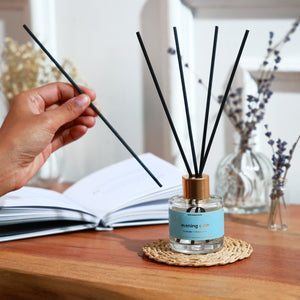
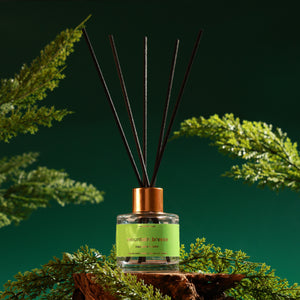

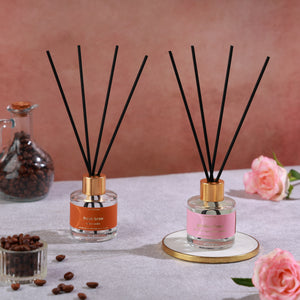
The floor and the ceiling: the floor is one bottle per place you are stationary daily, whatever the house calls that room. The ceiling is eight — past that a 4BHK stops smelling of a fragrance and starts smelling of fragrance, and doorways between bedrooms turn into small arguments between two scents.
Where households actually land: a couple in a large flat, five bottles, ₹4,495. A family of four, the standard six, ₹5,244. A joint family sleeping all four bedrooms, seven, ₹6,093. The same plus a closed kitchen — the ceiling — eight, ₹7,342.
2. Remove the class that never earns one, at any household size. The landing and the balcony are transit air and outdoor air respectively, and neither holds a fragrance long enough to justify a rupee — the same is true of any internal corridor the flat has, whatever it's called on the floor plan. That is two candidates gone before you have thought about a single scent.
3. Remove the foyer and, in most households, the fourth bedroom. The foyer is almost always served by the public-zone bottle standing near the front door rather than centred in the living room — it does not need its own. And most 4BHKs sleep three of their four bedrooms; the fourth earns a bottle only if someone is actually in it most days, on the occupancy test below.
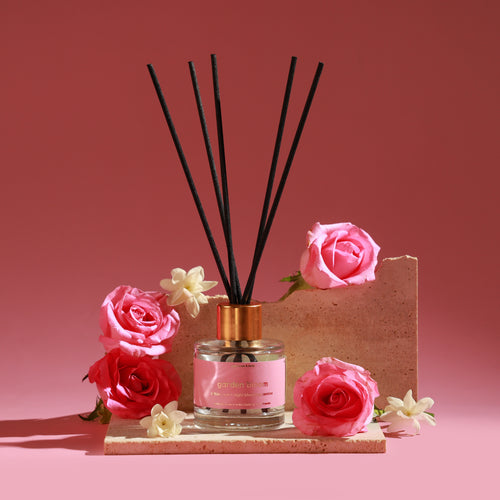
4. What survives for most households is six, ₹5,244. Garden Bloom 130ml ₹1,299 for the public zone, three 50ml bottles across three occupied bedrooms, and two Morning Freshness 50ml at ₹749 each for two bathrooms. Eleven candidates, five subtracted, six real stops.
5. Never cross eight, whatever the household. A larger family, all four bedrooms slept in and a closed kitchen in daily use, can honestly justify eight bottles at ₹7,342 — and that is the ceiling for this size of home, not a waypoint. Past eight, a house stops smelling of a fragrance and starts smelling of fragrance, and doorways between rooms turn into collisions rather than transitions.
Alcohol-free, IFRA-compliant, composed by an ISIPCA Versailles-trained perfumer and handmade in small batches in Pune — and every purchase funds a girl's education through Nanhi Kali.
Why the count needs a ceiling as well as a floor
Up through a 3BHK, "count the shut doors and add one for the open zone" is a safe rule because it never returns a number worth worrying about. A 1BHK gives three. A 2BHK gives four to six. Even a 3BHK, with three bedrooms and two bathrooms and a closed kitchen, tops out around seven — the same subtraction problem exists there, but the ceiling is high enough that the rule rarely bumps into it. A 4BHK is where the arithmetic finally catches up. Four bedroom doors, two bathroom doors, a foyer, a landing, a balcony, a kitchen and a public zone: run the naive rule and you land at nine or ten before you've asked whether a single one of those rooms is actually used. Nine or ten reed diffusers in one house is not thoroughness. It is the point where a home stops reading as considered and starts reading as anxious about being noticed.
The mechanism matters more than the number. A reed diffuser scents a soft radius around itself and nothing past that — no fan, no mist, oil climbing six fibre reeds by capillary action and evaporating off the tips. At the scale of a 1BHK or 2BHK, those radii sit far enough apart that a person only ever registers one at a time; you leave the bedroom's sphere before you enter the living room's. At the density of eight, nine or ten bottles across one floor plan, bedrooms and bathrooms sit closer together than their radii can respect, and a corridor of even a few steps stops being neutral transit and becomes the place where two competing fragrances physically meet. The human nose also fatigues faster than the arithmetic suggests — a household living inside nine simultaneous scents stops smelling any one of them clearly within days, which is the opposite of what every individual bottle was bought to do.
So a 4BHK needs two numbers, not one: the fewest bottles that cover every place a person is actually stationary, and the most a house of this size can carry before the doorways start colliding. The floor moves with the household — a couple needs fewer stops than a joint family. The ceiling does not move; it is set by the physics of overlapping radii and the limits of the nose, and it sits at eight regardless of who lives in the flat. The honest work in this size of home is finding the number between the two, and for most 4BHKs, once the fourth bedroom and the closed kitchen are checked against real use rather than the floor plan, that number is six.
The three decisions in a 4BHK
 Fresh Brew 50ml₹849Walk the flat and write down every space a bottle could plausibly stand in: the public zone (which may genuinely be two zones — the layout test for that split is here), four bedrooms, two bathrooms, a closed kitchen if the flat has one, a foyer, a landing and a balcony. That is eleven candidates, and it is the correct starting number — not because all eleven deserve a bottle, but because starting anywhere smaller means guessing which rooms to skip before you've actually looked at how the house is used. The list is the tool. The subtraction happens in decisions two and three.
How the count moves with household size
A 4BHK carpet area typically runs 1,800–3,000 sq ft, but as with every home in this cluster the number that matters is stops, not square feet. The table below runs the same eleven-candidate list against four real households, and keeps three rows fixed at zero regardless of who lives there — because no household size changes what a passage, a landing or a balcony is worth.
| Household | What's covered | Bottles | Total |
|---|---|---|---|
| Couple in a large flat | Public zone, master, two rooms in daily use (office / workout, not necessarily slept in), one bathroom | 5 | ₹4,495 |
| Family of four ★ | Public zone, three occupied bedrooms, both bathrooms — the standard case | 6 | ₹5,244 |
| Joint family, all four bedrooms slept in | Public zone, four bedrooms, both bathrooms | 7 | ₹6,093 |
| Joint family + closed kitchen — the ceiling | Public zone, four bedrooms, both bathrooms, closed kitchen | 8 | ₹7,342 |
| Foyer | Folded into the public-zone bottle standing on that side — never a separate purchase | 0 | ₹0 |
| Landing / internal corridor | Transit air. Moved by every door around it, occupied by nobody long enough to matter | 0 | ₹0 |
| Balcony | Outdoor air, whatever its size — nothing bought for it holds | 0 | ₹0 |
| Note on the eleven: every row above starts from the same list of eleven candidate spaces. The count that survives never exceeds eight, whatever the household, and the three rows fixed at ₹0 stay at ₹0 whether the family below spends ₹4,495 or ₹7,342. | |||
Garden Bloom · the public zone130ml ₹1,299Shop → 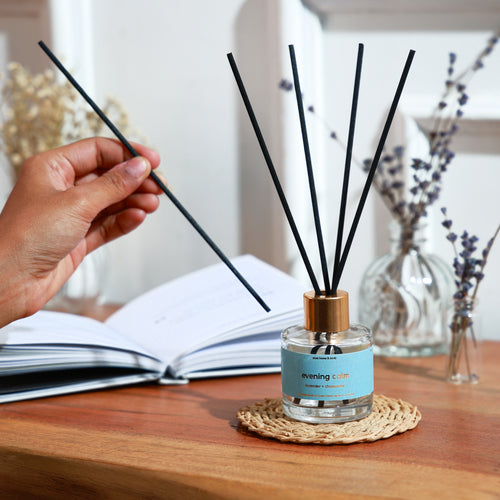 Evening Calm · the master50ml ₹799Shop →
  Morning Freshness · each bathroom50ml ₹749Shop →
Reeds, flipping and where each bottle actually stands
Bottle size and reed count do the fine work that the count alone can't. The public-zone 130ml runs all six reeds — it carries the first impression across the widest room in the house and needs the strength. Every occupied bedroom runs a 50ml on three reeds, the standard bedroom setting across this whole cluster: half the reeds of the public rooms, because a closed bedroom is a small sealed volume and six reeds in it reads as insistent rather than calm. Bathrooms run two to three reeds each; a 50ml on two reeds in a compact ensuite comfortably clears ten to twelve weeks. None of this changes with the household count above — a five-bottle house and an eight-bottle house run the same reed logic per room, just across more rooms.
Flip every reed saturated-end up every three to five days, in every bottle, regardless of how many are running. A house at six to eight bottles is easiest kept on a single day — pick a Sunday, walk the flat, flip every reed at once, so the whole house resets to the same starting strength together rather than drifting in and out of sync room by room. Skipping the flip is the most common reason a reed diffuser "stops working": the reed hasn't run dry, it has saturated on one end and stalled. This matters more, not less, at eight bottles, because an under-flipped bottle at this density doesn't just go quiet — it leaves a gap in the sequence that makes the ceiling feel arbitrary rather than deliberate.
Placement earns more scrutiny as the count rises, because a larger house has more surfaces that look plausible and are wrong. The public-zone bottle belongs on a console near the entrance, about a metre off the floor, clear of a ceiling fan's draught and out of direct sun through the entrance glazing — never centred in the room, which spends the same bottle on a corner nobody stands in. Bedroom bottles belong on the bedside table or dresser, not the windowsill. Bathroom bottles belong on the counter beside the basin, never inside the shower zone. And with more bottles running and, in a larger household, more children and visitors moving through the house, the reach-of-children-and-pets rule matters more, not less — every one of these bottles is oil in an open glass.
What a 4BHK reed count actually costs — and whether it should be a machine
This is also the size of home where the question changes shape — instead of asking which bottles, people start asking whether a machine solves the ceiling problem for them. It doesn't, and the honest answer is short: SOSA's Vaayu at ₹11,999 and Aangan at ₹25,999 are waterless, HVAC-integrated machines rated for 8,000–10,000 sq ft — retail floors, lobbies, clinics — and a 4BHK at 1,800–3,000 sq ft is the wrong building for either, on price and on the ducting a home doesn't have. The Sukoon at ₹1,899 sits at the opposite end and is genuinely useful here — an on-demand room machine you switch on for an evening, complementing the reed bottles rather than replacing them. Reeds stay the always-on baseline across the six to eight rooms that need one; a Sukoon changes one room quickly when guests are coming. Neither one solves the counting question this guide is about — that is arithmetic, not equipment.
| Setup | What you get | Covers | Total |
|---|---|---|---|
| The floor | Public zone ₹1,299 + master ₹799 + two more occupied rooms ₹849 + ₹799 + one bathroom ₹749 | Every daily stop for a couple, five bottles | ₹4,495 |
| The standard case ★ | The five above + a second Morning Freshness 50ml ₹749 | Public zone, three bedrooms, both bathrooms | ₹5,244 |
| Full occupancy | The six above + a Fresh Brew 50ml ₹849 for the fourth bedroom | Every bedroom slept in, both bathrooms | ₹6,093 |
| The ceiling | The seven above + a Morning Freshness 130ml ₹1,249 for a closed kitchen | Every candidate that ever earns a bottle in a 4BHK — no further | ₹7,342 |
| Running cost | A 300ml refill ₹2,399, or 500ml ₹3,499 (₹7/ml) | 500ml is ten 50ml fills — roughly ₹350 a fill, across as many bottles as you run | from ₹2,399 |
Versailles
Every home size up to this one, I can answer the counting question with a single subtraction and move on. A 4BHK is the first size where I have to stop someone from over-answering it. I had a client walk me through her flat room by room — foyer, living, dining, four bedrooms, two bathrooms, a closed kitchen — and by the end she had talked herself into ten bottles, because every single room technically qualified. It wasn't a bad instinct. It was thoroughness without a ceiling, and a ceiling is exactly what a house this size needs.
The number I give most often at this size is six, and the conversation that gets there is almost always about honesty rather than arithmetic — which bedroom is actually a study, which bathroom is actually a guest room nobody enters, which fourth room is four weekends of use a year rather than a daily one. Once those are named out loud, the count falls out on its own, and it is almost always smaller and cheaper than the person expected walking in.
And when someone asks whether a house this size should just get a machine instead, I tell them the truth: the Vaayu and the Aangan are built for spaces four to five times larger, and buying one for a flat is buying square footage you don't have. Six bottles and ₹5,244 is the proportionate answer, and proportion, at this scale, is worth more than completeness. Every purchase funds a girl's education through Nanhi Kali — not a percentage, not a quarterly cheque. Every one.
Frequently asked questions
- Best reed diffuser setup for a 4BHK — the room-by-room kit this count adds up to.
- How many reed diffusers does a 3BHK need? — the same subtraction, one size down.
- Should every bedroom in a 3BHK have its own reed diffuser? — the occupancy test, applied to one room at a time.
- Which SOSA reed diffusers should you buy for a 3BHK? — the fragrance pairings that carry across several rooms without clashing.
- Brand: the SOSA founder story.
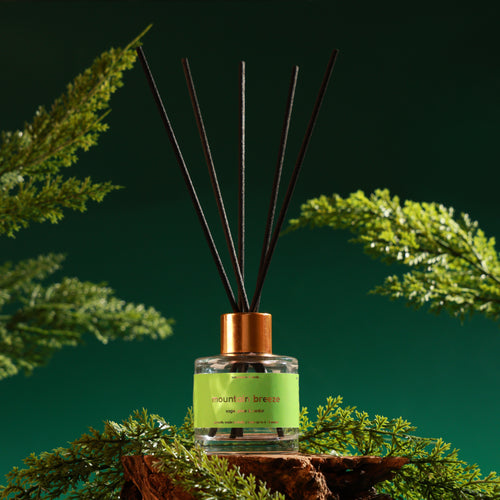
SOSA reed diffusers & prices (verified August 2026): Morning Freshness (Malabar lemon · peppermint · eucalyptus) 50ml ₹749 · 130ml ₹1,249 · Evening Calm (lavender · chamomile) 50ml ₹799 · 130ml ₹1,299 · Garden Bloom (British rose · night-blooming jasmine) 50ml ₹799 · 130ml ₹1,299 · Fresh Brew (Coorg coffee · Kerala vanilla) 50ml ₹849 · 130ml ₹1,349 · Mountain Breeze (Himalayan pine · sage · cedar) 50ml ₹849 · 130ml ₹1,349. Duo sets: Day & Night 2 × 50ml ₹1,498 · 2 × 130ml ₹2,498; Fresh & Grounded 2 × 50ml ₹1,548 · 2 × 130ml ₹2,548; Warmth & Bloom 2 × 50ml ₹1,598 · 2 × 130ml ₹2,598. Refills 300ml ₹2,399 · 500ml ₹3,499. Six fibre reeds included with every bottle; refillable glass. 50ml suits rooms up to 150 sq ft and lasts 6–8 weeks; 130ml suits rooms above 150 sq ft and lasts 14–18 weeks. Fractionated coconut oil (CCT) carrier, alcohol-free, phthalate-free, paraben-free, IFRA-compliant, low VOC; tested through 45°C heat and 85% monsoon humidity. Composed and handmade in small batches in Pune. Ultrasonic machines quoted for comparison: Boond ₹899 · Sukoon ₹1,899 · Megh ₹3,499, which run the separate water-based Hotel Collection fragrances (15ml ₹299 · 100ml ₹999 · 300ml ₹1,799) — the two lines are not interchangeable. Every purchase funds a girl's education through Nanhi Kali. Prices and availability subject to change — see the live product pages.