
How Long Do Indian Cooking Smells Actually Stay in a Flat?

How Long Do Indian Cooking Smells Actually Stay in a Flat?

★ Indian cooking, small flats and the smell that is still there at eleven · the order that actually worksCandle ₹379 · reed ₹749 · Boond ₹899 · Sukoon ₹1,899 · free shipping above ₹499A portion funds girl-child education
★ SOSA · find the cause, then scent the room
Extraction while you cook, ten minutes after, a door shut and the air changed — and only then anything with a scent in it
★ ★ ★ ★ ★
★★★★★
"Chimney on only while cooking was my mistake. Ten minutes afterwards was the whole difference, and it cost nothing."
Meghna K. Free fix · extraction
1BHK, Mumbai
★★★★★
"Fish for two days. Learned it was aerosol landing on fabric rather than air, washed what I could, and it went in an afternoon."
Joseph A. Fabric, not air
Kochi
★★★★★
"Asked straight out whether a diffuser would cover tadka. Was told no, and told why. I bought one anyway, for afterwards, and it is the right way round."
Preeti N. Honest answer
Told the truth
★★★★★
"Open kitchen, so containment was never going to work. Switched to a dry scent that sits somewhere completely different from food. That was the trick."
Rahul V. Forest Suite ₹299
Open kitchen
★★★★★
"Bedroom door shut during cooking. One sentence, free, and my clothes stopped smelling of dinner."
Shalini D. Free fix · shut the door
2BHK, Pune
★★★★★
"Sukoon on the 4H timer from six, not at eight when everyone arrives. The flat has already got there by then."
Imran H. Sukoon · 4H timer
₹1,899
★★★★★
"Chimney on only while cooking was my mistake. Ten minutes afterwards was the whole difference, and it cost nothing."
Meghna K. Free fix · extraction
1BHK, Mumbai
★★★★★
"Fish for two days. Learned it was aerosol landing on fabric rather than air, washed what I could, and it went in an afternoon."
Joseph A. Fabric, not air
Kochi
★★★★★
"Asked straight out whether a diffuser would cover tadka. Was told no, and told why. I bought one anyway, for afterwards, and it is the right way round."
Preeti N. Honest answer
Told the truth
★★★★★
"Open kitchen, so containment was never going to work. Switched to a dry scent that sits somewhere completely different from food. That was the trick."
Rahul V. Forest Suite ₹299
Open kitchen
★★★★★
"Bedroom door shut during cooking. One sentence, free, and my clothes stopped smelling of dinner."
Shalini D. Free fix · shut the door
2BHK, Pune
★★★★★
"Sukoon on the 4H timer from six, not at eight when everyone arrives. The flat has already got there by then."
Imran H. Sukoon · 4H timer
₹1,899
Find the source first · two windows for twenty minutes beats any product for a closed smell Fragrance is the finishing layer. It does not remove damp, a dry drain or a loaded sofa Sukoon ₹1,899 · 270–320 sq ft · 16–18 hours per fill · three 15ml scents included


Founder Diaries · Home Fragrance · Why Your Home Smells of Cooking
By Sonal Sahani · ISIPCA Versailles 10 min read Updated August 2026
This question has two answers and almost every argument about it comes from people quoting one of them at each other. Airborne cooking smell — the molecules actually suspended in the air — is gone in about twenty minutes with a genuine cross-draught and in an hour or two without one. Adsorbed cooking smell — the same molecules stuck to curtains, sofa, cushions, clothes and the painted wall above the hob — lasts days to weeks, and re-releases continuously the whole time. That single distinction explains why a flat you aired at eight still smells of dinner at eleven, and it is the whole of this page.
Quick answers — read this first
Airborne: about twenty minutes with two openings on opposite walls, one to two hours with one window, and most of an evening in a sealed flat.

Adsorbed: days to weeks. Fabric, the oil film above the hob and unwashed curtains hold cooking odour and give it back slowly, which is why the air keeps re-loading after you have cleared it.

What decides the difference: oil content, temperature and how much aerosol the cooking made. Boiled dal leaves nothing behind; deep frying leaves a week; burnt food can leave three.

The honest part: fragrance shortens neither clock. Laundry and airflow shorten the second one.
The short answer
Short answer: twenty minutes to two hours for the air, and two days to three weeks for what the smell has landed on. Most people are asking about the first and are actually experiencing the second, which is why airing the flat appears not to have worked.
Typical durations: boiled dal or rice, under twenty minutes and nothing left behind; a tadka, twenty to thirty minutes airborne and a day or two on nearby fabric; deep frying, thirty to sixty minutes airborne and three to seven days adsorbed; fish, a day or two; a slow-cooked meat dish, two to four days because of duration; burnt food, one to three weeks.
What to do about it: extraction for ten minutes after the hob goes off and two openings for twenty minutes are free and do the airborne half. Laundry does the adsorbed half. Then, on clean air, the Hotel Collection is ₹299 for 15ml and the Sukoon ₹1,899 with steady, 2H and 4H timers and three scents included. Free shipping above ₹499.
Straight answer
How long do Indian cooking smells actually stay in a flat?
1. The air clears in about twenty minutes, if you actually change the air. Two openings on opposite or adjacent walls, twenty minutes, immediately after the hob goes off. With one window it takes an hour or two. With everything shut it takes most of the evening, and it never quite finishes.

2. What has landed on things lasts days to weeks, and that is what you are smelling at bedtime. Cooking aerosol deposits on curtains, sofa, cushions, the clothes you cooked in and the painted wall above the hob, and re-releases slowly for as long as it sits there. Airing the flat removes the air; it does not remove the reservoir, which promptly re-loads the air you just changed.

3. Three things decide how long a given evening lasts: oil, temperature and aerosol volume. Boiled food at 100°C makes almost no aerosol and leaves nothing behind. Frying at 180°C makes a great deal, and oil droplets are the vehicle that carries odour onto surfaces and holds it there.

4. So a boiled dal is twenty minutes and a deep-fried evening is most of a week. A tadka is half an hour in the air and a day or two on whatever was hanging nearby. Burnt food is the outlier and can run to three weeks, because smoke particles are extremely fine and the nose detects them at very low concentrations.

5. And there is a third clock nobody mentions: your own nose gives up in about a fortnight. Receptors adapt to a constant smell, so a flat that genuinely smells of last month's cooking can seem perfectly fine to the people who live in it while every visitor still receives it.

A portion of every order supports girl-child education through Nanhi Kali.

TL;DR: there are two clocks. Airborne cooking smell clears in about twenty minutes with two openings and an hour or two with one; adsorbed smell on fabric, clothes and the wall above the hob lasts days to weeks and re-releases the whole time. Oil, temperature and aerosol volume decide which evening is which, and fragrance shortens neither clock.
SOSA · what fragrance does and does not do
The clock no product on this site can shorten
SOSA · what fragrance does and does not do from ₹379
There are two timescales in this article and fragrance shortens neither of them. Airborne smell is removed by moving air, which costs nothing. Adsorbed smell is removed by washing the thing it is sitting on, which also costs nothing. A scent added on top of either one gives you two smells rather than one, and the second one is still the first one. SOSA does not make a room spray or a linen spray for the home; the sprays in the range are car perfumes. What we do make is worth buying at the end of the sequence and not in the middle of it — a candle from ₹379, a reed from ₹749, the Sukoon at ₹1,899.

Two clocks, and the one everybody is actually asking about

Here is the reason this question feels unanswerable when you search it. One person tells you cooking smell clears in twenty minutes and another tells you their flat smelled of fried fish for a week, and both of them are correct, because they are describing two different physical situations that happen to share a name. A smell in the air and a smell on a surface behave nothing alike. The first is a population of molecules floating in a volume you can replace wholesale by opening two windows. The second is a population of molecules attached to something, leaving it one at a time, at a rate set by temperature and airflow and by nothing you can hurry. Separate the two and every confusing observation in this subject resolves at once.

1
CLOCK ONE
Airborne: twenty minutes with a cross-draught, an hour or two without
The airborne clock is short, and it is the one you have direct control over. Cooking puts odour molecules into the air of the flat, and the only thing that removes them is replacing that air with different air. Twenty minutes of genuine cross-ventilation — two openings, on opposite or adjacent walls, at the same time — turns over the volume of an ordinary flat several times and takes the airborne fraction with it. One open window does far less than half as much, because a single aperture has to serve as both the inlet and the outlet and the exchange becomes a slow shuffle rather than a flow; this is the difference between ventilation and exchange, and it is worth more than most equipment. With nothing open at all, the airborne fraction still declines, but by dilution and slow leakage through gaps rather than by removal, and it takes most of an evening. Running the extraction for ten minutes after the hob goes off is the other half of this clock, and it is the step almost everybody skips. The pan, the oil film on the hob surround and the canopy above it are all still hot, and hot surfaces carry on volatilising for several minutes after the flame has gone. A hood switched off with the burner leaves that entire tail in the room. Ten minutes of run-on costs nothing, uses a trivial amount of electricity, and removes the part of the evening you were going to be smelling at ten o'clock.
2
CLOCK TWO
Adsorbed: days to weeks, and it re-releases the whole time
The second clock is the one that answers the actual question, and it runs on a completely different scale. Cooking does not only make vapour. Frying, tempering and any vigorous heat make an aerosol — droplets of oil fine enough to stay airborne and travel — and those droplets carry odour compounds with them and then land. They land on the nearest absorbent surfaces, which in a home are textiles: curtains, upholstery, cushions, rugs, bedding through an open bedroom door, and the clothes you happen to be wearing. They also land on hard surfaces, where they form the thin film that the oil page in this group is about. Once there, the odour is no longer in the air, so opening a window does nothing to it — and it is not staying put either. It leaves slowly and continuously, hour after hour, day after day, re-supplying the air you have just cleared. This is precisely why a flat that was properly aired at eight smells of dinner again at eleven, and why people conclude that ventilation does not work when in fact it worked perfectly on the fraction it can reach. The duration depends on the load. A light deposit from one tempering is gone from fabric in a day or two. A heavy deposit from an evening of deep frying, onto curtains that have not been washed in two years, is measured in weeks — and unwashed curtains beside a kitchen are, in my experience, the single most under-suspected object in an Indian flat.
3
THE THIRD CLOCK
Your own nose, which stops reporting in about a fortnight
And then the clock nobody includes in the question, which quietly determines what anybody believes about the other two. Olfactory receptors adapt. A smell that does not change stops being reported within minutes of continuous exposure, and a household smell you live inside becomes effectively invisible to you within roughly two weeks, while every visitor still receives it exactly as it is. The practical consequences are worth spelling out. First, you are a bad instrument for measuring your own flat, so estimates of how long a smell lasted in your home are systematically too short. Second, the residual cooking smell that new arrivals notice in a flat where somebody fries daily is usually not a recent event at all — it is the steady output of a loaded reservoir that the residents stopped perceiving months ago. Third, and this is where people go wrong commercially, the instinct adaptation produces is to add more fragrance, which raises the level for the visitor without changing anything for you. The correct instrument is another person. Ask one honest guest what your flat smells like, having told them you want the truth rather than good manners, and treat what they say as data. It costs nothing and it is more accurate than anything you can do yourself.
The one-line version of this whole page: you can change the air in twenty minutes and you cannot change the curtains in twenty minutes, and it is the curtains you are smelling.

How long each kind of cooking really lasts

Typical Indian cooking events against both clocks. The airborne column assumes the free method — extraction running for ten minutes after the hob goes off, then two openings for twenty minutes — and roughly doubles or trebles without it. The adsorbed column assumes ordinary soft furnishings within a few metres and no laundry afterwards, which is the usual case.

Two clocks, six evenings
What each kind of cooking leaves in the air, and what it leaves on things
The cooking Why it lingers or does not Airborne, with the free method Adsorbed on fabric and surfaces What shortens it
Boiled dal, rice, steamed food ★ About 100°C, water-carried, almost no oil aerosol — very little to deposit 10–20 minutes Effectively none. Gone with the air Nothing needed. This evening is already solved
A tadka or tempering Very high release in thirty seconds from hot fat, but a small total quantity of oil 20–30 minutes 1–2 days on whatever fabric was within a few metres Extraction running before the seeds go in; a lid; the airer out of the room
Deep frying — pakora, puri, fish fry 180°C and sustained. The largest aerosol load of any domestic cooking, and oil is the vehicle 30–60 minutes 3–7 days on fabric, and weeks on the unwiped film above the hob as it oxidises Wipe the hob surround and canopy while warm; wash covers and the clothes you cooked in
Fish, cooked any way Volatile amines detectable at extremely low concentrations, plus residue on cloths, board and bin 30–45 minutes 2 days typically, longer if the kitchen cloth and bin were left A mild acid wipe on surfaces, the bin emptied, and every cloth into the wash
A slow-cooked meat dish or biryani Ninety minutes of continuous moderate release, steam-carried, with real fat content 30–45 minutes 2–4 days, worst on curtains because of the duration rather than the intensity Curtains washed; the run-on extended to fifteen minutes; the bedroom door shut throughout
Burnt food, or a pan left dry Submicron smoke particles, a very low detection threshold, and they penetrate everything porous 45–90 minutes with everything open 1–3 weeks, and it will be in bedding and clothing as well as soft furnishings Full laundry, hard surfaces washed, and several consecutive days of cross-ventilation
Shop this guide
For after the twenty minutes, not instead of them
The SOSA principle
You can change the air in twenty minutes. You cannot change the curtains in twenty minutesand it is the curtains you are smelling at eleven o'clock.
Airborne smell is a population you can replace wholesale. Adsorbed smell is a population attached to your furniture, leaving it one molecule at a time, for as long as it takes.

What shortens each clock, and what does nothing at all

For the airborne clock there are exactly three interventions and all of them are free. The first is extraction, run before the pan is hot and for ten minutes after the hob goes off, on high rather than low for anything fried or tempered. This is the only measure that acts before the smell reaches the rest of the flat, and the ten-minute run-on is the most valuable free minute-for-minute thing in this entire cluster. The second is genuine cross-ventilation: two openings, on opposite or adjacent walls, for twenty minutes, starting the moment the hob goes off rather than at bedtime. Timing matters here more than duration — twenty minutes at eight o'clock removes a concentrated load before it has had time to deposit, and the same twenty minutes at eleven removes a diluted one after most of the depositing has already happened. If the second opening is a bathroom window with its extractor running, that counts as an outlet. A ceiling fan on low while both are open speeds the exchange; the same fan with everything shut simply distributes dinner evenly through the flat, which is worse than leaving it alone. The third is shutting the doors of rooms you do not want loaded — bedrooms and wardrobes especially — before you start rather than afterwards, which is the subject of the air-path page in this group and costs nothing but a moment's forethought. What does not shorten the airborne clock: burning a candle, running a diffuser, spraying anything, or boiling vinegar in an open pan, which mostly gives you a flat that smells of vinegar in addition to dinner.

For the adsorbed clock there is one intervention and it is laundry. Fabric holds the smell, so washing the fabric removes the smell, and nothing else does — not airing it, not spraying it, not covering it, and not waiting. In a household that fries or tempers most days, the sensible cadence is cushion covers and throws through the machine monthly, curtains two to four times a year if they hang anywhere near the cooking line, bedlinen weekly as usual, and the clothes you cooked in going into the wash rather than back onto a hook — cotton kurtas and dupattas hold a remarkable amount and are frequently the source of a smell people are blaming on their sofa. For upholstery that cannot be washed, a vacuum with an upholstery head fortnightly, seams and under the back cushions included, plus two hours of direct sunlight on anything portable, does more than any product sold for the purpose; the sofa page in this group covers the method in full. The hard surfaces matter too, and the one that matters most is the one nobody looks at: the wall and the tiles immediately above and beside the hob, the underside of the hood, and the cupboard doors at head height. Warm degreaser on a cloth, top down, once a month in a frying household. That film is a reservoir with an enormous surface area for its volume, and until it is removed it will keep re-supplying the air you keep clearing, which is the frustration described in the oil-film page.

Then the honest part, which is where fragrance belongs and what it cannot do. Fragrance shortens neither clock. Not the airborne one, because adding molecules to air is the opposite of removing them, and not the adsorbed one, because the deposit on your curtains is entirely unaffected by anything happening in the air above it. A scent run into a room that still holds cooking gives you both smells at once and a strong impression that something is being covered up, which is the subject of the diffuser page in this group. What fragrance does, once both clocks have been dealt with, is give the flat a consistent character of its own — and that is worth having, which is why I sell it. On timings, so you can plan an evening: a candle puts scent into a normal room in fifteen to twenty minutes and must be attended and put out; a Sukoon at ₹1,899 reaches a steady level in about twenty minutes from cold, with 16–18 hours per fill on low at 30–50 ml/h against 9–12 on high, steady, 2H and 4H timers and three 15ml Hotel Collection scents of your choice included; a reed diffuser needs twenty-four to seventy-two hours before it is doing its job, which makes it the wrong purchase for tonight and the right one for a hall you want holding one level for months. The Hotel Collection is water-based and ultrasonic only, at three to six drops per tank, per tank rather than per litre. SOSA does not make a room or linen spray for the home. And a cool-mist machine adds 30–50 ml of water an hour to the air, which is worth knowing before you run one in a kitchen that is already humid from cooking.

Airing the flat removed the air, and it worked. What it could not remove was the sofa, which spent the next three hours quietly putting dinner back.
— Sonal Sahani, SOSA

The SOSA edit

In the order that actually shortens the two clocks, which means four free steps before anything is bought. The last row is the product category people go looking for at this point and the range does not contain.

The SOSA edit
Shortening both clocks, in working order
Do this Which clock it acts on What it does Cost
1. Ten minutes of extraction after the hob goes off ★ Airborne Removes the tail that a hot pan, a hot oil film and a warm canopy carry on releasing after the flame is out ₹0
2. Two openings, twenty minutes, immediately Airborne Turns the flat's volume over several times. One window is ventilation; two is exchange, and the timing matters more than the duration ₹0
3. Laundry on a schedule Adsorbed Covers and throws monthly, curtains two to four times a year, and the clothes you cooked in into the wash rather than onto a hook ₹0
4. The film above the hob, once a month Adsorbed Warm degreaser, top down, on the wall and tiles beside the hob, the hood underside and the cupboard doors at head height ₹0
5. Hotel Collection 15ml and Sukoon Neither — it is the finish Three to six drops per tank on clean, moving air, twenty minutes from cold to a steady level, with the 2H timer to stop it ₹299 / ₹1,899
Not in the range: a room or linen spray The sprays SOSA makes are car perfumes. A spray is a thirty-minute product in any case, which is shorter than either clock on this page
Honest notes for buyers: fragrance is the last step, never the first. It layers on air that is already clean and moving, and it will not remove a source — not damp, not a dry drain trap, not a loaded sofa, not a filter that needs washing. Deal with the cause, change the air, then scent the room. On timing: a candle puts scent into a room in fifteen to twenty minutes and a Sukoon reaches a steady level in about twenty, while a reed diffuser needs a day to three days before it is doing its job — the wrong buy for a deadline and the right buy for a room you want to hold one level for months. SOSA does not make a room or linen spray for the home; the sprays in the range are car perfumes. A cool-mist ultrasonic adds 30–50 ml of water an hour to the air, so it is the wrong machine for a room you are trying to dry out. The Hotel Collection is water-based and runs in the Sukoon, Boond and Megh only — not in reeds and not in the waterless Vaayu. Reed diffusers are a separate alcohol-free line with their own scents. Candles must be attended and put out. The Hotel Collection scents are SOSA's own interpretations inspired by the world's finest hotels; SOSA is an independent Indian fragrance house, not affiliated with or endorsed by any hotel brand. A portion of every order supports girl-child education through Nanhi Kali.
SOSA Sukoon
Bought for the timer, because this page is about time
SOSA Sukoon ₹1,899
A 500ml BPA-free tank rated for 270–320 sq ft, 16–18 hours per fill on low at 30–50 ml/h against 9–12 on high, a 2.4MHz cool-mist plate, a remote, auto shut-off and steady, 2H and 4H timers, with three 15ml Hotel Collection scents of your choice included. A steady level arrives in about twenty minutes from cold, which is the same twenty minutes a genuine cross-draught needs — so the honest arrangement is to spend the first twenty minutes clearing the air and the second twenty putting something into it. The 2H timer exists so the machine stops on its own at the point where the room has arrived rather than at the point where you remember it.
SS
ISIPCA
Versailles
A note from Sonal

I get asked this question more precisely than almost any other, usually by somebody who wants a number so they can plan around it — guests on Saturday, a landlord's visit, a viewing. The reason no single number satisfies anyone is that there are two of them, and they are two orders of magnitude apart. Twenty minutes for the air. Days to weeks for what the air put onto your furniture. Anybody who gives you one number is answering half a question.

What I would like people to take from this page is the diagnostic rather than the durations. If a smell comes back within an hour of a proper airing, it is not in the air and you are not going to solve it with air. It is in the fabric, or in the film above the hob, or in the clothes on the back of the chair, and until you wash one of those you will keep having the same evening. I have watched people spend considerably more than the cost of washing their curtains on products intended to fix a problem that a washing machine would have ended in one cycle. Fragrance comes afterwards, and it is genuinely worth having afterwards — but it does not appear anywhere on the list of things that make a smell go away sooner, and I would rather say so on a page like this one.

Everything is made and supported from Pune, and a part of every order funds girl-child education through Nanhi Kali. You get a home that smells like somewhere you chose; a girl gets a classroom. That equation has always felt right to me.

Frequently asked questions

How long does a cooking smell take to leave a flat?
About twenty minutes for the airborne part, with two openings on opposite or adjacent walls and the extraction run for ten minutes after the hob goes off. Without a cross-draught it is an hour or two. What has landed on curtains, upholstery and clothes lasts days to weeks and re-releases the whole time, which is the part people are usually asking about.
Why does my flat smell of dinner again a few hours after I aired it?
Because airing removed the air and not the reservoir. Cooking aerosol deposits on fabric and on the film above the hob, and leaves those surfaces slowly and continuously, re-loading the air you just cleared. The fix is laundry and degreasing rather than more ventilation.
Which cooking leaves the longest smell?
Burnt food, by a distance — one to three weeks, because smoke particles are very fine and detectable at very low concentrations. Deep frying is next at three to seven days on fabric. A boiled dal leaves essentially nothing once the air has been changed.
Does a diffuser make a cooking smell go away faster?
No. It adds molecules to the air rather than removing them, and it has no effect at all on what has adsorbed onto fabric. Extraction and cross-ventilation shorten the airborne clock, laundry shortens the adsorbed one, and fragrance is what you add once both have been dealt with.
Why can my family not smell it when visitors can?
Olfactory adaptation. Receptors stop reporting a constant smell within minutes, and a household smell becomes effectively invisible to its residents within about two weeks while visitors still receive it normally. Ask one honest guest rather than trying to judge your own flat.
Two clocks, one method
Twenty minutes for the airand a wash cycle for everything else
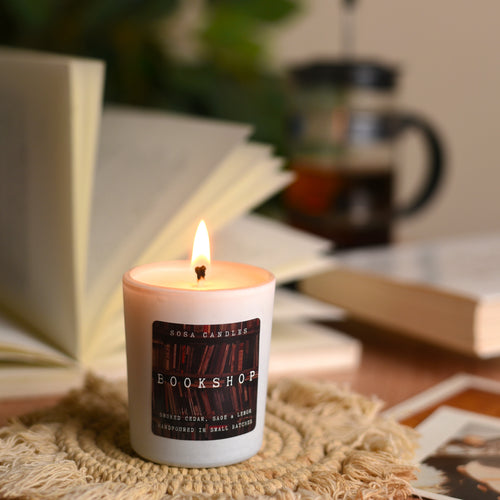
Once both clocks have been dealt with: the Hotel Collection is ₹299 for 15ml, ₹999 for 100ml and ₹1,799 for 300ml at about ₹6 per millilitre, at three to six drops per tank. The Sukoon is ₹1,899 for 270–320 sq ft with steady, 2H and 4H timers, 16–18 hours per fill on low and three 15ml scents of your choice included; the Bookshop candle is ₹379 and reaches a room in fifteen to twenty minutes. Free shipping above ₹499, and a portion of every order supports girl-child education through Nanhi Kali.
See the Sukoon · ₹1,899 See the seven scents · ₹299
Continue the read
More from SOSA
Editorial standards & sources
About this guide: Written by Sonal Sahani, ISIPCA Versailles-trained founder and perfumer at SOSA Home & Body, on the two timescales people conflate when they ask how long a cooking smell lasts — the airborne fraction that genuine cross-ventilation clears in about twenty minutes, and the adsorbed fraction on fabric, clothing and the film above the hob that persists for days to weeks and re-releases continuously — with typical durations for boiled food, tempering, deep frying, fish, slow-cooked dishes and burnt food, and a plain statement that fragrance shortens neither.

Facts verified August 2026: Diagnostic facts used in this guide: a closed room accumulates what it cannot exchange, so cross-ventilation needs two openings rather than one; a drain's U-bend water seal evaporates in roughly two to four weeks of disuse and then admits sewer gas, which is corrected by pouring water down the drain; microbial growth in fabric and on surfaces accelerates above about 60% relative humidity, and Indian monsoon indoor humidity commonly runs 80–95%, which is the one situation where ventilating on a wet day can import moisture rather than remove it; an air-conditioner's cold, wet evaporator coil and filter grow biofilm that is blown into the room on start-up; textiles adsorb cooking aerosol and body oils and re-release them for weeks; and olfactory adaptation makes a constant household smell undetectable to its residents within about a fortnight while visitors still perceive it. Timings: a scented candle scents a normal room in roughly 15–20 minutes, a Sukoon ultrasonic diffuser reaches a steady level in about 20 minutes from cold, and a reed diffuser needs roughly 24–72 hours. SOSA products and prices: Sukoon 500ml ₹1,899 (270–320 sq ft, 16–18h on low, 9–12h high, 30–50 ml/h, 2.4MHz cool mist, remote, steady/2H/4H timers, BPA-free, auto shut-off, includes three 15ml Hotel Collection scents of your choice); Boond 300ml ₹899; Megh 6-litre ₹3,499; waterless Vaayu ₹11,999 (up to 1000m³); Aangan ₹25,999. Hotel Collection water-based fragrance 15ml ₹299, 100ml ₹999, 300ml ₹1,799, Pack of 7 at 15ml ₹1,799; dose 3–6 drops per tank. Reed diffusers (separate alcohol-free line): Morning Freshness from ₹749, Garden Bloom and Evening Calm from ₹799, Fresh Brew and Mountain Breeze from ₹849; 130ml from ₹1,249; duos from ₹1,498; 300ml refills ₹2,399. Scented candles: Bookshop 80g ₹379, Amber Rose 130g ₹599 and 220g ₹799, Smoked Oudh 130g ₹449, ceramic jar candles ₹949, Pure Calm wax melt set ₹854. Free shipping above ₹499. SOSA does not make a room or linen spray for the home. The Hotel Collection scents are SOSA's own interpretations; SOSA is not affiliated with or endorsed by any hotel brand. Prices subject to change — see the live product pages.
Retour au blog