


For reeds and ultrasonics: gentle incidental traffic is right. A direct draught from a split AC, a fan or an open window is the commonest cause of a weak large room and a bottle that finishes early.
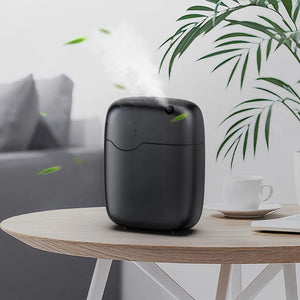
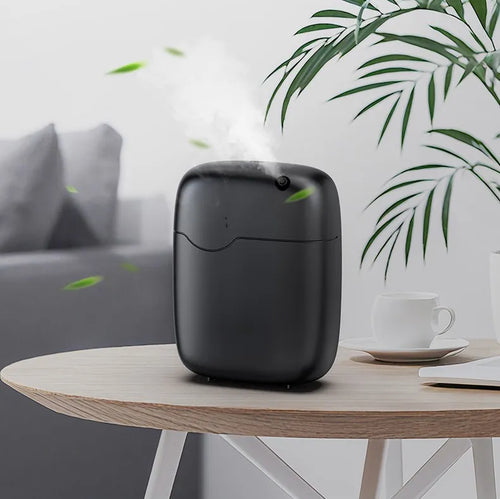
For a cold-air machine like the Vaayu: ceiling fans on low and the AC circulating are helpers, not enemies. The dry nano-mist is what needs distributing, and the room's own currents do it.
The honest caveat: the Vaayu ships with 400ml of cold-air oil and SOSA does not currently sell a separate refill for it. Ask before you spend ₹11,999.
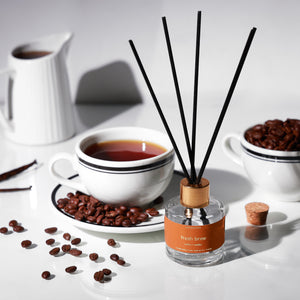
2. For a reed diffuser, a draught is the most expensive mistake you can make. Fast air across a wet reed raises the evaporation rate well past the level the composition was dosed for. You get a bottle that empties in weeks rather than the 6–8 a 50ml is rated for, and a room that still smells of nothing, because the fragrance is being carried away in a thin stream rather than accumulating.
3. For a reed diffuser, dead air is the second most expensive. In an alcove, behind a sofa or in a corner of a 40-foot room with nothing moving, the fragrance pools within a foot of the glass. The correct condition is neither: gentle incidental traffic, near a doorway or walkway, waist to chest height.
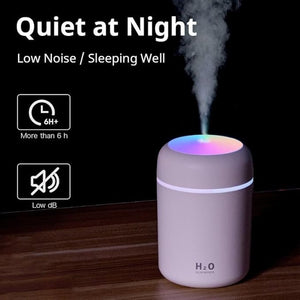
4. For an ultrasonic, the same rules apply with a small extra margin. A Sukoon has a tiny fan and a visible plume, so it throws a few feet on its own. Past that it is the room's job again, and a direct AC draught will still shred the plume before it reaches head height.
5. For a cold-air nebuliser, the instruction reverses. The Vaayu uses pressurised air to atomise undiluted oil into a dry nano-mist. Those particles stay suspended, so ceiling fans on their lowest setting and a circulating AC are exactly what you want. Turning the fans off to "protect" the scent is the wrong instinct here.
6. Air exchange is a separate variable from air movement. Movement distributes; exchange removes. An open window in an open-plan home does both — it stirs the air and replaces it — which is why an airy sea-facing living room is the hardest space in India to scent with anything passive.
7. Before you spend, run the free version. Put what you already own in gentle passing air rather than a jet, and see what changes over a week. A surprising number of "I need a bigger machine" emails end there.
The Vaayu is made in India, ships with four SOSA Hotel Collection fragrances at 100ml each, and a portion of every order supports girl-child education through Nanhi Kali.
Part one — the inversion, in three mechanisms
I want to take the general statement apart, because "airflow matters" is the kind of sentence that sounds useful and changes nobody's behaviour. There are three separate physical things happening when air moves past a fragrance source, and they have different consequences for different formats. Understanding which of the three is dominant in your room is what tells you whether to switch the fans on or off — and, more usefully, whether the machine you are about to buy will behave better or worse than the one you already own.
 Sukoon₹1,899 · 270–320 sq ftPeople who have been burned by mechanism one over-correct into mechanism two. The bottle goes into a still corner, the fans go off, the room is sealed — and now the fragrance forms a small dense cloud around the source and stops. In a 12 × 14 bedroom that is survivable; the room is small enough that diffusion alone will eventually fill it. In a 40-foot open living-dining, molecular diffusion is far too slow to matter and you get a scented three-foot bubble in the middle of an unscented room. The Sukoon at ₹1,899 buys you a little margin here, because it has a small fan and pushes a visible plume, but its honest rating is 270–320 sq ft and that number assumes the room does some of the work. Neither format is designed to be its own weather system.
Part two — the same air condition, three different verdicts
Here is the table I wish existed when I started answering these emails. Read down your own room's air conditions and across to the format you own. The point is not that one column is better — it is that the same condition earns a different verdict in each one, which is why generic diffuser advice fails in large homes.
| Air condition in the room | Reed diffuser (no propulsion) | Ultrasonic — Sukoon / Boond | Cold-air nebuliser — Vaayu |
|---|---|---|---|
| Gentle incidental traffic ★ | Ideal — the condition the format is designed for | Ideal, plume reaches a few feet further | Fine, but under-uses what you paid for |
| Sealed, still, nothing moving | Pools at the bottle; large rooms read empty | Plume rises and stalls; a small scented column | Works, but distribution is slower than it needs to be |
| Ceiling fans on lowest speed | Marginal — depends how far the bottle sits from the blade path | Usable if the unit is out of the direct downdraught | Actively helpful — this is the intended condition |
| Split AC blowing across the source | Worst case: bottle empties early, room stays quiet | Plume shredded before head height | Helpful, provided the machine is not inside the jet |
| Central or ducted AC circulating | Unpredictable — supply grilles are draughts, returns are dead spots | Better than a split, still limited by the 270–320 sq ft rating | The strongest case for this format — the duct loop distributes it |
| Windows open, genuine cross-breeze | Poor — movement plus air exchange, both against you | Poor for the same reason | Reduced, because exchange removes what movement spreads |
| Double-height volume, warm air rising | Stratifies out of reach; the room reads empty at head height | Same problem, slightly higher starting point | Mount low and aim into the traffic; see the placement note below |
| The honest caveat: no amount of airflow tuning turns a point source into a whole-floor solution. If your connected open volume is genuinely large, the free fixes on this page will improve a reed diffuser from bad to acceptable-nearby, not from bad to good-everywhere. Equally, a Vaayu at ₹11,999 in a 400 sq ft flat is money spent on capability you will never use — a Sukoon at ₹1,899 is the honest answer there. | |||
Vaayu · uses the airflow₹11,999Shop →  Sukoon · one room, on demand₹1,899Shop →
 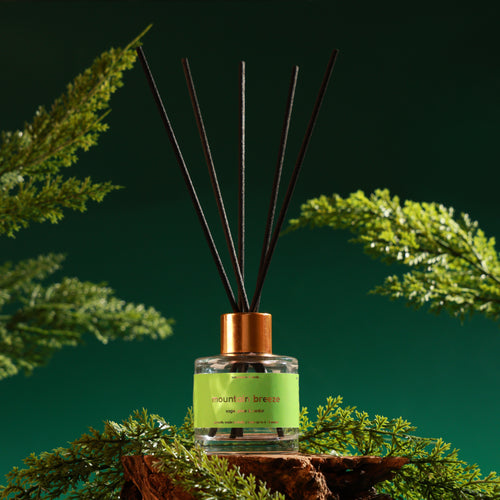 Mountain Breeze · keep it out of the draughtfrom ₹849Shop →
Part three — tuning the air you already have, and when not to buy
Before anyone spends ₹11,999, I would like them to spend an hour instead. Stand in the middle of the open space with everything running as it normally runs — fans, AC, whatever is open — and hold a strip of tissue at chest height. Walk the room slowly and watch it. You will find, in almost every Indian open-plan home, that the space divides into three zones: a fast zone directly under a fan or in front of a split unit, a slow zone along the traffic path between doorway and sofa, and a dead zone in at least one corner, usually the one containing the console table where the diffuser lives. Moving a passive source from the dead zone to the slow zone is free and frequently doubles what you perceive. Moving it out of the fast zone is also free and will visibly extend the life of the bottle.
Two more free adjustments are worth running before any purchase. First, reverse the instinct about fans if you already own a machine with propulsion: set ceiling fans to their lowest speed rather than off, and let them run while the machine runs. Second, separate movement from exchange. An open window is not a fan — it swaps the air rather than stirring it, and no format on this page can outrun a genuine cross-breeze in a large room. Close up for the hour before people arrive, run the machine into a room that is circulating but not exchanging, and open again afterwards if you like. And a note that applies to every format: ventilate first, fragrance second. A scent machine adds fragrance to a room; it does not clean the air, and I will not pretend otherwise. If a space smells of something you would rather it did not, the extractor and the window come first, and nothing on this page is a substitute for them.
Now the part that talks some readers out of the purchase. If your open volume is under roughly 800 sq ft of genuinely connected space and the airflow test above shows a decent slow zone, you do not need a cold-air machine. Two reed diffusers at opposite ends — a duo set from ₹1,548 — or one Sukoon at ₹1,899 placed in the traffic path will do the job for a seventh of the money. If your space is genuinely large, the airflow argument is the reason a Vaayu behaves differently rather than merely bigger, and it is a fair reason to spend. But there is one more thing to settle first. SOSA does not currently sell a separate Vaayu refill oil. The 400ml supplied in the box — four Hotel Collection fragrances at 100ml each — is the whole supply available today, and at 90+ days a fill that is a meaningful run but not an indefinite one. The water-based Hotel Collection sold for ultrasonic machines is a different product and does not go in a Vaayu, despite sharing scent names. If long-term supply matters to you, ask SOSA where refills stand before you commit, not after.
Part four — what to change, in the order I would change it
Everything above as a sequence of decisions. The first four cost nothing. Most people reading this because their large room smells of nothing will get a real improvement somewhere in the first four and never reach the fifth.
| Step | What you are correcting | Applies to | Cost |
|---|---|---|---|
| 1. Tissue-strip walk of the room ★ | Finding the fast, slow and dead zones you actually have | Every format | Free · ten minutes |
| 2. Move a passive source out of the dead zone into the traffic path | Distribution — the room was never receiving it | Reeds, Boond, Sukoon | Free |
| 3. Move a passive source out of the AC or fan jet | Wasted oil and a short bottle life | Reeds especially | Free · and it extends the bottle |
| 4. Stop exchanging air during the hour that matters | Cross-breeze removing what you have just released | Every format | Free |
| 5. Add a second source rather than a bigger one | Output per bottle is fixed — two ends beat one middle | Duo sets | From ₹1,548 |
| 6. One Sukoon in the traffic path | On-demand scent for a normal room, 270–320 sq ft | Rooms up to about 320 sq ft | ₹1,899 |
| 7. Change category — Vaayu cold-air | Turns the room's airflow from a hazard into the delivery system | Connected volumes up to 1000m³ | ₹11,999 |
| Not an airflow fix: a Megh | 6L and ~100 hrs of runtime, but only ~215 sq ft — less coverage than the Sukoon | Long unattended runtime and humidity, not reach | ₹3,499 |
Versailles
I spent the first two years of this business writing the same sentence: keep the bottle away from the AC. It is good advice and I stand by it. What I did not anticipate was how many people would carry that sentence into a completely different situation and apply it to a machine it was never written about. I have had villa owners tell me they switch off every fan in a forty-foot great room before running a cold-air diffuser, because they read on our own blog that draughts ruin fragrance. They were following my instructions and getting a worse result for it.
So this page exists to say the quiet part plainly. The rule was never "air is bad." The rule was always "a source with no propulsion cannot survive being outrun by the room." Once the source has propulsion and produces something light enough to stay up, the room stops being an obstacle and starts being infrastructure. That is not marketing; it is the reason a 1000m³ figure is possible for one machine and impossible for twenty bottles.
What I would ask, as ever, is that you run the free version first. Walk your room with a tissue strip. Move what you own. Give it a week. If the space is genuinely large and the format is genuinely the limit, the upgrade is a fair one — and if you go that way, please ask us about refill availability before you spend, because I would rather lose the sale than have you discover the gap in month four. Everything we make is composed in Pune, and a part of every order funds a girl's classroom through Nanhi Kali.
Frequently asked questions
- Why are large open rooms difficult to fragrance? — the three compounding problems behind this one.
- How does air conditioning affect large-space scenting? — the delivery-network argument in full.
- Best machine for high-ceiling living rooms — where to mount when the volume is vertical.
- The complete large open-space guide — this page and the eight around it, in one place.
- Brand: the SOSA founder story.
SOSA Vaayu specifications (verified from the live product page, August 2026): ₹11,999 (the product page displays a rounded ₹12,000). Waterless cold-air nebulisation — pressurised air atomises undiluted fragrance oil into a dry nano-mist; no water, no heat, residue-free. Coverage up to 1000m³, about 2,000–3,000 sq ft. 400ml refillable tank, 90+ days per fill at a mid intensity setting. Bluetooth app plus onboard buttons, 1h / 4h / 8h / 24h timers, adjustable mist intensity, auto-stop and key-lock. Under 38 dB. DC 12V / 1A, 5W. 165 × 80.5 × 215 mm, 0.9 kg, black or white. Freestanding or wall / HVAC mount. CE, RoHS and SGS certified. Ships with four SOSA Hotel Collection fragrances at 100ml each (400ml in total) in one of three combos chosen at checkout. SOSA does not currently sell a separate Vaayu refill oil; the 400ml supplied in the box is the fragrance available at the time of writing, and buyers who need long-term supply should confirm current refill availability with SOSA before purchasing. The cold-air oil supplied with the Vaayu is a different product from the water-based Hotel Collection sold for ultrasonic machines (15ml ₹299 · 100ml ₹999 · 300ml ₹1,799), which must not be used in a Vaayu despite sharing scent names. Other SOSA machines: Boond 300ml ₹899 (~150 sq ft) · Sukoon 500ml ₹1,899 (270–320 sq ft) · Megh 6L ₹3,499 (~215 sq ft — a runtime and humidity machine, not a coverage upgrade) · Aangan ₹25,999 (~8,000–10,000 sq ft) · Meenar ₹38,500 (12,000–18,000 sq ft) · Safar car diffuser ₹3,999. Reed diffusers 50ml ₹749–₹849 (6–8 weeks) · 130ml ₹1,249–₹1,349 (14–18 weeks) · duo sets ₹1,498–₹1,598 · oil-only refills 300ml ₹2,399 / 500ml ₹3,499. Runtime, consumption and coverage figures are manufacturer specifications and vary with intensity setting, run hours, ceiling height, ventilation and season; any per-month or per-day figure in this guide is arithmetic on those specifications, not a measurement. Electricity costs vary by state tariff. No claim is made that scenting affects ratings, reviews, bookings, occupancy, revenue, health, mood or air quality. Free shipping above ₹499. A portion of every order supports girl-child education through Nanhi Kali. Prices subject to change — see the live product pages.