
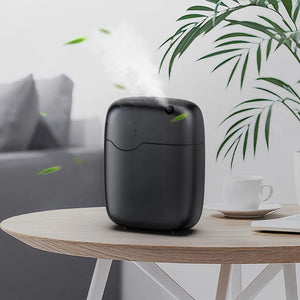


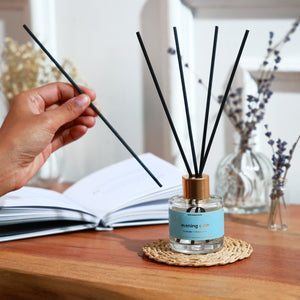
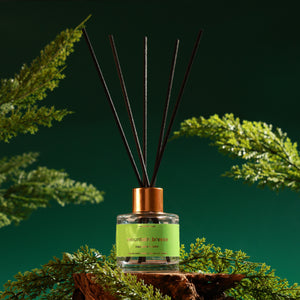
Central or ducted AC: a supply-and-return loop. Fragrance introduced into that loop travels wherever the air travels, which is why the Vaayu offers a wall / HVAC mount as well as freestanding use.
The cycling problem: a fixed-speed compressor stops moving air when it reaches setpoint. Fragrance distribution stops with it. Timers matter for this reason.
The monsoon note: cold-air nebulisation adds no water to a room. An ultrasonic does, which in an air-conditioned coastal house is a real difference.
2. If you have splits, stop treating the AC as a distributor. It is not one. It circulates the air of its own room at speed and does very little for the floor. Keep passive sources several feet out of the jet, and place any machine where the room's general traffic will carry the output, not in front of the unit.
3. If you have ducted air, you own a delivery network — use it. This is where a cold-air machine changes character entirely. The Vaayu is designed to be freestanding, wall-mounted or HVAC-mounted precisely so it can put a dry nano-mist into that stream rather than into one corner of one room.
4. Mind the compressor cycle. A fixed-speed system stops the fan when it reaches setpoint, and distribution stops with it. Many systems have a fan-only or circulate mode; if yours does, that is the setting that keeps scent moving between cooling cycles.
5. Schedule rather than run continuously. The Vaayu's 1h / 4h / 8h / 24h timers exist for this. Match the run to the hours the air is actually moving and the hours people are actually in the space.
6. Prefer waterless in an air-conditioned coastal house. An ultrasonic works by putting water vapour into the room and the fragrance rides on it. A cold-air nebuliser adds no water at all. In Mumbai, Goa or Kochi in August, that is not a marginal distinction.
7. Ventilate before you scent, always. Fragrance is an addition to a room, not a correction to it. Nothing on this page cleans air, removes anything, or does any job an extractor and an open window should be doing first.
The Vaayu is made in India, ships with 400ml of fragrance across four Hotel Collection scents, and a portion of every order supports girl-child education through Nanhi Kali.
Part one — jets, loops and cycles
There are three separate things an air-conditioning system does to a fragrance, and they are worth separating because a homeowner can control two of them without spending anything. The system moves air at a certain velocity in a certain pattern; it either does or does not connect one room to another; and it starts and stops on a thermostat rather than on your schedule. Most large-space scenting failures in air-conditioned Indian homes come from assuming the first two are better than they are, and forgetting the third entirely.
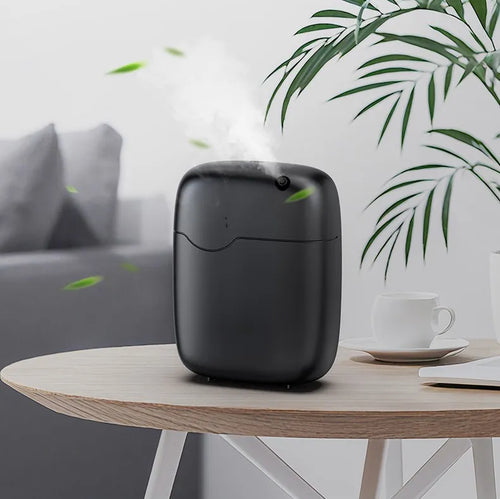
 Vaayu₹11,999 · up to 1000m³A ducted system is a genuine circulation loop: conditioned air goes out through supply grilles into every room on the circuit, crosses those rooms, and comes back through one or more returns to be conditioned again. While the fan runs, the whole floor's air is being continuously stirred and exchanged between rooms. Introduce a dry nano-mist into that loop and you are not scenting a room — you are scenting a circuit. This is the reason the Vaayu lists a wall / HVAC mount alongside freestanding use, and it is the single biggest behavioural difference between this machine and any diffuser you can stand on a sideboard. If you cannot mount into the duct, the next best position is near a return, where the air is on its way back into the system and will take the mist with it. What I will not do is walk you through cutting into your own ductwork: whether a given system can take a mount, and who should do it, is a question for SOSA and your HVAC contractor, not for a blog post.
Part two — every AC setup, and the honest recommendation for it
Find your setup in the first column. The recommendation in the fourth is what I would actually say to a friend with that system and a large open floor to scent, and the fifth column is the mistake I see most often with it.
| Your AC setup | How the air actually moves | Does it link rooms? | What I would do | Common mistake |
|---|---|---|---|---|
| Ducted / VRF with returns ★ | Continuous supply-and-return loop across the floor | Yes — the whole circuit | Vaayu HVAC-mounted, or freestanding near a return | Placing it in the middle of the room for looks |
| Ceiling cassettes, no ducting between rooms | Four-way throw within each room, fast at the edges | No | One machine per connected volume, out of the direct throw | Assuming a cassette circulates the floor |
| Wall-mounted splits, one per room | Narrow high-velocity jet, recirculating one room | No | Machine in the traffic path; reeds several feet off the jet | Standing the diffuser under the unit |
| Window units | Short, turbulent throw close to the wall | No | Same as splits; keep passive sources on the opposite wall | Putting the bottle on the sill beside it |
| Splits plus ceiling fans | Jet plus a slow whole-room stir — the best of the non-ducted options | Partially, through open doorways | Fans on lowest, machine in the doorway traffic path | Switching the fans off to "protect" the scent |
| No AC, fans and open windows | Movement plus continuous air exchange | Yes, but it also removes | Close up for the hour that matters, then run | Running fragrance into a cross-breeze |
| The honest caveat: the great majority of Indian homes, including large ones, are on splits or cassettes rather than ducted air — which means the HVAC-mount advantage described here is simply unavailable to most readers. That does not make the Vaayu the wrong machine for those homes; it means the reason to buy it is its own propulsion and volume rating, not the duct trick. Be clear which argument you are buying on. | ||||
Vaayu · ducted or open-plan₹11,999Shop →  Sukoon · one AC room₹1,899Shop →
 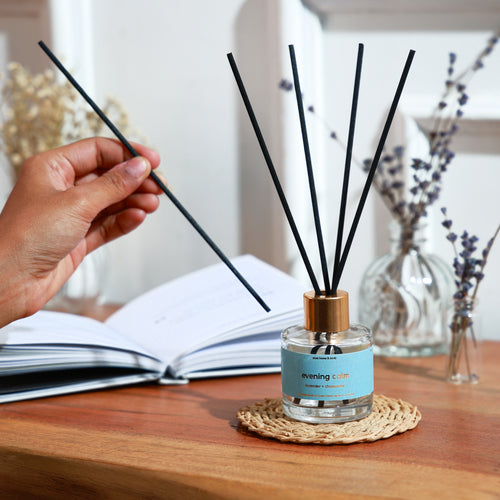 Evening Calm · bedrooms, off the jetfrom ₹799Shop →
Part three — the Indian reality, and when I would tell you not to buy
I want to be careful here, because the HVAC-mount argument is genuinely persuasive and genuinely irrelevant to most of the people it persuades. The great majority of large Indian homes — including four-bedroom flats and a great many villas — run on individual splits or ceiling cassettes. There is no shared duct, no return path, no loop to join. If that is your house, mounting into HVAC is not an option you have, and buying a machine for that capability is buying something you cannot use. The Vaayu may still be right for you, but for a different reason: it produces its own velocity and it is rated for a connected volume of up to 1000m³, which no passive source and no ultrasonic approaches. Buy it on that argument, place it in the traffic path between the doorway and the seating, run the ceiling fans on low, and you will get what you paid for.
There is a second reason air conditioning changes the format choice, and it has nothing to do with distribution. An ultrasonic machine works by putting water vapour into the room; the fragrance rides on it. In a sealed, air-conditioned flat on the Konkan coast in August, adding water to the air is a decision with consequences, and running a 6L tank for a hundred hours is quite a lot of water. This is where the Megh at ₹3,499 gets misread constantly, so let me state it as plainly as I can: the Megh is a runtime and humidity machine covering roughly 215 sq ft — less than the ₹1,899 Sukoon. Its 6 litres buy you about a hundred hours of unattended running, not a bigger room. Nobody should buy it to solve an air-conditioned villa. Cold-air nebulisation, by contrast, adds no water at all, which is why I recommend it for humid climates on physical grounds rather than as any sort of wellness argument — and while we are on that, a scent machine does not clean air, filter anything, or remove any smell. It adds fragrance. Ventilation is a separate job done by separate equipment.
Finally, the thing to settle before you spend ₹11,999, whatever your ductwork looks like. SOSA does not currently sell a separate refill oil for the Vaayu. The machine ships with 400ml — four Hotel Collection cold-air fragrances at 100ml each, in one of three combos you choose at checkout — and that is the entire supply available today. At 90+ days a fill it is a long run, but it is a finite one, and I would rather you know now. The water-based Hotel Collection at ₹299 / ₹999 / ₹1,799 is a different product built for ultrasonic machines; it shares scent names with the cold-air oils and it does not go in a Vaayu. If continuity of supply matters to you — and for anyone running a signature scent across a large home, it should — ask SOSA where refills stand before you commit. The same goes for warranty length, installation service and whether your particular HVAC setup can take a mount: those are questions for SOSA, and I will not invent answers to them here.
Part four — the AC-aware edit
Arranged as a decision sequence. The first three are free and are worth doing whatever you eventually buy; the rest are in ascending order of commitment.
| Step | Why it matters with air conditioning | Best for | Price |
|---|---|---|---|
| 1. Identify jets, returns and dead corners ★ | You cannot place a source correctly until you know which you have | Every home | Free |
| 2. Move passive sources out of the throw | Stops a 50ml finishing well inside its 6–8 week rating | Reed diffusers | Free |
| 3. Use fan-only or circulate mode | Keeps the air moving between compressor cycles | Ducted and inverter systems | Free |
| 4. Reed diffusers in bedrooms off the jet | No electricity, no water, nothing to schedule | Closed rooms up to about 150 sq ft | From ₹749 · 6–8 weeks |
| 5. One Sukoon per air-conditioned room | On-demand scent with timers; 16–18 hrs on low | 270–320 sq ft rooms | ₹1,899 |
| 6. Vaayu freestanding, splits house | Own propulsion; up to 1000m³ regardless of ductwork | Large open floors on split ACs | ₹11,999 |
| 7. Vaayu HVAC-mounted, ducted house | Puts the mist into an existing whole-floor loop | Ducted / VRF systems — confirm the fit with SOSA | ₹11,999 |
| Not an AC answer: the Megh | ~215 sq ft — less than the Sukoon. Runtime and humidity, never coverage | Long unattended running in one room | ₹3,499 |

Versailles
The first time I saw a scenting machine mounted into ductwork was in a hotel lobby, and what struck me was not the machine but how little of it there was. One small unit, out of sight, and a whole floor that smelled deliberate. Nothing on a console. Nothing on a reception desk. The building was doing the work, and the machine was only supplying the material. That is the mental model I would like more homeowners to have before they spend on this category.
The trouble is that the model only transfers if your house has the same plumbing, and most Indian houses do not. We are a split-unit country, for good reasons of cost and retrofitting, and a split unit is a cooling appliance rather than a circulation system. So when someone writes to me from a four-bedroom flat in Gurugram asking whether an HVAC mount will scent the whole place, the honest answer is that there is no HVAC to mount into — and that they should decide on the machine's own merits instead.
What I try to avoid is letting a true statement about one kind of building become a sales argument in another. The Vaayu is a serious piece of equipment and ₹11,999 is a serious amount of money in India. It earns its place in a large connected volume because it makes its own velocity and its mist is dry. If it also happens to join your duct loop, that is a genuine bonus. If it does not, nothing is lost — but you should know which of those two you are buying. And do ask us about refills first. Everything we make is composed in Pune, and a part of every order funds a girl's classroom through Nanhi Kali.
Frequently asked questions
- How does airflow affect fragrance in large open spaces? — the inversion this page builds on.
- Why fragrance disappears in a double-height room — stratification, and what to do about it.
- Can the Vaayu scent a large open-plan home? — including how to measure your own volume first.
- The complete large open-space guide — this page and the eight around it, in one place.
- Brand: the SOSA founder story.
SOSA Vaayu specifications (verified from the live product page, August 2026): ₹11,999 (the product page displays a rounded ₹12,000). Waterless cold-air nebulisation — pressurised air atomises undiluted fragrance oil into a dry nano-mist; no water, no heat, residue-free. Coverage up to 1000m³, about 2,000–3,000 sq ft. 400ml refillable tank, 90+ days per fill at a mid intensity setting. Bluetooth app plus onboard buttons, 1h / 4h / 8h / 24h timers, adjustable mist intensity, auto-stop and key-lock. Under 38 dB. DC 12V / 1A, 5W. 165 × 80.5 × 215 mm, 0.9 kg, black or white. Freestanding or wall / HVAC mount. CE, RoHS and SGS certified. Ships with four SOSA Hotel Collection fragrances at 100ml each (400ml in total) in one of three combos chosen at checkout. SOSA does not currently sell a separate Vaayu refill oil; the 400ml supplied in the box is the fragrance available at the time of writing, and buyers who need long-term supply should confirm current refill availability with SOSA before purchasing. The cold-air oil supplied with the Vaayu is a different product from the water-based Hotel Collection sold for ultrasonic machines (15ml ₹299 · 100ml ₹999 · 300ml ₹1,799), which must not be used in a Vaayu despite sharing scent names. Other SOSA machines: Boond 300ml ₹899 (~150 sq ft) · Sukoon 500ml ₹1,899 (270–320 sq ft) · Megh 6L ₹3,499 (~215 sq ft — a runtime and humidity machine, not a coverage upgrade) · Aangan ₹25,999 (~8,000–10,000 sq ft) · Meenar ₹38,500 (12,000–18,000 sq ft) · Safar car diffuser ₹3,999. Reed diffusers 50ml ₹749–₹849 (6–8 weeks) · 130ml ₹1,249–₹1,349 (14–18 weeks) · duo sets ₹1,498–₹1,598 · oil-only refills 300ml ₹2,399 / 500ml ₹3,499. Runtime, consumption and coverage figures are manufacturer specifications and vary with intensity setting, run hours, ceiling height, ventilation and season; any per-month or per-day figure in this guide is arithmetic on those specifications, not a measurement. Electricity costs vary by state tariff. No claim is made that scenting affects ratings, reviews, bookings, occupancy, revenue, health, mood or air quality. Free shipping above ₹499. A portion of every order supports girl-child education through Nanhi Kali. Prices subject to change — see the live product pages.