
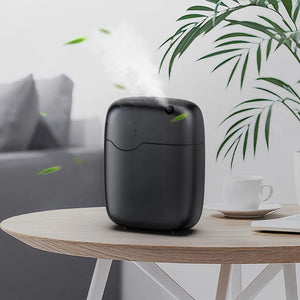


The target: detectable but unnameable. A parent should be unable to say what it is, or whether there is anything there at all.
The correction: if anyone comments on the fragrance, halve it the same afternoon. A comment is not a compliment in this building.
The boundary: reception and admin only. All seven clinical zones stay fragrance-free at any dose.
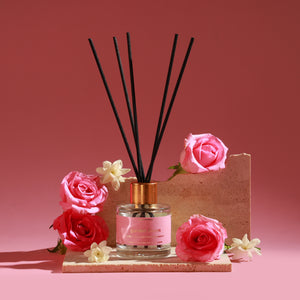
2. Know what the numbers are. A reed diffuser ships with six reeds; use three. A Sukoon runs three to six drops; use three, in intermittent rather than continuous mode. A Vaayu sets intensity as seconds on against seconds off; start at the shortest on-time and the longest off-time the unit offers, and schedule it to clinic hours only — there is no reason to scent an empty building overnight, and running only when occupied roughly halves consumption as well.
3. Aim below the naming threshold. There are three levels a room can sit at. Undetectable. Detectable but unnameable — the parent registers that the air is pleasant without being able to say why. Identifiable — the parent could tell you it is a white tea. The premium band is the middle one and it is narrower than most people expect. Above it the room reads commercial, and a suspicious parent starts wondering what is underneath.
4. Treat any comment as a fault report. In a hotel, a guest remarking on the lobby scent is the system working. In a children’s clinic it is the signal to reduce, because a parent who noticed the fragrance strongly enough to mention it has been sitting in a dose that a wheezy four-year-old is also sitting in. Halve it the same afternoon. This single rule, applied honestly, prevents the majority of over-scented clinics we are called in to fix.
5. And resist the urge to buy your way up. The instinct when a room does not feel premium is to buy a bigger machine. It does not work that way. The Vaayu at ₹11,999 belongs in a clinic only where a large lobby or a separately ducted reception justifies it, and its value there is the duty cycle — it can run far lower than a passive diffuser’s floor. Note too that the Megh at ₹3,499 holds 6L but covers only about 215 sq ft, less than the 500ml Sukoon: tank size buys runtime and humidity, not reach.
Made in India, composed by an ISIPCA Versailles-trained perfumer — and a portion of every order supports girl-child education through Nanhi Kali.

Why a low dose reads as expensive and a high one does not
The association between intensity and cheapness is learned, and it is learned very thoroughly. The scented products most people meet daily are dosed to prove they are working: the aerosol freshener, the taxi hanging, the agarbatti in a shop doorway, the corridor of a budget hotel. All of them announce themselves, because announcing themselves is the product promise. The environments people read as expensive do the opposite — the note is present at a level that has to be inferred rather than identified, and the inference is what does the work. The same molecules, at two different doses, land in two different social categories. This is why blend selection is a much smaller decision than clinics believe. You cannot buy your way past a bad setting with a better oil, and you do not need an expensive oil to get the effect if the setting is right.
In a paediatric clinic a second, entirely independent argument arrives at the same number, which is unusual and worth exploiting. The room is occupied for thirty to sixty minutes at a stretch, by children who are unwell, sometimes nauseated and sometimes asthmatic, whose breathing zone sits roughly 0.8–1.2 m from the floor against an adult’s 1.5–1.7 m — so a unit at desk height doses the child more heavily than the parent standing beside them. Added fragrance is a recognised trigger for some people with respiratory sensitivity, and paediatric lists carry asthma, allergic rhinitis and post-viral cough as a matter of routine. Restraint is therefore not merely the aesthetic answer here; it is the conservative one. When the taste argument and the caution argument point at the same setting, take it and stop negotiating with yourself.
The three levers, in the order they matter
 Three drops, not six₹1,899Halve whatever the packaging suggests, then halve the running time. Three reeds in the neck of the bottle rather than six roughly halves the evaporative surface. Three drops on a Sukoon in intermittent mode rather than six in continuous is a larger reduction again. On a waterless machine, the duty cycle is the reason the equipment is usable in healthcare at all: seconds on against seconds off lets it sit below the floor of any passive diffuser. A clinic that starts at the minimum and never raises it has solved this question permanently.
What dose belongs where
Every row that carries a dose carries the lowest one the equipment can hold. Every row that does not carry a dose carries nothing at all, at any setting.
| Area of the clinic | Scented? | Why | What we would use |
|---|---|---|---|
| Entrance and reception desk ★ | Yes — minimum | Fresh noses and short dwell; this is where a barely-there note is actually perceived | Three drops on Sukoon, or three reeds |
| Billing and administrative area | Yes — same source | Staff-facing, no seated patients; it does not need or deserve a second unit | Whatever reception runs, nothing additional |
| Parent and child waiting seating | Minimum, or nothing | Thirty to sixty minutes of exposure and a child’s breathing zone at 0.8–1.2 m from the floor | Reception’s source only, mounted high, aimed away |
| Consultation and examination rooms | No dose is low enough | Clinicians rely on unaltered air; a low dose is still an added odour in a diagnostic room | Nothing |
| Vaccination, injection and procedure rooms | Never | The association risk does not scale down with dose — presence at the moment is what matters | Nothing |
| Nebulisation, asthma, neonatal and isolation areas | Never | Respiratory patients and newborns; added airborne load is the thing being avoided at any level | Nothing |
| Before any of this: the dose conversation only starts once the room smells of nothing to begin with. Disinfectant choice and dilution, lidded bins emptied on a schedule, AC filter and drain pan, damp under basins, and airing before opening — all of it comes first. | |||
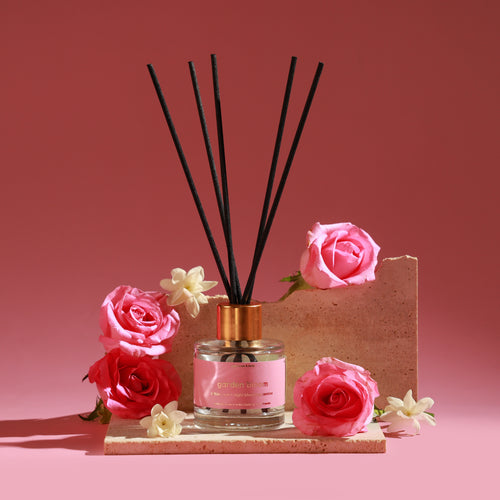 Small reception · no power neededFrom ₹749Shop → Mid reception · has an off switch₹1,899Shop →
 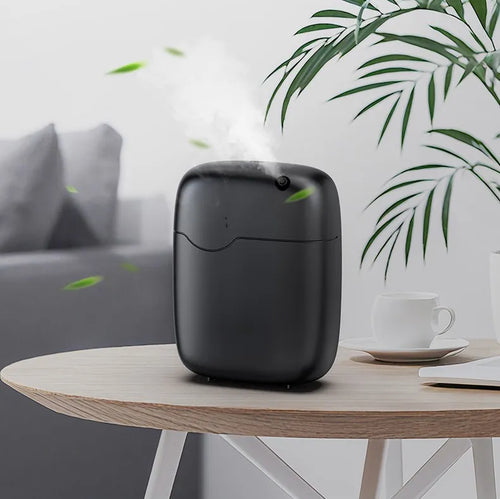 Large lobby · timed, dialable₹11,999Shop →
The calibration routine, and the trap inside it
Start at the minimum and stay there for a fortnight before you touch anything. The first week is not a fair test: a new fragrance in a room that has never carried one reads stronger than it will once the space has settled, and the temptation is to conclude either that it is too much or, more often after a few days of adaptation, that it is doing nothing. Run three drops on a Sukoon or the shortest cycle on a Vaayu, scheduled to clinic hours, and leave it alone.
Then judge it with a nose that has been outside for thirty minutes. Olfactory adaptation is essentially complete within about twenty minutes of arriving, so by ten in the morning nobody on the premises can assess the level — and because they cannot smell it, they conclude it has stopped working and ask for more. That is the trap, and it accounts for more heavy clinic receptions than every other cause combined. Give the job to someone walking in from the street, or step out for half an hour and judge your own first breath on return. Repeat a fortnight after install, at every refill, and at the start of monsoon, when humidity pushes the same setting noticeably higher.
Finally, build the reduction path in before you need it. The clinic should be able to switch the unit off within seconds, and staff should know they are allowed to, without asking, for a family with a scent-sensitive or asthmatic child. A plainly worded line at the desk — that the reception carries a light fragrance and it will be switched off on request — converts a potential complaint into evidence of care. And the whole decision, including the dose, belongs with your clinic’s own clinical governance, infection-control and housekeeping leads rather than with a fragrance supplier.
What we would actually install
Matched to reception size and run at the bottom of its range in every case. Note that the cheapest options here are also the hardest to over-dose, which is not a coincidence.
| Option | Suits | Control you get | Price |
|---|---|---|---|
| Reed diffuser | A small reception desk — up to about 150 sq ft on three reeds; no settings to creep upward and nothing for a child to switch on | Reed count only — no switch, no timer | from ₹749 |
| Sukoon 500ml ★ | A reception up to ~320 sq ft — up to about 320 sq ft at three drops, intermittent, clinic hours only — the lowest-risk active option | On/off, intermittent mode, you control the drops | ₹1,899 |
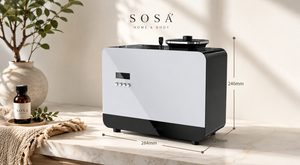
| Vaayu | A large lobby or a zoned duct — a large lobby or separately ducted reception, valued for the duty cycle rather than the output | Duty cycle in seconds, timer, app scheduling | ₹11,999 |
| Aangan | Whole-facility HVAC — a zoned 8,000–10,000 sq ft facility, at zone level, with clinical branches excluded at the duct | Zone-level control, but only if the ducting is zoned | ₹25,999 |
| Nothing at all | Any clinic that has not yet run the housekeeping list, and any facility centred on newborn, respiratory or infectious care | Complete — and the correct answer more often than the trade admits | ₹0 |
Versailles
The most expensive-smelling rooms I have worked in were not the most heavily scented — they were the ones where I had to stop and think about whether there was anything there at all. That hesitation is the effect people are paying for, and it is produced by dose, not by the price of the oil. A ₹299 bottle of white tea at three drops will out-perform a far more expensive fragrance run at six, every time, in every room I have ever set up.
Clinics do not usually over-scent on purpose. It happens through a sequence that is almost identical every time: the unit goes in, everyone is pleased, three weeks later the staff cannot smell it because they are adapted, someone turns it up, the parents start noticing, and by the second month the reception is heavy and nobody inside the building knows. If you take one operational thing from this page, let it be the outside nose. It costs nothing and it is the only reliable instrument you have.
And there is a limit to what fragrance can contribute to feeling premium in a children’s clinic, which I say as someone who sells it. Lighting temperature, the noise level, the state of the seating and how long people wait will all outrank it. Get those right, run a dry note at the desk at the bottom of its range, keep every clinical room clear, and let your own governance people set the policy. A portion of every order funds a girl’s classroom through Nanhi Kali.
Frequently asked questions
- How subtle is subtle enough? — the threshold, in practical terms.
- Stopping a machine over-scenting — duty cycle, schedule, placement.
- Lower intensity than a salon or hotel? — yes — and by how much.
- What actually reads as premium — and where fragrance ranks.
- Brand: the SOSA founder story.
SOSA products & prices (verified August 2026): Hotel Collection water-based ultrasonic diffuser fragrance 15ml ₹299 · 100ml ₹999 · 300ml ₹1,799 · Pack of 7 (15ml, all fragrances) ₹1,799; refills 100ml from ₹999. Seven scents: The Ritz-Carlton-inspired (white tea · bergamot · cedar), Westin-inspired (white tea · aloe · cedar), 1 Hotels-inspired (cedarwood · vetiver · green leaves), The St. Regis-inspired (amber · violet · woods), Shangri-La-inspired (jasmine · green tea · white tea), Four Seasons-inspired (citrus · floral · sandalwood), W Hotels-inspired (citrus · pepper · amber). Diffusers: Boond 300ml ₹899 · Sukoon 500ml ₹1,899 · Megh 6L ₹3,499. Water-based, phthalate-free, composed to IFRA standards for home diffusion; 3–6 drops per tank. Made in India, Pune. The Hotel Collection scents are SOSA's own interpretations inspired by the world's finest hotels; all hotel names are trademarks of their respective owners and are used only to describe the scent style — SOSA is an independent Indian fragrance house, not affiliated with or endorsed by any hotel brand. Prices and availability subject to change — see the live product pages.