

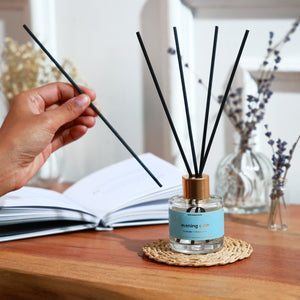


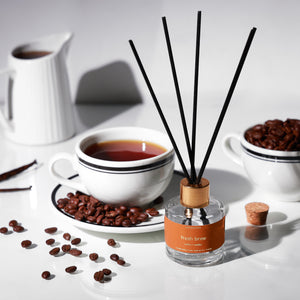
Good addresses: a console beside the front door, a passage shelf, a sideboard on the route between rooms, a windowsill out of direct sun.
Bad ones: inside cabinets, behind sofas, low shelves, on top of the fridge, directly under an AC vent, in full sunlight.
2. Put it on a path, not on a surface. Think about where air actually travels: through doorways, along passages, up stairwells, past a window that is opened daily, along the route people walk between rooms. A sideboard on that circuit is worth more than a grander shelf away from it.
3. Get it to waist or chest height. Floor level and the lowest shelf of a unit sit in the stillest, coolest layer of the room and well below nose height. A console, a sideboard, a mantel or an open shelf is the right range for a room you want to notice it in.
4. Leave air on at least two sides. A bottle in the back corner of a bookcase is enclosed on three, and the fabric near it — curtains, cushions, upholstery, rugs — absorbs fragrance steadily. Bring it forward from the wall and clear of the curtain.
5. Avoid sun, vents and bare wood. Direct sunlight fades the fragrance and warms the oil. A vent or fan empties the bottle quickly and pushes everything against one wall. And reed oil marks polished wood and untreated stone permanently, so stand it on a tray.
Made in India, composed by an ISIPCA Versailles-trained perfumer — and a portion of every order supports girl-child education through Nanhi Kali.
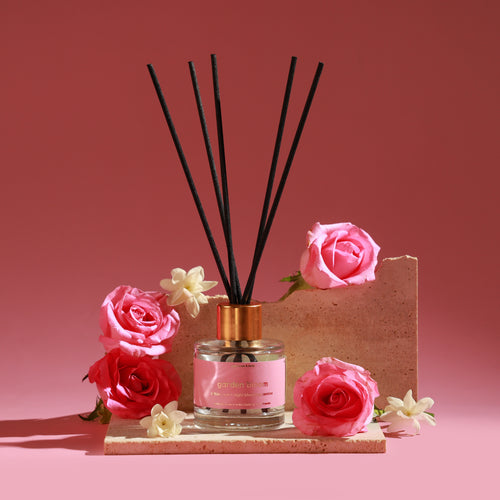
Air in a house does not wander — it runs along paths
The reason placement matters so much is that household air is not evenly stirred. It moves along a small number of routes, and those routes are set by architecture and habit: the front door opening and closing, the corridor between the bedrooms and the hall, the stairwell, the window that gets opened every morning, the kitchen doorway, the path people take from the sofa to the fridge. Between those routes sit pockets of air that barely exchange with anything for hours — the alcove, the closed cabinet, the space behind a sofa, the shelf under a television. Put a reed on a route and the whole floor gets it; put it in a pocket and the pocket gets it. The bottle is identical in both cases.
This is why placement is the first thing to fix and the last thing people try. It is free, it is completely reversible, it takes about ten seconds, and it changes the outcome more than reed count, blend choice or bottle size. There are limits, of course. Placement cannot make one bottle cover a space far larger than the roughly 150 sq ft it is rated for, and it cannot overcome a set of reeds that have clogged after two or three months. It also has three hard exclusions of its own — sunlight, direct airflow from a vent or fan, and bare polished or stone surfaces — which are about protecting the fragrance and your furniture rather than about throw. Within those limits, though, the shelf is the most powerful decision you will make.
The five variables, ranked
Good addresses and bad ones
Most homes contain all of these. The difference between the top of this table and the bottom is larger than the difference between any two bottles in the range.
| Where the bottle stands | What happens there | Verdict |
|---|---|---|
| Console beside the front door ★ | Air changes every time the door opens; everybody passes it | The best address in most Indian homes |
| Passage shelf or sideboard on a route | Constant gentle movement from people walking through | Excellent — reaches rooms on both sides |
| Windowsill out of direct sun | Exchange with outside air whenever the window is opened | Very good, provided the sun never lands on it |
| Low shelf or TV unit | Still, cool air well below nose height | Poor — raise it to waist or chest height |
| Inside a cabinet, or behind a sofa | Almost no air exchange; fabric absorbs what escapes | The commonest reason a good bottle seems weak |
| Under an AC vent, or on the fridge | Empties fast, and the scent is pushed to one wall | Avoid entirely — this shortens the bottle for nothing |
| Whichever you choose: stand it on a tray, out of reach of children and pets, and never decant it. See all five reed diffusers — 50ml from ₹749, 130ml from ₹1,249. | ||
The reed range · five scentsFrom ₹749Shop → 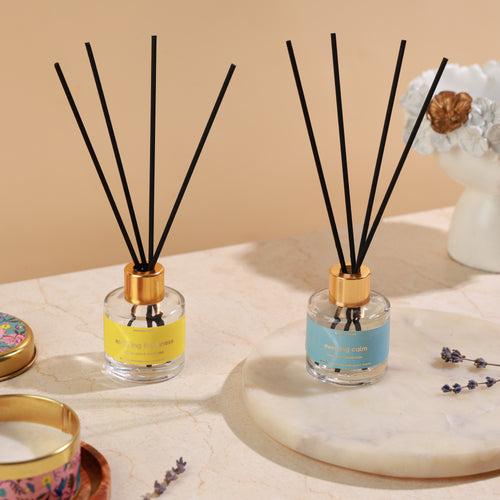 Day & Night duo · two rooms₹1,498Shop →
 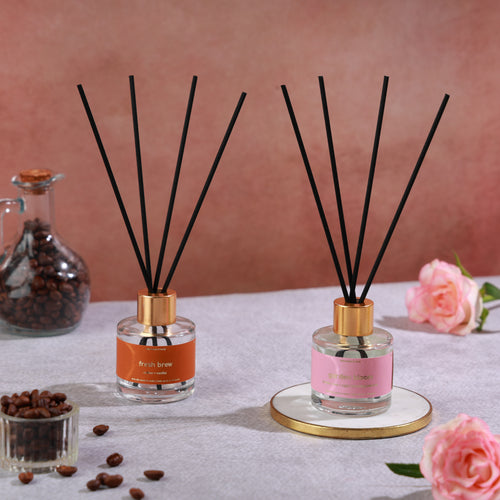 Refills · 300ml₹2,399Shop →
Reeds, placement and flipping — the three things you control
Settle placement first, then set reed count, because changing both at once teaches you nothing about either. Six fibre reeds come with every bottle: six for an entrance, a hall, a living room or a kitchen; four for a bedroom; two or three for a small bathroom. A good address on four reeds will usually beat a poor one on six, which is a useful thing to know before you decide the product is at fault. Never use more than the six supplied, and never top up or dilute the liquid — a thinned composition throws less, not more.
Placement itself has three hard exclusions, and they are worth repeating because each of them costs money in a different way. Direct sunlight fades the fragrance and warms the oil, so a sunny sill is a false friend. The direct blast of an AC vent, a ceiling fan or an exhaust fan empties the bottle quickly and drives the scent against one surface. And bare polished wood or untreated stone will be marked permanently if the bottle is knocked or a reed drips during a flip — a tray or a coaster costs nothing and solves it. Keep the bottle out of reach of children and pets, never decant it into another container, and never leave it somewhere it can be pulled over.
Flipping is the last thing to add, once the bottle has found its address. Every three to five days, saturated-end up, with a tissue and over the tray — a genuine refresh that lasts a day or two and costs a little bottle life. Do it on the morning of a day you are hosting rather than every morning. And keep an eye on the reeds themselves: at two or three months the fibre loads up with heavier fragrance molecules, wicking slows, and no shelf in the house will compensate. Fit the fresh six that came with your next bottle, and use a 300ml refill at ₹2,399 rather than buying new glass.
Where to put it, room by room
The best address in each room of a typical Indian home, with the bottle and reed count I would pair with it. Every price is the real one.
| Room | Where to stand it | What to buy |
|---|---|---|
| Entrance or foyer ★ | Console beside the door, waist to chest height, on a tray | Morning Freshness 130ml · six reeds · ₹1,249 |
| Living room | Sideboard on the route to the passage or kitchen, not behind the sofa | Mountain Breeze 130ml · six reeds · ₹1,349 |
| Bedroom | Chest of drawers across the room from the bed, never the bedside | Evening Calm 130ml · three or four reeds · ₹1,299 |
| Bathroom | Shelf near the extractor, out of the shower spray and off the sill | Morning Freshness 50ml · two or three reeds · ₹749 |
| Study or reading corner | Open shelf near the door rather than on the desk | Fresh Brew 130ml · six reeds · ₹1,349 |
| Two rooms at once | The two best addresses in the flat, at opposite ends | Day & Night duo 50ml × 2 · ₹1,498 |
Versailles
I ask for a photograph before I answer any question about weak throw, and the photograph almost always contains the answer. Bottles are put where there is a gap on a shelf, not where air moves, because nobody thinks of home fragrance as having a delivery problem. It does. The fragrance is made at the tips of six reeds and it has no legs.
The pattern in Indian homes is remarkably consistent. The best address is usually the console or shoe cabinet beside the front door, because that door opens several times a day and everybody who arrives walks straight past it. The worst is a closed display cabinet in the drawing room, which is where the prettiest bottles tend to end up.
So run the test before you spend anything. Two shelves, forty-eight hours each, judged by somebody walking in from outside. It is free, it is reversible, and it settles the question better than any recommendation I could give you. A portion of every order supports girl-child education through Nanhi Kali.
Frequently asked questions
- Why does it only smell up close? — the still-air problem, explained.
- How to make a reed diffuser smell stronger — every lever, ordered by cost.
- My reed diffuser smells weak — the ten-minute triage.
- The complete scent throw guide — placement, count and reed condition.
- Brand: the SOSA founder story.
SOSA products & prices (verified August 2026): Hotel Collection water-based ultrasonic diffuser fragrance 15ml ₹299 · 100ml ₹999 · 300ml ₹1,799 · Pack of 7 (15ml, all fragrances) ₹1,799; refills 100ml from ₹999. Seven scents: The Ritz-Carlton-inspired (white tea · bergamot · cedar), Westin-inspired (white tea · aloe · cedar), 1 Hotels-inspired (cedarwood · vetiver · green leaves), The St. Regis-inspired (amber · violet · woods), Shangri-La-inspired (jasmine · green tea · white tea), Four Seasons-inspired (citrus · floral · sandalwood), W Hotels-inspired (citrus · pepper · amber). Diffusers: Boond 300ml ₹899 · Sukoon 500ml ₹1,899 · Megh 6L ₹3,499. Water-based, phthalate-free, composed to IFRA standards for home diffusion; 3–6 drops per tank. Made in India, Pune. The Hotel Collection scents are SOSA's own interpretations inspired by the world's finest hotels; all hotel names are trademarks of their respective owners and are used only to describe the scent style — SOSA is an independent Indian fragrance house, not affiliated with or endorsed by any hotel brand. Prices and availability subject to change — see the live product pages.