
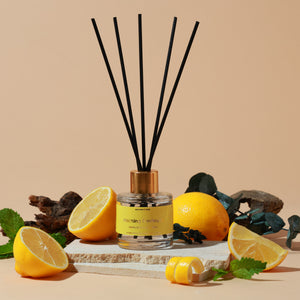
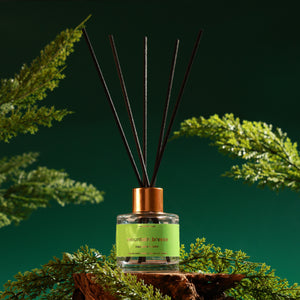
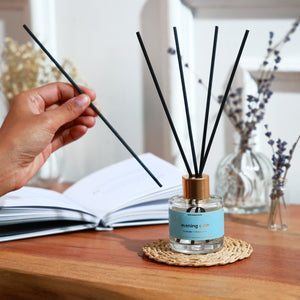

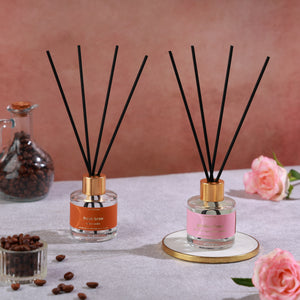
The worst case is direct sun on the glass, not ambient heat — a sunlit bottle goes flat within a week while still looking half full, because sun accelerates the lightest, most volatile part of the fragrance specifically.
The fix costs nothing: move the bottle out of sun and airflow, and match the reed count to the season. Only consider the 130ml at ₹1,299 if the room is genuinely above 150 sq ft.
2. But reed count is the bigger lever. Going from six reeds to four roughly doubles the exposed wicking surface's effect in reverse — the same bottle that ran six weeks at six reeds can run closer to nine at four, in the same room, in the same heat. Heat is the second-largest variable in how fast a bottle finishes. Reed count is the first, and unlike the weather, you set it.
3. Direct sun is a different failure and the worst case. Sun on the glass heats the oil well above room temperature and accelerates the lightest, most volatile materials specifically — not the whole fragrance evenly. A sunlit bottle goes flat and dull within a week while still looking half full: the bright opening is gone and only the heavier base remains. That is not the bottle finishing early; it is the bottle going flat while oil is still inside it, and the two need different fixes.
4. The other accelerators, in order: a draught or fan directly on the reeds; an AC return-air path, which strips scent off the fibres and dilutes it before it reaches the room, so the bottle empties faster and smells weaker at the same time; six reeds where three would genuinely do; and a room above 150 sq ft asking a 50ml to do a 130ml's job.
5. The fix costs nothing, mostly. Move the bottle out of sun and out of any airflow, keep it 300mm off any sill, and drop to four reeds for the sealed AC months. Only after that is done should you consider the 130ml at ₹1,249–₹1,349, and only if the room is genuinely large.
SOSA reed oil is tested through 45°C heat and 85% humidity, and its carrier is alcohol-free fractionated coconut oil rather than an alcohol or water base — which is why the fragrance does not flash off the way an alcohol-carried scent does in heat. That is a real product fact, not a claim of immunity to it. Composed by an ISIPCA Versailles-trained perfumer, handmade in small batches in Pune, and every purchase funds a girl's education through Nanhi Kali.
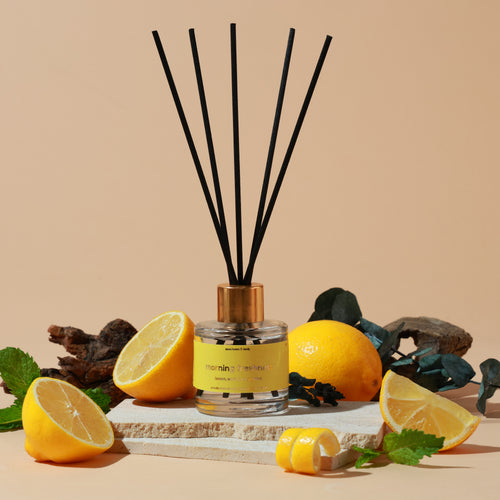
Why heat empties the bottle faster — and why that is not the same as smelling stronger
A reed diffuser works by capillary action: oil climbs the fibre reeds and evaporates off the exposed ends into the room. Evaporation rate is a function of temperature — the hotter the surface, the faster molecules leave it. In a 24°C room the oil at the tip of each reed evaporates slowly and steadily. In a 42°C Delhi living room in May, the same reed tip is losing oil markedly faster, because the molecules simply have more thermal energy pushing them off the surface. This is not a SOSA-specific effect; it is true of any reed diffuser, from any brand, anywhere.
Here is the part that feels contradictory and is not. A hot room genuinely smells stronger at the same time as the bottle is emptying faster — both are the same evaporation increase, read two different ways. More oil leaving the reeds per hour means more fragrance molecules in the air right now, which is why a bottle can smell noticeably livelier in June than it did in February. People read that stronger smell as the product working better, and are then caught out three weeks later when the bottle is dry ahead of schedule. The strength and the depletion are not two separate facts to reconcile — they are one fact, evaporation rate, described from two ends.
The practical upshot is that a hot room is not a good judge of how long a bottle will last, because your nose is telling you the room smells fine right up until the reeds run dry. The honest way to track it is by the calendar, not by the nose: note the date you opened the bottle, and expect the six-week mark at six reeds in peak summer rather than waiting to be told by an empty bottle. That is also why the fix is dosage, not detection — you cannot smell your way to knowing a bottle is two weeks from empty, but you can plan for it.
The three accelerators worth checking, in order
 Any SOSA reed bottlefrom ₹749Ambient room heat raises evaporation broadly across the whole fragrance. Direct sun on the glass does something different: it heats the oil locally, well above room temperature, and accelerates the lightest, most volatile materials — the citrus and green top notes — far faster than the heavier base. That is why a bottle left on a sunlit windowsill can go flat and dull within a week while it still looks half full in the glass. The oil has not gone; the bright opening has, and only the quieter, heavier notes remain. This is a distinct failure from simply running dry, and worth telling apart, because the fix for a flat-smelling half-full bottle is different from the fix for an empty one.
Ranking the causes, so you fix the free ones first
Most Delhi flats have more than one of these running at once — a bottle can sit in afternoon sun on a table that is also in the path of a split AC. The table below ranks the accelerators by how much they change the outcome and what it costs to fix each one, so you know which to check before spending anything.
| Accelerator | What it does | What you notice | Fix |
|---|---|---|---|
| Direct sun on the glass | Heats oil locally, strips the lightest top notes specifically | Flat, dull smell within a week — still half full | Move it — ₹0 |
| Draught or fan on the reeds | Increases airflow across the fibre surface | Empties noticeably faster than the calendar suggests | Move it — ₹0 |
| AC return-air path | Strips scent off the fibres and dilutes it before it reaches the room | Empties faster and smells weaker — both at once | Move it — ₹0 |
| Six reeds where three would do | Roughly doubles the exposed wicking surface | Roughly doubles the depletion rate for no gain in a small room | Drop reeds — ₹0 |
| Room above 150 sq ft on a 50ml | Same oil volume asked to fill more air | Reads weak regardless of reed count or season | Move up to a 130ml — ₹1,249 |
| Plain heat, everything else already right | Raises evaporation rate at the fibre surface | ~6 weeks at six reeds in peak summer vs ~7–8 in cool months | Nothing free left to fix — adjust reed count instead |
| Note: the first four rows cost nothing and, taken together, change how fast a bottle finishes more than the season does. Check all four before buying anything different — heat is real, but it is rarely the whole story on its own. | |||
Morning Freshness · Apr–Jun50ml ₹749Shop → 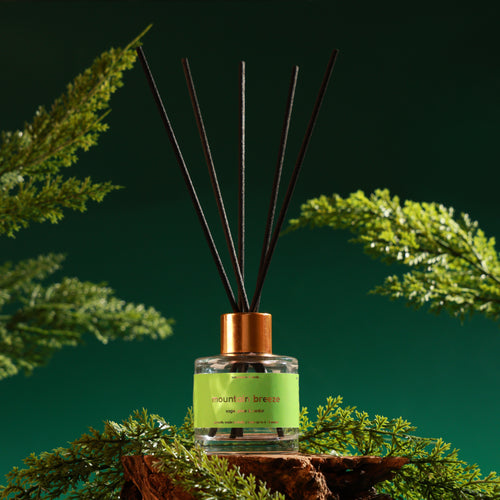 Mountain Breeze · Jul–Aug50ml ₹849Shop →
 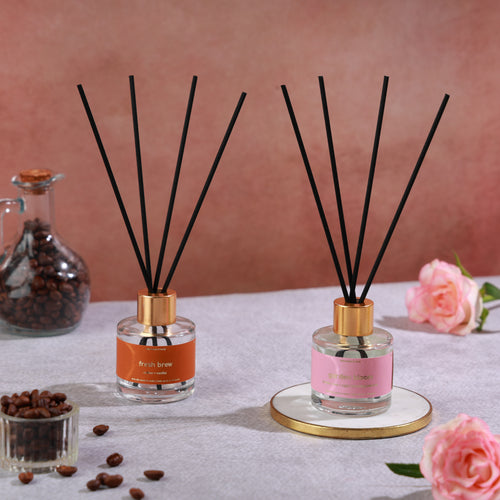 300ml refill · running cost₹2,399Shop →
The Delhi reed schedule — the practical takeaway
The single change that does the most good in a Delhi flat costs nothing and takes thirty seconds: match the reed count to the season rather than leaving all six in year-round. April to June, the driest and hottest stretch, run four reeds — dry air already disperses scent efficiently, and four is enough to be noticeable without accelerating an already-hot room into a six-week bottle. July to August, once the monsoon humidity sets in, drop to three reeds — humid air holds fragrance closer and longer, so the same bottle reads heavier at the same reed count, and three keeps it from turning cloying while roughly halving cost per week. November to February, Delhi's cool dry season, is the one stretch where you can run five to six reeds without either heat or humidity working against you, and it is also when a bottle lasts closest to its full eight-week potential.
Placement does the rest. Keep the bottle at least 300mm off any windowsill, regardless of season — this clears both direct sun and the draught that collects at a sill. Keep it out of a split AC's direct throw and off the return-air path entirely; a console or shelf away from the vent line holds the fragrance in the room rather than pulling it into the duct. Flip the reeds saturated-end up every three to five days as usual — this does not change with heat, but it matters more in summer, because a reed that has stopped drawing in a hot room reads as an empty bottle days before it actually is one.
One caution in the other direction: do not over-correct by running Delhi's dry pre-monsoon weeks on three reeds because "the heat means less is more." Dry, dusty air disperses scent fast and thin, which is the one case in the diagnostic library where four or five reeds is the right call rather than three — three reeds is a monsoon-humidity answer, not a general hot-weather one. Match the reed count to what the air is actually doing — dry heat, humid heat, or cool and dry — rather than to the thermometer alone.
What Delhi heat actually costs, per week and per day
Every figure below is worked from the reed-count-to-weeks relationship above — six reeds running roughly six weeks (42 days) through Delhi summer, four reeds stretching that to roughly nine weeks (63 days), and three reeds in the humid weeks stretching further to roughly twelve (84 days) — divided against the actual shelf price to the rupee.
| Route | Weeks (Delhi season) | Cost per week | Cost per day |
|---|---|---|---|
| Six reeds, ₹749 bottle, Apr–Jun | ~6 weeks | ₹125 | ₹18 |
| Four reeds, same ₹749 bottle, Apr–Jun | ~9 weeks | ₹83 | ₹12 |
| Three reeds, same ₹749 bottle, Jul–Aug | ~12 weeks | ₹62 | ₹9 |
| 130ml, ₹1,249, large room, six reeds | 14–18 weeks | ₹69–₹89 | ₹10–₹13 |
| 300ml refill, ₹2,399 — running cost | six 50ml-equivalent fills | ₹400 a fill | |
Versailles
This question comes to me every May, almost always in the same worried shape: is my diffuser faulty, or is it just Delhi? It is neither, quite. The heat is real and it does finish a bottle faster — I will not pretend otherwise, and I would rather you know the number than guess at it. But in nine years of doing this, the flats that burn through a bottle in four weeks flat almost never have a heat problem alone. They have six reeds in, a windowsill with an afternoon of sun on it, or a bottle standing in the exact path of a split AC's return.
What I want people to take from this is not a warning about summer. It is that you have more control over this than the weather gives you credit for. Move the bottle three feet, pull two reeds out, and you have done more for that bottle's lifespan than any reformulation of mine could. I test every batch through 45°C and 85% humidity because Delhi and Chennai and Mumbai are real markets, not edge cases — but no formulation removes the physics of evaporation, and I would rather tell you that plainly than sell you a bigger bottle for a placement problem.
If you take one thing from this page, let it be the seasonal reed count: four through the summer, three through the humid weeks, five or six once winter arrives. It costs nothing, and it is the difference between a bottle that lasts six weeks and one that lasts twelve. Every purchase funds a girl's education through Nanhi Kali — not a percentage, not a quarterly cheque. Every one.
Frequently asked questions
- Best home fragrance for a Delhi apartment with AC running all summer — the sealed-room half of this problem.
- Best reed diffuser for a 120 sq ft bedroom in Delhi — sizing the bottle to the room, not just the season.
- What home fragrance lasts in a Delhi 2BHK without constant spraying — the always-on answer for a bigger flat.
- Best clean-smelling home fragrance for Delhi's dusty weather — the dry-season reed count, in full.
- Brand: the SOSA founder story.
SOSA products & prices (verified August 2026): Scented candles from ₹379 (small, ~15–18 hrs) · candle duos ₹664 (~30–36 hrs) · wax melts ₹474 · woodenwick and ceramic jar candles ₹949. Reed diffusers: Morning Freshness 50ml ₹749 · 130ml ₹1,249 · Evening Calm 50ml ₹799 · 130ml ₹1,299 · Garden Bloom 50ml ₹799 · 130ml ₹1,299 · Fresh Brew 50ml ₹849 · 130ml ₹1,349 · Mountain Breeze 50ml ₹849 · 130ml ₹1,349; six fibre reeds and refillable glass with every bottle, 50ml lasts 6–8 weeks at six reeds and longer at three, 130ml 14–18 weeks. Reed duo sets 2 × 50ml ₹1,498–₹1,598 · 2 × 130ml ₹2,498–₹2,598. Reed refills 300ml ₹2,399 · 500ml ₹3,499. Ultrasonic diffusers: Boond ₹899 (USB) · Sukoon ₹1,899 (ships with three 15ml fragrances) · Megh ₹3,499; Hotel Collection water-based fragrance 15ml ₹299 · 100ml ₹999 · 300ml ₹1,799 — a fragrance for a machine, not a standalone product. Reed oil and the water-based Hotel Collection are not interchangeable. Alcohol-free, phthalate-free, paraben-free, IFRA-compliant, tested through 45°C heat and 85% humidity; composed and handmade in small batches in Pune. Every purchase funds a girl's education through Nanhi Kali. Prices and availability subject to change — see the live product pages.