



What that means practically: prepare the areas nobody prepares. Utility, services, plant and pump rooms, the terrace, the parking bay, the staff quarters. An adviser will reach them and a first-time buyer would not.
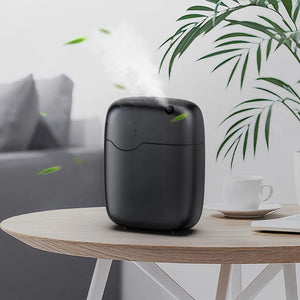
The scent part, honestly: the same register as any other viewing — clean, quiet, unremarkable — at a lower level, held steady across a visit that may run two hours. The Vaayu at ₹11,999 does this because it is adjustable and waterless. Fragrance never covers a defect an adviser is about to find.
2. So prepare the areas nobody prepares. The services cupboard, the utility, the pump or plant room, the terrace and its waterproofing, the parking bay, the staff accommodation, the shafts. A first-time buyer looks at the living room. An architect opens the panel next to the meter.
3. Assume the viewing is long and scheduled around them. Ninety minutes is normal and two hours is not unusual, often at an hour that suits a buyer flying in rather than an hour that suits you. Everything you prepare has to survive that duration, including the air.
4. Remember that somebody lives there. Most properties at this level are occupied, which means the seller's own cooking, laundry, pets, incense and perfume are already in the space, and you are a guest arranging somebody else's home. That is a conversation, not a checklist item.
5. The fragrance changes least: same register, lower level, longer hold. The Vaayu at ₹11,999 on its lowest usable setting from two hours before, with the Ritz-Carlton-inspired Quiet Luxury at ₹299 or the drier 1 Hotels-inspired Forest Suite. Waterless matters here because there is marble, veneer and often art.
6. And nothing on this page is a way of getting past a defect. If there is damp behind the terrace parapet, the adviser will find it, and you will have spent the rest of the meeting explaining why the house smelled of white tea. Find it, fix it or disclose it.
A portion of every order supports girl-child education through Nanhi Kali.
The buyer is not the only professional in the room
The single biggest difference between showing a ₹2 crore flat and showing a ₹20 crore house is that in the second case you are not presenting to an amateur. A buyer at this level typically arrives with an architect or an interior designer, frequently with a second professional whose job is the transaction rather than the building, and occasionally with a contractor who has been asked to price the changes before an offer is made. Those people are not hostile and they are not looking for reasons to say no. They are doing the job they are paid for, which is to look at the parts of a property that a person in love with a view does not look at. And the practical effect on your morning is enormous, because almost every preparation habit a realtor develops in the mid-market is calibrated for a buyer who will see four rooms and form an impression, not for three people who will see fourteen and form a list.
Four things that change, and one that does not
A straight comparison between a well-run mid-market viewing and a viewing at this level, with what each difference actually costs you in preparation. The last row is the one that surprises people: the fragrance brief itself does not move at all between the two columns. What moves is the setting and the duration.
| What | At a regular apartment | At ₹20 crore | What it costs you on the day |
|---|---|---|---|
| Who is in the room ★ | One or two buyers, occasionally a parent | The buyer plus an architect or designer, sometimes a lawyer or family office representative | Prepare for inspection, not admiration. Service areas, terraces, ceilings, taps, window frames |
| The route through the property | Hall, living, two bedrooms, kitchen, out in twenty minutes | Everything, including utility, services, plant, terrace, staff quarters, parking | The rooms nobody stages are the rooms that get opened. Open them the day before yourself |
| Who controls access | Your keys and your time | A manned gate, a visitor protocol, a lift to be released, a housekeeper in the house | Confirm names, lift, parking and staff the previous evening. Also lets you prepare far earlier |
| Whose diary the viewing fits | Yours, on a Saturday, back to back | The buyer's, often mid-week, often once, sometimes at an awkward hour | One attempt. Nothing gets a second pass, so nothing can be left to be fixed on arrival |
| Whether anyone lives there | Often vacant or lightly furnished | Usually fully occupied by the family selling it | A conversation a week ahead about cooking, laundry, incense and pets. Free, and worth more than any machine |
| The fragrance brief | Clean, quiet, unremarkable. Notice the property, not the scent | Identical. Clean, quiet, unremarkable | Nothing. The register does not change — only the level goes down and the duration goes up |
Vaayu · held low, held long₹11,999Shop →  Ritz-Carlton-inspired · the register₹299Shop →
  Sukoon · one occupied room₹1,899Shop →
One notch lower, two hours longer, and the rooms nobody prepares
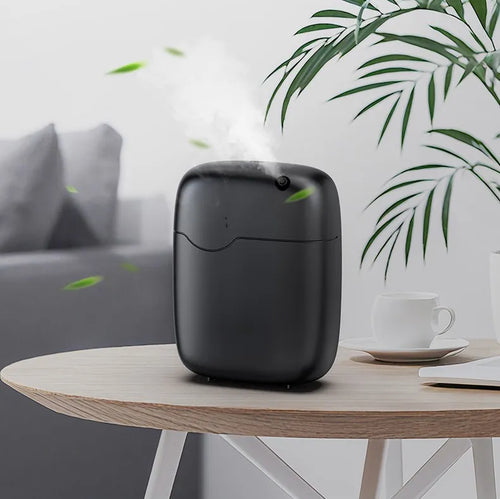
Take the setting first, because it moves in the opposite direction from what the price suggests. A viewing at this level runs long — ninety minutes is ordinary, two hours happens, and people sit down — and a level that is pleasant for the first four minutes becomes noticeable by the fortieth and tiring by the ninetieth. Air in a closed flat does not clear, it accumulates, and a nose that has adapted to a scent still registers it as heaviness even when it has stopped identifying it. So the instruction is the reverse of the instinct: run the Vaayu lower than you would for a twenty-minute viewing, not higher. In practice that means starting it two hours before on the lowest usable setting, walking the property from the front door thirty minutes before the appointment, and adjusting downwards if you can identify the fragrance at all rather than simply noticing that the air is pleasant. The machine helps here in a way a smaller one cannot: it holds a level rather than climbing to one, it is adjustable in fine steps, and at under 38 dB it is inaudible in a quiet house where three people are listening to how the building sounds. It is also waterless, which stops mattering as a specification and starts mattering as a fact once you are standing in a house with book-matched marble, lacquered joinery and, quite often, art on the walls. Nothing is added to the air but fragrance: no water, no heat, no film on a polished surface, and nothing anybody's insurer would raise an eyebrow at.
Then placement and the sequence, which at this scale is a floor plan question rather than a room question. Put the machine where the property is entered and nowhere near where the property is discussed. In most homes of this kind that means the entrance hall or the lobby side of the main living volume, at waist height or above, out of the path of a diffuser vent, and physically out of sight — behind a plant, on a console beneath something, inside a niche. A buyer who spots the machine has been told what you did, and at this level being caught arranging is worse than not having arranged. Then leave the rest of the house alone. Bedrooms want less than living areas, a study wants nothing, and the areas an adviser will inspect — utility, services, plant, terrace, parking — want no fragrance at all under any circumstances. A faint clean note in a services cupboard reads immediately as a cover, and it is the single fastest way to make a professional start looking harder. The sequence I would run: the previous morning, open everything and water every trap, including the terrace outlets and the guest bathroom nobody uses; the previous evening, confirm gate, lift, parking and housekeeper; on the day, windows open early and closed three hours before so the house comes to temperature; machine on two hours before; a full walk from the front door at thirty minutes; and then nothing further, because every adjustment made after that point is made by a nose that has already stopped being reliable.
And then the part that governs everything above it. An adviser is going to look at the terrace waterproofing, the shaft, the bathroom below the kitchen and the ceiling under the upstairs bath, and if there is a problem in any of them they will find it, because that is precisely what they were brought for. If the property has damp, a leak, a drain issue, smoke damage or anything with a structural cause, that is a material fact about the property and running a machine over it is not preparation, it is misrepresentation. Find it, fix it, or disclose it, and only then scent a property that is genuinely sound. I am aware this is an odd thing for somebody selling diffusers to keep repeating, and I repeat it because the commercial logic runs the same way as the ethical one at this level: a defect discovered by a buyer's own architect after a scented viewing does not cost you the flat, it costs you the adviser's trust, and that adviser has four other clients. The rest of the constraints are ordinary. The Vaayu takes its own undiluted oil rather than the water-based Hotel Collection bottles, which belong in the Sukoon, the Boond and the Megh. Those ultrasonic machines add 30 to 50 ml of water an hour to the air, which is acceptable in an occupied, air-conditioned home and wrong in a closed one. A reed diffuser needs 24 to 72 hours and suits a house being shown across a season. A candle has to be attended and put out, which rules it out of any property you do not personally lock. And SOSA does not make a room spray for the home — the sprays in the range are car perfumes — which in a two-hour viewing would be irrelevant anyway, since a spray is a twenty-minute product.
The SOSA edit
In the order I would actually spend it for a ₹20 crore home, which puts three unpaid items above everything on this website. The machine appears fourth, and the row says why it is the right one rather than the expensive one. The last row states something we do not make.
| Do or buy | What it is | When it earns its place | Price |
|---|---|---|---|
| 1. The seller conversation ★ | Cooking, laundry, incense, pets and windows, agreed a week ahead rather than on the morning | First, always. In an occupied house it changes the air more than any machine, and it costs nothing | ₹0 |
| 2. Opening the rooms nobody opens | Utility, services, shafts, plant, terrace, guest bathrooms. Every trap watered, every unused tap run | The day before. These are the rooms an adviser reaches and the rooms where a real smell lives | ₹0 |
| 3. Confirming the access chain | Gate, lobby, lift release, parking bay, housekeeper, no common-area works that morning | The previous evening. The buyer meets your building's staff before they meet your property | ₹0 |
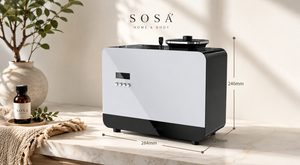
| 4. Vaayu | Waterless, up to 1000 m³, 400ml for ~75 days, 1h/4h/8h/24h timers, under 38 dB, key-lock, 0.9 kg | Two hours before, lowest usable setting, entrance zone only. It holds a level across a two-hour visit | ₹11,999 |
| 5. Hotel Collection 15ml | Ritz-Carlton-inspired Quiet Luxury, or the drier 1 Hotels-inspired Forest Suite if the house runs warm | The register does not change with the price. Buy at 15ml to settle the choice before the 300ml at ₹1,799 | ₹299 |
| Instead, if the family is present throughout: Sukoon | 500ml, 270–320 sq ft, three 15ml scents included, water-based at 30–50 ml/h | A furnished, occupied, air-conditioned house where you only need the entrance zone treated | ₹1,899 |
| Not made: a room spray for the home | The sprays in the SOSA range are car perfumes. There is no home spray and there is not going to be one | Printed rather than implied. A spray is a twenty-minute product and this is a two-hour viewing | — |
Versailles
I have been in a handful of houses at this level while they were being shown, and the thing that struck me was how little of the difference was glamour. The ₹20 crore viewings that went well were the ones where somebody had thought about the utility room. The ones that went badly were the ones where the living room was perfect and the terrace door had not been opened since April. That is not a fragrance observation. It is an observation about attention, and fragrance happens to be the last two hours of it.
The thing I would push back on hardest is the instinct to scale the fragrance with the price. A larger number does not want a larger scent. If anything it wants a smaller one, because the buyer is in the building for longer and because the people with them are trained to notice arrangements. The brief at ₹20 crore is the same brief as at ₹2 crore, phrased more strictly: the buyer should walk out able to describe the ceiling height and unable to describe the smell. And if the house has a problem, say so. An architect who finds something you had covered will remember you for years, and so will their clients.
Everything is made and supported from Pune, and a part of every order funds girl-child education through Nanhi Kali. You get a space that smells like somewhere considered; a girl gets a classroom. That equation has always felt right to me.
Frequently asked questions
- Preparing a ₹10 crore apartment for a private viewing — the long-format visit, from the other end.
- A ₹25 crore villa, audited from the gate inwards — the same bracket where the property has grounds.
- At what property price does professional scenting become worth considering? — why the price is the wrong question entirely.
- How much attention should a realtor give the buyer's sensory experience? — the pillar for this group.
- Brand: the SOSA founder story.
Facts verified August 2026: Product facts used in this guide. SOSA Vaayu ₹11,999: waterless cold-air nebulising diffuser, atomises undiluted fragrance oil to a dry residue-free nano-mist, coverage up to 1000m³ (approximately 2,000–3,000 sq ft), 400ml refillable tank lasting up to about 75 days per fill, Bluetooth app plus onboard control, 1h/4h/8h/24h timer scheduling, adjustable intensity, under 38 dB, DC 12V/1A at 5W, 165 × 80.5 × 215 mm and 0.9 kg, freestanding or wall/HVAC mounted, auto-stop and key-lock, CE, RoHS and SGS certified, supplied with four hotel-inspired fragrances. SOSA Aangan ₹25,999: HVAC-connected or standalone commercial nebulising diffuser, coverage up to 3,000m³ (roughly 8,000–10,000 sq ft), 800ml reservoir, metal body, programmable schedules, under 42 dB. Ultrasonic machines are water-based and consume 30–50 ml of water an hour: Sukoon ₹1,899 (500ml, 270–320 sq ft, 16–18 hours on low, 3–6 drops per tank, steady/2H/4H timers, three 15ml Hotel Collection scents included), Boond ₹899 (300ml), Megh ₹3,499 (6 litres). Hotel Collection water-based fragrance 15ml ₹299, 100ml ₹999, 300ml ₹1,799, Pack of 7 at 15ml ₹1,799 against ₹2,093 bought singly; the Vaayu and Aangan take their own undiluted oil rather than these water-based bottles. Reed diffusers (separate alcohol-free line) from ₹749, requiring 24–72 hours to reach their working level. Scented candles from ₹379, scenting a room in roughly 15–20 minutes but requiring attendance. Free shipping above ₹499. Timings: a nebulising diffuser reaches a working level within minutes and a stated viewing level well inside two hours. This guide makes no claim that fragrance affects a property's price, offer level or time on market; it is presentation, in the same category as photography, styling and lighting. Fragrance must never be used to conceal a material defect. SOSA is not affiliated with or endorsed by any hotel brand. Prices subject to change — see the live product pages.