


Cold-air: pressurised air shears undiluted oil into a dry nano-mist. No water, no heat, no dilution — the fragrance is the whole output.
Why reach differs: a water droplet is heavy and falls; a nano-scale oil droplet stays airborne. That is the physical reason a Sukoon covers 270–320 sq ft and a Vaayu is specified up to 1000m³.
Two different oils: the water-based Hotel Collection (15ml ₹299) is for ultrasonic machines and must never go in a Vaayu, despite the shared scent names.
2. The carrier differs, and this is the important one. In an ultrasonic, fragrance is dissolved into 300ml or 500ml of water and the output is overwhelmingly water. In a cold-air machine there is no carrier at all — what leaves the nozzle is the fragrance itself.
3. Reach follows directly from carrier. Water droplets are relatively large and heavy and settle within a few feet. Nano-scale oil droplets stay suspended and travel with the room's air. Hence 270–320 sq ft for a Sukoon against up to 1000m³ — roughly 2,000–3,000 sq ft by ceiling height — for a Vaayu.
4. One adds water to your room; the other adds none. A Sukoon emptying 500ml over 16–18 hours puts that water into the air. In a dry Delhi winter many people count this as a benefit. In a coastal August, when the air is already heavy, most do not. That is a comfort preference, not a health claim, and I make no health claim about either machine.
5. The oils are different products and are not interchangeable. The water-based Hotel Collection at 15ml ₹299, 100ml ₹999 and 300ml ₹1,799 is made to disperse in a water tank. The Vaayu runs a cold-air oil made to be nebulised neat, and ships with 400ml of it. Reed oil goes in neither.
6. Know the gap before you spend. SOSA does not currently sell a separate Vaayu refill oil. The 400ml in the box is today's whole supply. Ask SOSA about refill availability before committing if that matters to you.
7. Six litres is not a bigger room. The Megh at ₹3,499 runs about 100 hours but covers roughly 215 sq ft — less than the ₹1,899 Sukoon. It is a runtime and humidity machine, never a coverage upgrade.
The Vaayu is made in India; our reed fragrances are composed and handmade in small batches in Pune, and a portion of every order supports girl-child education through Nanhi Kali.

Part one — what each machine is physically doing inside the case
I want to describe both mechanisms carefully, because almost every buying mistake in this category comes from imagining that they are the same process at different power levels. They are not. One is a dilution device and one is a concentration device, and that is a bigger difference than any specification on either product page.
 Vaayu₹11,999 · waterlessA Vaayu holds 400ml of undiluted oil and a small pump drives air across it at pressure. The shear breaks the oil into droplets at nano scale — fine enough that they behave less like a spray and more like a gas, staying suspended in the room's air instead of falling to the nearest horizontal surface. Nothing is added and nothing is diluted, so a given volume of output carries far more fragrance than the same volume of ultrasonic mist, and the same pressurised stream that atomised it also throws it. Heavier droplets that do not make the cut fall back into the reservoir rather than onto your floor, which is why the output reads as dry and leaves no film on glass or stone. Power is 5W, noise under 38 dB, and the unit is 0.9 kg, freestanding or wall and HVAC mountable, CE, RoHS and SGS certified.
Part two — the mechanism, line by line
No prices in this table and no verdicts; it is the two processes set against each other so you can see where each specification comes from. Every performance figure downstream of these lines is a consequence of them.
| The question | Ultrasonic (Boond · Sukoon · Megh) | Cold-air nebulisation (Vaayu) |
|---|---|---|
| What breaks the liquid up? ★ | A piezoelectric disc vibrating above the range of hearing | Pressurised air shearing the oil at a nozzle |
| What is in the tank? | Water, plus a few millilitres of water-based fragrance | Undiluted fragrance oil and nothing else — 400ml |
| What is the carrier? | Water. The fragrance is dissolved in it and rides out with it | There is no carrier. The fragrance is the output |
| What does the output feel like? | A visible cool mist; surfaces close by can read slightly damp | A dry mist, generally invisible, leaving no film on glass or stone |
| Where do the droplets go? | They are relatively heavy and settle within a few feet | Nano-scale, so they stay suspended and travel with room air |
| What limits the reach? | Fragrance density — past a point, more oil separates instead of dispersing | Room volume and air exchange, not dilution |
| What else does it change in the room? | Humidity rises — 500ml of water over 16–18 hrs on a Sukoon | Nothing but fragrance. Identical behaviour in every season |
| What maintenance does it ask? | Refill water each run; descale and wipe the disc periodically | Refill 400ml at 90+ days a fill; wipe the housing |
| What fragrance does it take? | Water-based Hotel Collection only — never reed oil | Cold-air oil only — never water-based fragrance, never reed oil |
| How is it controlled? | Sukoon: remote, steady / 2H / 4H timers. Boond: onboard, night light | App plus onboard buttons, 1h / 4h / 8h / 24h, intensity, auto-stop, key-lock |
| The honest caveat: the row that costs you money is the fragrance row. The two oils share scent names and are entirely different formulations — the water-based Hotel Collection is built to disperse through a water tank and must never be put into a Vaayu, and the Vaayu's cold-air oil is not an ultrasonic fragrance. And SOSA does not currently sell a separate Vaayu refill oil at all; the 400ml in the box is the whole supply available today, where Hotel Collection refills for the ultrasonic machines are on sale from ₹299. If long-term supply is part of your decision, ask SOSA where the refill stands before you spend ₹11,999. | ||
Sukoon · 270–320 sq ft₹1,899Shop →  Hotel Collection · ultrasonic onlyfrom ₹299Shop →
 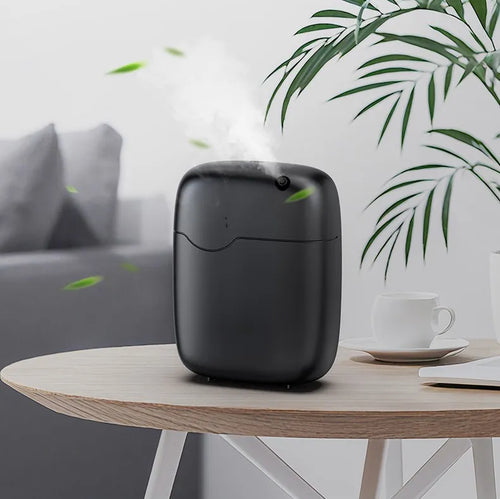 Vaayu · waterless, up to 1000m³₹11,999Shop →
Part three — when dilution is the feature rather than the flaw
I have spent two sections explaining why water limits an ultrasonic, so let me now argue the other side properly, because for the great majority of Indian rooms the ultrasonic mechanism is the right one and the cold-air mechanism is overkill. Dilution is what makes an ultrasonic gentle. A machine whose output is mostly water cannot easily overwhelm a bedroom, which matters if you are scenting a space where somebody sleeps, or a small flat, or a room used by people with different tolerances. A cold-air machine at high intensity in a 200 sq ft bedroom is simply too much instrument for the job, and the fix — turning the intensity down and the timer short — means paying ₹11,999 to use a fraction of what you bought.
Dilution is also what makes an ultrasonic cheap to run, and this is where the comparison genuinely favours the ₹1,899 machine. A 15ml Hotel Collection bottle at ₹299 doses many tank-fills, the 100ml is ₹999 and the 300ml is ₹1,799, and the other ingredient is tap water. That supply exists, is on sale today, and can be planned around for years. The Vaayu's position is the opposite: the machine is superb and the oil situation is unfinished, because no separate cold-air refill is currently sold. I would rather write that sentence in every comparison than let a reader discover it after they have committed. Write to SOSA and ask before you buy if you are planning past the first 400ml.
And the case where neither machine is the answer: if what you want is a constant low background in one room and you never want to think about it, a reed diffuser at ₹749–₹849 for 50ml or ₹1,249–₹1,349 for 130ml does that with no socket, no tank and no noise, and goes on doing it through a power cut. Machines exist for two things a reed cannot do — filling a space on demand, and covering a volume larger than a point source can reach. If you need neither, do not buy either machine. The one product I would steer you away from as a coverage answer is the Megh: at ₹3,499 with six litres and roughly 100 hours of runtime it looks like the big one, but it covers about 215 sq ft, less than the Sukoon at ₹1,899. It buys you runtime and humidity. It does not buy you a larger room.
Part four — matching the mechanism to the room
The same four machines, arranged by the question the mechanism answers rather than by price. The last column is the one to read twice.
| Machine | Mechanism | Coverage | What it adds besides fragrance | Price |
|---|---|---|---|---|
| Sukoon ★ | Ultrasonic · 500ml water tank | 270–320 sq ft, 16–18 hrs on low | Moisture — welcome in a dry winter, less so in a coastal August | ₹1,899 |
| Boond | Ultrasonic · 300ml, USB | ~150 sq ft, ~6 hrs a fill | Moisture, plus a colour night light | ₹899 |
| Megh | Ultrasonic · 6L, ~100 hrs runtime | ~215 sq ft — less than the Sukoon | A great deal of moisture. This is what it is for | ₹3,499 |
| Vaayu | Cold-air nebulisation · 400ml neat oil | Up to 1000m³ ≈ 2,000–3,000 sq ft | Nothing. No water, no heat, no residue | ₹11,999 |
| Reed diffuser | Passive evaporation off six fibre reeds | One room, honest ceiling near 250–300 sq ft | Nothing, and no electricity either | From ₹749 |
Versailles
The question in this title arrives in my inbox more than any other machine question, and it is almost always asked as though one answer will be revealed as the good one. I have never been able to answer it that way, because the two mechanisms are not competing — they are sized differently. Asking whether cold-air is better than ultrasonic is a little like asking whether a kettle is better than a boiler.
What I do think is worth insisting on is the water. A great many readers on the coast bought an ultrasonic, ran it through one monsoon, found the room heavier than they liked and concluded the machine was faulty. It was not faulty. It was putting half a litre of water into their air every day, which is what it is designed to do and what a dry-winter buyer in Amritsar specifically wants. Knowing that in advance would have sent them to a different mechanism, or to a reed diffuser, and saved everyone the disappointment.
The last thing, and I would rather say it here than bury it: our cold-air machine is the better instrument on reach and the worse one on supply. There is no separate Vaayu refill oil on sale from us today. The ultrasonic side of the range has fragrance available from ₹299 and always will. If you are the kind of buyer who plans three years ahead, that asymmetry deserves a place in your decision, and a note to us asking where it stands. A portion of every order funds a girl's classroom through Nanhi Kali.
Frequently asked questions
- Nebulising vs ultrasonic — what the word means, and how to test any seller's claim to it.
- Cold-air vs reed diffuser — active against passive, scored on eight axes.
- Sukoon vs Vaayu — ₹1,899 against ₹11,999, and why most homes should stop at the first.
- Which SOSA system for your room size — the range mapped to measured spaces.
- Brand: the SOSA founder story.
SOSA Vaayu specifications (verified from the live product page, August 2026): ₹11,999 (the product page displays a rounded ₹12,000). Waterless cold-air nebulisation — pressurised air atomises undiluted fragrance oil into a dry nano-mist; no water, no heat, residue-free. Coverage up to 1000m³, about 2,000–3,000 sq ft. 400ml refillable tank, 90+ days per fill at a mid intensity setting. Bluetooth app plus onboard buttons, 1h / 4h / 8h / 24h timers, adjustable mist intensity, auto-stop and key-lock. Under 38 dB. DC 12V / 1A, 5W. 165 × 80.5 × 215 mm, 0.9 kg, black or white. Freestanding or wall / HVAC mount. CE, RoHS and SGS certified. Ships with four SOSA Hotel Collection fragrances at 100ml each (400ml in total) in one of three combos chosen at checkout. SOSA does not currently sell a separate Vaayu refill oil; the 400ml supplied in the box is the fragrance available at the time of writing, and buyers who need long-term supply should confirm current refill availability with SOSA before purchasing. The cold-air oil supplied with the Vaayu is a different product from the water-based Hotel Collection sold for ultrasonic machines (15ml ₹299 · 100ml ₹999 · 300ml ₹1,799), which must not be used in a Vaayu despite sharing scent names. Other SOSA machines: Boond 300ml ₹899 (~150 sq ft) · Sukoon 500ml ₹1,899 (270–320 sq ft) · Megh 6L ₹3,499 (~215 sq ft — a runtime and humidity machine, not a coverage upgrade) · Aangan ₹25,999 (~8,000–10,000 sq ft) · Meenar ₹38,500 (12,000–18,000 sq ft) · Safar car diffuser ₹3,999. Reed diffusers 50ml ₹749–₹849 (6–8 weeks) · 130ml ₹1,249–₹1,349 (14–18 weeks) · duo sets ₹1,498–₹1,598 · oil-only refills 300ml ₹2,399 / 500ml ₹3,499. Runtime, consumption and coverage figures are manufacturer specifications and vary with intensity setting, run hours, ceiling height, ventilation and season; any per-month or per-day figure in this guide is arithmetic on those specifications, not a measurement. Electricity costs vary by state tariff. No claim is made that scenting affects ratings, reviews, bookings, occupancy, revenue, health, mood or air quality. Free shipping above ₹499. A portion of every order supports girl-child education through Nanhi Kali. Prices subject to change — see the live product pages.