
The rule that matters: never place the bottle directly under the fan. Six feet of distance, or diagonally opposite, and the loss becomes marginal.
The one exception: a windowless bathroom, where the fan is the only air exchange and runs far more than an hour. That bathroom earns a 130ml at ₹1,249 rather than a 50ml, for a longer cycle between refills, not for extra strength.
2. The fan and the diffuser are doing different jobs, and neither should replace the other. The extractor removes humidity and odour, which is exactly what you want gone. The diffuser supplies a base note that re-establishes once the fan has finished. Using fragrance instead of ventilation is the actual error — no reed diffuser has ever out-scented a running bathroom, and one should never be asked to try.
3. Position decides how much you lose, and it is the whole decision. A bottle sitting directly beneath the extractor is genuinely wasteful — the evaporated oil is pulled straight into the duct before it circulates. Six feet away, or diagonally opposite if the room is too small for six feet, and the loss becomes marginal.
4. A heavy-extractor bathroom gets one extra reed, not a bigger bottle. Three reeds instead of two in a small bathroom, four instead of three in a large one. This is the one case in the whole catalogue where reed count is set by ventilation rather than room size.
5. The habit costs nothing and matters more than any purchase. Switch the fan off once the mirror has cleared, rather than leaving it running for an hour out of routine. The single exception is a windowless bathroom, where the fan is the only air exchange and earns a 130ml at ₹1,249 instead of a 50ml, for a longer cycle between refills rather than extra strength.
Alcohol-free, IFRA-compliant, composed by an ISIPCA Versailles-trained perfumer and handmade in small batches in Pune — and every purchase funds a girl's education through Nanhi Kali.
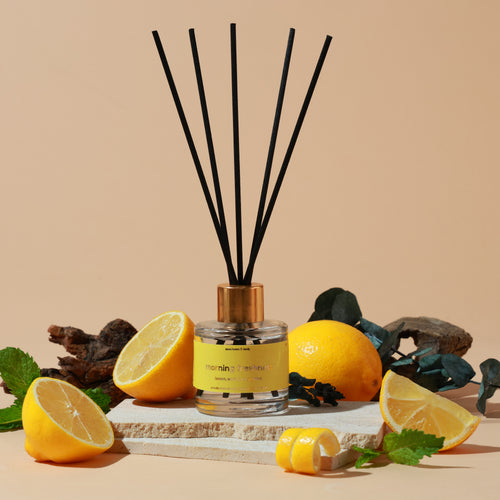
Why the fan is not the enemy people assume
Every doctrine on this blog says a bathroom is the highest-return room in a home for a reed diffuser — small, enclosed, visited constantly, cheapest to fit out, biggest change for the money. The same doctrine also says a bathroom is a room that actively removes its own air. Those two facts look like a contradiction until you notice the assumption hiding inside it: that the fan is running the whole time. It is not. An exhaust fan is switched on for a shower and switched off once the room feels clear, which in most Indian homes totals thirty to sixty minutes across the whole day. For the remaining twenty-three-odd hours the door is shut, the fan is off, and the bathroom behaves exactly like any other sealed room in the flat — which is to say, it behaves in the diffuser's favour, because a shut door is an absolute barrier that keeps the fragrance in rather than letting it drift away.
The confusion comes from picturing the fan and the bottle in a tug-of-war, as if every minute the fan runs is a minute the diffuser loses outright. It is not that simple, because the two are not competing for the same job. An exhaust fan exists to clear humidity and odour — steam, soap, the smell of the shower itself — and that is precisely the air you want removed. A reed diffuser exists to supply a quiet baseline that the room returns to once the air has cleared. Asking the diffuser to hold its ground against a running extractor is asking it to do the fan's job in reverse, and it was never built for that. The correct division of labour is: extractor clears, diffuser re-establishes. Nobody would expect a candle to stay lit in a wind tunnel and call that the candle's failure.
For scale, a full flat rarely needs more than a handful of bottles across every room — the standard kits run ₹2,847 for a 1BHK, ₹3,696 for a 2BHK, ₹4,445 for a 3BHK and ₹5,244 for a 4BHK — and the bathroom line is the cheapest single item in every one of them. This guide is only about that one bottle, in the one room that also happens to own an exhaust fan, and the small adjustments that room deserves. It is not a case for skipping the bathroom bottle. If anything, it is the opposite: the fan changes where the bottle sits and how many reeds go in, and nothing else.
The three adjustments that matter
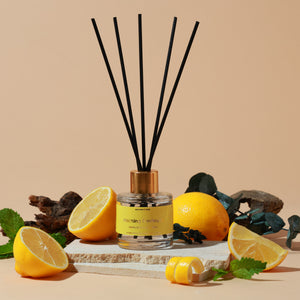
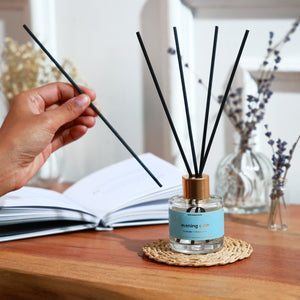
 Morning Freshness 50ml₹749Most households switch the extractor on with the shower and off within ten to twenty minutes of stepping out — thirty to sixty minutes a day in total, once or twice. That is roughly four percent of the day. The diffuser is not competing against a permanently running machine; it is losing a small, predictable window and recovering fully for the rest. Judging a bathroom bottle's strength while the fan is on, or right after, will always make it seem weaker than it is — the honest test is how the room smells an hour later, with the fan long since off and the door shut.
Fan usage and room type, matched to reeds
The table below sorts a bathroom-with-a-fan setup by how the fan is actually used, because two bathrooms with an identical extractor can behave very differently depending on runtime and placement. Expected life assumes a flip every three to five days and judging the room at least an hour after the fan has been switched off.
| Fan usage and room type | Reeds | Bottle | Expected life | Verdict |
|---|---|---|---|---|
| Small bathroom, fan on 30–60 min/day, bottle six feet from fan ★ | Two to three | 50ml ₹749 | Up to 12 weeks | Correct — the standard case |
| Small bathroom, fan on 30–60 min/day, bottle directly under fan | Two to three | 50ml ₹749 | Notably shorter, real fragrance loss | Avoid — move the bottle, not the reeds |
| Small bathroom, fan on 30–60 min/day, bottle diagonally opposite | Two to three | 50ml ₹749 | Close to the full 12 weeks | Correct — the fallback when six feet isn't there |
| Larger bathroom, heavy fan use (1+ hour/day) | Three to four — one extra reed | 50ml ₹749 | 8–10 weeks | Correct with the extra reed |
| Windowless bathroom, fan is the only ventilation, runs most of the day | Three | 130ml ₹1,249 | 12–16 weeks | Correct — fewer refills, not more strength |
| Windowless bathroom on a 50ml instead | Three | 50ml ₹749 | Refilled constantly | Works, but a false economy |
| Note on the fix: the position fix costs ₹0 — six feet of distance or the diagonal corner is the entire adjustment for most bathrooms. The 130ml upgrade is reserved for the windowless case, where the fan's runtime, not its power, is what shortens the bottle's life. | ||||
Morning Freshness · standard fan50ml ₹749Shop → Morning Freshness · windowless130ml ₹1,249Shop → 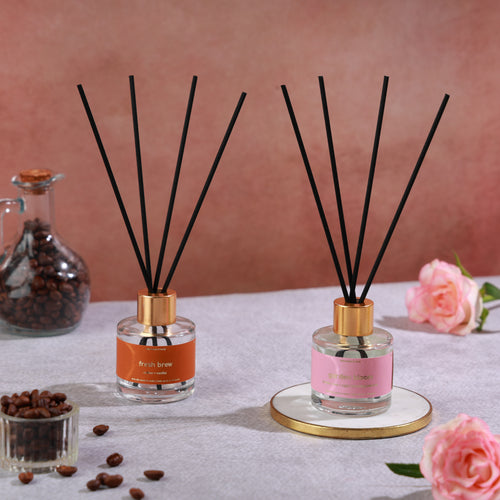 Refills · running costfrom ₹2,399Shop →
Reeds, placement and the windowless case in full
Start at the reed count for the room's size — two in a small bathroom, three past roughly 60 sq ft — and add exactly one reed if the fan is used heavily: run for more than an hour a day, or the room's only real source of air exchange. That single reed is the entire correction for a hard-working extractor. It is tempting to add two or three once you've decided the fan is a problem, but the fan is not removing that much fragrance in a normally placed bottle, and over-correcting just turns a bathroom that was quiet into one that is loud the moment the door opens. Six reeds, the full set every bottle ships with, is still never right in a bathroom — hard tiled surfaces reflect fragrance rather than absorbing it, and that stays true whether or not there is a fan in the room.
Placement does more work here than reed count does. Stand the bottle on the basin counter or a shelf, roughly a metre off the floor where the room allows it, and keep it at least six feet from the exhaust fan's intake. Where the room is too small for six feet, the diagonal corner from the fan is the next best spot — anywhere that is not directly in the fan's draw. This is worth doing before reaching for an extra reed, because it is free and because it addresses the actual mechanism: a bottle losing fragrance to a duct is a placement problem, not a strength problem, and no amount of extra reed surface fixes a bottle that is standing in the one place actively working against it.
The windowless bathroom is the genuine exception to "the fan runs an hour, not a day." Without a window, there is no other way for the room to exchange air, so the fan tends to run longer per use and more often across the week — after every shower rather than only after the longest ones, and sometimes left on for general freshening in a way a windowed bathroom rarely needs. That longer, more frequent runtime shortens the effective cycle between refills, which is the specific case where a 130ml at ₹1,249 earns its place over the standard 50ml — not for extra strength, since the reed count still governs that, but so you are not reordering every few weeks. Everything else about placement and reed count in this guide still applies to a windowless bathroom; only the bottle size changes.
What a bathroom-with-a-fan reed setup actually costs
There is no premium for having an exhaust fan. The bottle stays the same 50ml at ₹749 in almost every case, and the only added cost is a single extra reed in a heavy-extractor bathroom, which SOSA already includes six of in every box — the adjustment is free. The one real spend is the windowless upgrade to a 130ml, and even that is offset by needing to refill less often.
| Setup | What you get | Best for | Total |
|---|---|---|---|
| The standard case ★ | One Morning Freshness 50ml, two to three reeds | Any bathroom where the fan runs 30–60 minutes a day | ₹749 |
| Heavy-extractor bathroom | The same 50ml, one extra reed — three instead of two, four instead of three | Fan run more than an hour a day | ₹749 |
| Windowless bathroom | Morning Freshness 130ml, three reeds | No window — the fan is the only air exchange | ₹1,249 |
| Softer alternative | Evening Calm 50ml — lavender and chamomile, for a guest bathroom that wants calm over sharp | Any of the above, if citrus isn't the note you want | ₹799 |
| Running cost | A 300ml refill ₹2,399, or 500ml ₹3,499 (₹7/ml) | 500ml is ten 50ml fills — roughly ₹350 a fill | from ₹2,399 |
Versailles
This question comes up more than almost any other, usually from someone who has already decided the answer is no before they ask it. They picture the fan running constantly, quietly undoing the bottle they just bought, and conclude the bathroom is a lost cause. It very rarely is. Most exhaust fans run for well under an hour a day, and a bathroom door, once shut, is one of the most effective barriers in the whole flat.
What I actually see going wrong is placement, not the fan itself. People put the bottle wherever the free shelf happens to be, and in a lot of Indian bathrooms that free shelf is directly under the extractor — the one spot that genuinely does undercut it. Move the bottle six feet, or to the opposite corner if six feet doesn't exist in the room, and the same ₹749 that seemed to be doing nothing suddenly holds through the whole day.
The only bathroom I treat differently is the windowless one, because there the fan really is working overtime — it is the room's only lungs. That is worth the extra ₹500 for the 130ml, not because the room needs to smell stronger, but because you will not be refilling it every few weeks. Everywhere else, the fan is not the enemy; it is just a machine that runs less than people assume. Every purchase funds a girl's education through Nanhi Kali — not a percentage, not a quarterly cheque. Every one.
Frequently asked questions
- Where to place a reed diffuser in a bathroom — the surface, the height and the draught, ranked.
- How many reeds for a small bathroom? — the two-reed rule, worked through by room size.
- How many reeds for a large bathroom? — the same ladder, sized up, including the fan's own daily cycle.
- Reed diffuser near the bathroom sink — the basin position, splash and all.
- Brand: the SOSA founder story.
SOSA reed diffusers & prices (verified August 2026): Morning Freshness (Malabar lemon · peppermint · eucalyptus) 50ml ₹749 · 130ml ₹1,249 · Evening Calm (lavender · chamomile) 50ml ₹799 · 130ml ₹1,299 · Garden Bloom (British rose · night-blooming jasmine) 50ml ₹799 · 130ml ₹1,299 · Fresh Brew (Coorg coffee · Kerala vanilla) 50ml ₹849 · 130ml ₹1,349 · Mountain Breeze (Himalayan pine · sage · cedar) 50ml ₹849 · 130ml ₹1,349. Duo sets: Day & Night 2 × 50ml ₹1,498 · 2 × 130ml ₹2,498; Fresh & Grounded 2 × 50ml ₹1,548 · 2 × 130ml ₹2,548; Warmth & Bloom 2 × 50ml ₹1,598 · 2 × 130ml ₹2,598. Refills 300ml ₹2,399 · 500ml ₹3,499. Six fibre reeds included with every bottle; refillable glass. 50ml suits rooms up to 150 sq ft and lasts 6–8 weeks (up to roughly 12 in a bathroom on two reeds); 130ml suits rooms above 150 sq ft and lasts 14–18 weeks. Fractionated coconut oil (CCT) carrier, alcohol-free, phthalate-free, paraben-free, IFRA-compliant, low VOC; tested through 45°C heat and 85% monsoon humidity. Composed and handmade in small batches in Pune. Ultrasonic machines quoted for comparison: Boond ₹899 · Sukoon ₹1,899 · Megh ₹3,499, which run the separate water-based Hotel Collection fragrances (15ml ₹299 · 100ml ₹999 · 300ml ₹1,799) — the two lines are not interchangeable. Every purchase funds a girl's education through Nanhi Kali. Prices and availability subject to change — see the live product pages.