

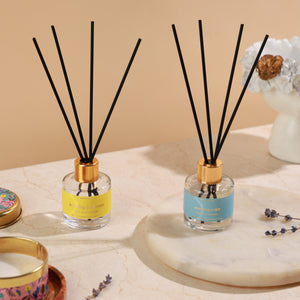



Route one — reeds: two 130ml at opposite ends, ₹2,498, about fourteen weeks on six reeds each.
Route two — a machine: a Sukoon at ₹1,899, rated to about 270–320 sq ft, plus a 15ml Hotel Collection at ₹299 — ₹2,198, and it covers the room from one position.
2. Route one: two bottles, placed apart. Two 130ml at ₹2,498, one near the entrance and one at the far end of the seating, on six reeds each. That is two points of origin rather than one — the only thing a second bottle genuinely buys. Do not stand them together on the same console; two bottles in one corner is one bottle that empties twice as fast.
3. Route two: one Sukoon at ₹1,899. The Sukoon is a 500ml ultrasonic diffuser rated to about 270–320 sq ft, which covers a 200 sq ft living room comfortably from one position. It runs the water-based Hotel Collection — 3 to 6 drops per tank, so a 15ml at ₹299 gives you many fills and the running cost is low. Total to start: ₹2,198. The trade is that it needs a socket and a switch, where reeds simply run.
4. Do not buy a bigger bottle, and do not buy the Megh. A 130ml does not reach further than a 50ml. Both stand the same six reeds, and the evaporating surface is what sets the throw; the liquid behind it sets the weeks. And the Megh at ₹3,499 is rated to about 215 sq ft — less coverage than the Sukoon at ₹1,899. It is a runtime-and-humidity product, not an area product. If you want more area than one Sukoon, the answer is a second Sukoon.
5. Scent the doorway, not the middle. A living room is entered, not inhabited for eight unbroken hours. Guests and family form their impression in the first three seconds through the door, and everyone already in the room adapted to the smell twenty minutes ago. That changes where the money goes: the strongest point should be near the entrance and the second point deep in the seating area, rather than one bottle centred on a coffee table where nobody arrives.
Made in India, composed by an ISIPCA Versailles-trained perfumer — and a portion of every order supports girl-child education through Nanhi Kali.
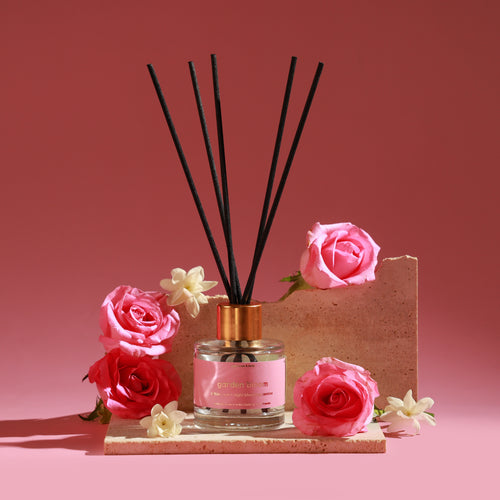
Why 200 sq ft is where one bottle stops
The coverage figure for a reed diffuser is up to about 150 sq ft on six reeds, measured in a closed room with still air and a standard ceiling. 200 sq ft is a third more floor and, at nine feet, 1,800 cubic feet against 1,350. That is the whole of the arithmetic. A reed diffuser is a passive evaporative source: oil climbs the porous core of each reed, evaporates from the exposed length, and the room's own air movement distributes it from there. Nothing pushes. So the rated area is not a beam the bottle projects but the size of air pocket a single evaporating surface can keep charged. Give it a third more air and the concentration everywhere drops, most noticeably furthest from the bottle.
Living rooms then add two problems bedrooms do not have. Distance: a 200 sq ft living room usually runs eighteen to twenty-two feet on its long axis, and once a room is longer than about twenty-two feet no single point reaches the far end at a useful level regardless of bottle size. Openings: living rooms are the room with the balcony, the room adjoining the dining space, the room whose door is never shut. A closed room exchanges roughly 0.2 to 0.5 of its air an hour; open the balcony and cross-ventilate and that becomes three to eight, and a passive source cannot charge air that is being replaced several times an hour. So a 200 sq ft living room is often effectively a 300 sq ft problem. This is the point where a machine you can switch on for the hours you are actually in the room starts to make more sense than a passive bottle evaporating into an empty flat all afternoon.
The two routes, costed
 Two bottles₹2,498Two 130ml bottles at ₹1,249 each, six reeds in both, one near the entrance and one at the far end of the seating. At about fourteen weeks each on six reeds that is roughly ₹178 a week for the pair. The placement is the product here. Two bottles standing together are not two points of coverage; they are one point that costs twice as much and empties twice as fast. If the budget only stretches to one bottle now, buy one 130ml and put it by the entrance rather than in the middle — you will get the arrival right and add the second later.
Sizing by space — the living room and its neighbours
Living rooms vary more than bedrooms, so read down for the one that matches yours. Two of these rows cost less than you expect and one of them costs nothing.
| Space | What it needs | How many | Cost |
|---|---|---|---|
| 200 sq ft living room, doors mostly closed ★ | Two points of origin, or one machine — the case in this article | Two bottles or one Sukoon | ₹2,498 or ₹1,899 |
| 200 sq ft living room opening onto a balcony left open | An air-change problem before it is a sizing one — a machine you run for a few hours beats a passive bottle evaporating into a draught | One Sukoon | ₹1,899 |
| 200 sq ft living-dining run over about twenty-two feet | Beyond any single point regardless of size — two bottles far apart, not one big one | Two | ₹2,498 |
| 160–180 sq ft sitting room, closed | Just past the reed figure — one bottle on six reeds by the door will do most of it honestly | One, at the entrance | from ₹1,249 |
| 200 sq ft living room with a double-height or twelve-foot ceiling | 2,400 cubic feet at twelve feet — volume, not floor area, is the constraint | One Sukoon, placed low | ₹1,899 |
| A formal drawing room opened four or five times a year | Nothing permanent. A bottle evaporating for eleven unvisited months is money leaving the room — scent it the week guests come | None until needed | ₹0 |
| A note on all of the above: every figure here assumes a closed room with still air and a standard ceiling. Living rooms are the least likely room in an Indian flat to meet those conditions, which is exactly why this is the size where a switch starts to beat a permanently open bottle. | |||
One room · the unitFrom ₹749Shop → 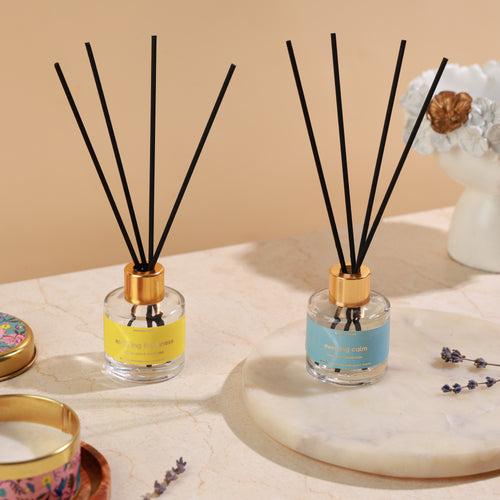 Two rooms · better value₹1,498Shop →
  Large room · a switch₹1,899Shop →
Placement, reeds and the first three seconds
Decide where the room is entered, and put the strongest point there. Everyone sitting in a living room stopped smelling it about twenty minutes after they sat down — olfactory adaptation is close to complete by then, and it is not a fault, it is how noses work. The people who will actually register the fragrance are the ones walking in: guests, family coming home, you returning from the market. So the first bottle belongs near the entrance at chest height on a console or shelf, not centred on a coffee table where no one arrives. The second bottle goes at the opposite end of the seating, as far from the first as the furniture allows. Two bottles fifteen feet apart cover a room that two bottles two feet apart do not.
Run six reeds in both bottles, and expect fourteen weeks rather than eighteen. Reed count is the only volume control a reed diffuser has, and a room at this size needs the full setting. Six reeds means more exposed fibre evaporating at once, so a stronger room and a shorter bottle — that trade is worth taking here in a way it is not in a small bedroom. Allow forty-eight hours for fresh reeds to saturate before you judge anything, and if throw drops after a few months replace the reeds rather than the liquid: heavier fragrance molecules clog the fibre core over time and stop the capillary climb. Keep both bottles out of direct sunlight, off bare polished wood, and out of the direct path of a fan or an AC vent, all three of which cost you weeks.
If you go the machine route, buy the fragrance small first. A Sukoon at ₹1,899 with a 15ml Hotel Collection at ₹299 comes to ₹2,198 and is enough to find out whether you like running a machine at all. At 3 to 6 drops per tank a 15ml goes a very long way, so there is no need to commit to a 300ml at ₹1,799 on day one; the pack of seven 15ml scents at ₹1,799 is the better second purchase, because it lets you match the scent to the evening rather than the room. Keep it away from the wall and off soft furnishings, and remember the liquids do not cross over — reed oil never goes in the tank.
What to buy
Two routes, both honest, at ₹2,498 and ₹2,198. The row you should not pick is the one that costs more and covers less.
| Buy | What it covers | Lasts | Price |
|---|---|---|---|
| One 50ml | A single reed diffuser — a second point of origin on a small budget, or the far end of the room while you save for the second 130ml | 6–8 weeks | from ₹749 |
| One 130ml | The value size — the main position by the entrance — buy two of these for a 200 sq ft room, ₹2,498 the pair | 14–18 weeks | from ₹1,249 |
| The duo | Day & Night duo — two points immediately for ₹1,498 against ₹1,548 bought separately, at the cost of reordering sooner | 6–8 weeks each | ₹1,498 |
| Sukoon ★ | 500ml ultrasonic — the whole 200 sq ft room from one position, rated to about 270–320 sq ft, and a switch rather than always-on | Runs when you switch it on | ₹1,899 |
| 300ml refill | The running cost — keeps two 130ml bottles going — the running cost of the two-bottle route, roughly two fills | Roughly 2 × 130ml fills | ₹2,399 |
Versailles
This is the one size in the early part of this cluster where I will tell you to spend more, and I want to be clear about why. It is not that a reed diffuser is weak. It is that 200 square feet is a third more air than the figure covers, and I would rather say so than let you buy one bottle, find the far end of the room reads flat, and conclude that home fragrance does not work in your house.
What I will not do is sell you the expensive answer. The Megh is our largest machine and it costs ₹3,499, and it covers about 215 square feet — less than the Sukoon at ₹1,899. It is built for runtime and for humidity, not for area. People assume the biggest unit covers the most space and it is simply not true, so if a shop tells you otherwise, walk away. For 200 square feet the Sukoon is the machine.
And if ₹2,000 is not available this month, buy one 130ml and put it by the door. Not in the middle of the room — by the door. You will get the arrival right, which is most of what a living room fragrance is for, and you can add the second bottle at the far end whenever you like. That is a better use of ₹1,249 than a bigger bottle would be, because bottle size buys weeks and never square feet. A portion of every order funds a girl's classroom through Nanhi Kali.
Frequently asked questions
- Is one enough for a 150 sq ft room? — the last size where one bottle wins.
- When to stop adding reeds and buy a Sukoon — the honest crossover point.
- Does a bigger bottle scent a bigger room? — no, and here is the mechanism.
- Open-plan living-dining-kitchen — when three rooms are one air space.
- Brand: the SOSA founder story.
SOSA products & prices (verified August 2026): Hotel Collection water-based ultrasonic diffuser fragrance 15ml ₹299 · 100ml ₹999 · 300ml ₹1,799 · Pack of 7 (15ml, all fragrances) ₹1,799; refills 100ml from ₹999. Seven scents: The Ritz-Carlton-inspired (white tea · bergamot · cedar), Westin-inspired (white tea · aloe · cedar), 1 Hotels-inspired (cedarwood · vetiver · green leaves), The St. Regis-inspired (amber · violet · woods), Shangri-La-inspired (jasmine · green tea · white tea), Four Seasons-inspired (citrus · floral · sandalwood), W Hotels-inspired (citrus · pepper · amber). Diffusers: Boond 300ml ₹899 · Sukoon 500ml ₹1,899 · Megh 6L ₹3,499. Water-based, phthalate-free, composed to IFRA standards for home diffusion; 3–6 drops per tank. Made in India, Pune. The Hotel Collection scents are SOSA's own interpretations inspired by the world's finest hotels; all hotel names are trademarks of their respective owners and are used only to describe the scent style — SOSA is an independent Indian fragrance house, not affiliated with or endorsed by any hotel brand. Prices and availability subject to change — see the live product pages.