

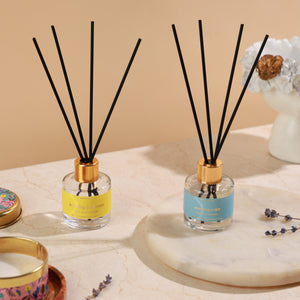

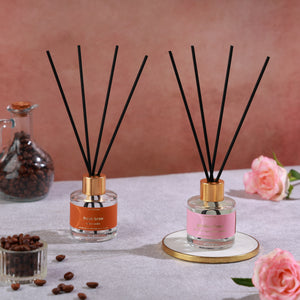

The trick within the trick: buy them in one order and start them apart. You keep the single delivery and still offset the calendar.
Already converged? Run one bottle on three reeds instead of six for eight weeks and it gains about four weeks. Also ₹0.
2. Stagger the starting, not the buying. This is the part that makes it painless. Buy two or four bottles in a single order — one delivery, one decision — and open the second four weeks after the first. An unopened bottle sits in a cupboard indefinitely without evaporating, so nothing is lost by holding it. Buying together and starting apart gives you the single order and the spread calendar at the same time, which is why the usual objection to staggering, that it means more orders, is simply not true.
3. What it actually buys you is the end of the dead fortnight. Four bottles bought on the same afternoon do not just need replacing at the same time — they fade at the same time. For the two weeks before you get round to it, the entire home reads flat at once, which is the version of this that guests notice. Staggered, there is always something recently opened somewhere, and the one bottle that is nearly finished is surrounded by three that are not. A staggered home never has a bad fortnight.
4. It also makes refills land properly. A 300ml refill at ₹2,399 fills a 130ml roughly twice. If all four of your bottles empty in the same fortnight, a single refill covers half your house and you need a second immediately. On a four-week rota, one 300ml refill covers two consecutive emptyings, or eight weeks of the rota — and at ₹8.00 a millilitre against ₹9.60 for a new bottle, that is also the cheaper way to buy oil.
5. If they have already converged, reset one for free. You do not need to buy anything to fix this. Take reeds out of one bottle: three reeds instead of six roughly halves the evaporation rate, so eight weeks at three reeds consumes about four weeks' worth of six-reed life and pushes that bottle around four weeks later. Do it in the room where a quieter month matters least — a bedroom rather than a hall. Or simply leave one low-value position empty for a fortnight, which costs nothing and buys the same offset.
Made in India, composed by an ISIPCA Versailles-trained perfumer — and a portion of every order supports girl-child education through Nanhi Kali.
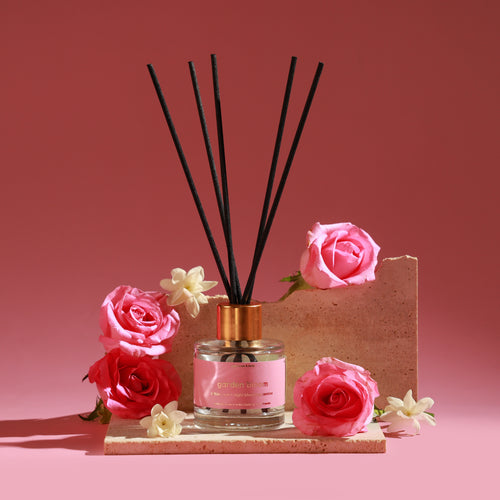
Why four bottles converge in the first place, and what that costs you
Bottles converge because homes are furnished in one afternoon. Somebody decides to scent the flat, buys three or four diffusers in a single order, and opens all of them the day the parcel arrives. Fourteen to eighteen weeks later they all fade together, and about three times a year the whole house has a flat fortnight followed by a four-bottle shopping trip. Nothing has gone wrong with any of the bottles. They were simply given identical start dates, and a reed diffuser is a clock that starts when you open it — the oil begins climbing the reeds within hours and the countdown is running from that moment whether the room is occupied or not.
The cost of convergence is not money; it is that the home reads badly at exactly the wrong moments and the reordering arrives as a lump. A staggered house always has something recently opened. On a four-week offset, one bottle is fresh, one is a month in, one is two months in and one is nearly done, so the average across the home stays steady even though every individual bottle is rising and falling. The arithmetic that produces this is trivially simple: offset equals bottle life divided by the number of bottles. Sixteen weeks over four bottles is four weeks. Sixteen over two is eight. Sixteen over three is a little over five. For 50ml bottles at around seven weeks, two of them want three or four weeks between them. And because you are spacing the opening rather than the buying, none of this requires more orders — an unopened bottle keeps indefinitely, so you can buy four at once, open one, and diarise the rest.
The three decisions when spacing a rota
 The offset₹0One division decides it. A 130ml runs 14–18 weeks on six reeds — call it sixteen — so four bottles want four weeks between them, three want about five, two want eight. Five bottles want about three. If you run four reeds rather than six, the bottle life stretches to nearer twenty-four weeks and the offsets stretch with it: four bottles then want six weeks apart. A 50ml at roughly seven weeks wants three or four weeks between a pair. Write the dates down once. The rota then maintains itself, because each bottle is replaced when it empties and inherits its own slot.
Sizing by space — the offset for every household
The right-hand column is what staggering costs, and it is the same in every row. This is the only table in the cluster where the correct answer is to buy nothing at all, six times over.
| Space | What it needs | How many | Cost |
|---|---|---|---|
| Four 130ml bottles on six reeds ★ | 16 ÷ 4 — start them four weeks apart, and one bottle finishes every four weeks for ever | Four weeks apart | ₹0 |
| Two 130ml bottles on six reeds | 16 ÷ 2 — eight weeks apart, which is why a duo bought together should be opened two months apart | Eight weeks apart | ₹0 |
| Three 130ml bottles on six reeds | 16 ÷ 3 — a little over five weeks apart; five is close enough and easier to remember | Five weeks apart | ₹0 |
| Four 130ml bottles on four reeds | Bottle life stretches to nearer 24 weeks, so the offsets stretch too: 24 ÷ 4 | Six weeks apart | ₹0 |
| Two 50ml bottles at about seven weeks | 7 ÷ 2 — three or four weeks apart. Small bottles converge fastest because they turn over fastest | Three or four weeks | ₹0 |
| Four bottles that already finish in the same fortnight | Buy nothing. Run one on three reeds for eight weeks and it gains about four — an extra bottle bought to even things out only adds a fifth clock | None | ₹0 |
| A note on all of the above: bottle life is a range and not a fixed number, so a rota drifts. Heat and airflow shorten a bottle and air-conditioning lengthens it, which means the hall bottle will always run faster than the bedroom one. That is fine — drift in different directions is what keeps them apart. Re-space only when two of them have visibly landed in the same week. | |||
One room · the unitFrom ₹749Shop → 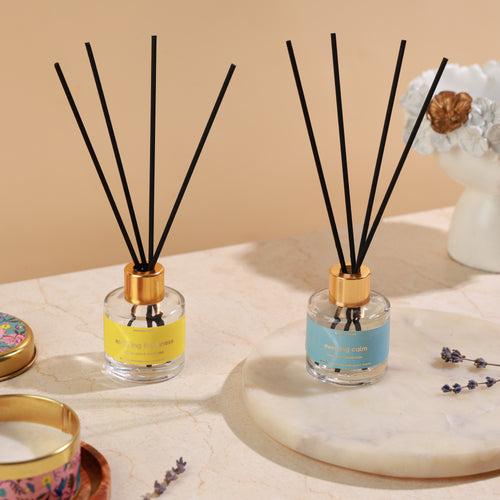 Two rooms · better value₹1,498Shop →
  Large room · a switch₹1,899Shop →
Setting the rota, and resetting one that has collapsed
Set the rota once, on paper, and let it maintain itself. Work out your offset — bottle life divided by bottle count — and write four dates in whatever you use for reminders. Open the first bottle the day it arrives and leave the others sealed. When the first empties, replace it and it inherits that slot automatically; you never have to recalculate. The rota is self-sustaining because each position keeps its own start date for as long as you replace bottles as they run out. The one thing that breaks it is buying a replacement early and opening it while the old one still has oil in it, which resets that position's clock and pulls it towards its neighbours. Keep the spare sealed until the bottle it replaces is genuinely finished — and "finished" means dry, not "seems quieter", because a bottle that has faded with liquid still in it usually has clogged reeds rather than an empty tank.
Then let the rota do the buying for you. Once one bottle empties every four weeks rather than four emptying at once, refills start working properly. A 300ml refill at ₹2,399 fills a 130ml roughly twice, which on a four-week rota covers two consecutive emptyings — eight weeks of house — and at ₹8.00 a millilitre against ₹9.60 for a new bottle it is the cheaper oil. A 500ml at ₹3,499 is ₹7.00 a millilitre and covers nearly four fills — about fifteen weeks of a staggered four-bottle home. Fit fresh reeds at each refill while you are there. The result is that a household which used to place four panicked orders three times a year places two or three calm ones, and no room is ever flat while it waits.
And if the rota has already collapsed, reset it with reeds rather than with money. Pick the bottle in the room where a quieter month matters least — a bedroom, not the entrance you arrive through — and take reeds out. Three reeds instead of six roughly halves the evaporation rate, so eight weeks at three reeds consumes about four weeks' worth of six-reed life and pushes that position roughly four weeks later. Four reeds instead of six is gentler and takes about twelve weeks to gain the same four. Repeat on a second bottle a month afterwards if you need a wider spread. What not to do is buy an extra diffuser to smooth the calendar: a fifth bottle does not fix four converged clocks, it adds a fifth. Staggering is a scheduling problem with a scheduling answer, and the answer is free.
What to buy
Nothing on this page requires a purchase. If you are about to buy for two rooms anyway, the duo is the natural place to start a rota — buy both, open them eight weeks apart.
| Buy | What it covers | Lasts | Price |
|---|---|---|---|
| One 50ml | A single reed diffuser — a bathroom position, which at two or three reeds drifts slowest and needs re-spacing least | 6–8 weeks | from ₹749 |
| One 130ml ★ | The value size — every main position — sixteen weeks on six reeds is the number your offset is divided from | 14–18 weeks | from ₹1,249 |
| The duo | Day & Night duo — starting two rooms in one order and opening the second eight weeks later, which is the rota in miniature | 6–8 weeks each | ₹1,498 |
| Sukoon | 500ml ultrasonic — the one room over about 200 sq ft, which sits outside the rota entirely because it has no bottle to empty | Runs when you switch it on | ₹1,899 |
| 300ml refill | The running cost — the reason staggering pays: one refill covers two consecutive emptyings on a four-week rota | Roughly 2 × 130ml fills | ₹2,399 |
Versailles
This is the cheapest advice in the entire range and there is nothing to sell attached to it, which is probably why you have never been given it. Divide the bottle life by the number of bottles and start them that far apart. Four 130ml diffusers at sixteen weeks means four weeks between openings, and one bottle then finishes every four weeks instead of four finishing at once, three times a year.
The objection I hear is that staggering means more orders, and it does not, because an unopened bottle does not evaporate. Buy them all in one delivery. Open one. Put the others in a cupboard with a date written on the box. You get the single order and the spread calendar, and you also get the thing that matters most: a spare in the house, so no room ever sits empty while somebody remembers to buy something.
If yours have already converged, please do not buy a fifth bottle to even it out — that adds a clock rather than removing one. Take reeds out of one bottle instead. Eight weeks on three reeds gains you about four, in whatever room you mind least having quieter for a month. It is free, it works, and it takes one decision. A portion of every order funds a girl's classroom through Nanhi Kali.
Frequently asked questions
- Reordering with five bottles — the calendar, in days.
- Budgeting a full year — litres, not bottles.
- Two 50ml against one 130ml — how the weeks compare.
- The complete sizing and quantity guide — every home type, three builds.
- Brand: the SOSA founder story.
SOSA products & prices (verified August 2026): Hotel Collection water-based ultrasonic diffuser fragrance 15ml ₹299 · 100ml ₹999 · 300ml ₹1,799 · Pack of 7 (15ml, all fragrances) ₹1,799; refills 100ml from ₹999. Seven scents: The Ritz-Carlton-inspired (white tea · bergamot · cedar), Westin-inspired (white tea · aloe · cedar), 1 Hotels-inspired (cedarwood · vetiver · green leaves), The St. Regis-inspired (amber · violet · woods), Shangri-La-inspired (jasmine · green tea · white tea), Four Seasons-inspired (citrus · floral · sandalwood), W Hotels-inspired (citrus · pepper · amber). Diffusers: Boond 300ml ₹899 · Sukoon 500ml ₹1,899 · Megh 6L ₹3,499. Water-based, phthalate-free, composed to IFRA standards for home diffusion; 3–6 drops per tank. Made in India, Pune. The Hotel Collection scents are SOSA's own interpretations inspired by the world's finest hotels; all hotel names are trademarks of their respective owners and are used only to describe the scent style — SOSA is an independent Indian fragrance house, not affiliated with or endorsed by any hotel brand. Prices and availability subject to change — see the live product pages.