



Control second: you want a device that runs in one room, at a level you set, for hours you choose. Safar ₹3,999 gives 3 speeds and a 1, 2 or 3-hour auto-off timer, cordless on a 2000 mAh Type-C battery — and it is named and sold as a car and travel diffuser, with no published room-coverage figure. Sukoon ₹1,899 covers 270–320 sq ft with on/off and intensity, accepting water and humidity.
The reed’s honest limitation: it cannot be switched off. It evaporates into the room whether anyone is there or not, and with the door open it drifts into the flat. That is the one place where a machine wins outright.
What not to buy for this: Vaayu ₹11,999 — it is rated to 1000 m³, roughly 2,000–3,000 sq ft, and buying it to scent one room deliberately is buying a whole-flat machine to do a single-room job. Unless a whole-flat machine is what you actually want, which is a different and legitimate purchase.
The honest gap: between Safar and Vaayu, SOSA has no mid-sized waterless bedroom nebuliser. For one contained room the real three-way is reed ₹749–₹849, Sukoon ₹1,899, or Safar ₹3,999.
2. Put the source inside the room and out of the draught. Not on the threshold. A doorway is the most turbulent point in a home: it opens, air exchanges, and anything sitting there is repeatedly stripped and then hit at close range. Slightly inside, away from the direct blast of a split air conditioner and out of a window’s cross-draught, gives both a better result and a longer-lasting product.
3. Use the air conditioner as an ally rather than an enemy. A running split AC in a closed room recirculates that room’s own air rather than exchanging it with outside, which distributes fragrance evenly across the space instead of leaving it pooled near the source. This is a large part of why a sealed bedroom reads strongest at night. It also dries the air, which speeds evaporation, so you get better distribution and a shorter bottle in the same season.
4. Choose a mechanism that can be switched off. This is the honest dividing line. A reed diffuser cannot be stopped — oil climbs six fibre reeds and evaporates continuously, into an empty room as readily as an occupied one. Safar has three speeds and a 1, 2 or 3-hour auto-off timer and is fully cordless. Sukoon is switched on when you want it. Control is a genuine feature, not a luxury, and it is the feature this particular question is really asking for.
5. Do not buy a whole-flat machine to do a single-room job. Vaayu at ₹11,999 is rated to 1000 m³ or roughly 2,000–3,000 sq ft. Pointing it at one bedroom is the opposite of zoning — it is buying the capability to scent everything and then trying not to. If one machine scenting the whole flat is genuinely what you want, buy it for that reason and enjoy it. If the brief is one room, it is the wrong tool.
Alcohol-free, phthalate-free, paraben-free, IFRA-compliant, 0 ppm formaldehyde. Free shipping above ₹499, and a portion of every order supports girl-child education through Nanhi Kali.

Containment — why a door is the whole game
Everybody underrates this because it is free and nobody sells it. A flat with its internal doors open is not a set of rooms; it is one connected volume with furniture in the way. Air moves through a doorway continuously, driven by temperature differences, by fans and air conditioners, by the pressure changes of an outside door opening, and by nothing more dramatic than somebody walking down a corridor. Anything airborne goes with it. That is why a bedroom source with the door open produces a mild everywhere-scent rather than a strong somewhere-scent, and it is why the reader who writes to me asking for lobby intensity in one room has usually never run the experiment with the door shut.
 Evening Calm₹799Two things happen the moment the door shuts, and they compound. The volume being scented collapses to the room alone, so the same output produces a far higher concentration — concentration is quantity divided by volume, and you have just divided the volume by a large number. And the loss rate collapses too, because the main route out has closed. A closed room therefore climbs to a perceptible level quickly and then holds it, which is exactly the behaviour a hotel guest room exhibits and exactly what an open-plan floor cannot do. Nothing you buy replicates this, and anything you buy works better with it.
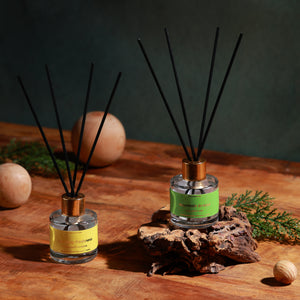
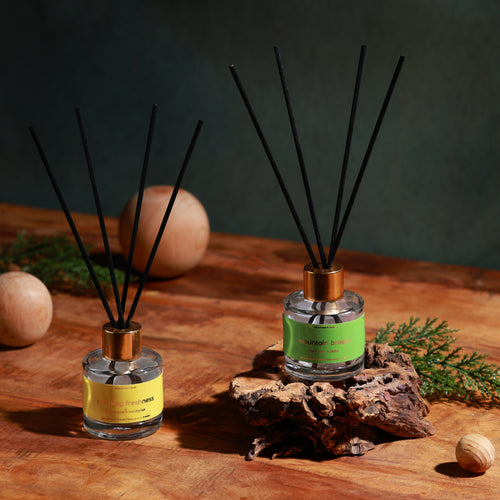
 Mountain Breeze₹849The instinct is to put the source by the door so that it hits you on entry. It is almost always wrong. An entrance is the most turbulent point in any home: the door swings, air exchanges, and whatever sits there is repeatedly stripped and then encountered at close range, which produces a sharp burst followed by nothing. Slightly inside the room, in the path air already takes but out of any direct draught, gives a better first impression, a more even room and a longer-lasting product. The same applies to a split air conditioner — do not put a reed directly under the outlet, where the blast will strip the lightest materials off in days and leave you with the base. In an AC room, the machine or bottle wants to be in the circulation, not in the jet.
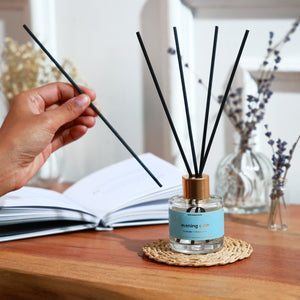
 Hotel Collection₹999This is the honest limitation of the format we sell most of, and pretending otherwise costs trust. A reed diffuser cannot be switched off. Oil climbs six fibre reeds by capillary action and evaporates at whatever rate the room allows, all day, into an empty flat as readily as an occupied one. You can slow it — three reeds instead of six gives a soft bedside level and roughly doubles the life — but you cannot stop it and you cannot schedule it. Safar answers this precisely: three speeds, a 1, 2 or 3-hour auto-off, 2000 mAh Type-C battery giving up to 10 hours continuous or around 30 hours intermittent, fully cordless at 6.9 cm, throwing undiluted oil as a dry mist with no water at all. It is named and sold as a car and travel diffuser and has no published room-coverage figure, and you should know both of those before you buy rather than after.
Control — the second half, and the one people skip
Containment decides where. Control decides when, and when is most of what separates a room that feels deliberate from a house that smells of a product. A hotel does not run its lobby fragrance because the lobby exists; it runs it on a schedule, at a set intensity, matched to the hours people arrive. That is a completely reproducible idea at domestic scale and it costs almost nothing to imitate: run the bedroom for the two hours around when you go up, not for the eleven hours you are at work. You will use less oil, the room will read as stronger because the level is fresh rather than stale, and nothing will have drifted into the rest of the flat while nobody was home.
There is a second, subtler argument for controlled hours, and it belongs to your nose rather than to the fragrance. Olfactory receptors adapt to a constant, unchanging stimulus within minutes. A room held at one level all day is a room you will stop perceiving entirely, which is why so many people conclude that a product has stopped working when in fact they have stopped noticing. Running the fragrance for a defined window and letting the room fall quiet in between gives you an on-and-off signal instead of a flat one, and an on-and-off signal is the only kind you will keep registering in your own home. This is also, incidentally, the honest answer to why the hotel seemed so much more noticeable: you arrived un-adapted, and the building had nothing to do with it.
And accept one small, pleasant unfairness. Some of what you release will settle onto soft furnishings — curtains, bedlinen, upholstery — and re-release slowly afterwards, so a room that has been scented for two hours holds a soft trace long after the machine has stopped. This is why the second and third evening of a routine feel easier than the first, and it is another reason to run at a lower level than instinct suggests. Almost any composition at too high a concentration flattens into a single sweet or sharp impression — which is precisely what people mean when they say something smells like air freshener. The same oil at a lower dose reads as layered, because the nose has room to resolve the separate materials. Restraint is free and it is the most reliable luxury signal there is.
| Move | What it does mechanically | Effect on one-room intensity | Cost |
|---|---|---|---|
| Close the door, an hour ahead | Collapses the volume being scented and closes the main route out | The largest single gain available, and it is free | ₹0 |
| Move the source off the threshold | Takes it out of the most turbulent air in the home | More even room, better first impression, longer-lasting bottle | ₹0 |
| Run the AC in the closed room | Recirculates the room’s own air rather than exchanging it | Distributes evenly instead of pooling near the source | ₹0 |
| Cut the reed count from six to three | Halves the evaporating surface | Softer bedside level and roughly double the life — the volume dial nobody uses | ₹0 |
| Sukoon ₹1,899 | Ultrasonic water mist — a piezo plate throws oil dispersed in water, and the plume moves air | Real coverage of 270–320 sq ft, on demand. Accepts dilution, humidity, refilling | ₹1,899 |
| Safar ₹3,999 | Waterless cold-air nebulising — pressurised air shatters undiluted oil into a dry mist | 3 speeds, 1/2/3-hour auto-off, cordless. Named and sold as a car and travel diffuser; no published room coverage | ₹3,999 |
| A reed ₹749–₹849 | Passive capillary — oil climbs six fibre reeds and evaporates. No air moved | Excellent contained zone, silent, no socket. Cannot be switched off or scheduled | ₹749–₹849 |
| The honest gap: for one contained room there is no perfect SOSA product — between Safar’s personal scale and Vaayu’s 2,000–3,000 sq ft there is no mid-sized waterless bedroom nebuliser. Megh ₹3,499 does not fill it: about 215 sq ft, which is less than the ₹1,899 Sukoon. | |||
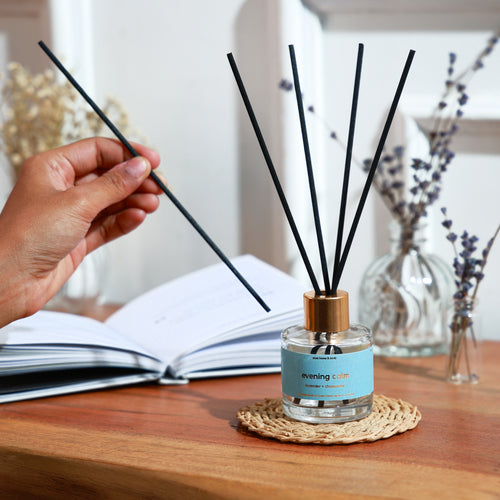 Passive · Evening Calm₹799Shop → Active · Sukoon₹1,899Shop →
  Ultrasonic-only · Hotel Collection₹999Shop →
What leaks anyway, and what to do about it
Containment is very good and it is not perfect, so it is worth naming the three routes by which a scented room reaches the rest of the flat. The first is simply opening the door, which exchanges a slug of the room’s air with the corridor every time. There is no fix for this and it does not need one — the corridor gets a hint rather than a dose, and that hint is much closer to how a hotel floor actually behaves than most people realise. The second is a shared exhaust or a passage window, particularly in bathrooms adjoining bedrooms, which can pull air out of the room and change the direction of flow entirely. If an exhaust fan runs, the room is being ventilated, and a ventilated room does not hold fragrance. The third is a running ceiling fan with the door open, which is an efficient way of turning two rooms into one.
Two practical corrections follow. If you want an arrival effect at a bedroom door in the evening, close the door and let the room build for an hour, then leave it closed until you go in — the gradient at the threshold is the effect, and every early opening flattens it. And if you want the flat to stay neutral, do not compensate for a leaky arrangement by turning everything up. Over-dosing a room to overcome an open door is the most common way people end up with a home that smells uniformly of one thing, at which point nobody notices it at all, because a home that smells identical everywhere stops registering as a smell within about a week. Zoning works precisely because of the contrast between rooms.
One last honest note, because it belongs on any page about strong fragrance in a small room: fragrance does not remove a smell. Adding a pleasant odour to an unpleasant one produces a mixture rather than a cancellation, and the mixture is frequently worse, because the brain now tracks two things instead of one. If the room has a damp corner, a shoe cupboard or last night’s cooking still in the curtains, the order is source, then ventilation, then fragrance. A contained room with something wrong in it becomes a contained room with two things in it.
What to buy for one contained room — and the rung that does not exist
In the order I would work through it, with what each step gives up. The last row is the honest gap in our own range, named because it is the reason there is a choice here rather than an obvious answer.
| Buy | What it is | When it is the right answer | Price |
|---|---|---|---|
| 1. The free three — door, placement, hours ★ | Door shut an hour ahead, source inside the room and out of the draught, and the fragrance run only for the hours you are there | Always first. These three do more for one-room intensity than any product, and they cost nothing | ₹0 |
| 2. A reed, dosed for a closed room | A reed diffuser — passive capillary, six fibre reeds, refillable glass, 50ml up to ~150 sq ft for 6–8 weeks, about ₹13–₹15 a day. Three reeds for a soft bedside level, six for full projection | When you want silence, no socket, nothing to fill or charge and an object rather than an appliance. It cannot be switched off, so it zones by place and never by time | ₹749–₹849 |
| 3. Sukoon — the value answer for one bedroom ★ | Ultrasonic water mist, 500ml, 270–320 sq ft, 16–18 hours on low, three 15ml Hotel Collection scents included | Real coverage, on demand, at roughly a sixth of Vaayu’s price. You accept dilution in water, added humidity, refilling and a plug | ₹1,899 |
| 4. Safar — when water is the deal-breaker | Waterless cold-air nebulising of undiluted oil, 20ml, 2000 mAh Type-C, up to 10h continuous or ~30h intermittent, 3 speeds, 1/2/3-hour auto-off, 6.9 cm and fully cordless. Named and sold as a car and travel diffuser, with bedside and hotel room among its stated uses | When you want no water in the room and precise control of hours. No published room-coverage figure, and it needs recharging | ₹3,999 |
| Only for a whole flat: Vaayu | Up to 1000 m³ or roughly 2,000–3,000 sq ft, 400ml tank up to ~90+ days, app plus onboard control, 1h/4h/8h/24h windows, choice of days, key-lock, under 38 dB, 5W | The opposite purchase to zoning unless one machine scenting the entire flat on a schedule is what you actually want — which is a legitimate reason, just not this page’s question | ₹11,999 |
| Never as a coverage upgrade: Megh | 6L tank, around 100 hours of runtime, about 215 sq ft of coverage | Less coverage than the ₹1,899 Sukoon. A runtime and humidity machine, and never the missing middle rung | ₹3,499 |
| The honest gap | No mid-sized waterless bedroom nebuliser exists at SOSA — nothing sits between Safar’s personal scale and Vaayu’s 2,000–3,000 sq ft | Said plainly, because it is why a contained bedroom is answered by Sukoon with water accepted, or Safar correctly understood, and not by a smaller Vaayu | — |
Versailles
Of all the questions in this cluster, this is the one where the cheapest advice is also the best advice, and I am aware that is an awkward thing for somebody who sells diffusers to keep writing. A closed door outperforms every product on our shelf at the specific job of making one room intense and the rest of the flat neutral. It is not a consolation prize and it is not a workaround. It is the mechanism.
What the product then adds is time. A reed diffuser is a beautiful object and it is the thing I keep in my own bedroom, but it has one genuine design limitation and I would rather state it than have a customer discover it: it cannot be switched off. It runs into an empty room at three in the afternoon exactly as willingly as into an occupied one at nine at night. If your requirement includes the words “only when I am there”, no reed at any price meets it, and that is a mechanism fact rather than a quality one.
And I will keep naming the hole in our own ladder. If you want the hotel mechanism — waterless, undiluted, dry, no humidity — sized for one bedroom, we do not make it. Safar is personal scale and is named and sold as a car and travel diffuser, with no published room coverage. Vaayu is a machine for a floor, and buying it to scent a single room is the exact opposite of what this page is about. So the honest answer here is Sukoon at ₹1,899 with the water accepted, or Safar understood for what it is. Everything is composed in Pune, and part of every order funds a girl’s classroom through Nanhi Kali.
Frequently asked questions
- Room scenting vs lobby scenting — the two problems, named and separated.
- Lobby smell in my bedroom — do I need a commercial machine? — no, and why.
- 120 sq ft against a lobby — the arithmetic, done honestly.
- Safar or Vaayu for a small room? — the head-to-head, sized properly.
- Do I need Vaayu for one bedroom? — no, said plainly.
- When Safar makes more sense than a large machine — small volume, occupied hours.
- When a home is genuinely large enough for Vaayu — thresholds, not adjectives.
- Intensity versus coverage — two different specifications.
- Safar vs Vaayu, the family pillar — chosen by space, not by spend.
- Brand: the SOSA founder story.
Facts verified August 2026: Three diffusion mechanisms are described — passive capillary (reed diffusers), ultrasonic water mist (Boond ₹899, 300ml, up to ~150 sq ft, ~6 hours, USB, night light; Sukoon ₹1,899, 500ml, 270–320 sq ft, 16–18 hours on low, three 15ml Hotel Collection scents included; Megh ₹3,499, 6L tank, ~100 hours runtime, ~215 sq ft, which is less coverage than Sukoon) and waterless cold-air nebulising (Safar ₹3,999, 20ml bottle, 2000 mAh Type-C battery, up to 10 hours continuous or around 30 hours intermittent, 3 speeds, 1/2/3-hour auto-off timer, 6.9 cm, named and sold as a car and travel diffuser with car, handbag, desk, bedside and hotel room among its stated uses, no published room-coverage figure; Vaayu ₹11,999, coverage up to 1000 m³ or roughly 2,000–3,000 sq ft, 400ml refillable tank lasting up to about 90+ days, Bluetooth app and onboard buttons, 1h/4h/8h/24h run windows, choice of days, adjustable mist intensity, key-lock, under 38 dB, freestanding or wall/HVAC mount, 5W, CE, RoHS, SGS). Aangan ₹25,999 and Meenar ₹38,500 are commercial HVAC systems for 8,000–10,000 and 12,000–18,000 sq ft respectively and are never a home recommendation. SOSA reed diffusers: five scents, 50ml ₹749–₹849 lasting 6–8 weeks and suiting rooms up to ~150 sq ft, 130ml ₹1,249–₹1,349 lasting 14–18 weeks and suiting above 150 sq ft, six fibre reeds included and flipped every 3–5 days, about ₹13–₹15 a day, heat-stable CCT carrier rather than DPG, alcohol-free, phthalate-free, paraben-free, IFRA-compliant, 0 ppm formaldehyde, refillable glass bottle, climate-tested at 45°C and 85% RH, composed in Pune. Duos are two 50ml bottles at ₹1,498–₹1,598; 130ml duos ₹2,498–₹2,598; refills 300ml ₹2,399 and 500ml ₹3,499, oil only and never a first purchase. SOSA strength scale: Evening Calm 8.9, Garden Bloom 8.9, Morning Freshness 9.0, Mountain Breeze 9.4, Fresh Brew 9.5. Hotel Collection fragrance oils are water-based and ultrasonic-only at 15ml ₹299 (a refill), 100ml ₹999, 300ml ₹1,799 and a pack of seven at ₹1,799; they cannot be used in reed diffusers and reed oil cannot be used in ultrasonic machines, so no hotel-inspired reed diffuser exists. Between Safar and Vaayu there is no mid-sized waterless bedroom nebuliser in the SOSA range. No health, air-quality, allergy, asthma or antimicrobial claims are made, and fragrance does not remove a smell — source, then ventilation, then fragrance. Free shipping above ₹499. A portion of every order supports girl-child education through Nanhi Kali. SOSA is an independent Indian fragrance house; the Hotel Collection scents referenced here are SOSA’s own interpretations inspired by the world’s finest hotels, and SOSA is not affiliated with, endorsed by or a supplier to any hotel brand. Prices subject to change — see the live product pages.