



The level: lower than the empty room suggests. Sixty warm bodies raise the room’s temperature and its humidity, and warmth lifts the lighter materials, so the same setting is perceived as stronger at capacity than at commissioning.
The control that matters: the schedule, not the intensity. Vaayu gives run windows of 1h / 4h / 8h / 24h and a choice of days, so the signal can go in before the doors open and then step down while the room fills.
The honest gaps: no figure exists for how much a crowd changes perceived intensity — not on any SOSA page and not, honestly, anywhere I would trust. And if the lounge serves canapés and drinks at a counter, the area around that counter should be treated as food service and left alone.
- The straight answer, in five parts
- What sixty people do to a room’s air
- The register that survives a crowd by not competing with it
- Every direction proposed for a networking lounge, judged
- Scheduling an event room, and the drinks counter question
- The networking-lounge edit — and the honest gaps
- A note from Sonal
- FAQs
2. Set the level for the full room, and accept that it will feel too quiet when you set it. Commission in the empty room at the bottom of the range, then stand at the door during an actual event and judge it then. A crowd is warmer and damper than an empty room, and warmth accelerates the lightest materials, so a setting that felt correct at four o’clock is being read as stronger at half past seven — at exactly the moment the room contains the people whose opinion the club cares most about.
3. Use the schedule rather than the intensity. The useful shape for an event room is a clear signal laid down before the doors open, into a room that is still empty and cool, followed by a lower or paused output while it fills. Vaayu does this with run windows of 1h / 4h / 8h / 24h and a choice of days; Aangan does it with programmable work and pause cycles on its PCB. Neither is an app-and-sensor system that responds to occupancy, and nobody should tell you otherwise.
4. Treat the drinks and canapé counter as food service. Wherever food is plated or poured in a club, ambient fragrance competes with it, and a networking lounge with a bar is a dining area for the two hours that matter. Place the machine away from the counter and in the airflow path on the other side of the room, and if the club runs full dinners in that space, the honest answer is that it should be neutral during service.
5. Choose waterless. Sixty people have already added heat and moisture to the room; an ultrasonic machine adds more, because it mists oil diluted in water. A waterless cold-air nebuliser shatters undiluted oil into a dry nano-mist with no water, no dilution, no added humidity and no white mineral residue on glassware, dark stone or a laptop lid. Everything SOSA makes is alcohol-free, phthalate-free, paraben-free, IFRA-compliant and 0 ppm formaldehyde, composed in Pune, and a portion of every order supports girl-child education through Nanhi Kali.

What sixty people actually do to a room’s air
Density is usually discussed as a social property of a networking room and almost never as a physical one, which is a pity, because the physics is where the fragrance decisions come from. A crowd changes four things at once, and three of them push the perceived intensity up rather than down. If a club understands that, it stops treating a full room as a harder version of the empty room and starts treating it as a different room that happens to have the same walls.
 Vaayu₹11,999Every person in a room is a heat source and a moisture source, and a networking lounge at capacity is measurably warmer and more humid than the same room an hour earlier. Both changes matter to fragrance. Heat accelerates evaporation, and it accelerates the lightest molecules most, which are precisely the citrus and green materials at the top of a dry composition. Humidity changes the character rather than the quantity: saturated air carries fragrance less readily, so projection shortens and the scent hangs closer to people rather than filling the volume. The combination is a room in which the top of the composition is being pushed harder while the whole thing sits closer to the guests. That is why a setting commissioned in a cool, empty, air-conditioned room at four o’clock is being experienced as something noticeably more assertive at half past seven, and why the commissioning visit should never be the only visit.
 Mountain Breeze₹849An executive networking room is the most heavily perfumed environment a club ever produces. Members arriving from a day of meetings are wearing fine fragrance applied twelve hours earlier, which by evening is mostly base — woods, musk, amber, tonka — sitting warm and close. A house fragrance built in the same families arrives into a room that is already saturated with them and simply disappears into the mass. The reflex response is to raise the level so the house scent becomes audible again, and the outcome is reliably worse: not a clear house identity over a crowd, but a heavier and more confusing mixture, which members describe with words like stuffy and overpowering without being able to say what they are actually smelling. The way out is orthogonality rather than volume. Choose a family personal perfumery rarely occupies at room strength — transparent tea, dry citrus, green herbal — and let it sit underneath everything else as a clean floor.
Aangan₹25,999The fourth effect pulls the other way, and it is the one that makes a networking lounge genuinely difficult rather than merely counter-intuitive. A full room is a room with the doors opening constantly and the air handling working harder, and air that leaves takes the fragrance with it. So the room is simultaneously perceiving the composition more strongly, because it is warm and crowded, and losing it faster, because it is being ventilated harder. Those two effects do not cancel neatly, and no honest supplier can tell a club which one dominates in their particular room without standing in it. What follows practically is that this is a room to be judged rather than calculated, and that it should be judged at least twice: once empty, once full. It is also the strongest argument in this family for putting the fragrance into the air system rather than into the room, because a machine on an AHU is working with the ventilation instead of against it.
Mountain Breeze₹849An executive networking room is the most heavily perfumed environment a club ever produces. Members arriving from a day of meetings are wearing fine fragrance applied twelve hours earlier, which by evening is mostly base — woods, musk, amber, tonka — sitting warm and close. A house fragrance built in the same families arrives into a room that is already saturated with them and simply disappears into the mass. The reflex response is to raise the level so the house scent becomes audible again, and the outcome is reliably worse: not a clear house identity over a crowd, but a heavier and more confusing mixture, which members describe with words like stuffy and overpowering without being able to say what they are actually smelling. The way out is orthogonality rather than volume. Choose a family personal perfumery rarely occupies at room strength — transparent tea, dry citrus, green herbal — and let it sit underneath everything else as a clean floor.
Aangan₹25,999The fourth effect pulls the other way, and it is the one that makes a networking lounge genuinely difficult rather than merely counter-intuitive. A full room is a room with the doors opening constantly and the air handling working harder, and air that leaves takes the fragrance with it. So the room is simultaneously perceiving the composition more strongly, because it is warm and crowded, and losing it faster, because it is being ventilated harder. Those two effects do not cancel neatly, and no honest supplier can tell a club which one dominates in their particular room without standing in it. What follows practically is that this is a room to be judged rather than calculated, and that it should be judged at least twice: once empty, once full. It is also the strongest argument in this family for putting the fragrance into the air system rather than into the room, because a machine on an AHU is working with the ventilation instead of against it.
The register that survives a crowd by refusing to compete with it
The composition follows from the density argument rather than from taste. What a networking lounge needs is a fragrance in a family that the room is not already full of, pitched low enough to act as a base layer and transparent enough that it never becomes a thing anybody is smelling on purpose. Four materials do the work, and the reasoning for each is slightly different from the reasoning on a quiet working floor.
White tea is the obvious spine because almost nobody wears it. It is transparent, faintly astringent and very light, it has no accumulation behaviour worth speaking of, and it occupies a space in the olfactory field that personal fragrance mostly leaves empty. Bergamot or a dry citrus supplies lift, and in a crowded evening room lift is doing something specific: it counteracts the closed, warm, slightly heavy quality that a full room acquires by eight o’clock. It will also be the first material to go, which in this room is acceptable, because the early evening is when it is most needed. A green or herbal edge — something vegetal, slightly bitter, faintly aromatic — is what stops the whole thing reading as a corporate lobby, and it is also unusual enough on a lapel that it will not collide with anybody. Cedar, used sparingly, gives the room a floor. I would specify it lighter here than in a quiet lounge, because the room is already full of woody bases arriving on other people.
The exclusions are firmer in this room than anywhere else in the family. No white florals and no rose: these are the most heavily worn families in the building, and a house floral does not read as the club’s identity, it reads as somebody standing rather close. No amber, no oud, no resinous base, for the same reason and with more force, because those are exactly what a twelve-hour-old personal fragrance has become by evening. Nothing gourmand, because there are canapés in the room and a sweet fragrance competing with real food is a mistake a chef will hear about before the general manager does. And for completeness, because it is asked in this room more than any other: SOSA publishes no leather fragrance in any format and no tobacco or smoky fragrance for any diffuser, so the smoky-leather executive register that gets proposed for these rooms is not something I can supply and not something I would recommend if I could.
Every direction proposed for a networking lounge, judged at capacity
What gets suggested for an executive event floor, and how each behaves in a warm room holding sixty people who are already wearing fragrance. The middle column is the one that matters: not how the direction smells on a blotter, but what it does when it is the sixty-first composition in the air. The last row names a direction that does not exist in the range at all.
| Direction | Against sixty personal fragrances | At capacity, warm and damp | Verdict |
|---|---|---|---|
| White tea ★ | Occupies a space personal perfumery mostly leaves empty | Stays transparent; acts as a floor rather than a layer | The spine of the composition |
| Bergamot or dry citrus | Rarely worn at room strength; reads as air rather than as scent | Counteracts the closed warm quality a full room acquires | Specify as the lift, accepting it leaves first |
| Green or herbal edge | Unusual on a lapel, so it collides with almost nobody | Stable, and keeps the room from reading as an office lobby | Specify. It is what makes the identity distinctive |
| Cedar, used lightly | Shares territory with many personal bases, so use less of it | Near-linear and undemanding at a low proportion | Specify sparingly, as a floor rather than a feature |
| Rose, jasmine, white floral | The most heavily worn family in the room | Stacks with personal fragrance; reads as proximity, not identity | No. The collision is guaranteed |
| Amber, oud, heavy resin | Exactly what a twelve-hour-old personal fragrance has become | Thickens as the room warms; described as stuffy | No, and raising the level makes it worse |
| Leather, tobacco or smoke | The classic request for an executive evening room | Cannot be assessed — it does not exist in the range | SOSA publishes no leather fragrance in any format and no tobacco or smoky fragrance for any diffuser. A dry tea-and-green register is the honest answer instead |
Scheduled · Vaayu₹11,999See it → On the air system · Aangan₹25,999See it → 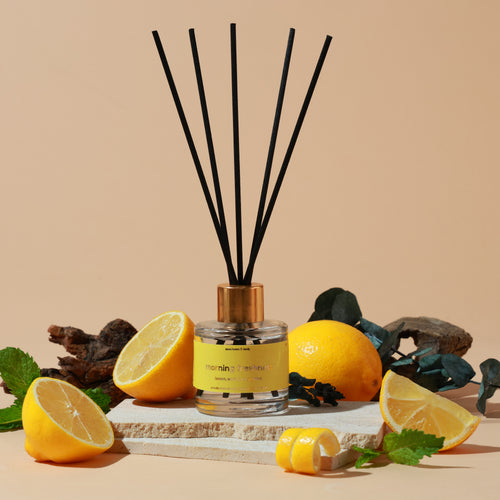 Dry citrus, to try · reeds₹749See it →
Scheduling an event room — and the drinks counter nobody wants to discuss
Two practical matters decide whether a networking lounge is pleasant or complained about, and neither is a composition question. The first is the shape of the delivery across the evening. The useful pattern is to lay the signal into a cool empty room before the doors open, then reduce or pause while the room fills, because the guests themselves are about to add heat, moisture and sixty fragrances to the air, and the house contribution should be shrinking as theirs grows. A room does not need continuous output during an event; it needs to have been prepared for one. Vaayu handles this with run windows of 1h / 4h / 8h / 24h and day selection; Aangan handles it with programmable work and pause cycles and daily schedules on its PCB. It is worth being exact about what that is and is not: these are timers and cycles set by a person, not sensors reacting to occupancy. No SOSA machine has occupancy detection, and none offers Wi-Fi, a building-management connection or any other digital integration — the Aangan HVAC connection is a mechanical one into ductwork.
The second is the bar. Almost every executive networking lounge has a counter where drinks are poured and canapés are plated, and for the two hours that matter that counter is food service. The club rule that applies everywhere else in the building applies here too: ambient fragrance competes with food and flattens wine, and a sommelier pouring at a networking evening is doing the same job as one pouring at dinner. The practical compromise is geometric rather than philosophical — put the machine in the airflow path at the opposite side of the room, keep it well away from the plating and pouring position, and if the club regularly runs seated dinners or tastings in that space, accept that the room should be neutral during service. I would rather a club scent the approach, the lift lobby and the corridor outside and leave the event floor almost bare than have the head chef and the fragrance arguing in front of members.
The third thing, which nobody asks and everybody needs, is about placement geometry. Two machines at opposite ends of a long networking room do not produce an even room. They produce two concentrations with a thinner patch between them, because the midpoint is the farthest point from both, and in a standing-room event the midpoint is usually where the crowd is densest. One machine correctly positioned in the supply path will beat two placed for the convenience of a power outlet, at any budget. And reason in volume rather than floor area while you decide: a double-height event room or one that opens onto a galleried stair contains a great deal more air than its square footage suggests, and a closed door is a boundary while an open plan is a single volume however large it is.
The networking-lounge edit, in order — and the honest gaps
What I would do with an executive networking floor, in sequence. The first two steps cost nothing and are the ones that decide whether the purchase works. The last two rows name what is not worth buying and what is not published, because a specifier will go looking for both.
| Step | What it is | Why it matters in a crowded room | Cost |
|---|---|---|---|
| 1. Judge the room full, not empty ★ | Commission at the bottom of the range, then attend one real event and assess it walking in from outside | A crowd is warmer, damper and already fragranced; the setting that felt right at four o’clock is read as stronger at half past seven | No cost |
| 2. Write the schedule before buying the machine | Signal laid down into a cool empty room before doors, reduced or paused while it fills | The guests are about to supply their own heat, moisture and fragrance. The house contribution should shrink as theirs grows | No cost |
| 3. Choose a family the members are not wearing | Transparent tea, dry citrus, a green or herbal edge, light cedar. No floral, no amber, no gourmand | A house scent sharing a family with sixty personal fragrances produces a blur rather than an identity | No extra |
| 4. Test the register for a fortnight first | A dry citrus reed diffuser on the events desk, on three reeds rather than six | Settles a committee argument about direction for ₹749. It will not scent an event floor and is not meant to | ₹749 |
| 5. Specify the machine and its schedule | Vaayu, up to 1000 m³ ≈ 2,000–3,000 sq ft, run windows of 1h / 4h / 8h / 24h, day selection, key-lock, under 38 dB, DC 12V / 1A 5W | Waterless, so nothing added to a room sixty people are already warming, and quiet enough for a room whose purpose is conversation | ₹11,999 |
| 6. If the floor is on one air system | Aangan on a mechanical HVAC or AHU connection, up to 3,000 m³ ≈ 8,000–10,000 sq ft, work and pause cycles | Works with the ventilation that a full room is running harder, rather than against it | ₹25,999 |
| Do not buy: a second machine for event nights | An additional unit, or a raised setting, brought in because the fragrance “gets lost” when the room is busy | It does not produce a clear house identity above a crowd. It produces a thicker mixture, and that is what members describe as overpowering | Saves ₹11,999 |
| The honest gaps: what is not published | No figure exists for how much occupancy changes perceived intensity, and none is published by SOSA. No purchasable refill oil is listed for the waterless commercial machines — that fragrance is specified and quoted per property. No occupancy sensing, and no digital or building-management integration of any kind | Said plainly, because an events manager will ask for exactly those numbers and should know they do not exist rather than be given invented ones | Quoted |
Versailles
I was once asked to fix a networking lounge that had been described by two different members, on the same evening, as overpowering and as smelling of nothing. That is not a contradiction and it is not a fault report. It is a description of a room in which one person had just walked in from a car park and the other had been standing near the bar for an hour and a half.
Adaptation is the most underrated fact in commercial scenting, and a networking evening is where it does the most damage, because the people making decisions about the setting are always the ones who have been in the room longest. The events manager, the duty manager, the steward with the remote — all of them have been breathing that air since well before the first guest arrived, and all of them are certain the fragrance has weakened. It has not. They have stopped receiving it, and if they respond by turning it up, the only people who will notice are the ones arriving.
So the discipline I ask a club to adopt in this room is procedural rather than perfumery. Set the level once, write it into the house standard, turn the key, and give nobody on the evening shift the ability to change it. Then assess it exactly the way a member does: park, walk to the door, come in, and pay attention for the first fifteen seconds. If it is pleasant and unremarkable in that window, it is right, no matter what anybody inside the room believes. Everything we make is composed in Pune, and a part of every order funds a girl’s classroom through Nanhi Kali.
Frequently asked questions
- The pillar: what premium smells like when the room’s job is work.
- A membership that wears its own fragrance and dark timber interiors.
- Meeting rooms: mostly no and the boardroom.
- Premium without the hotel-lobby register and coworking floors.
- One identity at three intensities and what scent can and cannot carry commercially.
- Brand: the SOSA founder story.
SOSA commercial scenting — facts verified August 2026: Vaayu ₹11,999, waterless cold-air nebulising, up to 1000 m³ ≈ 2,000–3,000 sq ft, 400ml refillable sealed tank lasting up to about 90+ days depending on intensity and hours, Bluetooth app plus onboard buttons, run windows of 1h / 4h / 8h / 24h, day selection, adjustable intensity, auto-stop and key-lock, under 38 dB, freestanding, wall-mounted or HVAC-return, DC 12V / 1A at 5W, CE, RoHS and SGS, black and white. Aangan ₹25,999, HVAC or AHU connection or standalone wall-mount or lay-flat, up to 3,000 m³ ≈ 8,000–10,000 sq ft, 800ml reservoir giving weeks between refills on business-hours schedules, under 42 dB, DC 12V at 14W, intelligent PCB with programmable work and pause cycles and daily schedules, metal body 3.9 kg at 284 × 125 × 246 mm, black or white, one-year warranty, imported; it is not app-controlled, has no Bluetooth, and no certifications are published for it. Meenar ₹38,500 is the larger-property option, specified on enquiry; no coverage figure is published for it here, and it should not be assumed to reach further than Aangan. Ultrasonic machines: Sukoon ₹1,899 at 270–320 sq ft with a 500ml tank and 16–18 hours on low, Boond ₹899 with a 300ml tank at up to about 150 sq ft, and Megh ₹3,499 with a six-litre tank and around 100 hours of runtime but only about 215 sq ft of coverage, which makes it a runtime machine rather than a coverage upgrade. Hotel Collection fragrance oils are water-based and ultrasonic-only at 15ml ₹299, 100ml ₹999 and 300ml ₹1,799, taking three to six drops in the water tank; they are not for reed diffusers and not for the waterless commercial machines. Published tea and woody directions in that ultrasonic range include Quiet Luxury, White Tea Serenity, Tea Garden, Forest Suite, Lobby Bar, Old-World Glamour and Warm Welcome. No purchasable refill oil is listed for the waterless commercial machines; that fragrance is specified and quoted per property. SOSA publishes no leather fragrance in any format and no tobacco or smoky fragrance for any diffuser. SOSA sells no air purifier and no dehumidifier, and every SOSA spray is a car perfume rather than an interior product. No SOSA machine offers occupancy sensing, Wi-Fi, Alexa, Google Assistant, KNX, Crestron, Control4, Modbus, BACnet or any building-management integration; the Aangan HVAC connection is mechanical. Reed diffusers 50ml ₹749–₹849 lasting 6–8 weeks and 130ml ₹1,249–₹1,349 lasting 14–18 weeks, six fibre reeds, alcohol-free, phthalate-free, paraben-free, IFRA-compliant, 0 ppm formaldehyde, heat-stable CCT carrier, refillable glass bottle, tested at 45°C and 85% RH, composed in Pune. No dealer programme, reseller margin, trade price, territory or service contract is published. Free shipping above ₹499. A portion of every order supports girl-child education through Nanhi Kali. SOSA is an independent Indian fragrance house; the Hotel Collection scents are SOSA’s own interpretations inspired by the world’s finest hotels, and SOSA is not affiliated with or endorsed by any hotel brand. Prices subject to change — see the live product pages.