


The register: cool, clean and transparent. Green citrus, light florals, clean woods. Not gourmand, not heavy, not sweet — sweetness at a threshold reads as air freshener faster than any other note family.
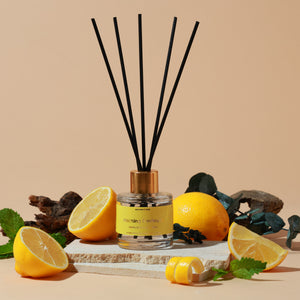
The picks: Garden Bloom at ₹799 (British rose, night-blooming jasmine — rounded and hotel-like) and Morning Freshness at ₹749 (Malabar lemon, peppermint, Nilgiri eucalyptus — cold and green).
The physics problem: entrances are the draughtiest square metres in a property. A bottle beside an opening door empties weeks early and scents the corridor rather than the hall.
2. In the SOSA reed range, that is Garden Bloom or Morning Freshness. Garden Bloom — British rose over night-blooming jasmine, 8.9 on our internal scale at six reeds — is the rounded, hotel-like one and the composition I most often put in an entryway. Morning Freshness — Malabar lemon, peppermint, Nilgiri eucalyptus, 9.0 — is the cold, green alternative for a bright modern flat.
3. Place it two to three metres in, not beside the door. A bottle next to an opening main door sits in the worst airflow in the property: it gets stripped, it empties weeks early, and half of what it releases goes into the corridor. Aim for a console or shelf at waist-to-chest height in gentle passing air, clear of an AC vent and out of direct sun.
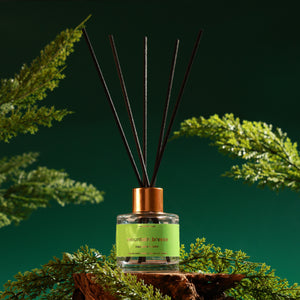
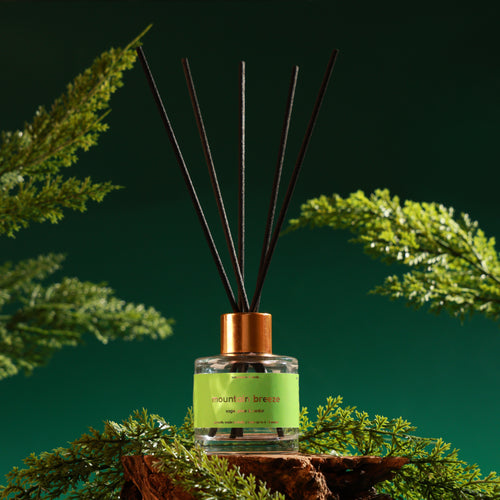
4. Make sure it agrees with what is behind it. If the living room carries a different scent, the two must share a note or the guest walks into a seam. Mountain Breeze and Morning Freshness meet on green eucalyptus; Fresh Brew and Garden Bloom meet on warmth and soft musk. Unrelated pairs read as an accident.
5. If the hall opens directly into a large connected volume, stop scenting the hall separately. Beyond roughly 800–1,000 sq ft of connected space, a single point source at the door cannot do it. One Vaayu at ₹11,999, specified up to 1000m³, treats the entrance and everything behind it as one space.
6. And the honest boundary: a good entrance scent improves how it feels to walk in. Nobody can promise you it changes a rating, a review, a booking or a nightly rate, and no such data exists.
Our reed compositions are handmade in small batches in Pune, the machines are made in India, and a portion of every order supports girl-child education through Nanhi Kali.

Part one — why an entrance is a different room from everything behind it
The entrance of a let property has three properties that no other room shares, and each of them argues for a different fragrance choice than the one a host's instincts produce. It is the most ventilated space in the building, the least occupied, and the only one a guest experiences while their nose is still calibrated to somewhere else. Get those three straight and the shortlist narrows quickly — usually to something a shade cleaner and cooler than the scent the host personally prefers.
 Morning Freshness₹749 · 9.0/10Nobody sits in a hall. A guest passes through it on arrival, then four or five times a day for the rest of the stay, and each pass is a fresh reading because they have been outside in between. That pattern rewards a very particular kind of composition: one that is legible immediately and does not become tiring on repetition. Depth, complexity and slow development — the qualities that make a fragrance rewarding to sit inside for an evening — are wasted on somebody walking past, and the heavier note families that carry them are precisely the ones that grow wearing when met five times a day. Cold, bright and transparent survives repetition far better than warm and sweet. It is the same reason hotel groups run white tea and cedar in a lobby and something else entirely in a bar.
Part two — the entrance brief against the living-room brief
The same property, two zones, two different specifications. This is the table I would keep in front of me when choosing, because it makes clear that the entrance is not simply a smaller version of the room behind it.
| Specification | Entrance and hall | Living room and open plan | Bedrooms |
|---|---|---|---|
| Time a guest spends there ★ | Seconds, several times a day, always after being outside | Hours, continuously, nose fully adapted | Overnight, mostly asleep |
| What the scent must do | Read correctly and instantly; agree with what is behind it | Hold a pleasant background nobody has to think about | Stay well out of the way |
| Register that works | Cool, clean, transparent — green citrus, light floral, clean wood | Fuller and warmer is fine — depth is rewarded here | Soft, low, nothing bright |
| Intensity | Lower than instinct — the nose is unadapted at the threshold | Mid — it is being met by adapted noses | Lowest in the property; four reeds rather than six |
| SOSA reed pick | Garden Bloom ₹799 · Morning Freshness ₹749 | Fresh Brew ₹849 · Mountain Breeze ₹849 | Evening Calm ₹799 |
| Where it fails | Bottle beside the door; sweetness; over-dosing | One point source trying to cover an open plan | Anything a guest has to sleep beside |
| The honest caveat: strength positions quoted here are SOSA's own internal scale at six reeds, not an industry standard and not a concentration. Everything on this page concerns how a property is experienced on arrival. No one can promise that an entrance fragrance changes a review score, a rating, a booking, occupancy or a nightly rate, because no data of that kind exists — and no fragrance purifies air, removes odours or affects health or mood. Ventilate first, scent second. | |||
Garden Bloom · rounded, hotel-likefrom ₹799Shop → 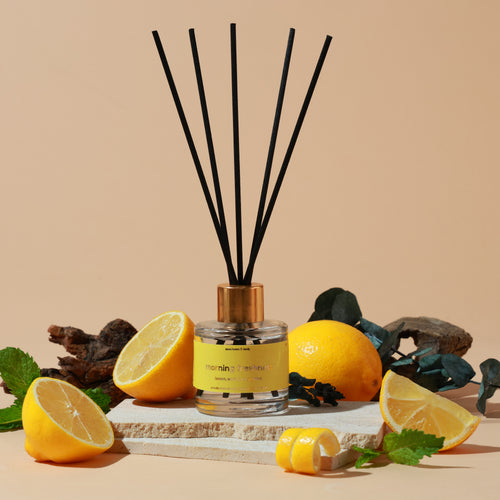 Morning Freshness · cold and greenfrom ₹749Shop →
 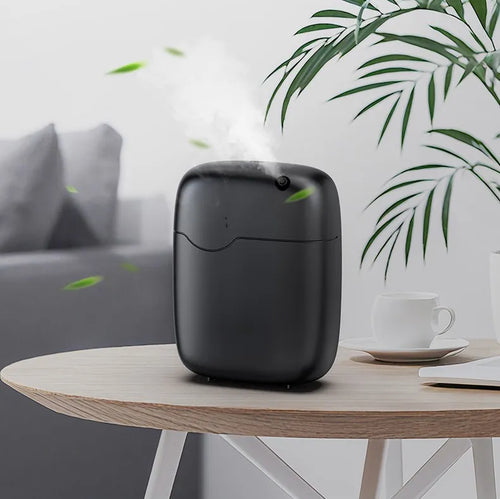 Vaayu · hall and living room as one₹11,999Shop →
Part three — when the entrance is the wrong place to put your fragrance
Several properties should not be scented at the door at all, and I would rather name them than let a host discover it with a bottle. The first is the entrance that is really a shoe rack. If footwear lives inside the door — which in most Indian homes it does — then that is the dominant source in the space, and adding a fragrance beside it produces exactly the compound this cluster keeps warning about. Move the shoes into a closed cupboard or out of the entrance entirely, and only then think about scent. The same goes for an entrance with a damp umbrella stand, a bin, or a washing machine tucked into the utility beside the door.
The second is a doorway on a corridor with a stronger smell than yours. Some apartment blocks have a genuinely powerful evening cooking smell in the shared circulation, and no bottle on your console is going to win an argument with a stairwell. In that situation the useful work is a door seal or a draught excluder rather than fragrance, and the scent should be placed further into the property where your own air actually sits. The third is the very small entrance in a compact listing — a metre of tiling between the door and the living room. Scenting that as a separate zone gives you two sources a metre apart and a seam a guest walks straight through. One source in the living space, positioned to catch the incidental air near the doorway, is the correct answer and costs half as much.
The fourth is the one hosts of larger properties get wrong most expensively: an entrance that opens directly into a big connected volume is not an entrance, it is the near end of a large room. A double-height villa hall running into a living-dining, or a 3BHK with all the internal doors open, behaves as one body of air. Putting a 50ml reed bottle at the door of that space and expecting it to register is asking a passive point source with no propulsion to do a job it was never built for. The honest options are a Sukoon at ₹1,899 if the connected volume is genuinely one room's worth, or a waterless Vaayu at ₹11,999 if it runs to 2,000 or 3,000 sq ft. What is not an honest option is buying a third and fourth reed bottle in the hope that they add up. They do not add up the way people expect; they simply make three quiet zones instead of one.
Part four — the entrance pick, by what kind of doorway you actually have
Entrances vary more than any other part of a listing, so the recommendation has to start with the doorway rather than with the fragrance. Find the row that matches yours.
| Your entrance | The problem at the door | What I would run | Where to put it | Price |
|---|---|---|---|---|
| A proper hall with a console ★ | Nothing much — this is the ideal case | Garden Bloom 50ml, six reeds | On the console, waist-to-chest height, clear of the door swing | ₹799 · 6–8 weeks |
| A metre of tiling, then the living room | Too small to be its own zone; a seam forms | One bottle in the living space instead — Morning Freshness | Near the doorway on the living-room side | ₹749 |
| Opens onto a busy shared corridor | Cooking and stairwell air pushing in | A draught excluder first; scent placed deeper in | Two to three metres inside, out of the flush | Cost of the seal, then ₹749–₹849 |
| Shoe rack, umbrellas, utility beside the door | An active source you would be scenting over | Nothing, until the sources are enclosed or moved | Not applicable yet | Free — and it is the higher-value fix |
| Villa hall into a double-height living room | Not a hall at all — the near end of a large volume | Vaayu, treating hall and room as one space | Central to the connected volume, or wall-mounted | ₹11,999 · up to 1000m³ |
| One normal room behind the door | You want it on a schedule rather than constant | Sukoon with steady / 2H / 4H timers | Off the floor, away from soft furnishing | ₹1,899 · 270–320 sq ft |
Versailles
Garden Bloom was the first composition I made with a doorway in mind rather than a room. The brief I set myself was uncomfortable at the time: make something that is finished in three seconds. Everything in my training pushed the other way — towards development, towards a fragrance that unfolds over an hour and rewards attention. A hall gives you none of that. Somebody walks through with a bag in each hand and either it landed or it did not.
What that turned out to require was restraint rather than force. The rose sits over a night-blooming jasmine that carries a soft, almost soapy cleanliness underneath, and the whole thing is deliberately not the loudest thing we make. In an entrance, the loudest thing we make would be the wrong answer, because the person meeting it has just come in from outside with a completely unadapted nose.
The advice I give hosts most often about entrances has nothing to do with which bottle they buy. It is: move it away from the door. Nearly every host puts it on the console immediately beside the entrance, where the draught strips the reeds, the bottle dies in four weeks and the fragrance goes out into the corridor. Two metres in changes everything. Composed and handmade in Pune, machines made in India, and a portion of every order funds a girl's classroom through Nanhi Kali.
Frequently asked questions
- What should guests smell on entry? — the hierarchy, and why masking ranks lowest.
- How to make your Airbnb smell amazing when guests walk in — the ninety-second window.
- Keeping a property fresh between stays and the luxury first impression.
- The complete arrival scenting guide — the whole cluster in one place.
- Brand: the SOSA founder story.
SOSA Vaayu specifications (verified from the live product page, August 2026): ₹11,999 (the product page displays a rounded ₹12,000). Waterless cold-air nebulisation — pressurised air atomises undiluted fragrance oil into a dry nano-mist; no water, no heat, residue-free. Coverage up to 1000m³, about 2,000–3,000 sq ft. 400ml refillable tank, 90+ days per fill at a mid intensity setting. Bluetooth app plus onboard buttons, 1h / 4h / 8h / 24h timers, adjustable mist intensity, auto-stop and key-lock. Under 38 dB. DC 12V / 1A, 5W. 165 × 80.5 × 215 mm, 0.9 kg, black or white. Freestanding or wall / HVAC mount. CE, RoHS and SGS certified. Ships with four SOSA Hotel Collection fragrances at 100ml each (400ml in total) in one of three combos chosen at checkout. SOSA does not currently sell a separate Vaayu refill oil; the 400ml supplied in the box is the fragrance available at the time of writing, and buyers who need long-term supply should confirm current refill availability with SOSA before purchasing. The cold-air oil supplied with the Vaayu is a different product from the water-based Hotel Collection sold for ultrasonic machines (15ml ₹299 · 100ml ₹999 · 300ml ₹1,799), which must not be used in a Vaayu despite sharing scent names. Other SOSA machines: Boond 300ml ₹899 (~150 sq ft) · Sukoon 500ml ₹1,899 (270–320 sq ft) · Megh 6L ₹3,499 (~215 sq ft — a runtime and humidity machine, not a coverage upgrade) · Aangan ₹25,999 (~8,000–10,000 sq ft) · Meenar ₹38,500 (12,000–18,000 sq ft) · Safar car diffuser ₹3,999. Reed diffusers 50ml ₹749–₹849 (6–8 weeks) · 130ml ₹1,249–₹1,349 (14–18 weeks) · duo sets ₹1,498–₹1,598 · oil-only refills 300ml ₹2,399 / 500ml ₹3,499. Runtime, consumption and coverage figures are manufacturer specifications and vary with intensity setting, run hours, ceiling height, ventilation and season; any per-month or per-day figure in this guide is arithmetic on those specifications, not a measurement. Electricity costs vary by state tariff. No claim is made that scenting affects ratings, reviews, bookings, occupancy, revenue, health, mood or air quality. Free shipping above ₹499. A portion of every order supports girl-child education through Nanhi Kali. Prices subject to change — see the live product pages.