
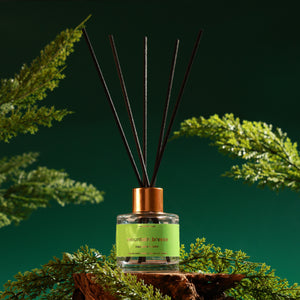
Why: the carrier is the majority of what is in a reed bottle, and the cheap carrier is DPG, which degrades above roughly 40°C and turns the fragrance bitter. Every SOSA reed sits on heat-stable CCT instead. That is the component a ₹499 diffuser has to cut, and it is the component that decides whether the gift is still good in May.
What SOSA does sell under ₹500: jar candles ₹379 · Sandalwood ₹449 · Smoked Oudh ₹449 · wax melts ₹474 · Everyday Beautiful Mugs ₹474 · car perfumes ₹449–₹509 · 3ml attars ₹379–₹399 · solid perfumes ₹459–₹489.
The honest gap: none of those is ambient fragrance. A candle has to be lit and runs roughly 15–18 hours; a reed runs 6–8 weeks with nothing to start and nothing to switch off. If that is the gift you actually want to give, the number is ₹749, not ₹499. The ₹299 Hotel Collection 15ml that turns up in cheap searches is a refill for an ultrasonic machine and never a standalone gift.
2. The floor is a bill of materials, not a policy. Fifty millilitres of composed oil, a refillable glass bottle, six fibre reeds and a heat-stable CCT carrier. Add compliance testing, a 45°C heat soak and an 85% humidity soak, and ₹749 is what the object costs before anybody has been paid to think about the smell.
3. The component that disappears at ₹499 is the carrier, and it is the one that matters most in India. DPG is the cheap alternative. It is stable in a temperate flat and it degrades above roughly 40°C, which is an ordinary afternoon in a closed Indian room for four months of the year. That degradation is why cheap diffusers go bitter rather than merely faint.
4. Reed diffusers are still an excellent Diwali gift — at ₹749. They are not duplicated the way food gifts are, they need no sizing, no dietary question and no follow-up, they are used by the whole household rather than one person, and they are still visibly working in December. All of that is true. None of it is available below the floor.
5. Under ₹500, buy the format that is honest at ₹500. A Sandalwood or Smoked Oudh candle at ₹449, a message-free jar candle at ₹379, a car perfume at ₹449–₹509, a 3ml attar at ₹379–₹399. These are complete, well-made objects at their price rather than compromised versions of a more expensive one. That distinction is the whole page.
Alcohol-free, phthalate-free, paraben-free, IFRA-compliant, 0 ppm formaldehyde. Composed in Pune. A portion of every order supports girl-child education through Nanhi Kali.
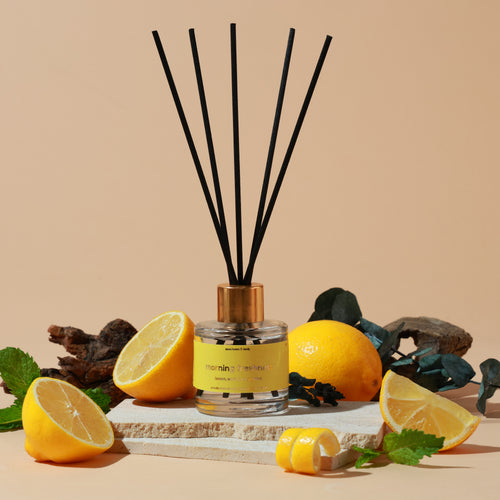
What is actually inside a reed diffuser — all four things
Most people picture a reed diffuser as a bottle of perfume with sticks in it, which is roughly the same mistake as picturing a car as an engine with seats. There are four components, they cost very different amounts, and only two of them are visible from outside the bottle. Understanding which is which is the fastest way to tell a properly built diffuser from a cheap one without smelling either, and it is the entire reason a ₹499 reed diffuser is a claim rather than a product. Here is what you are paying for, in the order the buyer never thinks about them.
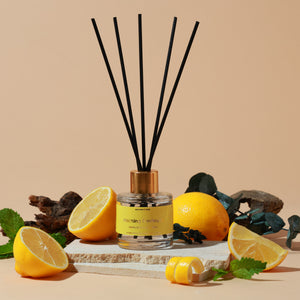
 Evening Calm₹799Fragrance concentrate is not poured neat into a diffuser; it is dissolved into a carrier oil that thins it, controls how fast it climbs a reed, and holds it stable for weeks in a room. The carrier is the larger part of what is in the bottle, and it is invisible. The cheap standard is DPG — dipropylene glycol — which is inexpensive, easy to work with, and completely fine in a climate that does not push a closed room past 40°C. India does, routinely, for months. Above that threshold DPG begins to break down, and because the fragrance is dissolved in it, the fragrance goes with it: the bright notes flatten first, then a sour, slightly acrid edge appears underneath. Every SOSA reed uses caprylic/capric triglyceride instead, a coconut-derived carrier that does not do this, tested through a 45°C heat soak and 85% relative humidity.
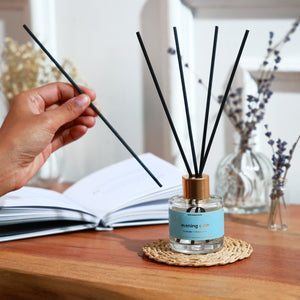
 Mountain Breeze₹849Reeds are not decoration; they are the pump. Natural rattan is the cheap option and it has a specific failure mode in humid air: the channels swell and clog, the wicking slows, and the bottle appears to stop working while still half full. That is the fade-then-nothing pattern people almost always blame on the oil. SOSA ships six synthetic fibre reeds in every bottle — more porous, more even, and stable through a monsoon. Six is also a working range rather than a fixed setting: six for a living room, three or four for a bedroom, two or three in a small bathroom, where a 50ml will run close to three months. Flip them every three to five days and the lift comes back for nothing.
 Garden Bloom₹799The fragrance itself is the most expensive material per gram and the smallest part by volume, which is why cheapening it is a less effective saving than cheapening the carrier — and why cheap diffusers are more often badly carried than badly composed. Real cold-pressed Malabar lemon costs a multiple of a lemon reconstruction; genuine Himalayan pine costs a multiple of pine disinfectant. On top of that sits compliance: alcohol-free, phthalate-free, paraben-free, IFRA-compliant, 0 ppm formaldehyde, and the climate testing that turns those claims into evidence. Then the glass — refillable, heavy enough to stand on a console without being knocked over, and made to be topped up from a 300ml refill rather than thrown away.
What actually gets cut to reach ₹499 — and when the buyer finds out
Take those four components and try to land the finished object, boxed and shipped, at a ₹499 shelf price. The glass will not move much; it is a commodity and the saving is small. The fragrance oil is already the smallest volume, so halving it saves less than it sounds and is immediately obvious — the diffuser smells thin on day one and gets returned. The reeds can be reduced from six to three, and often are, but the customer counts them in the box. That leaves the carrier, which is the largest volume, the least visible component and the only one whose failure is delayed by several months. It is not a coincidence that this is what gets substituted. It is the only cut that does not show up in the first week.
And the delay is the point. A diffuser built on DPG is genuinely pleasant on the day it is unwrapped. It smells like what you paid for through the festive season and through the whole of a mild winter. Then the room hits 40°C in the first real heat of the year, and the carrier starts to break down — not dramatically, not overnight, but enough that the fragrance sitting in it shifts. The complaint is never “it faded”; it is always “it turned” — went sharp, went bitter, developed a chemical edge that was not there before. Six months later nobody connects that to the gift they were given, and nobody blames a solvent they have never heard of. They conclude that reed diffusers are not very good.
That conclusion is the actual cost of the cheap bottle, and it is why I will not make one. A gift that is fine through the festive season and unpleasant by May is worse than no gift, because it has taught the recipient something untrue about an entire category. I would rather sell somebody a ₹449 candle that is completely honest at ₹449 than a ₹499 diffuser that is honest for four months. That is the whole of my answer to the question in the title, and I do not have a cleverer one.
The four components, and what ₹500 would have to do to each of them
Component by component, what a properly built 50ml reed contains, what a ₹499 build has to change, and when the buyer discovers the change. The last row is the item that keeps appearing in sub-₹500 searches and is not a gift at all.
| Component | What SOSA uses | What a ₹499 build changes | When you find out |
|---|---|---|---|
| The carrier | Heat-stable CCT, coconut-derived, tested at 45°C and 85% RH | DPG — cheaper, and degrades above roughly 40°C | The following summer, when it turns bitter rather than faint |
| The reeds | Six synthetic fibre reeds, stable in humidity | Three rattan sticks, which clog and stop wicking | Week six — half full and apparently dead |
| The oil | Composed in Pune, real materials, IFRA-compliant, 0 ppm formaldehyde | Reconstructions of the same notes at a fraction of the cost | Day one — it smells like a cleaning product |
| The bottle | Refillable glass, made to be topped up from a 300ml refill | Little saving available; this is rarely where the cut is | Not the problem, and not the saving either |
| Compliance and testing | Alcohol-free, phthalate-free, paraben-free, heat and humidity soak | The testing is simply not done | Never, visibly — which is exactly why it is cut |
| The ₹299 Hotel Collection 15ml | A water-based refill for an ultrasonic machine | Nothing — it is not a diffuser and cannot go in one | When the recipient opens it and owns no machine. Never a standalone gift |
What ₹500 buys instead — and buys honestly
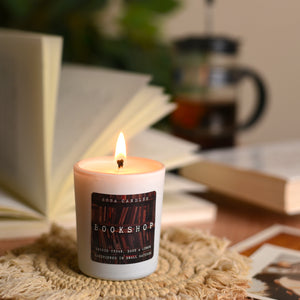
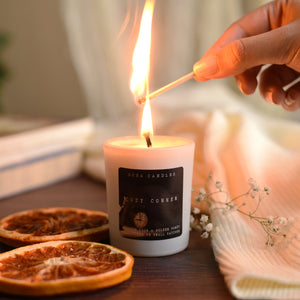
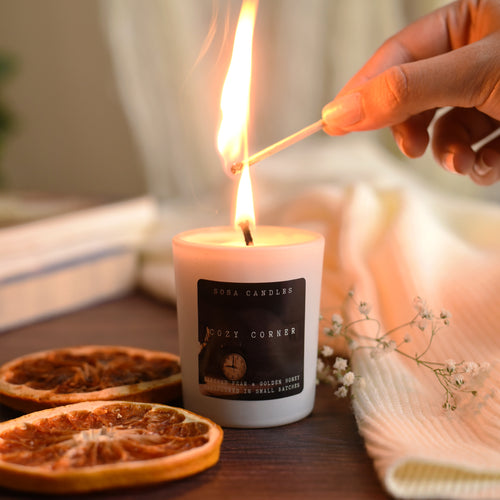
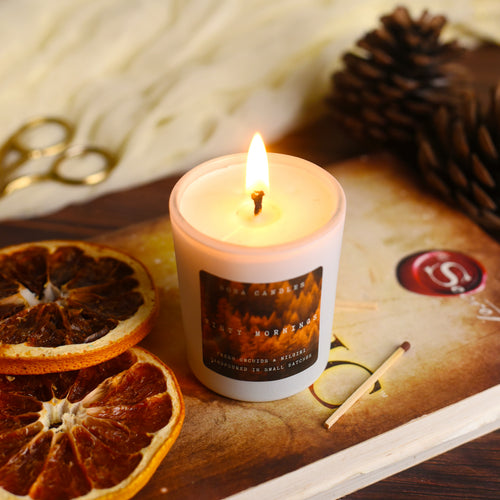
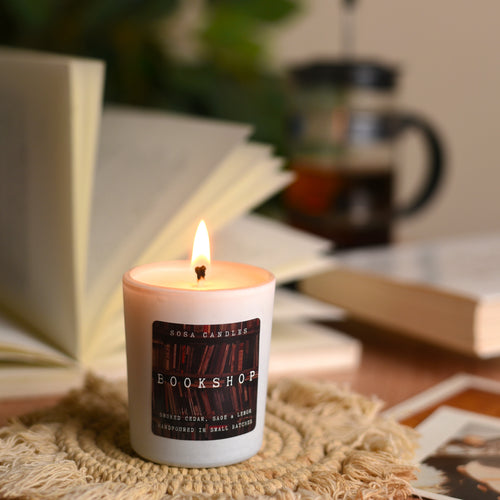
This is the part of the page that matters more than the refusal. Under ₹500 SOSA sells things that are complete at their price rather than compromised versions of something dearer, and a well-chosen ₹449 object is a better gift than a badly built ₹499 one by a distance that is not close. The shelf, in full: message-free jar candles at ₹379 in Bookshop, Cozy Corner, Misty Mornings and Evening Walks; the Sandalwood and Smoked Oudh singles at ₹449; wax melts at ₹474; Everyday Beautiful Mugs at ₹474; unscented bubble candles at ₹474; car perfumes from Lemon ₹449 and Jasmine ₹449 up through Lavender ₹479, Sandalwood ₹479 and Icy Mint ₹489 to Vetiver, Sea Breeze and Oud at ₹509; 3ml attars at ₹379–₹399; and solid perfumes at ₹459–₹489.
Two warnings on that list, because a page that only says yes is not much use. Wax melts at ₹474 need a warmer the household must already own, and a melt given to somebody without one is a decorative block of wax — this is the commonest way a thoughtful fragrance gift fails, and it fails silently. And the ₹299 Hotel Collection 15ml is a refill for an ultrasonic machine, not a standalone gift: it is water-based, it cannot go into a reed diffuser in either direction, and without hardware the recipient almost certainly does not own it does nothing at all. If it has appeared in your search for a cheap diffuser, that is the search being unhelpful rather than a bargain being found.
If the recipient is somebody you cannot read — a colleague, a neighbour, an in-law you have met three times — the candle is the safest of these, and the message-free jars or the ₹449 singles are the ones to use. SOSA does make candles with messages printed on them and several of them are jokes that would be badly wrong in those hands, so for anybody outside your close circle stay with the plain glass. And if you are buying for several households at once, buy the same object for all of them. Gifts arriving in the same building are compared within the hour, and sameness is what stops a kind gesture reading as a ranking.
The paragraph in favour of a good box of mithai
If the budget is firmly ₹500 and the recipient is somebody you are visiting formally for the first time, a box of sweets from a halwai with a real reputation is very likely the better gift, and I am not going to argue otherwise to sell a candle. Mithai is not a fallback; it is the expected form of the greeting in a great many households, it carries the ritual correctly, and where the ceremony matters more than the object a scented candle offered in its place can read as a small refusal to do the customary thing. If yours will be the only box through that door, buy the sweets.
The argument on the other side is about arrival rather than quality. A well-liked household receives several identical boxes across the festive days, more than anyone can eat, and a fair number move on unopened to somebody else. A fragrance gift is not competing with a good barfi; it is competing with the seventh box through the same door, and it sidesteps the dietary questions nobody wants to raise at a doorstep — diabetes, a fast, a household that simply does not eat that much sugar. If yours will be one of many, the ₹449 candle is the thing still in the house in December.
The honest case for stretching ₹250 to ₹749
I am not going to pretend the two are equivalent, so here is the case for the reed diffuser stated at its real price. In buying order, with the gap on the last row.
| Buy | What it is | When it is the right answer | Price |
|---|---|---|---|
| 1. Sandalwood Scented Candle ★ | Hand-poured soy in plain glass, a material name rather than a mood one, roughly 15–18 hours | The default under ₹500 — safest for elders, in-laws and a formal visit | ₹449 |
| 2. Smoked Oudh Scented Candle | The same build in the smoke-and-resin register, which reads as expensive without being told to | When the gift needs to look considered rather than merely correct | ₹449 |
| 3. Message-free jar candle, bought identically | Bookshop, Cozy Corner, Misty Mornings, Evening Walks — 80g, no printed message | Several households or colleagues at once, where sameness is the point | ₹379 |
| 4. Car perfume 12ml | Lemon and Jasmine ₹449, Lavender and Sandalwood ₹479, Icy Mint ₹489, Vetiver, Sea Breeze and Oud ₹509 | They drive, and nobody ever thinks to scent that space deliberately | ₹449–₹509 |
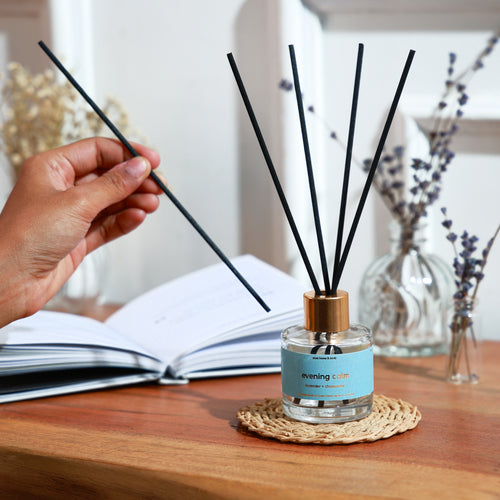
| 5. Morning Freshness 50ml — the stretch | Six to eight weeks of ambient fragrance, six fibre reeds, refillable glass, heat-stable CCT — about ₹13 a day | When the gift should still be working in December, and nothing needs lighting | ₹749 |
| The honest gap: there is no reed diffuser under ₹500 | None at any size, and no ultrasonic machine below the Boond at ₹899. The ₹299 Hotel Collection 15ml is a machine refill and never a standalone gift | If the answer has to be a reed diffuser, the budget is ₹749 and I would rather say so | ₹749 |
Versailles
The first reed diffusers I made for myself, before there was a company, were built on DPG, because that is what everybody uses and what the formulation books assume. They were lovely. Then I left one in a Pune flat through a April and came back to something I did not recognise — not weaker, which I would have expected, but sour. The lemon had gone metallic and there was a flat chemical edge underneath it that had not existed in the bottle I filled.
That was the afternoon the price of this product got decided. Moving to a heat-stable coconut-derived carrier costs real money on every single bottle, it is invisible on a shelf, no customer will ever ask about it, and it is the only reason the range survives an Indian summer intact. I have never found a way to keep it and reach ₹499, and I have looked, because a lower opening price would obviously sell more.
So when somebody writes to ask whether we have a small diffuser at ₹399 for a Diwali list, the answer is no, and this page is the long version of why. The floor is ₹749 and it is made of coconut oil and testing, not of margin. Under that, buy the candle — it is a completely honest object at ₹449 and I am glad to sell it. What I will not do is build the cheap bottle, because the person who receives it will conclude next May that reed diffusers are not very good, and they will be right about that one. Everything is composed in Pune, and a part of every order funds a girl’s classroom through Nanhi Kali.
Frequently asked questions
- Under ₹300 — the page that says there is nothing, and why a made thing has a floor.
- Under ₹400 — the complete list, and it is a short one.
- Under ₹500 — the whole shelf and how to choose across it.
- Premium-looking under ₹500 — the three levers of perceived expense.
- Useful under ₹500 — consumables get used, objects get stored.
- Luxury-looking under ₹500 — luxury is a register, not a price band.
- Home fragrance under ₹500 — four formats, four different jobs.
- The SOSA sub-₹500 shelf, ranked and the complete under-₹500 gifting guide.
- Brand: the SOSA founder story.
SOSA facts verified August 2026: The reed diffuser line is five scents — Morning Freshness 50ml ₹749 / 130ml ₹1,249 (9.0 on the SOSA strength scale), Evening Calm ₹799 / ₹1,299 (8.9, the softest), Garden Bloom ₹799 / ₹1,299 (8.9), Mountain Breeze ₹849 / ₹1,349 (9.4, the deepest woody) and Fresh Brew ₹849 / ₹1,349 (9.5, the deepest in range). There is no reed diffuser below ₹749 at any size, and no oud, sandalwood, vetiver or amber reed at any price. All five are alcohol-free on a heat-stable CCT (caprylic/capric triglyceride, coconut-derived) carrier rather than DPG, phthalate-free, paraben-free, IFRA-compliant, 0 ppm formaldehyde, with six fibre reeds rather than rattan in a refillable glass bottle, climate-tested through 45°C heat soak and 85% RH monsoon humidity, composed and made in Pune. 50ml lasts 6–8 weeks and 130ml 14–18 weeks; cost per day is roughly ₹13–₹15 on a 50ml. Duos ₹1,498–₹1,598; refills 300ml ₹2,399 · 500ml ₹3,499. Under ₹500: scented jar candles ₹379 in Bookshop, Cozy Corner, Misty Mornings and Evening Walks (hand-poured soy, 80g, roughly 15–18 hours, ₹664 as a two-pack), Sandalwood Scented Candle ₹449, Smoked Oudh Scented Candle ₹449, wax melts ₹474 (a warmer is required), Everyday Beautiful Mugs ₹474, unscented bubble candles ₹474, car perfumes 12ml ₹449–₹509, 3ml attars ₹379–₹399, solid perfumes 15g ₹459–₹489. The cheapest ultrasonic machine is the Boond at ₹899; the Hotel Collection 15ml at ₹299 is a water-based refill for such a machine and is never a standalone gift, and Hotel Collection oil and reed oil are not interchangeable in either direction. SOSA does not sell a gift set, gift hamper, gift box, gift card, gift wrap, gift note or personalisation, and does not sell a room spray — every SOSA spray is a car perfume. Free shipping above ₹499. A portion of every order supports girl-child education through Nanhi Kali. SOSA is an independent Indian fragrance house and is not affiliated with or endorsed by any hotel brand. Prices subject to change — see the live product pages.