



The two big ones are free to fix. Sun and draught are solved by moving the bottle a few feet, and moving it usually makes the room smell better at the same time, not worse.
The honest exception: if you added reeds on purpose, the bottle is behaving correctly. Ten reeds in a 50ml is four to five weeks rather than six to eight. You bought a louder room with weeks.
If the room is right and you simply use a lot of it: the 300ml oil refill at ₹2,399 works out around ₹7–8 per millilitre against ₹15–17 for a fresh 50ml.
2. Then look for moving air. A split AC blowing across the reeds, a ceiling fan directly above, or an open window with a cross-breeze replaces the air at the reed surface continuously. That is a double loss: the bottle empties weeks early and the room smells of less, because the fragrance is being carried out rather than distributed. This is the one accelerant that costs you scent as well as time.
3. Count the reeds. Every SOSA bottle ships with six fibre reeds, and each composition is dosed to sit correctly at six. Nine gives you roughly five weeks on a 50ml instead of eight; ten gives you four to five. If you added reeds, nothing is wrong — you spent weeks to buy presence, which is a fair trade as long as you made it knowingly.
4. Account for the season honestly. Ambient heat is a different variable from direct sun and it cannot be corrected by moving the bottle. A closed flat at 40°C in May runs a bottle faster than the same flat in December. Our compositions sit on a heat-stable coconut-derived CCT base tested through 45°C precisely so that what heat costs you is time rather than character.
5. Check the neck. The reeds are not the only evaporation path; the exposed oil surface at the mouth of the bottle is the second one. Decanting into a wide-mouthed decorative vase turns a small opening into a large one. Keep the oil in the vessel it came in.
6. Flip cadence is real but small. Flipping more often than weekly does shorten the bottle — by days across its life, not weeks. It is sixth on this list for a reason.
7. Then decide whether anything actually needs fixing. If the bottle is running fast because the room is warm and the reeds are working, you are getting the fragrance you paid for, only sooner. The 300ml refill at ₹2,399 makes that pace affordable. Composed and handmade in small batches in Pune, and a portion of every order supports girl-child education through Nanhi Kali.
Part one — the three accelerants that cost the most weeks
A reed diffuser loses oil in exactly two ways: off the wetted length of the reeds standing in the air, and off the surface of the oil at the mouth of the bottle. That is the whole system. Everything that shortens a bottle does it by making one of those two surfaces give up oil faster, and there are only three variables available to do that with — temperature, air movement and surface area. Every item in the ranking below is one of those three wearing different clothes, and once you can see which one you are looking at, the fix is usually obvious and usually free.
 Mountain Breeze₹849 · 9.4/10A reed sitting in still air develops a thin saturated layer around itself, and that layer slows further evaporation down — which is precisely how a reed diffuser is designed to meter itself out over eight weeks. A continuous draught strips that layer away and keeps stripping it. The bottle empties weeks early, and here is the cruel part: the room smells of less, not more, because the fragrance is being diluted into a moving stream and pushed past you rather than allowed to build. People in this situation replace the bottle, put the new one in the same place, and conclude the product is weak and short-lived at the same time. Split AC units are the usual culprit in Indian flats, followed by ceiling fans and windows left open onto a balcony. Three feet of clearance is usually enough; an interior wall is better.
Part two — all six accelerants, ranked by the time they cost
This is the table I wish came printed on the box. The time costs are SOSA's own working figures from in-house testing and several years of customer correspondence, not laboratory measurements, and they describe a 50ml bottle rated at six to eight weeks with its standard six reeds. Rooms differ enormously; treat these as an order of magnitude and a running order, not a promise.
| Rank | Accelerant | What it does to the oil | Rough cost on a 50ml | Free to fix? |
|---|---|---|---|---|
| 1 ★ | Direct sunlight on the glass | Warms and thins the oil while lighting both evaporation surfaces | Can take 8 weeks to nearer 4 | Yes — move it today |
| 2 | AC or fan draught | Continuously strips the saturated layer from the reed surface | Several weeks, plus a fainter room | Yes — three feet of clearance |
| 3 | More than six reeds | More wetted surface exposed to the same air | 9 reeds ≈ 5 weeks · 10 reeds ≈ 4–5 | Yes — but you lose the presence |
| 4 | Ambient heat (a 40–45°C month) | Raises evaporation everywhere at once, all day | A summer bottle runs visibly short of a winter one | No — this one is the season |
| 5 | A wide exposed oil surface | Adds a second, constant evaporation path at the neck | Meaningful if you decanted into a vase | Yes — keep the original bottle |
| 6 | Flipping more often than weekly | Re-wets the exposed length before it needed re-wetting | Days across a bottle, not weeks | Yes — but weekly is the calibration |
| The honest caveat: these are not additive in any tidy way, and two of them are not faults. Reed count above six and a hot May are both cases where the bottle is doing exactly what it should. Fix ranks one, two and five, decide consciously about three, and forgive four. If after all that the pace still suits your room better than your budget, the answer is cheaper oil rather than a slower bottle — the 300ml refill at ₹2,399 is roughly half the per-millilitre cost of a new 50ml. | ||||
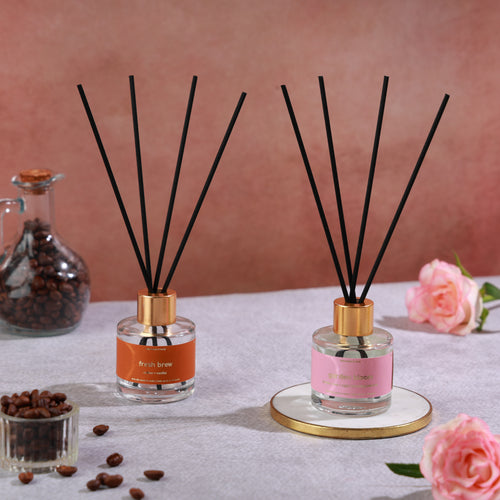 Oil refill · 300ml₹2,399Shop →
 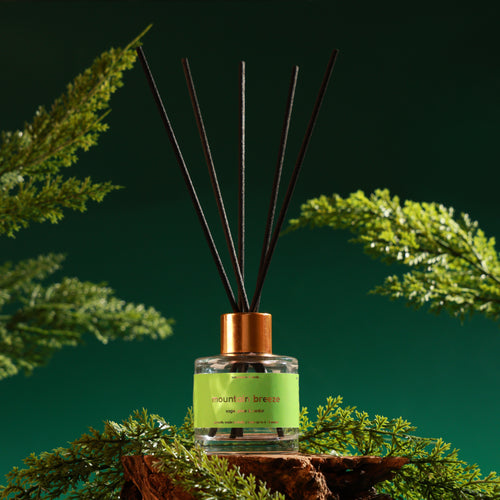 Mountain Breeze · 130ml₹1,349Shop → Evening Calm · 8.9/10from ₹799Shop →
Part three — auditing your own shelf in ten minutes
Do this once, properly, and you will not need to do it again. Go to the bottle at around four in the afternoon on a bright day, because that is when an Indian flat is at its most revealing. First, look for shadow. If the glass is in light — even indirect light off a pale balcony wall — that is your headline item. Second, hold the back of your hand against the bottle for ten seconds, then against the wall behind it. If the glass is noticeably warmer, something is heating it, and it hardly matters whether the source is the window, a television or a fridge motor. Third, wet a fingertip and hold it beside the reeds. If you feel cooling on one side, air is moving past the bottle — the accelerant that also costs you fragrance.
Now count the reeds and lift one out. The wet line — the boundary between oil-soaked fibre and dry fibre — is the most informative thing on the whole shelf. A wet line high up the exposed length, with the fibre dark and the reed slightly greasy, means the bottle is wicking hard and losing oil fast; combine that with a warm glass and you have confirmed the diagnosis. A wet line barely above the oil, in a bottle that is nevertheless going down, means the loss is happening at the neck rather than the reeds. Six reeds is the number you should find. If there are nine or ten and you have forgotten adding them, that is your answer and it is a good one, because it means you had a well-scented room for the whole period.
The last part of the audit is the part people skip: decide whether the fast bottle was actually a problem. There is a version of this complaint where nothing is wrong at all — a warm, well-ventilated, well-used living room with six reeds and a bottle that runs in six weeks instead of eight is a room that has been properly scented, slightly faster than average. You have had the fragrance. What you have not had is a discount. If that is your situation, the honest answer is not to slow the bottle down — slowing it down means a quieter room, and that is the trade running in the direction you did not ask for. The answer is to lower the cost per week, which is what the oil-only refills exist for: ₹2,399 for 300ml at roughly ₹8 per millilitre against ₹15–17 for a fresh 50ml. You reuse your own vessel, and should refresh the reeds every few months — they are not sold separately, which is an honest gap rather than an oversight I will talk around.
Part four — the recovery sequence, in the order I would do it
Everything above, arranged as a weekend job. The first four lines cost nothing and between them account for most complaints of this kind; the last two are for people whose placement is already correct and who simply want the running cost to make sense.
| Step | What you do | What it returns | Price |
|---|---|---|---|
| 1 ★ | Move the bottle out of every beam of direct light | The largest single recovery available — often weeks | Free |
| 2 | Put three feet between the reeds and any AC vent, fan or open window | Weeks back, and a room that smells more of the fragrance | Free |
| 3 | Count back to six reeds, or decide out loud to keep nine | Returns the bottle to its calibrated 6–8 weeks | Free |
| 4 | Return the oil to its own bottle if you decanted it | Closes the second evaporation path at the neck | Free |
| 5 | Move to 130ml next time you buy | 14–18 weeks instead of 6–8 — duration only, not a louder room | From ₹1,249 |
| 6 | Buy the oil refill rather than another bottle | Roughly ₹7–8 per ml against ₹15–17 — the running cost solved | ₹2,399 · 300ml |
| The honest caveat: steps one to four give you weeks back for nothing, but step three is the only one on this list that costs you presence, and you should make that trade deliberately rather than by default. If the room reads exactly as you want it at nine reeds, keep nine reeds and buy the oil more often. A short bottle in a well-scented room is a better outcome than a long bottle in a room you cannot smell. | |||
Versailles
The first thing I ask anyone who writes to me about a bottle finishing early is where it stands, and roughly half the time the answer contains the word window. It is a completely understandable choice — the glass looks beautiful with light behind it, and a windowsill is the one flat surface in an Indian flat that nobody has already covered with something else. It is also the most expensive place in the house to put fifty millilitres of fragrance oil.
I would rather you knew that than that you assumed we had filled the bottle short. We have never adjusted a fill volume quietly, and the six-to-eight-week figure on a 50ml is written for six reeds in an ordinary room with weekly flipping and no direct sun — which is a spec, not a promise, and I say so on every page where the number appears.
The thing I would most like people to take from this page is the sentence that surprises them: a fast bottle is often a well-used one. If the room smells right and the oil is going down, you are not being cheated, you are consuming. The lever to pull then is the price of the oil, not the speed of the bottle. Everything is composed and handmade in small batches in Pune, and a part of every order funds a girl's classroom through Nanhi Kali.
Frequently asked questions
- Why is it evaporating faster than expected? — where the stated weeks come from, and what each deviation costs in days.
- Does heat make it finish faster? and is a window really the worst spot? — the top two accelerants in full.
- How to make it last longer — the conservation list, with the presence cost of every item stated.
- The complete longevity guide — this page and the eight around it in one place.
- Brand: the SOSA founder story.
SOSA reed diffuser range & prices (verified August 2026): alcohol-free, phthalate-free, paraben-free and IFRA-compliant compositions on a heat-stable coconut-derived (CCT) carrier, low-VOC, supplied in a refillable glass bottle with six fibre reeds; 50ml lasts 6–8 weeks and 130ml lasts 14–18 weeks. Morning Freshness (Malabar lemon · peppermint · Nilgiri eucalyptus) 50ml ₹749 · 130ml ₹1,249 · 9.0/10; Garden Bloom (British rose · night-blooming jasmine) 50ml ₹799 · 130ml ₹1,299 · 8.9/10; Evening Calm (Kashmir lavender · chamomile) 50ml ₹799 · 130ml ₹1,299 · 8.9/10; Fresh Brew (Coorg coffee · Kerala vanilla) 50ml ₹849 · 130ml ₹1,349 · 9.5/10; Mountain Breeze (Himalayan pine · sage · Indian cedar) 50ml ₹849 · 130ml ₹1,349 · 9.4/10. Reed diffuser refills are oil only — you reuse your own vessel and reeds: 300ml ₹2,399 (roughly 8–11 months) · 500ml ₹3,499 (roughly 14–18 months), about ₹7–8 per ml against ₹15–17 per ml for a 50ml bottle. Duo sets ₹1,498–₹1,598 for 2 × 50ml and ₹2,498–₹2,598 for 2 × 130ml. Strength figures are positions on SOSA’s own internal strength scale, not an industry standard. Replacement reeds are not sold as a separate SKU; SOSA guidance is to refresh reeds every few months. The reed line is separate from the water-based Hotel Collection for ultrasonic machines (15ml ₹299 · 100ml ₹999 · 300ml ₹1,799) and the two are not interchangeable. Diffusers: Boond 300ml ₹899 · Sukoon 500ml ₹1,899 · Megh 6L ₹3,499 · waterless Vaayu ₹11,999. Composed and handmade in small batches in Pune, India; tested through 45°C summer heat and 85% monsoon humidity. Free shipping above ₹499. A portion of every order supports girl-child education through Nanhi Kali. Prices subject to change — see the live product pages.